F# standard tuning: gauges, tension, and strings for 8-string guitar
Written with AI help · Updated
F# standard on an 8-string (F#-B-E-A-D-G-B-E) is the factory tuning of most production 8-strings. On 27-inch scale use a .074 low (Ernie Ball 8-String Slinky .010–.074 or D'Addario NYXL 8-string) or step heavier for firmer feel. On longer scales (the 29.4-inch Ibanez Meshuggah signatures, or 28-inch bass-side multiscale), lighter lows like .068 work, the longer scale handles the gauge math without structural compromise.
What F# standard is for
F# standard is the factory tuning of 8-string electric guitar. It extends the instrument's low-end range a perfect fourth below 7-string B standard, giving composers access to pitches that previously required either a bass guitar or a de-tuned guitar with structural compromises. The tuning is the default for prog-metal, djent, and instrumental extended-range composition, Tosin Abasi's Animals as Leaders catalog, Javier Reyes's parallel work, most of the Sumerian Records djent-prog roster.
Unlike 7-string B standard, F# standard requires specific hardware considerations: 8-string-spaced bridges, 8-string-specific pickups (the pole-piece spacing of a 7-string pickup is wrong for an 8-string fingerboard width), and scale lengths of at least 27 inches to make the low F# hold pitch under picking attack.
Tension targets
The low F# is the entire story on 8-string. Get the low-string gauge wrong and the string either flaps under medium picking or feels like a piano wire under your fingers. Target: 14–18 pounds of tension on the low F# at F# standard pitch.
| Scale | Low F# gauge | Low F# tension | Full-set recommendation | |
|---|---|---|---|---|
| 27" Ibanez RG8 / RG2228 / Schecter SLS | .074 | ~16 lbs | .010–.074 (EB 2625) / 9–80 (NYXL0980) | |
| 27", heavy hand | .080 | ~18 lbs | 9–80 stock or .010–.080 custom | |
| 29.4" Ibanez M80M / M8M | .068 | ~17 lbs | .009–.068 custom | |
| Multi-scale 25.5–27" | .074 | ~16 lbs | .009–.074 | |
| Multi-scale 26.5–28" | .068 | ~16 lbs | .009–.068 | |
| 25.5" 8-string (rare) | .084 | ~17 lbs | .010–.084 custom, structurally borderline |
Recommended sets
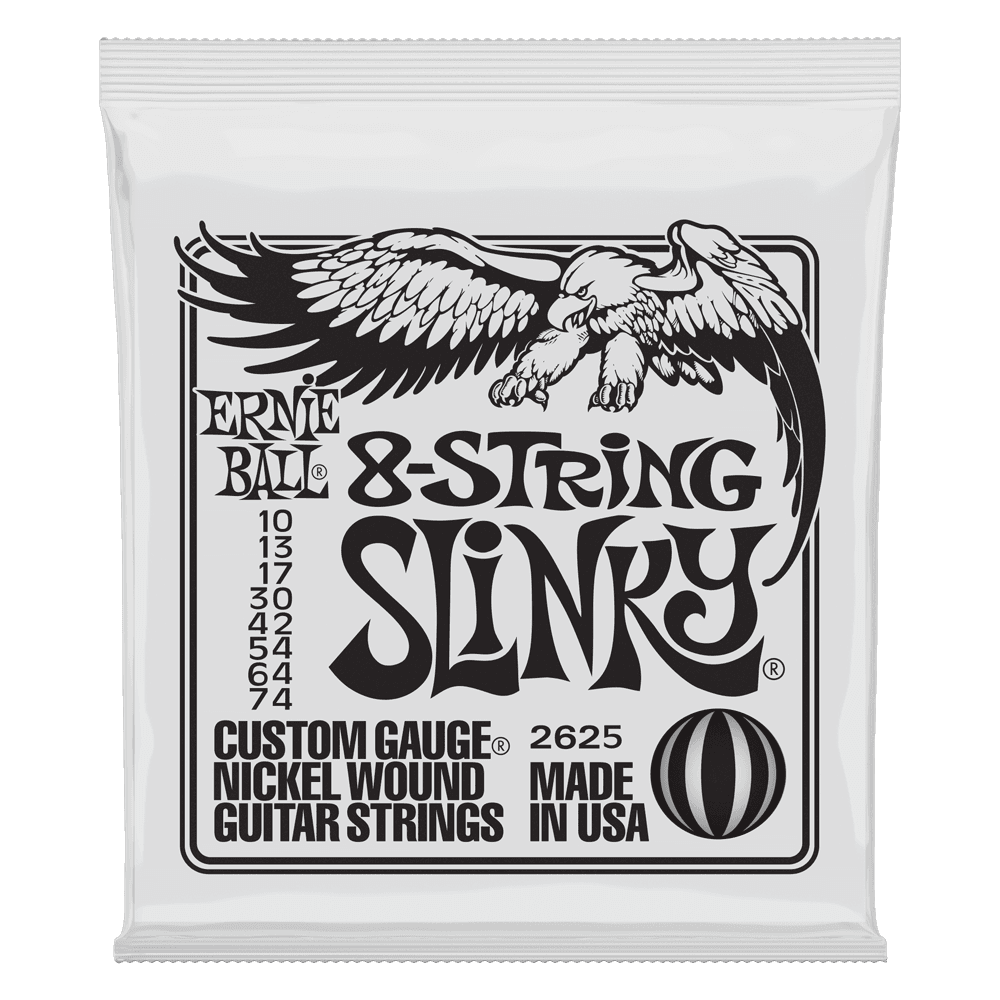
8-String Slinky Nickel Wound (.010–.074)
Why this one: The reference stock 8-string set (EB 2625, nickel wound). The .074 low holds F# standard cleanly on 27-inch scale.
For D'Addario: the NYXL 8-string set (NYXL0980, 9–80) covers F# standard with NYXL's high-carbon-core firmness. For coated: Elixir Nanoweb 8-string sets (10–74 ships on ESP's 8-strings) are the major coated option.
For custom: Stringjoy's online builder lets you spec exact gauges for your scale length, almost every signature-rig 8-string player ends up on a Stringjoy custom set eventually, because off-the-shelf 8-string gauge options are limited to two or three SKUs.
Scale length adjustments
- 27" (Ibanez RG8, RG2228, Schecter SLS Elite 8, most production 8-strings): a .074 low is the default. Step to .080 for heavy-hand players.
- 29.4" (Ibanez M80M / M8M Meshuggah signatures): the longest production scale; a .068 low feels comfortable without extreme gauge.
- Multi-scale 25.5–27" / 25.5–27.5" (Strandberg Boden 8, Kiesel Vader 8, Abasi Larada 8): a .074 low. The longer bass-side scale carries the tension math.
- Multi-scale 26.5–28" (Mayones Duvell 8, some Kiesel models): a .068 to .074 low.
Genre notes
- Animals as Leaders-adjacent prog-metal: Note the caveat: AAL themselves are documented in Drop E (E-B-E-A-D-G-B-E) per Premier Guitar's rig rundown, on multiscale Abasi Concepts Larada 8s. F# standard is the neighboring factory tuning.
- Djent on 8-string: F# standard or Drop E, depending on whether the material needs chord-shape parity with 6-string Drop D. Djent that sits in Drop E needs a heavier low string (.080 minimum on 27-inch scale).
- Instrumental technical metal: F# standard is the composing default for the shred lane (Rusty Cooley's Dean RC8X catalog is the reference).
- Deftones-adjacent heavy alt-metal: Carpenter's ESP STEF B-8 runs a 27-inch baritone scale. His base tuning is F# standard, with drops lower on some songs.
Setup checklist
Moving to F# standard from a higher tuning (or changing gauge on an F#-standard 8-string):
- Truss rod: Heavier low strings add forward bow. 8-string necks typically have dual-action truss rods with more margin than 6/7-string, but adjustments are more consequential because the necks are longer under tension.
- Nut slots: The 8th-string slot is cut for the factory gauge. Stepping up from .074 to .080 will require slot widening. Stepping down from .080 to .074 creates slot-buzz potential.
- Bridge saddle: 8-string bridges have specific 8-string saddle slots. Intonation reset at 12th fret harmonic is non-negotiable after gauge or tuning change.
- Pickup height: Drop the 8-string-side pickup 2–3mm lower than the treble side. 8-string low strings produce strong magnetic pull that will cause wolf notes if the pickup is too close.
- Bridge saddle position: The low F# saddle will sit further back toward the bridge than any other saddle. Expect to max out the saddle travel on some 8-string bridges.
Related
- 8-string lane: 8-string gauge guide, Top 10 8-string players.
- Other tunings: Drop E, Drop A, B standard.
- Individual rigs: Tosin Abasi, Fredrik Thordendal, Stephen Carpenter, Wes Hauch.
- Strings: Ernie Ball Cobalt review.
- Producer context: Ermin Hamidovic (prog-metal mix lane).
String gauge by tuning + scale length
Safe gauge ranges by tuning across Gibson (24.75"), Fender (25.5"), and baritone (27"+) scales. A dash in any cell means that scale length isn't recommended for the tuning, not that data is missing.
| Tuning | Gibson scale (24.75") | Fender scale (25.5") | Baritone (27"+) |
|---|---|---|---|
| E Standard | 10–46 | 9–42 | – |
| Drop D | 10–52 | 10–52 | – |
| Eb Standard | 11–48 | 10–52 | – |
| Drop C# | 11–54 | 11–48 +52 | – |
| D Standard | 11–54 | 11–48 | 10–52 |
| C Standard | 12–56 | 12–56 | 12–56 |
| Drop C | 12–56 | 11–54 +56 | 11–56 |
| Drop B | 12–64 | 12–62 | 11–54 |
| B Standard | 13–68 | 13–64 | 12–54 |
| Drop A | 13–70 | 12–68 | 12–62 |
| Drop G | – | – | 13–70 |
Source: CYS in-house tension-and-scale reference, built by Phil (luthier) and Wright (tension/scale). For scale lengths between categories (e.g., 25" PRS), split the difference between the two nearest columns.
Frequently asked questions
What is F# standard?
F#-B-E-A-D-G-B-E (low to high). The 8th string is a low F#, a perfect fourth below the low B of a 7-string. The top seven strings remain at 7-string B-standard pitches. F# standard is the factory tuning of virtually every production 8-string, Ibanez RG8, Schecter Damien-8 / SLS Elite 8, Jackson DK8, ESP LTD SC-608B.
What gauge for F# standard on 27-inch scale 8-string?
A .074 low is the reference: Ernie Ball's 8-String Slinky (EB 2625) ships at .010–.074. The low F# sits at ~16 lbs of tension on 27-inch scale. For firmer feel, step to .010–.080; for a lighter top with a heavier low, Ernie Ball's 8-String Skinny Top Heavy Bottom Slinky (EB 2624) runs 9–80, and D'Addario's NYXL 8-string set (NYXL0980) also runs 9–80. (Note: Ernie Ball does not make a Cobalt 8-string set.)
What gauge for F# standard on a longer-scale 8-string?
Step one gauge lighter across the board. A .068 low handles F# standard on a 29.4-inch scale (Ibanez M80M / M8M Meshuggah signatures) or a 28-inch bass-side multiscale at similar tension to a 27-inch scale running a .074. The longer scale is what lets F# standard feel natural rather than finger-fatigue heavy.
Who plays in F# standard?
Most production 8-strings ship in F# standard, so most 8-string players at least start here, Rusty Cooley's shred catalog is an example of the lane. But several of the most famous 8-string players sit elsewhere: Premier Guitar's rig rundown documents Animals as Leaders (Tosin Abasi, Javier Reyes) tuned to Drop E (E-B-E-A-D-G-B-E), and Meshuggah's Thordendal and Hagström are documented with the low string at F on their 29.4-inch Ibanez signatures. Treat F# standard as the factory default that individual artists then adjust.
Is F# standard lower than a bass guitar's low B?
Close but not quite. Bass guitar's low B (5-string bass standard tuning, B-E-A-D-G) is B0, approximately 30.9 Hz. The 8-string's low F# is F#1, approximately 46.3 Hz, a perfect fifth higher than bass low B. F#1 also sits a whole step above a standard 4-string bass's low E (E1, 41.2 Hz). So the 8-string low F# sits just above standard bass low E and well above extended-range bass low B in pitch.
For context on bass-guitar harmonic content in 8-string mix contexts, see producer pages, mixing is where this overlap becomes a real problem.
Can I play F# standard on a 7-string?
No. F# standard requires an 8th string. A 7-string has only seven strings and cannot be physically tuned to include the low F# without adding hardware. If you want to play in F# standard without buying an 8-string, the answer is: buy an 8-string. Some players tune their 7-string to A standard or Drop F# to get some of the low-end range, but those are different tunings with different chord voicings.