8-string guitar string gauge guide: F# standard, Drop E, and the lowest playable extended-range tunings
Written with AI help · Updated
For an 8-string in F# standard (F#-B-E-A-D-G-B-E) on a 27-inch scale, a .074 low is the reference floor, Ernie Ball 8-String Slinky (.010–.074) or D'Addario NYXL 9–80. Drop E (E-B-E-A-D-G-B-E) wants .009–.080 or .010–.084. On longer scales (29.4-inch Ibanez Meshuggah signatures, 28-inch bass-side multiscale), step one gauge lighter. 25.5-inch 8-string scales (rare) require stepping heavier, minimum .010–.084 for F# standard.

What 8-string is for
8-string electric guitar adds a low F# below the standard 7-string low B, putting the lowest string of the instrument a perfect fourth below the lowest string of a typical 6-string in Drop D. That note range opens up rhythm voicings for prog-metal, djent, and extended-range composition that 7-string and 6-string can't replicate without de-tuning to the point of structural compromise.
8-string is not 7-string with a bonus string. The composing logic is different. Tosin Abasi's writing treats the bottom strings as a separate harmonic register, bass-line territory played in counterpoint against the upper-string melody and chord work. Stephen Carpenter (Deftones) treats the 8-string differently, using the 8th string as a low pedal in heavily detuned riffs.
The tension targets, 8-string low F#
The lowest string is everything in 8-string land. Get the gauge wrong and the low F# either flaps under medium picking or feels like a piano string under your fingers. The target is 14–18 pounds of tension on the low F# at F# standard pitch.
| Scale | Low F# gauge | Low F# tension (F# std) | Full-set recommendation | |
|---|---|---|---|---|
| 27" Ibanez RG8 / RG2228 / Schecter SLS | .074 | ~16 lbs | .010–.074 (EB 2625) or 9–80 (NYXL0980) | |
| 27", heavy hand | .080 | ~18 lbs | 9–80 stock or .010–.080 custom | |
| 29.4" Ibanez M80M / M8M | .068 or .072 | ~16–18 lbs | .010–.072 or .009–.068 custom | |
| Multi-scale (25.5–27.0) | .074 | ~16 lbs | .009–.074 | |
| Multi-scale (26.5–28.0) | .068 | ~16 lbs | .009–.068 | |
| 25.5" 8-string (rare) | .084 | ~17 lbs | .010–.084 (custom required, structurally borderline) |
For Drop E on 27-inch scale, replace the low F# with a low E at .080 (~16 lbs) or .084 (~18 lbs). For E standard tuning of an 8-string (rare, most players use 7-string for that) you'd run a low E at .064 to .068.
The 8-string sets that actually ship
Stock 8-string sets, ranked by use case
- Ernie Ball 8-String Slinky (EB 2625), .010–.074, nickel wound
- The reference stock 8-string set. The .074 low holds F# standard cleanly on 27-inch scale. Note that Ernie Ball does not ship a Cobalt 8-string set; the 8-string Slinky is nickel wound.
- Ernie Ball 8-String Skinny Top Heavy Bottom Slinky (EB 2624), 9–80
- The light-top, heavy-bottom sibling. The .080 low gives Drop E real tension on 27-inch scale while the 9 top keeps lead feel fast.
- D'Addario NYXL 8-string (NYXL0980), 9–80
- High-carbon-core with the NYXL voicing, tighter feel and stable tuning. Tosin Abasi's documented brand: Abasi Concepts ships Larada 8s with NYXL sets.
- Stringjoy custom 8-string
- Stringjoy's online builder lets you spec exact gauges for your scale length and tuning. Almost every signature-rig 8-string player ends up on a custom set eventually, the off-the-shelf 8-string gauge options are limited to two or three SKUs across all major brands.
- Elixir Nanoweb 8-string
- Coated nickel, sold in 10–74 (the set ESP ships on its 8-strings). The longest-life 8-string option. For touring players who can't change strings every week, this is the stock 8-string set that lasts more than 2–3 weeks.
Pick by tuning
Per-tuning gauge floor on 27-inch scale
- F# standard (F#-B-E-A-D-G-B-E)
- A .074 low default (.010–.074 EB 2625 or 9–80 NYXL); .080 low if heavy-handed.
- Drop E (E-B-E-A-D-G-B-E)
- .009–.080 minimum; .010–.084 firmer.
- Drop D# (Eb-Bb-Eb-Ab-Db-Gb-Bb-Eb)
- .010–.084. Approaching the structural limit of 27-inch single-scale.
- F# standard on 29.4" scale (Ibanez M80M / M8M)
- .009–.068 default; .010–.072 firmer.
- 8-string E standard (rare)
- .010–.064. Most players who want this tuning move to 7-string instead.
Pick by scale length
The 27-inch scale (Ibanez RG8 and RG2228, Schecter SLS Elite 8) is the production standard. The 29.4-inch Ibanez Meshuggah signatures (M80M, M8M) are the longest production scale; they let you run lighter gauges across the board and let the low F# sit at meaningful tension without being a finger-fatigue gauge.
Multi-scale 8-strings (Strandberg, Kiesel Vader, Mayones Duvell) run typically 25.5"-27" or 26.5"-28". The longer bass-side scale gives the low F# the same tension benefit as a single-scale 27"+ guitar; the shorter treble-side scale keeps high-string bends comfortable.
25.5-inch single-scale 8-strings exist (early Schecter Hellraiser C-8, some custom builds) but are structurally borderline. The low F# at this scale needs a string heavy enough that articulation suffers and the bridge saddle sees more force than typical hardware was designed for.
The 8-string reference set
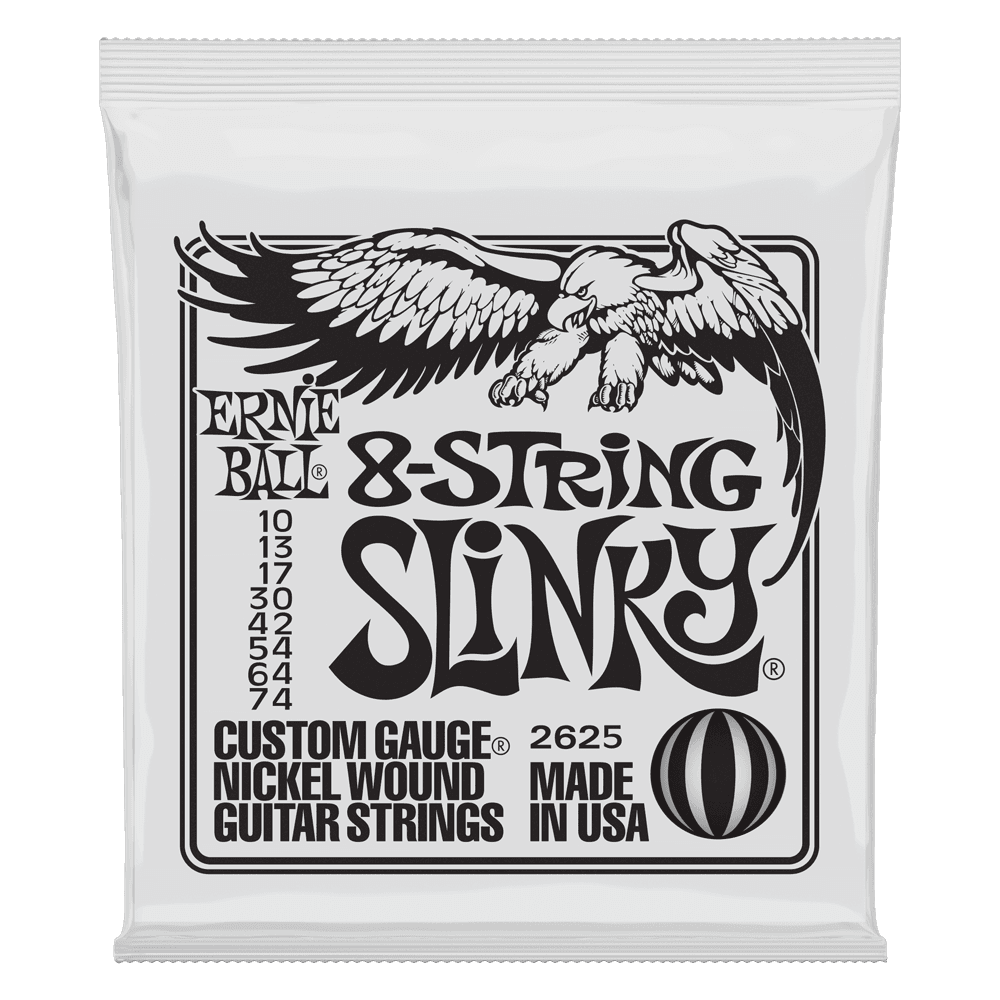
8-String Slinky Nickel Wound (.010–.074)
Why this one: The reference stock 8-string set (EB 2625, nickel wound). The .074 low holds F# standard cleanly on 27-inch scale.
Install notes specific to 8-string
Setup-adjustment checklist for 8-string
- Nut slots
- The 8th-string slot on most factory 8-strings is cut for the factory string. Heavier 8th strings often need slot widening; lighter ones don't, but the slot can be too wide and cause buzzing. See the precision nut filing guide for the gauge + 5 mils rule.
- Bridge
- 8-string Tune-O-Matic and Hipshot bridges have specific 8-string saddle slots. Don't try to retrofit a 7-string bridge for 8-string use.
- Truss rod
- Most 8-string necks have dual-action truss rods sized for the heavier load. Truss-rod adjustments behave the same as 6/7-string but the necks have less margin, over-adjustment is more consequential.
- Pickup height
- 8-string pickups need careful height adjustment to balance the low F#'s strong magnetic pull against the thinner top strings. Keep the bass side lower than the treble side.
- Intonation
- Re-intonate every 3–4 weeks of heavy playing. 8-string intonation drifts faster than 6-string.
For the deeper configuration walk-through covering pickup voicing options (Fishman Fluence Modern, EMG 808X, Bare Knuckle Aftermath, Lundgren M8), bridge intonation range (Hipshot vs Evertune vs Tune-O-Matic), and action measurement targets, see the 8-string high-tension setup pillar. For the nut-cut procedure: precision nut filing for heavy-gauge strings.
Related
- Pillar A reference: 8-string high-tension setup covers full configuration (scale length, gauge, nut work, truss rod, pickups, bridge, action, binding diagnosis)
- 7-string, not 8-string? See the 7-string gauge guide
- Who's on 8-string? Top 10 8-string players, plus individual rigs of Tosin Abasi, Javier Reyes, Stephen Carpenter, Fredrik Thordendal, Wes Hauch
- Tunings: F# standard, Drop E
- Cross-wire pillar: String gauge and scale length reference
- Nut work: precision nut filing for heavy-gauge strings
Frequently asked questions
What's the standard tuning for an 8-string guitar?
F# standard: F#-B-E-A-D-G-B-E (low to high). 8th string is a low F#, a perfect fourth below the low B of a 7-string. Production 8-strings ship factory-tuned here. Drop E (E-B-E-A-D-G-B-E) is next-most-common.
Why are 8-string scales so long?
Tension. A low F# on a 25.5-inch scale needs a string thick enough that it loses too much articulation under gain, the wrap-wire becomes a wobbly pendulum more than a vibrating string. 27-inch scale lets a .074 hold F# at ~16 lbs of tension; the 29.4-inch Ibanez Meshuggah signatures let a .068 do the same. Multi-scale 8-strings (25.5" treble side fanning out to 27" or 28" bass side) split the difference.
What gauge for Drop E on 8-string?
27-inch scale Drop E: .009–.080 minimum, .010–.084 firmer. Longer scales (28-inch bass-side multiscale, 29.4-inch Ibanez M80M) can run a .074 low with medium touch. Drop E pushes the low string into baritone-bass territory.
Can I play 8-string sets on a 7-string guitar?
No. 8-string sets have eight strings with a specific low-F# gauge sized for the 8th-string slot on the bridge and nut. A 7-string guitar can't physically accept the 8th string. If you want to push a 7-string into 8-string territory tuning-wise, you need a custom heavy 7-string set (.012–.072 or thereabouts), which is what some Drop F# 7-string players run.
Who plays 8-string at the highest level?
Tosin Abasi and Javier Reyes (Animals as Leaders) are the canonical 8-string composers. Stephen Carpenter (Deftones) and Fredrik Thordendal / Mårten Hagström (Meshuggah) are the longest-tenured 8-string rhythm players in metal. Wes Hauch, Jason Richardson, and Keith Merrow run 8-string on parts of their solo material.
Are 8-string strings expensive?
Yes, noticeably more than 6-string sets. An Ernie Ball 8-String Slinky or D'Addario NYXL 8-string set typically costs two to three times a 6-string equivalent. The 8th string itself accounts for most of the cost, manufacturing a consistent .074 or .080 wound string with good intonation behavior is genuinely harder than a .046 low E, and the volume produced is much smaller. (Note: Ernie Ball's Cobalt line does not include an 8-string set.)
Do I need a multi-scale 8-string?
Not strictly, but multi-scale (fanned-fret) 8-strings make extended-range guitars feel more comfortable. The shorter treble-side scale keeps high-string bends comfortable while the longer bass-side scale gives the low F# proper tension. Strandberg, Kiesel, Mayones, and Schecter all ship multi-scale 8-strings. Single-scale 27" 8-strings (Ibanez RG8) are simpler to set up; multi-scale is harder to find replacement parts for.
What pickups work best with 8-string in F# standard?
8-string-specific pickups, not 7-string-extended ones. Fishman Fluence Modern 8, Bare Knuckle Aftermath 8, Lundgren M8, Seymour Duncan Nazgul 8. 8-string pole-piece spacing matches 8-string fingerboard width; 7-string pickups in an 8-string body have weak outer-string readout. Full configuration covered in the 8-string high-tension setup pillar.