Drop D tuning: gauges, tension, and strings for the most-used alternate tuning
Written with AI help · Updated
Drop D (D-A-D-G-B-E) lowers only the 6th string a whole step, so most players keep their regular .010–.046 set. The low D drops to roughly 14 pounds of tension on a 25.5-inch scale, playable but noticeably looser. If you ride the low string hard most of the set, step the bottom up: a hybrid set with a .052 sixth string restores the tight feel without changing the top five.
- Gibson scale (24.75")
- 10–52
- Fender scale (25.5")
- 10–52
- Baritone (27"+)
- –
Gauge ranges from CYS's in-house tension-and-scale reference, built by Phil (luthier) and Wright (tension/scale).
Why Drop D is the default alternate tuning
Drop D takes standard tuning (E-A-D-G-B-E) and lowers the 6th string a whole step to D. Nothing else moves. That single change does three things at once: it extends the low range by a whole step, it turns the bottom-two-string power chord into a one-finger barre, and it leaves every chord shape on the top five strings exactly where it was.
That last point is why Drop D is the first alternate tuning most players learn. You give up almost nothing. Open chords, pentatonic boxes, and lead vocabulary all survive intact. Only riffs that fret the 6th string need transposing, two frets up on that string.
The one-finger power chord is the mechanic the whole drop-tuning family is built on. Drop C, Drop B, Drop A on 7-string, and Drop E on 8-string all reproduce the same grip at lower pitches. Drop D is where the pattern starts, and the only one of the family that needs no string change at all.
Tension math: what happens to the low string
String tension scales with the square of pitch. Dropping the 6th string from E2 (82.4 Hz) to D2 (73.4 Hz) cuts its tension to about 79 percent of standard. On a 25.5-inch scale, approximate figures for a nickel wound 6th string:
| 6th string gauge | Tension at E (standard) | Tension at Drop D | Feel | |
|---|---|---|---|---|
| .046 (stock 10-46) | ~17.5 lbs | ~13.9 lbs | Loose but playable | |
| .048 | ~19.0 lbs | ~15.1 lbs | Balanced | |
| .052 (hybrid set) | ~22.0 lbs | ~17.5 lbs | Tight, matches standard feel |
The takeaway: a .052 sixth string at Drop D feels almost exactly like a .046 at standard pitch. That is the entire logic of "skinny top heavy bottom" hybrid sets. The top five strings never detune in Drop D, so they should stay at the gauges you already like.
On a 24.75-inch Gibson scale the same gauges run about 7 percent looser, so the case for a heavier 6th string is slightly stronger. The full physics is in our string gauge and scale length reference.
Recommended sets
For players who split time between standard and Drop D, a stock 10-46 set is the right call. The slightly loose low D is a feature for some styles: grunge and alt-rock players often like the extra string movement and grind.
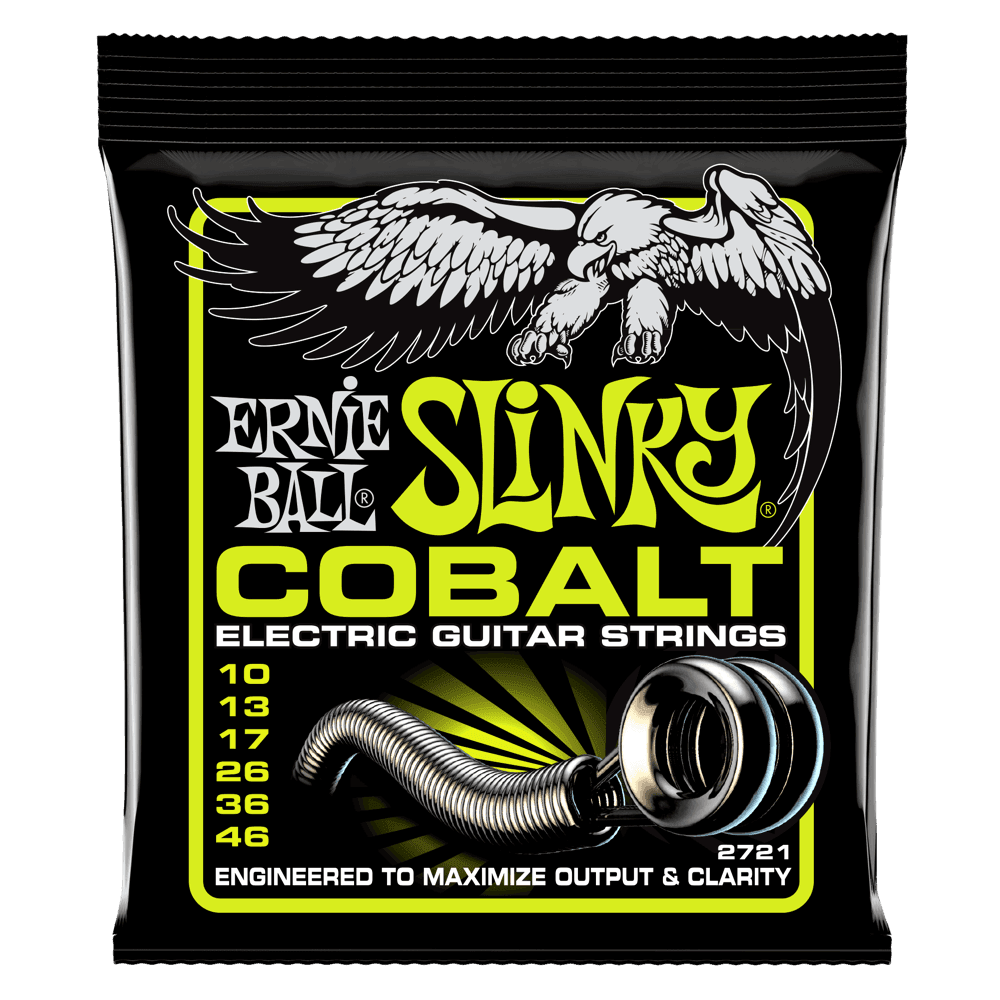
Regular Slinky Cobalt (.010–.046)
Why this one: The Cobalt wrap keeps the dropped low D articulate under palm muting, which is exactly where a detuned .046 tends to blur. Top five strings stay at standard pitch, so the familiar Regular Slinky feel carries over unchanged.
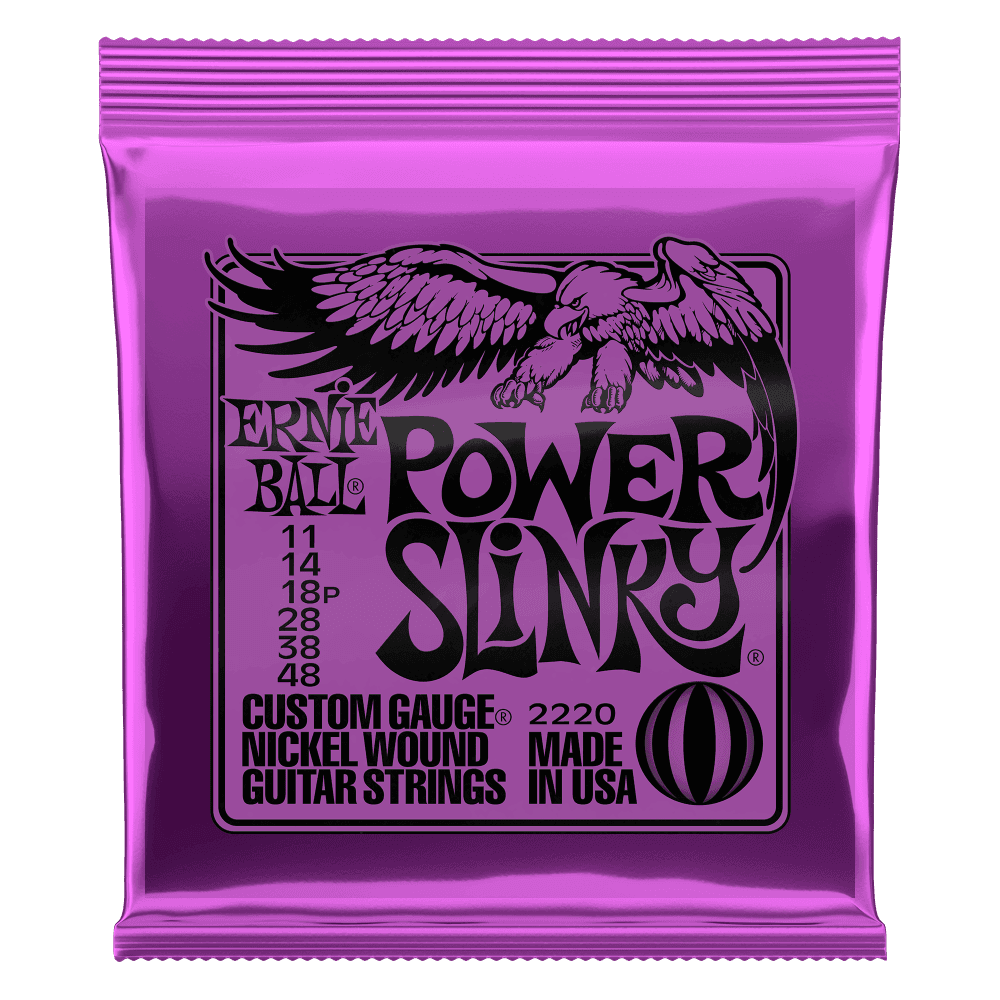
Power Slinky 2220 Nickel Wound (.011–.048)
Why this one: The documented Adam Jones set. A .048 sixth string at Drop D lands around 15 pounds, the balanced middle of the target range, and the .011 top suits players who dig in.

NYXL1046 Nickel Wound (.010–.046)
Why this one: The frequent-retuner's pick. NYXL's high-carbon core holds pitch unusually well through repeated drops between standard and Drop D, which matters if you switch tunings mid-set.
Genre notes
- Grunge / alt-rock: Stock .010–.046. The loose low D is part of the sound.
- Nu-metal / hard rock rhythm: A hybrid set with a .052 sixth string, or .011–.048 if you also want a firmer top.
- Prog-metal: .011–.048 is the documented Tool lane. If your material also visits Drop C, consider .011–.054 and read the Drop C guide.
- Acoustic fingerstyle / folk: Your existing light or medium acoustic set. No change needed.
- Heavy Drop D with detuned passages below D: Step to .011–.054 (Beefy Slinky territory) so the occasional Drop C# or Drop C section stays tight.
Setup checklist
Switching to Drop D on your current strings:
- Tune down, stretch, re-tune. The 6th string will drift sharp for a few minutes after the drop. Pull it gently at the 12th fret and re-tune twice.
- Check 6th-string intonation at the 12th fret harmonic if you record. Lower tension usually moves the fretted note slightly sharp.
- Floating tremolo guitars: lowering one string raises the others as the bridge tilts back. Re-tune the full set two or three times until it settles, or block the trem if you switch tunings every night.
Changing gauge for a permanent Drop D setup (e.g., .046 to .052 sixth string):
- Truss rod: check relief after a day. A heavier sixth string adds a few pounds of pull; many necks need no adjustment, some want an eighth of a turn.
- Nut slot: a .052 may bind in a slot cut for .046. Binding shows up as pinging while tuning.
- Saddle height and pickup pull: recheck only the bass side.
Related
- The physics: String gauge and scale length, the complete reference.
- Going lower: Drop C, B standard, Drop A (7-string).
- Documented Drop D rigs: Adam Jones, Tool's 10,000 Days.
- Choosing a set: What gauge strings should I use?
String gauge by tuning + scale length
Safe gauge ranges by tuning across Gibson (24.75"), Fender (25.5"), and baritone (27"+) scales. A dash in any cell means that scale length isn't recommended for the tuning, not that data is missing.
| Tuning | Gibson scale (24.75") | Fender scale (25.5") | Baritone (27"+) |
|---|---|---|---|
| E Standard | 10–46 | 9–42 | – |
| Drop D | 10–52 | 10–52 | – |
| Eb Standard | 11–48 | 10–52 | – |
| Drop C# | 11–54 | 11–48 +52 | – |
| D Standard | 11–54 | 11–48 | 10–52 |
| C Standard | 12–56 | 12–56 | 12–56 |
| Drop C | 12–56 | 11–54 +56 | 11–56 |
| Drop B | 12–64 | 12–62 | 11–54 |
| B Standard | 13–68 | 13–64 | 12–54 |
| Drop A | 13–70 | 12–68 | 12–62 |
| Drop G | – | – | 13–70 |
Source: CYS in-house tension-and-scale reference, built by Phil (luthier) and Wright (tension/scale). For scale lengths between categories (e.g., 25" PRS), split the difference between the two nearest columns.
Frequently asked questions
What gauge strings for Drop D?
Your existing .010–.046 set works. Drop D only detunes the 6th string, and a .046 at D still carries about 14 pounds of tension on a 25.5-inch scale, loose but fully playable. If most of your playing lives in Drop D and you palm-mute aggressively, use a set with a .048 to .052 sixth string. The top five strings stay at standard pitch, so they need no change at all.
Do I need a setup change for Drop D?
Usually no. One string moving down a whole step changes total neck tension by only a few pounds, which most necks absorb without measurable relief change. Check intonation on the 6th string if you record. A gauge change is different: moving from a .046 to a .052 sixth string can require a small truss rod adjustment and a check that the nut slot does not bind.
Is Drop D the same as D standard?
No. Drop D (D-A-D-G-B-E) lowers only the 6th string a whole step; the other five stay at standard pitch. D standard (D-G-C-F-A-D) lowers all six strings a whole step. D standard needs a heavier set across the board, typically .011–.054. Drop D works fine on a stock set.
Why do so many bands use Drop D?
Two reasons. The low D extends the bottom of the range by a whole step without touching the rest of the fretboard. And the dropped string turns the bottom-two-string power chord into a one-finger barre, which makes fast chord riffing physically easier. That one-finger grip is the same mechanic that Drop C, Drop B, and 8-string Drop E borrow at lower pitches.
Who plays in Drop D?
It is the most common alternate tuning in rock and metal, so the honest answer is almost everyone at some point. The best-documented full-catalog resident on CYS is Adam Jones: the bulk of Tool's catalog sits in Drop D on Ernie Ball Power Slinky .011–.048, with citations on his profile.
Does Drop D work on acoustic guitar?
Yes, and it is common in fingerstyle and folk because the low D lets you keep a droning root under D-shape voicings. Acoustic sets are heavier to begin with (.012–.053 light or .013–.056 medium), so the dropped 6th string keeps enough tension to stay clean under a flatpick.
Will Drop D damage my guitar or make strings break?
No. Lowering pitch reduces tension, which is the gentle direction. Strings break from sharp saddle or nut edges and from fatigue, not from detuning. The only mild annoyance is on floating-tremolo guitars, where lowering one string detunes the others until the bridge re-balances, so spring-loaded bridges make frequent Drop D switching tedious.