Ernie Ball Not Even Slinky Cobalt (.012–.056): the second-heaviest Cobalt Slinky, explained
Written with AI help · Updated
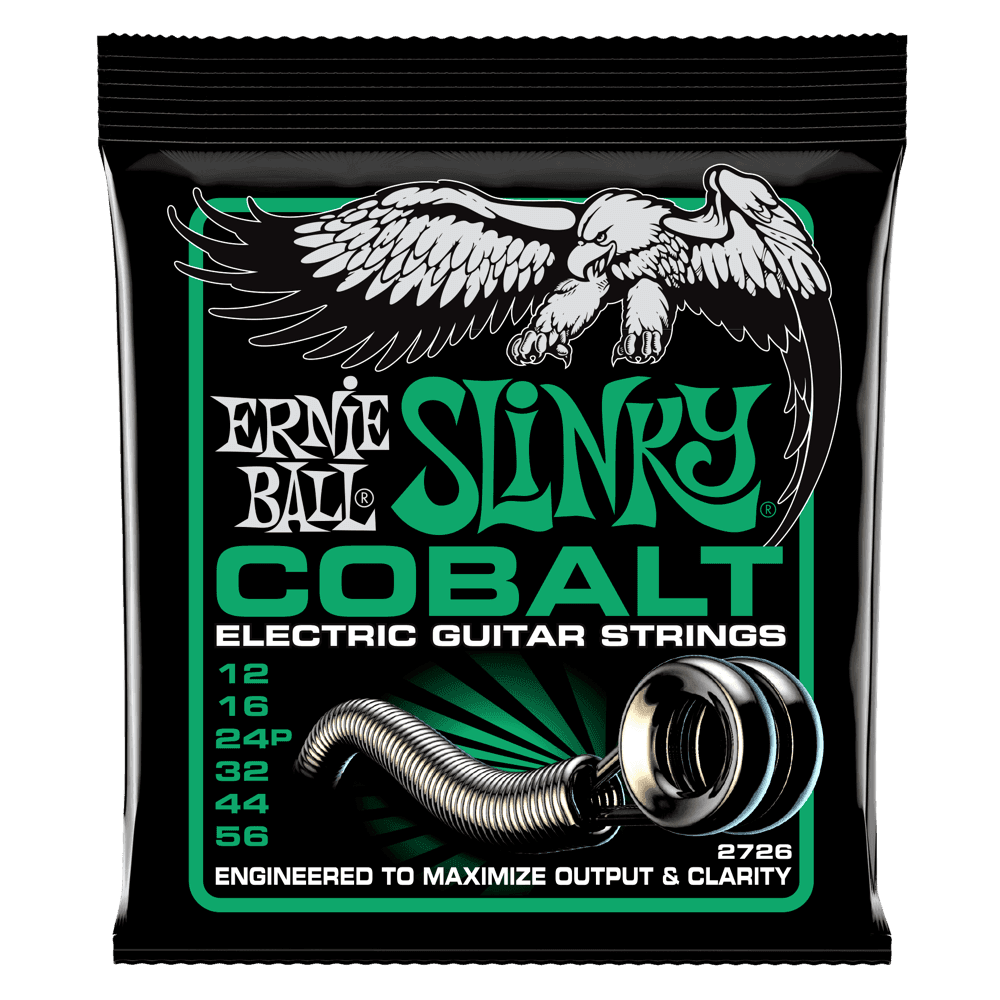
Ernie Ball Not Even Slinky Cobalt (2726) is a .012–.056 set wrapped in a cobalt-iron alloy instead of nickel-plated steel. The cobalt wrap is more magnetically reactive, so the set reads louder and brighter through passive pickups with a strong low-mid punch that suits Drop C, Drop B, and C standard. It's the second-heaviest standard 6-string Cobalt gauge, behind only Mammoth Slinky Cobalt. Pick it for tuned-down rhythm work on a 25.5-inch scale electric.

Anatomy
- SKU
- Ernie Ball 2726
- Gauge
- .012 – .056 (Not Even Slinky)
- Gauge set
- .012, .016, .024, .032, .044, .056
- Core wire
- Tin-plated hex steel
- Wrap wire
- Cobalt-iron alloy (the whole point of the line)
- Plain strings
- Tin-plated hex-core steel (.012, .016, .024 plain)
- Coating
- None, uncoated
- Winding
- Standard roundwound
- Intended scale
- 25.5" (Strat/superstrat) primary; works on 24.75" (Les Paul) for C standard
- Intended tunings
- Drop C, Drop B, C standard, D standard, baritone B standard
- Total tension (25.5", Drop C)
- ~98 lbs
- Total tension (25.5", E standard)
- ~115 lbs (stiff, not recommended)
- Launched
- January 2012 (Cobalt line debut)
- Package
- Single pack, 3-pack, and bulk 6-pack available
Not Even Slinky Cobalt (.012–.056)
Tone
Cobalt is the biggest voicing change Ernie Ball has made to the Slinky line since the line was introduced. Swapping the nickel-plated steel wrap for a cobalt-iron alloy bumps the string's magnetic permeability, which translates to real, measurable differences when you plug in.
Voicing through a passive pickup
- Output
- 2–3 dB louder than a same-gauge nickel Slinky through the same passive pickup. It's the first thing you hear.
- Top end
- More present upper midrange (around 2–4 kHz) and a slightly tighter high end. Not glassy, punchy.
- Low end
- Firmer attack, slightly less bloom on the low notes. Palm mutes sound more defined.
- Dynamic range
- Wider. Pick lightly and they sit back; dig in and they bite harder than nickel at the same gauge.
That voicing is why the .012–.056 gauge makes sense as the "heavy Cobalt" set. On a guitar tuned to Drop C through a high-gain amp, the extra definition stops the low string from smearing into mud. For the same reason, it's less exciting in E standard, the low end already has plenty of room to breathe up there, and the extra upper-mid push can feel aggressive.
For the full measured breakdown of Cobalt vs nickel Slinky (output dB, brightness curve, longevity, bend feel, pickup compatibility), see Cobalt vs nickel Slinky: the voicing difference, measured.
Where this set sits in the Cobalt range
Not Even Slinky Cobalt (.012–.056) is the second-heaviest of the twelve standard 6-string Cobalt gauges, behind only Mammoth Slinky Cobalt (.012–.062). It's the Drop C / Drop B / C standard answer. Lighter-gauge Cobalts cover E standard and Drop D; the full gauge-by-gauge picking guide is at Ernie Ball Cobalt Slinky gauges explained.
Quick orientation:
-
E standard or Eb standard: Regular Slinky Cobalt (.010–.046).
-
Drop D: Power Slinky Cobalt (.011–.048) or Skinny Top Heavy Bottom Cobalt (.010–.052).
-
Drop C (lighter touch): Beefy Slinky Cobalt (.011–.054).
-
Drop C / Drop B / C standard (heavier rhythm): This set, Not Even Slinky Cobalt (.012–.056).
Who plays the Cobalt line
The full documented Cobalt pro roster, 20 confirmed primary-source users plus 10 provisional Ernie Ball endorsers, lives on a dedicated page so we can keep it sourced and updated. See Who plays Cobalt Slinky strings, the 30-player roster.
Short version for this gauge specifically: no primary-source-documented artist is confirmed on this exact .012–.056 gauge yet (see the FAQ above). Dustin Kensrue (Thrice) runs the one-step-lighter Beefy Slinky Cobalt (.011–.054), the closest documented sibling; Wes Hauch's documented 6-string Cobalt gauge is the lighter .010–.046 Regular Slinky, not this one. This gauge sits in Drop C / Drop B / C standard hands, the tuning it was built for.
Best for
-
Drop C (C-G-C-F-A-D) on a 25.5-inch scale electric. This is the set's sweet spot.
-
C standard (C-F-Bb-Eb-G-C) on 25.5 inch. Firm, not stiff.
-
D standard on shorter 24.75" Gibson-scale guitars, the shorter scale compensates for the heavier gauge.
-
Baritone B standard on 27" scale (borderline; .013–.062 is usually better up there).
-
Doom, stoner rock, sludge, modern metal, djent on 6-string. Tuned-down rhythm work is what the set was built for.
Worst for
-
E standard. Total tension tops 110 pounds. Stiff bends, strained guitar setup. Use .010s or .011s.
-
Shorter Fender-scale guitars already strung light. A Mustang or Jaguar can take .012s, but it needs a full setup adjustment and a truss-rod tweak.
-
Seven-string guitars. Use the dedicated 7-string Cobalt set (2730, .010–.062) instead. Don't cobble a .012–.056 onto a 7 with a loose low string.
-
Eight-string guitars. Ernie Ball doesn't currently ship an 8-string Cobalt set. Use the nickel-wound 8-String Slinky (2625) or custom singles instead. (2732 is the Cobalt Regular Slinky bass set, .050–.105, not a guitar set.)
-
Slide players in open tunings. The extra tension fights the slide's natural pressure. Use a purpose-built open-tuning slide set.
Install and break-in
If you're stepping up to .012s from a .010 set, the extra ~20 lbs of total neck tension means a full setup pass: truss rod, nut slots, bridge saddles, intonation. The truss-rod-aware install walk-through is at Switching to heavier electric strings: the truss-rod-aware install guide.
Break-in is ~30–45 minutes of playing before the bright top end settles into its "played-in" voice. Stretch each string (press behind the 12th fret and pull up about an inch, 3–4 times per string, retune, repeat) before you start break-in playing.
Verdict
If you play Drop C, Drop B, or C standard on a 25.5-inch scale electric and you want passive pickups to read louder, brighter, and more defined without stepping up to an active EMG setup, the .012–.056 Cobalt Slinky is the best single answer in the Ernie Ball catalog. It's not a replacement for nickel Slinky, it's a voicing decision. The extra output and midrange definition is what the set is for. If you don't hear the difference in A/B tests with nickel, save your money and run the standard set.
The .012–.056 Cobalt is not an E-standard string. Buying a heavier gauge than your tuning needs makes the guitar fight you for no reward. Match the set to the tuning.
Related
Related