E standard tuning: the default gauges, tension, and best strings
Written with AI help · Updated
E standard (E A D G B E) is the default guitar tuning, the reference point every other tuning steps down from. The standard set is .010 to .046, which pulls roughly 104 pounds on a 25.5 inch scale and balances easy bends with a full low end. Drop to .009 to .042 for lighter lead feel, or step up to .011 and heavier for firmer rhythm, jazz, and thick clean tone.
- Gibson scale (24.75")
- 10–46
- Fender scale (25.5")
- 9–42
- Baritone (27"+)
- –
Gauge ranges from CYS's in-house tension-and-scale reference, built by Phil (luthier) and Wright (tension/scale).
Why E standard is the default tuning
E standard takes the six strings low to high as E, A, D, G, B, E. In pitch terms that is E2, A2, D3, G3, B3, E4. It is the tuning every chord shape and scale box is taught in, and it is the reference point that every other tuning is described against.
That matters when you shop for strings. A set sold as a regular or standard electric set is built and balanced for these exact pitches. Eb standard lowers everything a half step, Drop D lowers only the low E, and Drop C goes further still. Each of those loosens the strings and usually wants a heavier set to compensate. E standard is the one tuning where the off-the-shelf gauge is the right gauge, so here the only real question is how light or heavy you want it to feel.

EXL110 Nickel Wound Regular Light (.010–.046)
Why this one: The default standard-E set, full stop. D'Addario's best-selling electric gauge since 1974, balanced so the plain strings bend easily and the wound strings stay tight at concert pitch. If you do not have a reason to go lighter or heavier, this is the set.
What standard tension feels like
The .010 to .046 set is the tension baseline that the whole gauge conversation is measured against. On a 25.5 inch Fender scale at E standard, the set pulls roughly 104 pounds total, with the wound low strings carrying the most. These are D'Addario's own published figures from its string tension chart.
| String | Gauge | Tension | |
|---|---|---|---|
| 1st (E4) | .010 plain | 16.2 lb | |
| 2nd (B3) | .013 plain | 15.4 lb | |
| 3rd (G3) | .017 plain | 16.6 lb | |
| 4th (D3) | .026 wound | 18.4 lb | |
| 5th (A2) | .036 wound | 19.5 lb | |
| 6th (E2) | .046 wound | 17.5 lb |
Scale length shifts these numbers. A 24.75 inch Gibson scale runs the same gauges about 7 percent looser than a 25.5 inch Fender scale, which is why a Strat player can drop to .009s for a feel a Les Paul player gets from .010s. The full physics, including how to keep tension steady when you switch scale lengths, is in our string gauge and scale length reference.
Picking a gauge in E standard
In standard tuning, gauge is purely a feel and tone decision. Nothing is fighting the tuning, so pick by how hard you want the strings to push back.
| Set | Feel | Best for | |
|---|---|---|---|
| .008–.038 | Very light, almost no resistance | Shred, vintage light setups | |
| .009–.042 | Light, effortless bends | Rock and blues leads, Fender scale | |
| .010–.046 | The standard reference | Most rock, blues, country, pop | |
| .011–.049 | Firm, fuller low end | Jazz, blues rhythm, heavy strummers | |
| .011–.054 | Heavy, stiff under the hand | Thick clean tone, drop-tuning headroom |
Lighter strings bend and vibrato with less effort but can feel loose and sound thin under heavy picking. Heavier strings give a fuller tone and more attack resistance but take more hand strength and a setup tweak. The .010 to .046 middle is popular because it asks nothing of your hands or your guitar.
Recommended sets
Start from the default and move only if you have a reason.
Stay on the standard. The .010 to .046 set is the right answer for the widest range of players. Ernie Ball's version is the Regular Slinky, the other half of the two best-selling electric sets on earth.
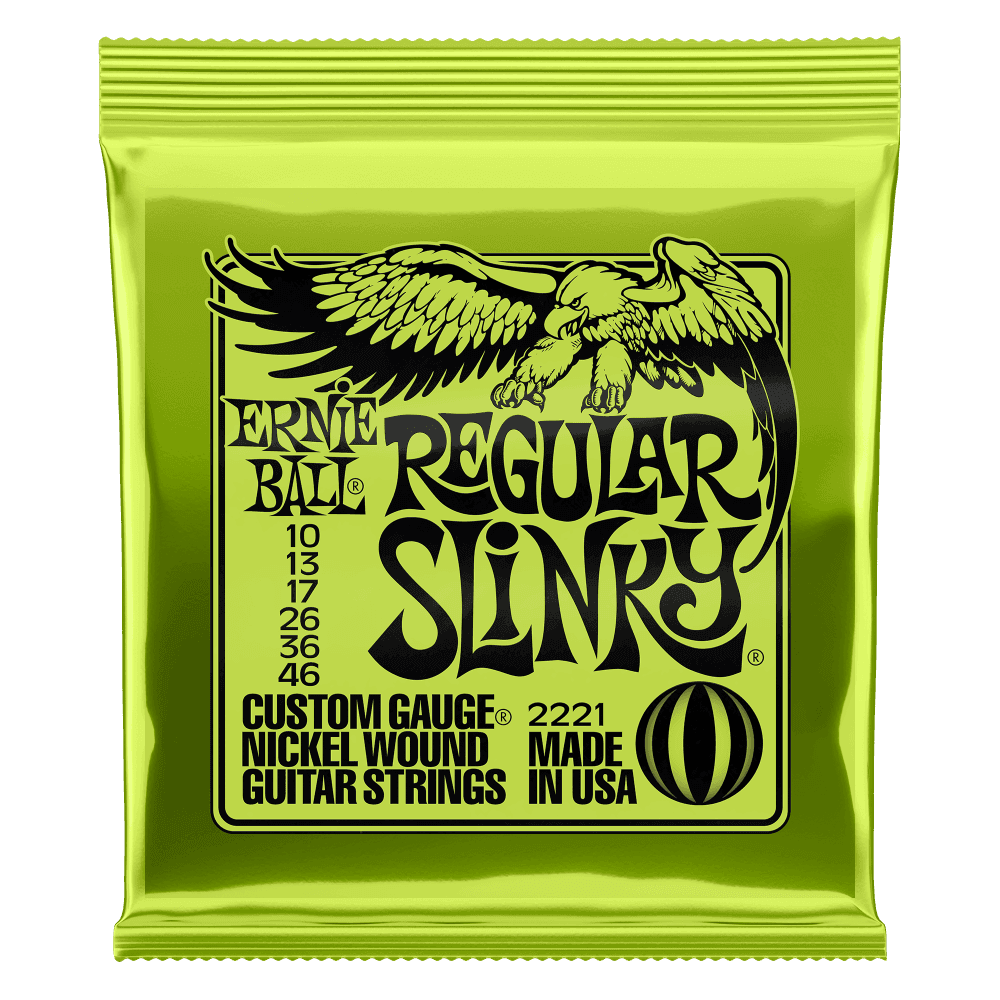
Regular Slinky (.010–.046)
Why this one: The Ernie Ball standard-E set, the direct counterpart to the EXL110. Bright nickel-wound tone and a feel that countless players learned on. Pick this or the EXL110 by which brand your hands already know.
Go lighter for leads. If you bend constantly and want the slinkiest possible feel, a .009 to .042 set drops the effort without losing standard-E low end. This is the classic light-and-bright Fender-scale choice.
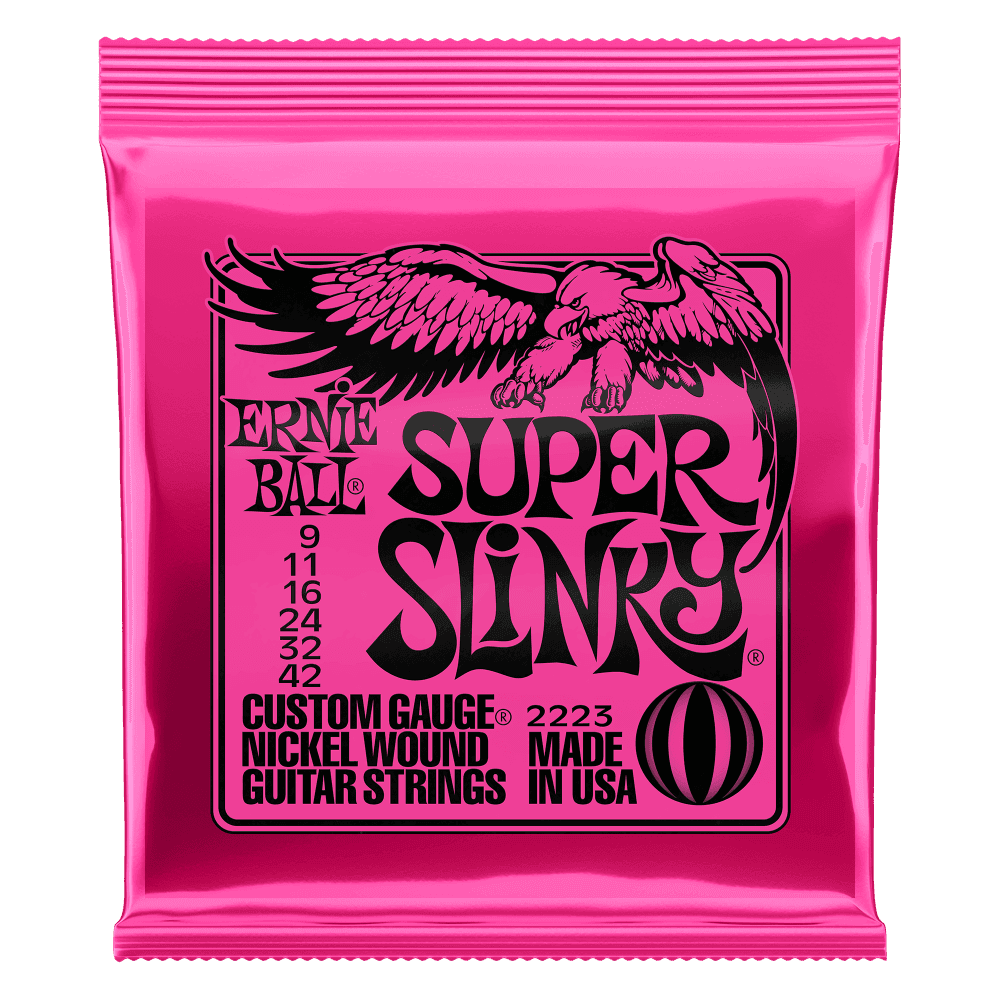
Super Slinky (.009–.042)
Why this one: The original light-gauge electric set, the bend-friendly default for lead players in standard E. Lighter plain strings make wide bends and fast vibrato easy, with enough wound-string body to keep rhythm parts honest.
Hold tune through hard playing. If you bend hard, gig nightly, or move between standard and a dropped string mid-set, a high-stability core returns to pitch better than a plain set.

NYXL1046 Nickel Wound (.010–.046)
Why this one: The standard .010 to .046 spread on D'Addario's high-carbon NY Steel core, which holds pitch noticeably better under hard bending. The pick for players who keep the default gauge but want it to stay in tune through a full set.
Player and genre notes
- Rock and pop: A .010 to .046 set covers almost everything. It is the documented choice of John Frusciante, Mark Knopfler, and The Edge, all in standard E.
- Blues: .010 to .046 for the all-rounder, or .011 and up if you want a stiffer string to dig into. Many blues players run a touch heavier than rock players.
- Country: .010 to .046 or .009 to .042. Chicken-pickin and big bends reward a lighter top end, while a wound or plain third is a personal call.
- Metal in standard E: .010 to .046 or .010 to .052 keeps the low E tight for palm-muted riffing without leaving standard tuning. Players like Nita Strauss run their signature sets here.
- Jazz: .011 to .049 and up, often flatwound, for a fat, dark tone and the stiffer feel that comping rewards.
Setup notes
E standard is the factory baseline, so most guitars need no work to play a fresh standard-gauge set. Two situations do call for a setup:
- You changed gauge. Moving from .010s to .011s adds pull and may need an eighth-turn of truss rod and a nut-slot check. Going down to .009s removes pull the other way. See the heavy-gauge install guide for the full procedure.
- Intonation drifts. Any new set can shift intonation slightly. Check each string at the 12th fret, harmonic against fretted note, especially if you record.
If you keep the same gauge you have always used, a restring in E standard is just that, a restring.
Next steps
- The physics behind every gauge call: string gauge and scale length, the complete reference.
- Step down from here: Eb standard (half step) and Drop D (low E only).
- Ranked picks for your style in standard E: rock and blues in E standard.
String gauge by tuning + scale length
Safe gauge ranges by tuning across Gibson (24.75"), Fender (25.5"), and baritone (27"+) scales. A dash in any cell means that scale length isn't recommended for the tuning, not that data is missing.
| Tuning | Gibson scale (24.75") | Fender scale (25.5") | Baritone (27"+) |
|---|---|---|---|
| E Standard | 10–46 | 9–42 | – |
| Drop D | 10–52 | 10–52 | – |
| Eb Standard | 11–48 | 10–52 | – |
| Drop C# | 11–54 | 11–48 +52 | – |
| D Standard | 11–54 | 11–48 | 10–52 |
| C Standard | 12–56 | 12–56 | 12–56 |
| Drop C | 12–56 | 11–54 +56 | 11–56 |
| Drop B | 12–64 | 12–62 | 11–54 |
| B Standard | 13–68 | 13–64 | 12–54 |
| Drop A | 13–70 | 12–68 | 12–62 |
| Drop G | – | – | 13–70 |
Source: CYS in-house tension-and-scale reference, built by Phil (luthier) and Wright (tension/scale). For scale lengths between categories (e.g., 25" PRS), split the difference between the two nearest columns.
Frequently asked questions
What gauge strings for E standard?
A .010 to .046 set is the standard reference and the right starting point for most players. Go lighter to .009 to .042 if you want effortless bends and a slinky lead feel. Step up to .011 to .049 or heavier for firmer rhythm, jazz, and thick clean tone. Gauge in standard tuning is a feel-and-genre choice, not a tension fix.
What notes is E standard tuning?
Low to high, E A D G B E. In scientific pitch that reads E2, A2, D3, G3, B3, E4. It is the tuning every chord shape, scale box, and beginner lesson is taught in, which is why it is called standard. Other tunings are described by how they move away from it, a half step down to Eb, a whole step down to D, or one string dropped for Drop D.
Why is a .010 to .046 set called regular or standard?
Because it is the most-played electric gauge in the world. D'Addario calls its EXL110 (.010 to .046) its best-selling set, made since 1974, and Ernie Ball's matching set is literally named Regular Slinky. The .010 to .046 spread balances bendable plain strings with wound strings heavy enough to stay tight, which is why factories set guitars up around it.
Is E standard the same as standard tuning?
Yes. On a six-string guitar, standard tuning means E standard, E A D G B E. The terms are interchangeable. It is different from Eb standard, which lowers every string a half step, and from Drop D, which lowers only the low E to D. If a song just says standard tuning with no other note, it is in E standard.
Do I need a setup change for E standard?
Usually not. Most electric guitars ship set up for a .010 to .046 set in E standard, so a fresh set of the same gauge needs nothing. What triggers setup work is changing gauge, not pitch. Move up to .011s or down to .009s and you may want a truss rod tweak, a nut-slot check, and an intonation reset at the 12th fret.
What strings do famous E standard players use?
A lot of the canonical standard-E rigs run D'Addario EXL110 (.010 to .046). John Frusciante of Red Hot Chili Peppers, Mark Knopfler of Dire Straits, and U2's The Edge all play that set in standard E. The takeaway is that the default .010 to .046 is not a beginner compromise, it is what many career professionals choose and stay on.