Eb standard tuning: gauges, tension, and the best strings for half-step-down
Written with AI help · Updated
Eb standard (Eb-Ab-Db-Gb-Bb-Eb) tunes every string down a half step. Tension drops to about 89 percent of standard, so a stock .010 to .046 set turns slightly slinky. Keep that set, or go lighter, for the loose bend-friendly feel Hendrix and Van Halen built their tone on. Step up to .011 to .048 to restore standard tension, the documented Slash approach. Players chasing thick clean tone, like Stevie Ray Vaughan, go heavier still.
- Gibson scale (24.75")
- 11–48
- Fender scale (25.5")
- 10–52
- Baritone (27"+)
- –
Gauge ranges from CYS's in-house tension-and-scale reference, built by Phil (luthier) and Wright (tension/scale).
Why Eb standard is the half-step-down standard
Eb standard takes standard tuning (E-A-D-G-B-E) and lowers every string a half step to Eb-Ab-Db-Gb-Bb-Eb. Nothing about the relationships between strings changes. Every chord shape, every scale box, every lead lick you already own transfers exactly, you just sound a semitone lower.
That is why it is the most-used downtuning that is not a drop tuning. You give up nothing in playability and gain three things: a lower vocal range, a slightly looser string feel that makes bends sing, and a home in flat keys. It is the tuning behind a huge slice of classic rock and blues, from Jimi Hendrix and Stevie Ray Vaughan to Eddie Van Halen and Slash.
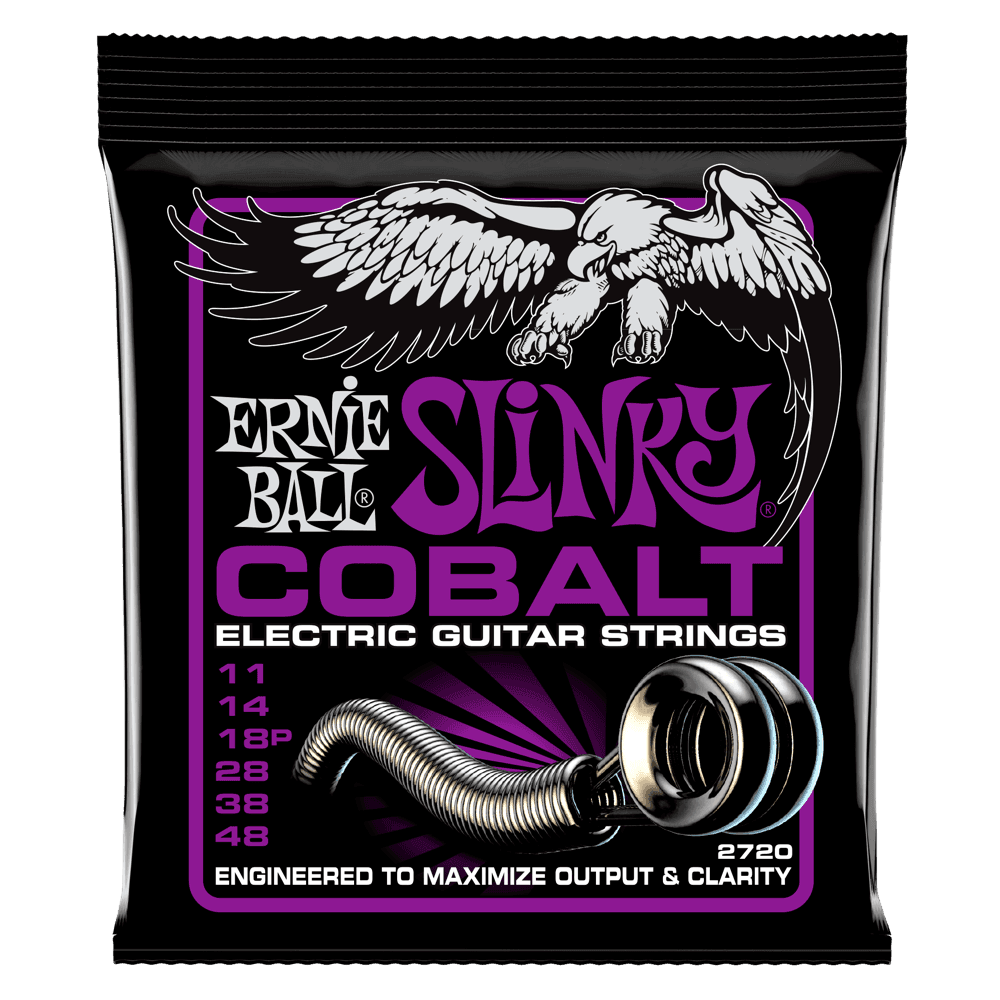
Power Slinky Cobalt (.011–.048)
Why this one: The cleanest way to play in Eb without the slack. A .011–.048 set at Eb lands almost exactly where a .010–.046 sits at standard pitch, so you get the half-step-down sound with standard-tuning tightness. The Cobalt wrap keeps the lowered strings articulate under gain.
What a half step does to tension
String tension scales with the square of pitch. Lowering every string a half step multiplies pitch by about 0.944, so tension falls to roughly 89 percent of standard, an 11 percent drop across the whole set. In concrete terms, a .046 low string falls from about 17.5 pounds at E to about 15.6 pounds at Eb on a 25.5-inch scale.
That is enough to feel, not enough to fight. Bends take less effort, vibrato widens, and aggressive pickers notice a little more flop. Whether that reads as "expressive" or "loose" is the whole decision about what gauge to run.
| Set | Feel at E standard | Feel at Eb standard | Best for | |
|---|---|---|---|---|
| .009–.042 | Light, easy bends | Very slinky, slack | Light-and-low rock leads | |
| .010–.046 | Standard reference | Slightly loose, bend-friendly | Most rock and blues | |
| .011–.048 | Firm | Close to .010–.046 at E | Firm rhythm, Slash lane | |
| .011–.054 | Heavy | Thick but playable | Heavy riffing, drop-friendly | |
| .013–.056 | Very stiff | Stiff but bendable | Thick clean tone, SRV territory |
Scale length compounds this. On a 24.75-inch Gibson scale the same gauges run about 7 percent looser than on a 25.5-inch Fender scale, so Les Paul players in Eb reach for a heavier set sooner than Strat players do. The full physics is in our string gauge and scale length reference.
Recommended sets
Pick by what you want the slack to do.
Keep it slinky. If you like the loose, vocal bend feel, stay on a regular set and let Eb do its thing. This is the Hendrix and early Van Halen lane, light strings tuned down.
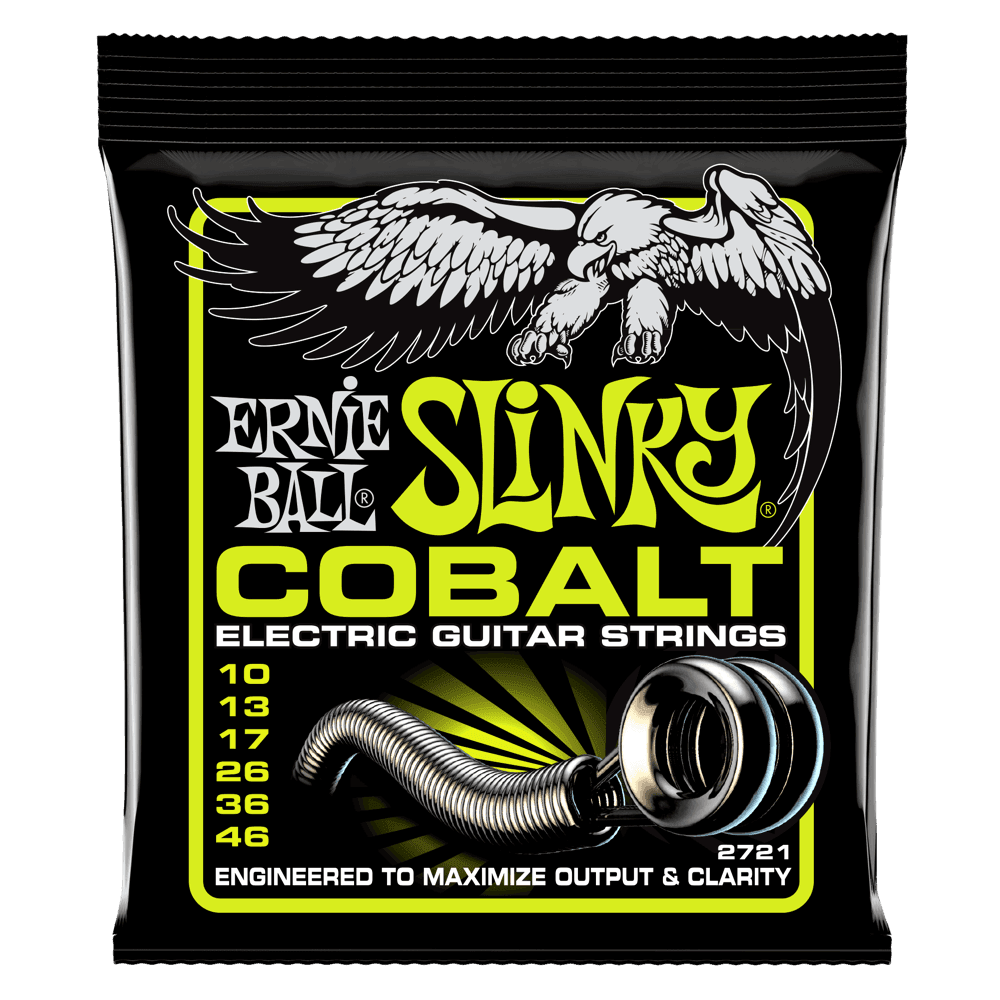
Regular Slinky Cobalt (.010–.046)
Why this one: The straight-ahead Eb set for players who want the half-step-down looseness as a feature. The Cobalt wrap adds output and keeps the slightly detuned strings clear, where a plain nickel .046 at Eb can start to blur under heavy hands.
Restore standard tension. Step up one gauge to .011–.048 and the set feels like a .010–.046 at E. This is the firm-rhythm Eb of hard rock and Guns N' Roses, and it is the documented Slash approach (specs and sources on his profile).
Go thick. For fat clean tone and bends that push against a stiff string, run .011–.054 or heavier. The half step down is exactly what made Stevie Ray Vaughan's famously heavy strings playable.
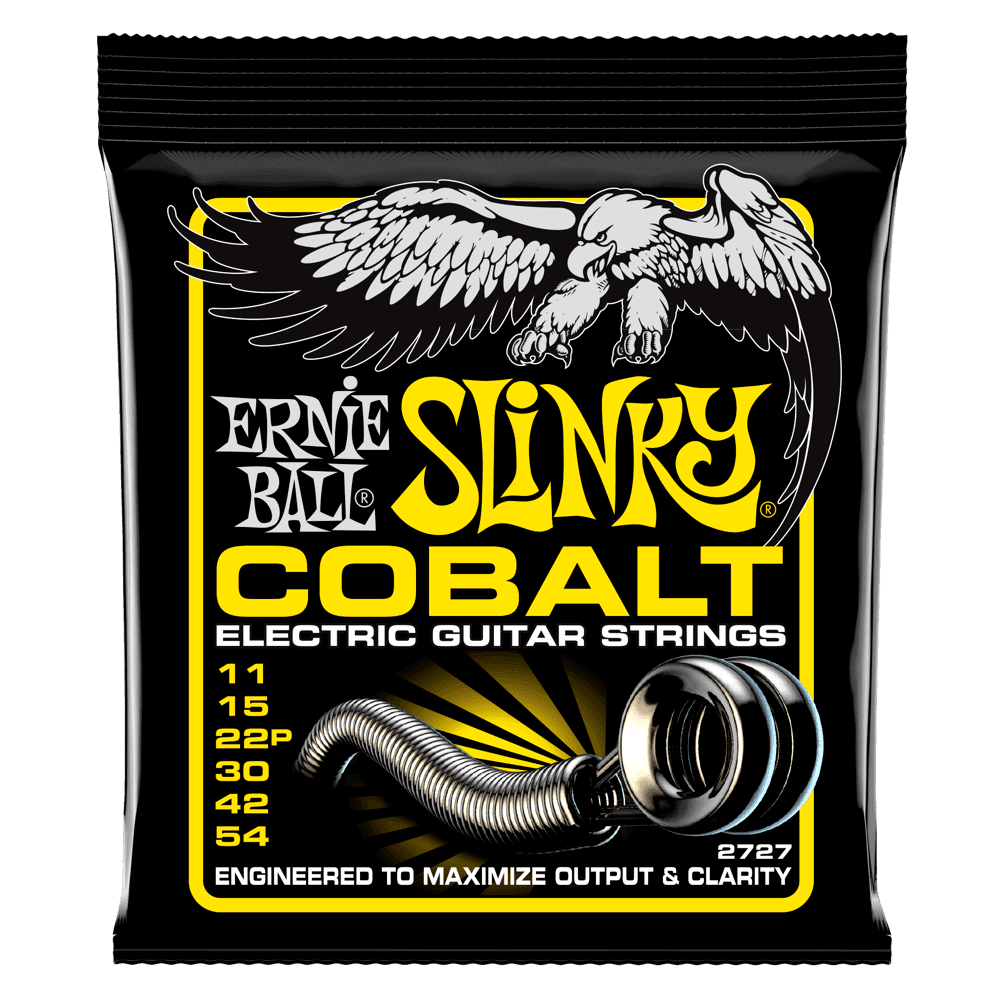
Beefy Slinky Cobalt (.011–.054)
Why this one: The accessible thick-Eb set. A .054 low string at Eb stays firm enough for chunky rhythm and aggressive bends without the very heavy .013 top that takes time to adjust to. Good bridge between standard feel and true heavy-gauge tone.
Switch tunings a lot. If you move between E and Eb mid-set, a high-stability core holds pitch through repeated retuning better than most.

NYXL1046 Nickel Wound (.010–.046)
Why this one: The frequent-retuner's pick. NYXL's high-carbon core returns to pitch reliably after repeated half-step drops, which matters if your set list jumps between standard and Eb.
Player and genre notes
- Blues and blues-rock: A regular .010–.046 is plenty, and heavier sets reward you. The half step down is the reason SRV-style .013s are playable at all.
- Classic rock and hard rock: .010–.046 for the light-and-low feel, or .011–.048 for firmer rhythm. Both are period-correct for the era's biggest Eb records.
- Metal rhythm: .011–.048 or .011–.054 keeps the low Eb tight under palm muting.
- Singer-songwriter and acoustic: A standard light or medium acoustic set, tuned down to sit under your voice. No gauge change needed.
Setup checklist
Switching to Eb on your current strings:
- Tune down evenly, stretch, re-tune. Drop all six a half step, stretch each string at the 12th fret, and re-tune twice. Fresh strings drift for a few minutes.
- Check intonation at the 12th fret if you record. Lower tension can push fretted notes slightly sharp.
- Truss rod: usually untouched. An 11 percent tension drop rarely moves relief enough to matter.
Changing to a heavier set for a permanent Eb setup:
- Truss rod: check relief after a day. A heavier set adds pull; many necks want an eighth of a turn, some none.
- Nut slots: a .011 or .013 top may bind in slots cut for .010. Binding shows up as pinging while tuning. See the heavy-gauge install guide.
- Floating tremolo: Eb is actually gentler on a Floyd than a single dropped string, because all six move together and the bridge stays closer to balanced.
Next steps
- The physics behind every gauge call: string gauge and scale length, the complete reference.
- Dropped cousins: Drop D and Drop C.
- Documented Eb rigs: Stevie Ray Vaughan, Jimi Hendrix, Eddie Van Halen, Slash, and Steve Vai.
String gauge by tuning + scale length
Safe gauge ranges by tuning across Gibson (24.75"), Fender (25.5"), and baritone (27"+) scales. A dash in any cell means that scale length isn't recommended for the tuning, not that data is missing.
| Tuning | Gibson scale (24.75") | Fender scale (25.5") | Baritone (27"+) |
|---|---|---|---|
| E Standard | 10–46 | 9–42 | – |
| Drop D | 10–52 | 10–52 | – |
| Eb Standard | 11–48 | 10–52 | – |
| Drop C# | 11–54 | 11–48 +52 | – |
| D Standard | 11–54 | 11–48 | 10–52 |
| C Standard | 12–56 | 12–56 | 12–56 |
| Drop C | 12–56 | 11–54 +56 | 11–56 |
| Drop B | 12–64 | 12–62 | 11–54 |
| B Standard | 13–68 | 13–64 | 12–54 |
| Drop A | 13–70 | 12–68 | 12–62 |
| Drop G | – | – | 13–70 |
Source: CYS in-house tension-and-scale reference, built by Phil (luthier) and Wright (tension/scale). For scale lengths between categories (e.g., 25" PRS), split the difference between the two nearest columns.
Frequently asked questions
What gauge strings for Eb standard?
Your existing .010–.046 set works fine. Tuning down a half step only drops tension about 11 percent, so a regular set just feels a touch slinkier. If you want the tighter response of standard tuning back, step up to .011–.048. If you are chasing thick clean tone or big bends on a stiff string, go heavier still, .011–.054 or even .013.
Is Eb standard the same as a half step down?
Yes. Eb standard lowers all six strings one semitone from standard tuning. Low to high it reads Eb-Ab-Db-Gb-Bb-Eb, sometimes written with sharps as D#-G#-C#-F#-A#-D#. Because every string moves the same amount, the intervals between strings stay identical, so every chord shape and scale you already know transfers without relearning.
Why do so many players use Eb standard?
Three reasons. It drops the vocal range a half step, which is why so many singers record there. It loosens the strings slightly, making wide bends and vibrato easier. And it sits in flat keys like Eb and Bb that brass and piano favor. Hendrix, Stevie Ray Vaughan, Van Halen, and Guns N' Roses all built signature tones around it.
Do I need heavier strings for Eb standard?
No, it is optional. A .010–.046 set is completely playable at Eb, just looser. Heavier strings are a tone-and-feel choice, not a requirement. Step up only if the slack bothers your picking hand or you want a fatter clean tone. Going up one gauge, to .011–.048, brings the tension back almost exactly to a .010–.046 at standard pitch.
Does Eb standard need a setup change?
Barely. An 11 percent tension drop moves neck relief so little that most guitars need no truss rod change at all. Check intonation at the 12th fret if you record, since lower tension nudges fretted notes slightly. If you also change gauge, then a small truss rod tweak and a nut-slot check make sense.
Eb standard vs D standard, what is the difference?
Eb standard is a half step down, one semitone on every string. D standard is a whole step down, two semitones on every string. Eb stays close to standard feel and works on a stock set. D standard loses a lot more tension and usually wants a heavier set, typically .011–.054, to stay tight and intonate cleanly.
Can I play Eb standard on acoustic guitar?
Yes, and it is common for singer-songwriters matching a vocal range. Standard light (.012–.053) or medium (.013–.056) acoustic sets work without modification. The half step down takes a little edge off the tension, which can make a medium set feel friendlier under the fingers while keeping the low-end body that acoustics need.