Drop E tuning: gauges, tension, and strings for 8-string Drop E
Written with AI help · Updated
Drop E on an 8-string (E-B-E-A-D-G-B-E) drops the low F# a whole step to E, giving chord-shape parity with 6-string Drop D on the bottom two strings. On 27-inch scale use .009–.080 minimum or .010–.084 for firm feel. On longer scales (28-inch+ bass side on multiscale, or the 29.4-inch Ibanez Meshuggah signatures), a .074 low works, the longer scale handles the lower pitch without structural compromise. Drop E is among the most common 8-string tunings alongside F# standard.
What Drop E is for
Drop E takes 8-string F# standard (F#-B-E-A-D-G-B-E) and drops the 8th string a whole step from F# to E. That single-string detune does the same thing Drop D does for 6-string and Drop A does for 7-string: it gives chord-shape parity with a single-finger power-chord grip on the bottom two strings. A power-chord shape on the 8th and 7th strings in Drop E plays an E5, the same shape that plays D5 in 6-string Drop D and A5 in 7-string Drop A.
The tuning is one of the two dominant 8-string tunings alongside F# standard, and for some major artists it IS the default: Premier Guitar's Animals as Leaders rig rundown documents both Abasi and Reyes tuned E-B-E-A-D-G-B-E. It's used when a composition needs the chord-shape parity and rhythmic punch of drop-tuned extended range, heavy djent breakdowns, prog-metal bridges, instrumental technical metal that needs the lowest available guitar pitch.
Tension targets
The low E string at Drop E pitch on 27-inch scale is the primary engineering concern. Target: 14–18 pounds of tension.
| Scale | Low E gauge | Low E tension (Drop E) | Full-set recommendation | |
|---|---|---|---|---|
| 27" Ibanez RG8 / Schecter SLS | .074 | ~13 lbs, floppy | Not recommended | |
| 27" Ibanez RG8 / Schecter SLS | .080 | ~16 lbs, balanced | .009–.080 | |
| 27", heavy hand | .084 | ~18 lbs, firm | .010–.084 | |
| 29.4" Ibanez M80M | .074 | ~15 lbs, balanced | .009–.074 | |
| 29.4", firmer | .080 | ~18 lbs, firm | .010–.080 | |
| Multi-scale 26.5–28" | .074 | ~16 lbs | .009–.074 | |
| Multi-scale 25.5–27" | .080 | ~16 lbs | .009–.080 |
Recommended sets
For Drop E on 27-inch scale, the stock Ernie Ball 8-String Slinky (nickel wound, .010–.074) is one gauge light, fine for F# standard, marginal for Drop E. The cleanest path is a custom Stringjoy or Kalium set with an .080 or .084 low string paired with the lighter upper strings of a Cobalt or NYXL 8-string set.
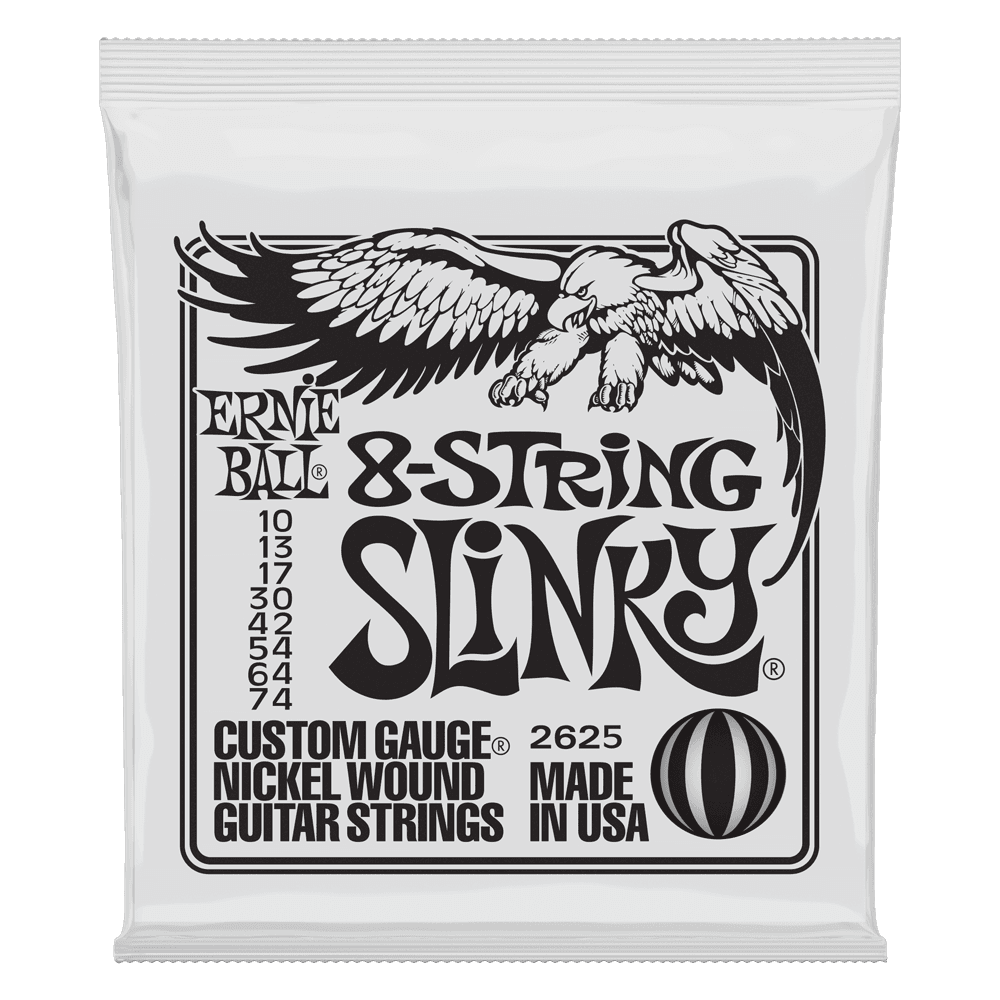
8-String Slinky Nickel Wound (.010–.074)
Why this one: Stock set for F# standard; borderline for Drop E on 27-inch scale. For Drop E specifically, either go longer-scale (28-inch+ bass side, where .074 works) or swap the 8th string for an .080 or .084.
For dedicated Drop E work on 27-inch scale, custom builds are the norm:
- Stringjoy custom 8-string (.009 or .010 top, .080 or .084 8th): Online builder; ships to spec.
- Kalium Strings custom 8-string: Heavier stainless-steel taper-core sets; overlaps with bass-string engineering for the low 8th string.
- Elixir Nanoweb 8-string .009–.074 with a custom Elixir .080 low string: Possible but requires buying singles separately.
Scale length adjustments
- 27" (Ibanez RG8, RG2228, Schecter SLS Elite 8): Drop E requires .080+ low string.
- 29.4" (Ibanez M80M / M8M Meshuggah signatures): Drop E works cleanly with .074 low.
- Multi-scale 26.5–28": The longer bass side carries the low E; .074 to .080 works.
- Multi-scale 25.5–27": Treat like 27-inch scale, needs .080 low for Drop E.
Genre notes
- Djent: Drop E is the detune of choice when the song needs a half-step lower than F# standard for a specific section. Full-album Drop E tracking is less common.
- Heavy prog-metal: Drop E for the specific passages where the composition needs a low-E pedal note.
- Animals as Leaders-adjacent instrumental: This is the home tuning. Premier Guitar's rig rundown documents Abasi and Reyes at E-B-E-A-D-G-B-E.
- Deftones-adjacent alt-metal: Stephen Carpenter's 8-string base is F# standard, with drops lower on some songs. His ESP STEF B-8 runs a 27-inch baritone scale; his string specs have varied across eras (custom Dunlop Heavy Core sets documented historically; custom Ernie Ball Paradigm per his more recent Ernie Ball String Theory appearance).
Setup checklist
Moving from F# standard to Drop E (whole-step detune on the 8th string only):
- Truss rod: Usually no adjustment needed for a whole-step detune on one string only. If the detune is permanent, recheck neck relief after a week.
- 8th string nut slot: Should fit the same gauge. No adjustment unless you change 8th string gauge.
- 8th string intonation: Reset at the 12th fret harmonic. The saddle will need to move back slightly (toward the bridge) for the lower pitch.
- 8th string pickup reading: Pickup output may want slight re-height adjustment if the 8th string's changed pitch produces noticeably different level from the 7th string.
- Floyd Rose / floating tremolo: A Floyd-equipped 8-string (rare but exists) requires claw-spring adjustment for any tuning change. Fixed-bridge 8-strings are easier here.
Related
- 8-string lane: 8-string gauge guide, Top 10 8-string players.
- Other tunings: F# standard, Drop A, Drop C.
- Individual rigs: Stephen Carpenter, Wes Hauch, Fredrik Thordendal.
- Strings: Ernie Ball Cobalt review.
- Producer context: Ermin Hamidovic (prog-metal mix lane).
String gauge by tuning + scale length
Safe gauge ranges by tuning across Gibson (24.75"), Fender (25.5"), and baritone (27"+) scales. A dash in any cell means that scale length isn't recommended for the tuning, not that data is missing.
| Tuning | Gibson scale (24.75") | Fender scale (25.5") | Baritone (27"+) |
|---|---|---|---|
| E Standard | 10–46 | 9–42 | – |
| Drop D | 10–52 | 10–52 | – |
| Eb Standard | 11–48 | 10–52 | – |
| Drop C# | 11–54 | 11–48 +52 | – |
| D Standard | 11–54 | 11–48 | 10–52 |
| C Standard | 12–56 | 12–56 | 12–56 |
| Drop C | 12–56 | 11–54 +56 | 11–56 |
| Drop B | 12–64 | 12–62 | 11–54 |
| B Standard | 13–68 | 13–64 | 12–54 |
| Drop A | 13–70 | 12–68 | 12–62 |
| Drop G | – | – | 13–70 |
Source: CYS in-house tension-and-scale reference, built by Phil (luthier) and Wright (tension/scale). For scale lengths between categories (e.g., 25" PRS), split the difference between the two nearest columns.
Frequently asked questions
What is Drop E?
On 8-string: E-B-E-A-D-G-B-E (low to high). The 8th string is dropped a whole step from F# to E, giving chord-shape parity with 6-string Drop D on the bottom two strings. On 6-string, 'Drop E' isn't a standard tuning; detuning below Drop D usually lands at Drop C# or Drop C instead. The canonical Drop E is the 8-string tuning.
What gauge for Drop E on 27-inch scale 8-string?
.009–.080 is the minimum, the low E at 27-inch scale requires .080 for meaningful tension (~16 lbs). .010–.084 is the firmer answer. F# standard's .074 low string on a 27-inch scale is too light for Drop E, it will flap under picking. The stock Ernie Ball 8-String Slinky (nickel wound, .010–.074) is not recommended for Drop E without swapping the 8th string for a heavier gauge.
Can I use a Drop E set at F# standard?
Yes, a heavier Drop E set (e.g., .010–.084) will feel stiff in F# standard because the .084 low string is well above the tension target for F# pitch. Most players who anticipate both tunings either keep two 8-string guitars (one in each tuning) or accept the stiffer feel during the F# standard sections of the set. The low string is the main compromise.
Who plays in Drop E?
Animals as Leaders are the highest-profile residents: Premier Guitar's rig rundown documents Tosin Abasi and Javier Reyes tuning their 8-strings E-B-E-A-D-G-B-E, exactly this tuning. Wes Hauch uses Drop E territory on parts of his 8-string material with a custom heavier low string. Meshuggah sit elsewhere: their 29.4-inch Ibanez signatures are documented with the low string at F, a half-step above Drop E's low E.
Is Drop E the same as Drop D an octave lower?
Not quite. Drop D is the 6-string tuning D-A-D-G-B-E, dropping the 6th string from E to D. Drop E on an 8-string is E-B-E-A-D-G-B-E, the bottom two strings are E and B (with the E being the 8th string, a perfect fifth below the 7th string's B, which is what makes the one-finger power chord work). The chord voicings match Drop D shape-wise on the bottom two strings, but the 8-string has six additional strings above those two that Drop D doesn't have.
Does Drop E require a different scale length than F# standard?
Not strictly, but Drop E benefits more from longer scale than F# standard does. A 27-inch scale with .080 low string works for Drop E; a 28.625-inch scale with .074 works equivalently. Multi-scale 8-strings (25.5"–27", 26.5"–28") were designed partially to handle Drop E and lower tunings without requiring extreme low-string gauges.