D standard tuning: gauges, tension, and the strings that hold up a whole step down
Written with AI help · Updated
D standard (D-G-C-F-A-D) tunes every string down a whole step from standard. Tension drops to about 79 percent, so a stock .010–.046 set turns floppy fast. On a 25.5-inch Fender scale, step up to .011–.048. On a 24.75-inch Gibson scale, go .011–.054, since the shorter scale is already looser. Baritone necks (27-inch-plus) can run .010–.052 and stay tight.
- Gibson scale (24.75")
- 11–54
- Fender scale (25.5")
- 11–48
- Baritone (27"+)
- 10–52
Gauge ranges from CYS's in-house tension-and-scale reference, built by Phil (luthier) and Wright (tension/scale).
Why D standard needs a heavier set
D standard takes standard tuning (E-A-D-G-B-E) and lowers every string one whole step to D-G-C-F-A-D. Nothing about the relationships between strings changes, every chord shape, scale box, and lead lick you already know transfers exactly. You just sound a whole step lower, and the strings get noticeably slacker.
That's the tradeoff. A whole step down is enough to feel in your picking hand, not just your ears. Drop D only detunes one string and most players never change gauge for it. D standard detunes all six, so the case for a heavier set is much stronger.
D standard sits between Eb standard and Drop C in how far it pushes the tension math: a half step further down than Eb, one whole step lighter than Drop C. It shares its top five open strings with Drop C exactly, which is why a lot of Drop C riffs are D standard riffs with one string dropped further.

EJ22 XL Nickel Round Wound Jazz Medium (.013–.056)
Why this one: A wound .026 third is the difference-maker at D standard. Plain third strings lose intonation accuracy once they're detuned this far and this heavy; the wrapped G stays true up and down the neck, which matters most in chord-melody and rhythm work above the 12th fret.
Tension math: what a whole step does
String tension scales with the square of pitch. Dropping every string from standard to D standard multiplies pitch by roughly 0.891, so tension falls to about 79 percent of standard, a drop you can feel the moment you fret a chord. That's the same E-to-D interval Drop D uses on its 6th string, just applied to all six strings at once.
| Gauge | Tension at E (standard) | Tension at D standard | Feel | |
|---|---|---|---|---|
| .046 (stock 10-46 low E) | ~17.5 lbs | ~13.9 lbs | Floppy, strings buzz under attack | |
| .048 | ~19.0 lbs | ~15.1 lbs | Loose but usable | |
| .052 | ~22.0 lbs | ~17.5 lbs | Matches standard-tuning feel |
The takeaway is the same one Drop D players already know: a .052 low string at D standard pitch feels almost exactly like a .046 at standard pitch. The difference is D standard applies that same math to every string, not just the 6th, so the top strings need the same kind of gauge bump to avoid feeling slack under bends and fast picking.
Scale length compounds the effect. A 24.75-inch Gibson-style scale runs about 7 percent looser than a 25.5-inch Fender-style scale at the same gauge, which is why Gibson-scale players reach for a heavier set sooner. A baritone neck works the opposite direction, its longer scale adds tension back, so a lighter gauge holds up fine.
Gauge by scale length
- 25.5" (Fender, Jackson, Ibanez RG): .011–.048 is the default. It restores most of what a .010–.046 set has at standard pitch.
- 24.75" (Gibson, Epiphone, PRS McCarty): go heavier, .011–.054. The shorter scale needs the extra mass to stay tight.
- 27" and longer (baritone): .010–.052 is enough. The added scale length does a lot of the work a heavier gauge would do on a shorter neck.
Recommended sets
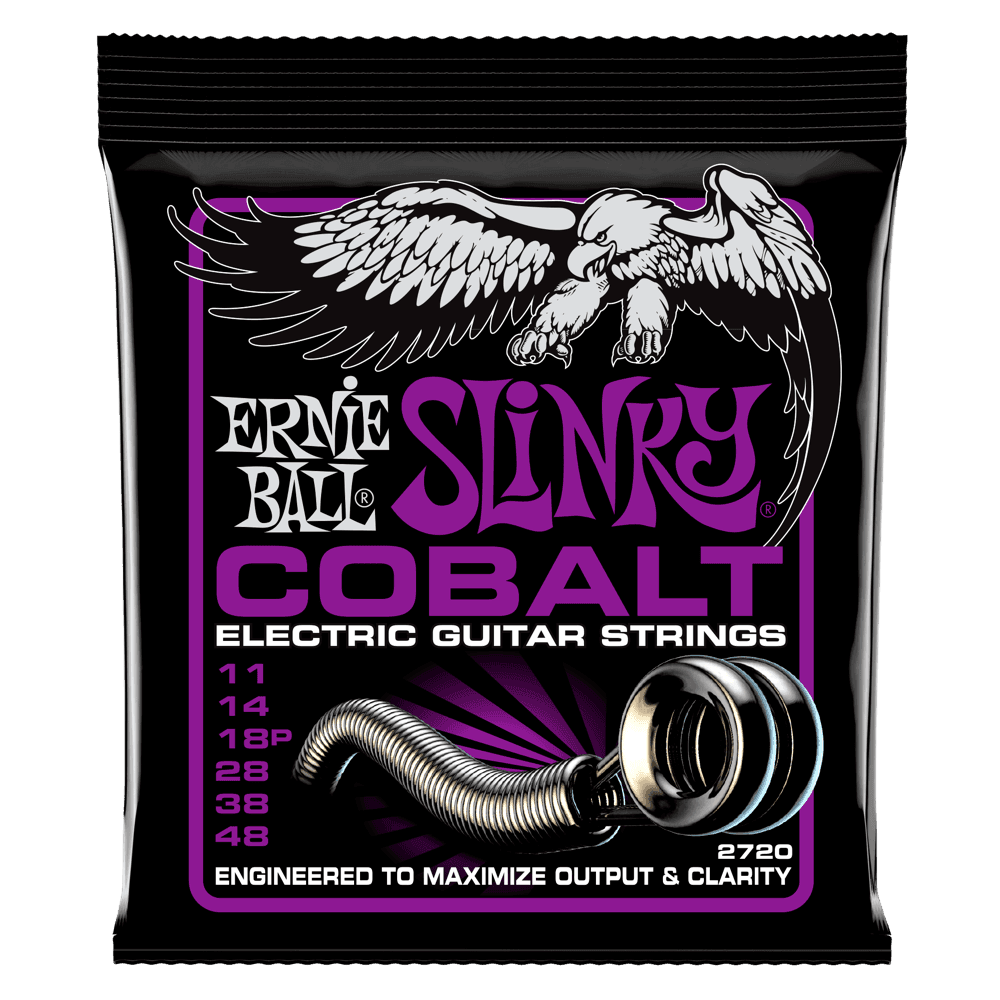
Power Slinky Cobalt (.011–.048)
Why this one: The default Fender-scale D standard set. .011–.048 lands close to a .010–.046 at standard pitch, so rhythm playing stays tight without the reach of a true heavy-gauge top string.
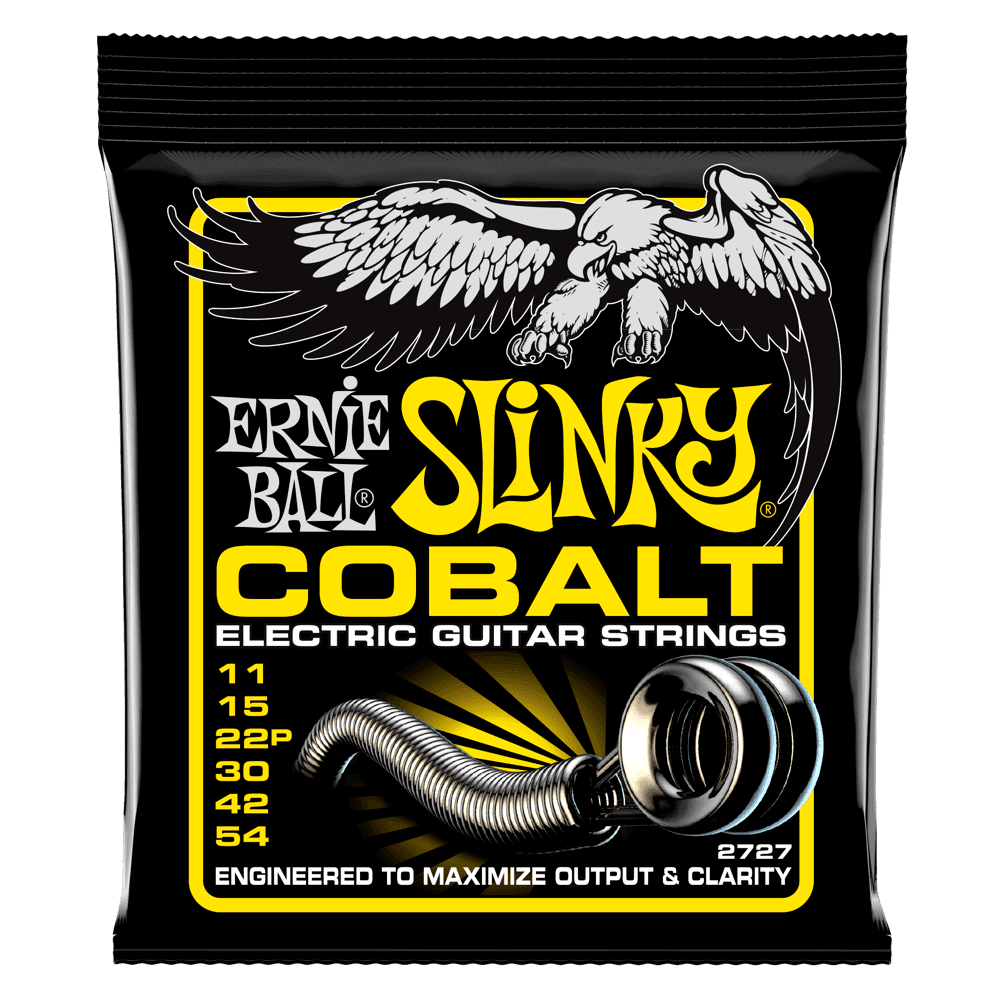
Beefy Slinky Cobalt (.011–.054)
Why this one: The Gibson-scale answer: a .054 low string carries enough mass to stay firm on a 24.75-inch neck at D standard, and the same set covers you if you drop the 6th string further into Drop C.
Genre notes
- Groove metal and thrash: D standard is a common landing point on the way to deeper down-tunings, the whole-step drop adds weight to palm-muted riffs without leaving standard chord shapes behind. Pantera's catalog documents the move well, see the FAQ below.
- Hard rock and classic rock: .011–.048 keeps rhythm playing tight while leaving enough give for wide bends.
- Post-hardcore and metalcore: players who split time between D standard and Drop C often run the same .011–.054 set for both, since the top five strings don't move.
Setup checklist
- Tune down evenly, stretch, retune. Drop all six strings a whole step, stretch each one at the 12th fret, and retune twice. New strings drift for the first few minutes.
- Truss rod: a gauge jump to .011–.054 adds real forward bow. Check relief after a day and adjust in small steps.
- Nut slots: a .011 or .013 top string can bind in slots cut for a .010. Binding shows up as pinging while you tune.
- Intonation: reset every string at the 12th fret harmonic once you've settled on a final gauge and tuning.
Next steps
- One whole step further down: Drop C tuning guide.
- The single-string version of this same drop: Drop D tuning guide.
- A half step lighter: Eb standard tuning guide.
- Documented D standard catalog: Dimebag Darrell's Pantera rig.
- Full review: D'Addario EJ22 Jazz Medium and Ernie Ball Beefy Slinky Cobalt.
String gauge by tuning + scale length
Safe gauge ranges by tuning across Gibson (24.75"), Fender (25.5"), and baritone (27"+) scales. A dash in any cell means that scale length isn't recommended for the tuning, not that data is missing.
| Tuning | Gibson scale (24.75") | Fender scale (25.5") | Baritone (27"+) |
|---|---|---|---|
| E Standard | 10–46 | 9–42 | – |
| Drop D | 10–52 | 10–52 | – |
| Eb Standard | 11–48 | 10–52 | – |
| Drop C# | 11–54 | 11–48 +52 | – |
| D Standard | 11–54 | 11–48 | 10–52 |
| C Standard | 12–56 | 12–56 | 12–56 |
| Drop C | 12–56 | 11–54 +56 | 11–56 |
| Drop B | 12–64 | 12–62 | 11–54 |
| B Standard | 13–68 | 13–64 | 12–54 |
| Drop A | 13–70 | 12–68 | 12–62 |
| Drop G | – | – | 13–70 |
Source: CYS in-house tension-and-scale reference, built by Phil (luthier) and Wright (tension/scale). For scale lengths between categories (e.g., 25" PRS), split the difference between the two nearest columns.
Frequently asked questions
What gauge strings for D standard?
Depends on scale length. On a 25.5-inch Fender-style scale, .011–.048 is the sweet spot: it restores most of the tension a .010–.046 set has at standard pitch. On a 24.75-inch Gibson-style scale, go heavier, .011–.054, because the shorter scale is already looser at any given gauge. On a baritone (27 inches or longer), the longer scale adds tension back on its own, so .010–.052 stays tight without feeling stiff.
Is D standard the same as Drop D?
No. Drop D (D-A-D-G-B-E) lowers only the 6th string a whole step; the top five strings stay at standard pitch. D standard (D-G-C-F-A-D) lowers all six strings a whole step, so every interval and every chord shape is identical to standard tuning, just a whole step lower. Drop D works fine on a stock set. D standard usually wants a heavier set across the board.
D standard vs Drop C, what's the difference?
D standard drops all six strings a whole step from standard (D-G-C-F-A-D). Drop C takes that same D standard shape and drops only the 6th string one whole step further, to C, while the other five strings stay where D standard left them (C-G-C-F-A-D). Every Drop C riff you play on the top five strings is really a D standard riff. The two tunings share four of six open strings.
Who plays in D standard?
Pantera is the best-documented D standard catalog on CYS. Dimebag Darrell's tunings deepened across the band's run: standard E on Cowboys from Hell (1990), then a mix of D standard, Drop D, and lower down-tunings on Vulgar Display of Power (1992), Far Beyond Driven (1994), and The Great Southern Trendkill (1996). It's a common landing point across groove metal and hard rock generally, one whole step down is enough to add weight without leaving standard-tuning chord shapes behind.
Does D standard need a setup change?
If you keep a stock .010–.046 set and just tune down, no. The strings go slack but nothing about the guitar's setup is stressed. If you move up to .011–.054 or heavier, expect to check the truss rod (heavier strings add forward bow), check the nut slots for binding on the thicker top strings, and reset intonation at the bridge on every string.
Can I play D standard on a 7-string or baritone?
Yes, and both make D standard easier to keep tight. On a 7-string, D standard usually means tuning the low B string down to A and running the other six strings at standard D standard pitch, which keeps the same low-string tension logic as a 6-string in Drop A. On a true baritone (27 inches or longer), the added scale length restores enough tension that a relatively light .010–.052 set feels as firm as a .011–.054 set does on a 25.5-inch scale.