Drop C tuning: the gauges, tension, and strings that actually feel right
Written with AI help · Updated
For Drop C on a 25.5-inch scale electric, use .011–.052 or .011–.054. A .010 set will flap, and a .012 set will feel stiff for soloing. For 24.75-inch scale (Gibson-style), bump to .012–.054. For baritone (26.5–27.5 inch), .012–.060 is the sweet spot.
- Gibson scale (24.75")
- 12–56
- Fender scale (25.5")
- 11–54 +56
- Baritone (27"+)
- 11–56
Gauge ranges from CYS's in-house tension-and-scale reference, built by Phil (luthier) and Wright (tension/scale).
Why gauge matters in Drop C
Tension on a guitar string is a function of pitch, scale length, and the string's unit weight. Drop the pitch and the tension drops with it. To restore a playable feel in Drop C, you need to add mass, either a thicker wrap or a heavier plain gauge.
Reference targets, pounds of tension per string, on a 25.5" scale:
| .010–.046 (stock) | .011–.052 | .012–.054 | |
|---|---|---|---|
| Low C (6th) | ~11.4 lbs (floppy) | ~15.8 lbs | ~17.6 lbs |
| G (5th) | ~14.1 lbs | ~17.0 lbs | ~18.4 lbs |
| C (4th) | ~15.2 lbs | ~18.1 lbs | ~19.3 lbs |
| High D (1st) | ~12.9 lbs | ~15.6 lbs | ~18.5 lbs |
You want the low string in the 15–18 lb range. Below that, it flaps. Above that, your fingers give up.
Recommended sets

NYXL1156 Medium Top / Extra Heavy Bottom (.011–.056)
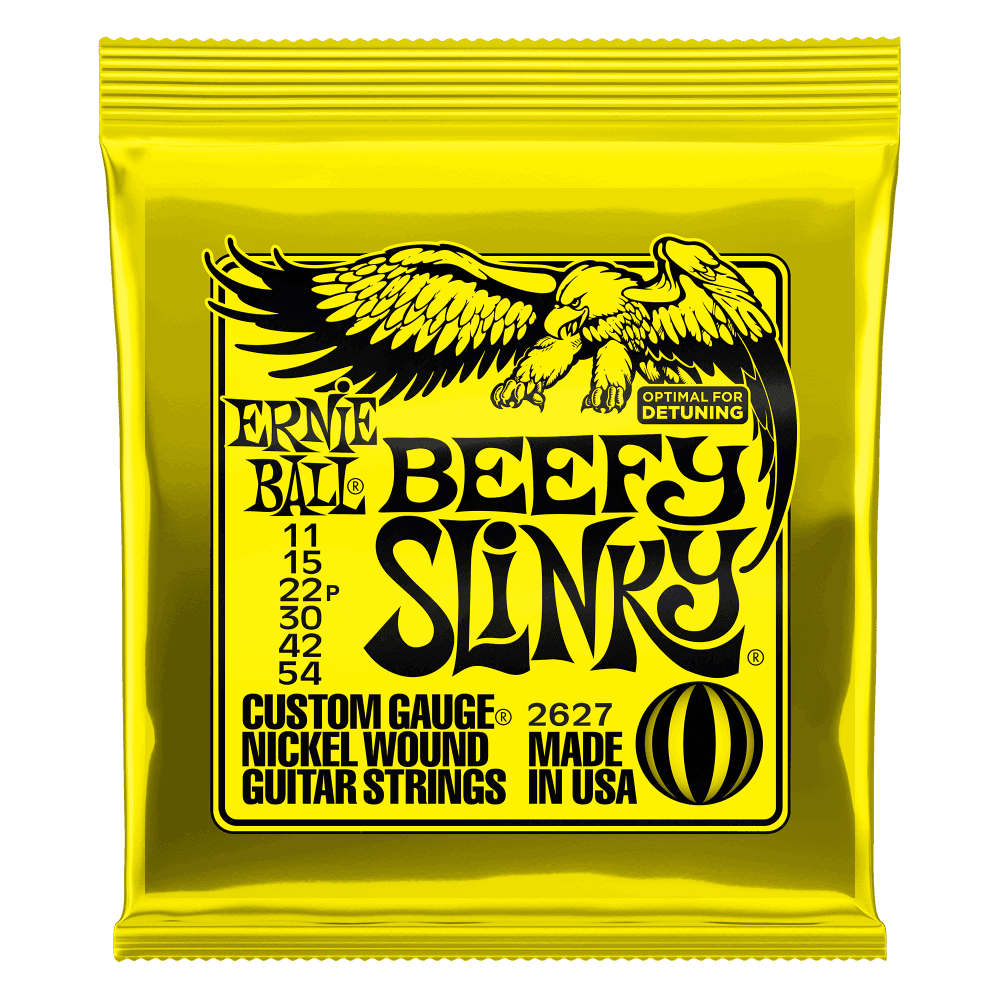
Scale length adjustments
- 24.75" (Gibson, Epiphone, PRS McCarty): add one gauge across the board. Use .012–.054 or .012–.056.
- 25.5" (Fender, Jackson, Ibanez RG): .011–.054 is the default.
- 26.5–27.5" (baritone): .012–.060 or .013–.062. The longer scale restores low-string tension naturally.
Genre notes
- Djent / progressive metal: tighter is better. Go .012 top at least for Drop C rhythm work.
- Alt-rock / grunge: .011–.054 is forgiving and bend-friendly.
- Post-hardcore: .011 top, .054 bottom is the modern standard.
Setup checklist after switching
- Expect to tighten the truss rod (clockwise) 1/8 to 1/4 turn: heavier strings pull the neck into more forward bow, and the rod counteracts it. Check relief first; adjust in small steps.
- Check the nut slots, heavier lows may bind in a slot cut for .046.
- Reset intonation at the 12th fret harmonic for every string.
- Reset bridge pickup height, heavier strings put out more magnetic pull.
Related
- For metal rhythm tones, read our upcoming metal tone guide.
- For the full signal chain, see the James Hetfield rig page.
- For the full gauge-by-tuning breakdown, read drop tunings and low tunings.
- Not sure where to start on gauge? See what gauge strings should you use?
String gauge by tuning + scale length
Safe gauge ranges by tuning across Gibson (24.75"), Fender (25.5"), and baritone (27"+) scales. A dash in any cell means that scale length isn't recommended for the tuning, not that data is missing.
| Tuning | Gibson scale (24.75") | Fender scale (25.5") | Baritone (27"+) |
|---|---|---|---|
| E Standard | 10–46 | 9–42 | – |
| Drop D | 10–52 | 10–52 | – |
| Eb Standard | 11–48 | 10–52 | – |
| Drop C# | 11–54 | 11–48 +52 | – |
| D Standard | 11–54 | 11–48 | 10–52 |
| C Standard | 12–56 | 12–56 | 12–56 |
| Drop C | 12–56 | 11–54 +56 | 11–56 |
| Drop B | 12–64 | 12–62 | 11–54 |
| B Standard | 13–68 | 13–64 | 12–54 |
| Drop A | 13–70 | 12–68 | 12–62 |
| Drop G | – | – | 13–70 |
Source: CYS in-house tension-and-scale reference, built by Phil (luthier) and Wright (tension/scale). For scale lengths between categories (e.g., 25" PRS), split the difference between the two nearest columns.
Frequently asked questions
What gauge for Drop C on a Les Paul?
On a 24.75-inch scale Les Paul, use .012–.054 for a tight feel in Drop C. You can get away with .011–.054 if you like lighter tops for bends.
Is Drop C the same as C standard?
No. Drop C (C-G-C-F-A-D) tunes the low string down two whole steps to C and the other five strings down one whole step (the top five match D standard). C standard (C-F-Bb-Eb-G-C) tunes all six strings down two whole steps from E standard.
Best strings for Drop C metal?
D'Addario NYXL .011–.054 or Stringjoy Signatures .011–.054. Both handle aggressive picking without going dull in a day.
Do I need a setup change to tune to Drop C?
Usually yes. Heavier strings add neck tension. Expect to adjust the truss rod, raise the nut slots slightly, and reset intonation at the bridge.
Can I leave my guitar in Drop C permanently?
Yes. Many metal players never retune. Just set the guitar up for Drop C and leave it.