B standard tuning: gauges, tension, and strings for 7-string and down-tuned 6-string
Written with AI help · Updated
B standard on a 7-string (B-E-A-D-G-B-E) is the default 7-string tuning, use .010–.056 or .010–.059 for a balanced feel on 25.5-inch scale. B standard on a 6-string (B-E-A-D-F#-B, all-fourths-like tuning a perfect fourth below E standard) is less common but used, a .013–.064 set or heavy baritone .014–.068 set handles it on 25.5"; baritone scale (26.5"+) is the better platform.
- Gibson scale (24.75")
- 13–68
- Fender scale (25.5")
- 13–64
- Baritone (27"+)
- 12–54
Gauge ranges from CYS's in-house tension-and-scale reference, built by Phil (luthier) and Wright (tension/scale).
What B standard is used for
B standard on a 7-string is the factory tuning of virtually every production 7-string guitar. Steve Vai's Ibanez Universe, Ibanez RG7-series, Jackson SL7, Schecter KM-7, PRS SE Mark Holcomb SVN, all ship in B standard (B-E-A-D-G-B-E) by default. The tuning extends the low-end range of the guitar a perfect fourth below standard 6-string E standard, which opens up rhythmic voicings for prog-metal, metal, and heavy rock that 6-string in Drop D can't reach.
B standard on a 6-string is less common but used, primarily in doom, stoner, and sludge contexts where the whole-instrument drop lets the full chord voicing sit in a darker register. Baritone 6-strings (26.5"–27.5" scale) are the more common platform for 6-string B standard than standard-scale 6-strings.
Tension targets
B standard on 7-string (25.5-inch scale)
The low B is the anchor. 13–16 pounds of tension on the low B at B standard pitch is the target, firm enough for palm-mute rhythms, not so stiff that it feels dead.
| Set | Low B gauge | Low B tension (B std, 25.5") | Best for | |
|---|---|---|---|---|
| .009–.052 | .052 | ~11 lbs, floppy | Fast legato, lighter touch | |
| .009–.054 | .054 | ~13 lbs, minimum | Balanced 7-string feel | |
| .010–.056 | .056 | ~14 lbs | Modern default 7-string | |
| .010–.059 | .059 | ~15 lbs, firm | Drop A secondary use | |
| .010–.062 | .062 | ~17 lbs, stiff for B std | Drop A primary, B std secondary |
B standard on 6-string (25.5-inch scale)
Baritone territory. A .013–.062 set produces roughly 13–17 lbs of tension on the low B at 25.5-inch scale; moving to 26.5-inch scale lets you use .012–.058 for similar tension.
| Scale | Recommended gauge | Low B tension | Notes | |
|---|---|---|---|---|
| 25.5" standard | .013–.064 (Stringjoy custom) | ~15 lbs | Requires heavy-set compatible hardware | |
| 26.5" baritone | .013–.062 | ~16 lbs | The cleanest 6-string B-standard platform | |
| 27"+ baritone | .012–.058 | ~15 lbs | Lightest comfortable option at this scale | |
| 24.75" Gibson | .014–.068 custom | ~15 lbs | Rarely done, tension math is marginal |
Recommended sets
For 7-string B standard
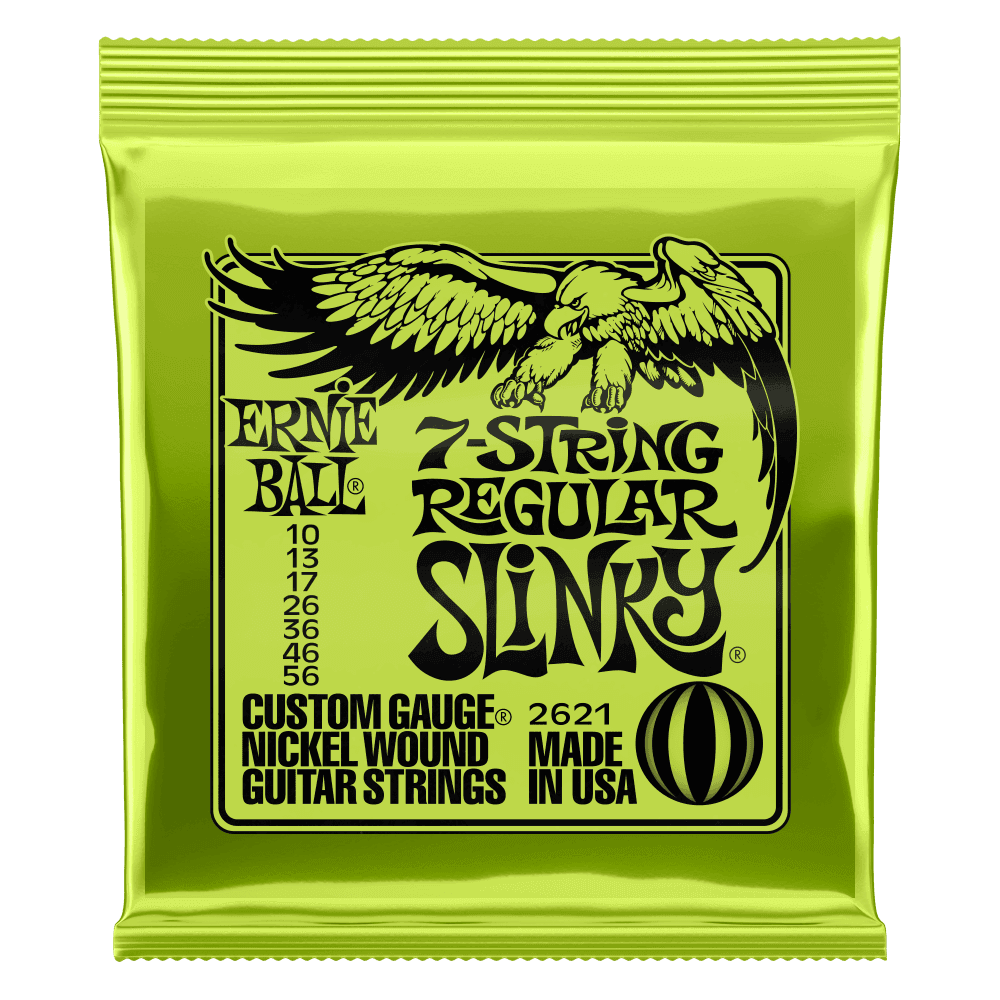
Regular Slinky 7-String (.010–.056)
Why this one: The factory-gauge 7-string set, and John Petrucci's documented set (Petrucci 7-String Regular Slinky shares the 10-56 gauge run). Covers B standard at balanced feel.
For a firmer feel or if you dual-purpose for Drop A, step up to the Skinny Top Heavy Bottom Slinky Cobalt 7-string .010–.062 (EB 2730; sits slightly stiff in B standard but handles Drop A perfectly).
For 6-string B standard (baritone preferred)
Stringjoy custom .013–.062 or Kalium custom sets. Off-the-shelf 6-string sets stop at .013 top / .062 bottom; heavier than that requires a custom build. D'Addario XL Baritone .013–.062 is one of the few stock baritone 6-string sets.
Scale length adjustments
- 24.75" Gibson-style: Not a B-standard platform. Use 25.5"+ scale for this tuning.
- 25.5" (standard electric): Default for 7-string B standard. Marginal for 6-string B standard.
- 26.5" baritone: The cleanest 6-string B standard platform.
- 27"+ multi-scale: Extended-range lane. Lets 6-string B standard sit comfortably with light-to-medium gauges.
Genre notes
- Prog-metal on 7-string: .010–.056 default. Petrucci's early lighter gauges (.009–.054) are less common today.
- Djent on 7-string: .010–.059 or .010–.062 is the djent lane. Drop A / Drop G# is more common than B standard in modern djent, but B standard comes back on some prog-adjacent sections.
- Doom / stoner on 6-string: Heavy gauges essential. .013–.062 minimum. Tuning often sits in B standard or even lower, Electric Wizard-territory drops to the A or G# standard.
- Technical death metal: B standard is common for sweep-picking-friendly scale runs on 7-string. .010–.059 is the lane.
Setup checklist
When moving to B standard from a higher tuning (or changing gauge on a B-standard guitar):
- Truss rod: Heavier strings add forward bow, which the rod counteracts. Expect to tighten (clockwise) 1/8 to 1/4 turn if adding mass, or loosen if reducing. Check relief first; adjust in small steps.
- Nut slots: Check that the low string sits in the slot without binding. A .062 low string in a slot cut for .056 will bind and cause tuning issues.
- Bridge intonation: Reset at the 12th fret harmonic for every string. Lower pitch = saddle moves back toward the bridge.
- Pickup height: Heavier strings produce more magnetic pull. Drop the bass-side pickup height 1–2mm to avoid wolf notes.
- String action: Low strings at higher tension sometimes allow lower action. Recheck fret buzz at open position and 12th fret.
Related
- 7-string lane: 7-string guitar string gauge guide, Top 10 7-string players.
- Other tunings: Drop A, Drop C.
- Individual rigs: John Petrucci (B standard 7-string reference).
- Strings: Ernie Ball Cobalt review, Ernie Ball lines compared.
String gauge by tuning + scale length
Safe gauge ranges by tuning across Gibson (24.75"), Fender (25.5"), and baritone (27"+) scales. A dash in any cell means that scale length isn't recommended for the tuning, not that data is missing.
| Tuning | Gibson scale (24.75") | Fender scale (25.5") | Baritone (27"+) |
|---|---|---|---|
| E Standard | 10–46 | 9–42 | – |
| Drop D | 10–52 | 10–52 | – |
| Eb Standard | 11–48 | 10–52 | – |
| Drop C# | 11–54 | 11–48 +52 | – |
| D Standard | 11–54 | 11–48 | 10–52 |
| C Standard | 12–56 | 12–56 | 12–56 |
| Drop C | 12–56 | 11–54 +56 | 11–56 |
| Drop B | 12–64 | 12–62 | 11–54 |
| B Standard | 13–68 | 13–64 | 12–54 |
| Drop A | 13–70 | 12–68 | 12–62 |
| Drop G | – | – | 13–70 |
Source: CYS in-house tension-and-scale reference, built by Phil (luthier) and Wright (tension/scale). For scale lengths between categories (e.g., 25" PRS), split the difference between the two nearest columns.
Frequently asked questions
What is B standard?
On 7-string: B-E-A-D-G-B-E (low to high), the factory tuning of most 7-string guitars. The low B sits a perfect fourth below standard 6-string low E. On 6-string: B-E-A-D-F#-B, which tunes the whole 6-string down 2.5 steps below E standard. Both use the same low B reference pitch; the 7-string version adds the low B below a standard 6-string, while the 6-string version moves the whole instrument down to that register.
What gauge for B standard on a 7-string?
.010–.056 or .010–.059 on 25.5-inch scale. .009–.054 is borderline floppy on the low B. John Petrucci's early 7-string work used lighter gauges; modern players tend toward the .059 territory. Ernie Ball Regular Slinky 7-string and D'Addario NYXL 7-string both ship in this range.
What gauge for B standard on a 6-string?
Heavy, a .013–.064 set at minimum on 25.5-inch scale. The 6-string B-standard lane is rare and mostly used on baritone guitars (26.5"–27.5" scale), where .013–.062 works. Stringjoy and Kalium make custom sets in this range; off-the-shelf heavy sets in 6-string stop at .013 top end and .062 low.
Who plays in B standard?
On 7-string: John Petrucci (Dream Theater) is the canonical B-standard 7-string player; his documented set is the Ernie Ball Petrucci 7-String Regular Slinky (10-56). (Jeff Loomis's 7-string reputation comes from Nevermore, where the documented tuning was a half-step lower at Bb standard; in Arch Enemy he plays 6-string in C standard per his own signature-set marketing.) On 6-string: B-standard 6-string is rare but shows up on some doom, stoner, and sludge material. More common is A-standard (whole step below B) on 6-string for drop-tuned metal, or the band de-tunes to Drop A / Drop G instead of B-standard all-strings-down.
Is B standard the same as Drop A on 7-string?
No. B standard is B-E-A-D-G-B-E. Drop A lowers the 7th string from B down to A (A-E-A-D-G-B-E), giving chord-shape parity with 6-string Drop D on the bottom two strings. Drop A is more common in modern djent and prog-metal than B standard, bands like Periphery use Drop A / Drop G# almost exclusively.
Do I need to change my setup for B standard?
On a 7-string already tuned to B standard from factory, no setup change is needed unless you change gauge. Stepping from .009–.054 to .010–.059 will require a truss rod adjustment and intonation reset. On a 6-string moving to B standard, yes, nut slots, bridge saddle positions, and intonation all need adjustment, and you'll likely want a heavier set. See the setup checklist below.