Guitar string gauge explained: what the numbers mean and how to choose
Written with AI help · Updated
Guitar string gauge is the thickness of each string, measured in thousandths of an inch, and a set is named by its high E: a .010 set has a .010 high E. Lighter gauges bend easier and suit standard tuning; heavier gauges hold tension for low tunings and sound fuller. Match your gauge to your tuning first, your scale length second, and your feel last. A .010 to .046 set is the standard-tuning default most players start from.

What the numbers on your strings mean
A string's gauge is simply its thickness, measured in thousandths of an inch. A string marked .010 is ten one-thousandths of an inch across; a .046 is forty-six. That is the whole code. The thin plain strings carry the small numbers, and the thicker wound strings, the ones with a wire wrapped around a core, carry the big ones.
A full set is named by its thinnest string, the high E. So when someone says they play "tens" or a ".010 set," they mean the high E is a .010 and the rest of the set is built to match, getting progressively thicker down to the low E. For the exact thickness of every string in a set, in both inches and millimeters, our guitar string gauge chart lists them all.
The standard sets and their gauges
Most players never buy single strings; they buy a named set, and a handful of sets cover almost everyone. Ernie Ball's Slinky line is the reference most of the industry is measured against, and the pattern holds across D'Addario and every other major brand.
| Gauge range | Common name | Who it suits | |
|---|---|---|---|
| Extra light | .008 to .038 | Extra Slinky | Easiest bends, vintage low-tension feel |
| Light | .009 to .042 | Super Slinky | Beginners and lead players in standard tuning |
| Regular | .010 to .046 | Regular Slinky | The all-purpose standard-tuning default |
| Heavy | .011 to .048 | Power Slinky | Harder picking, Drop D, fuller tone |
| Hybrid | .010 to .052 | Skinny Top Heavy Bottom | Light leads up top, tight low end for drop tunings |
The Regular Slinky (.010 to .046) is the one to start from if you have no reason to pick anything else. Go lighter with the Super Slinky (.009 to .042) if you want the easiest bends, or heavier with the Power Slinky (.011 to .048) if you pick hard or tune down.
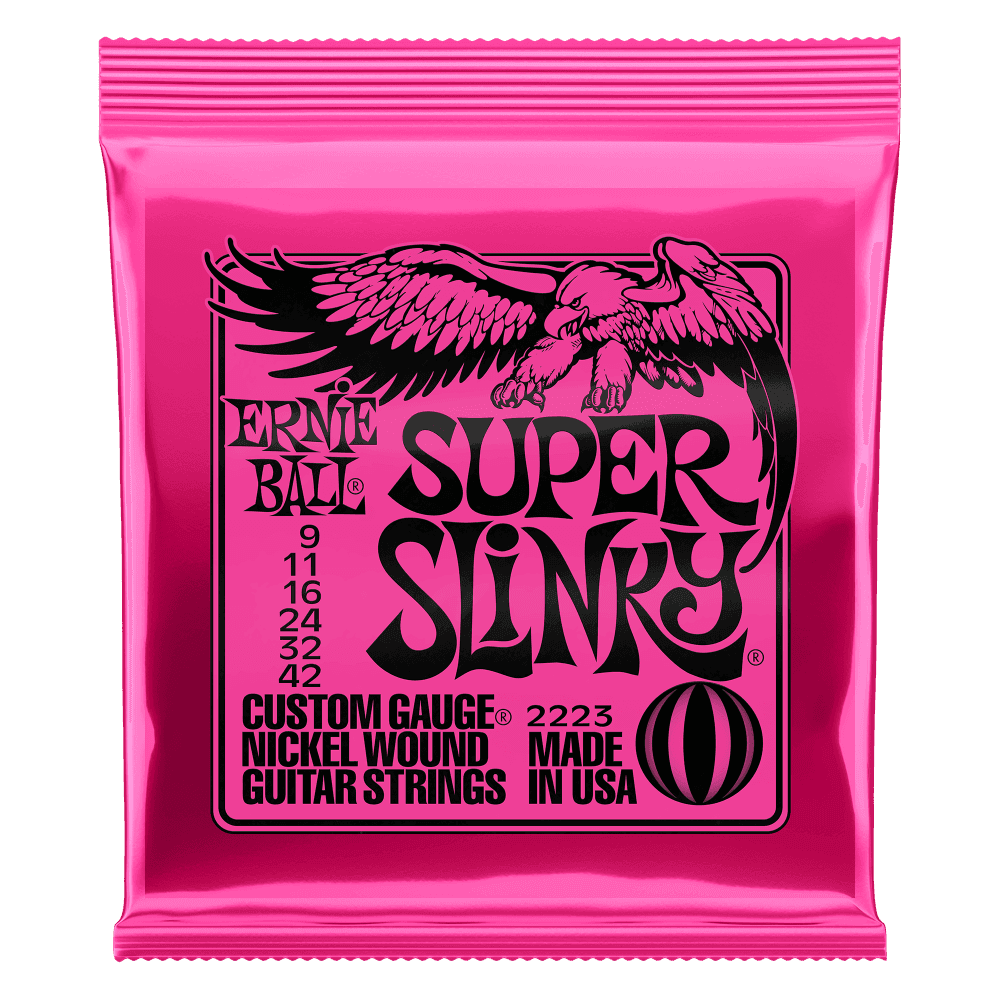
Super Slinky (.009–.042)
Why this one: Lighter: the easiest bends and a bright top. The go-to for lead players and beginners in standard tuning.
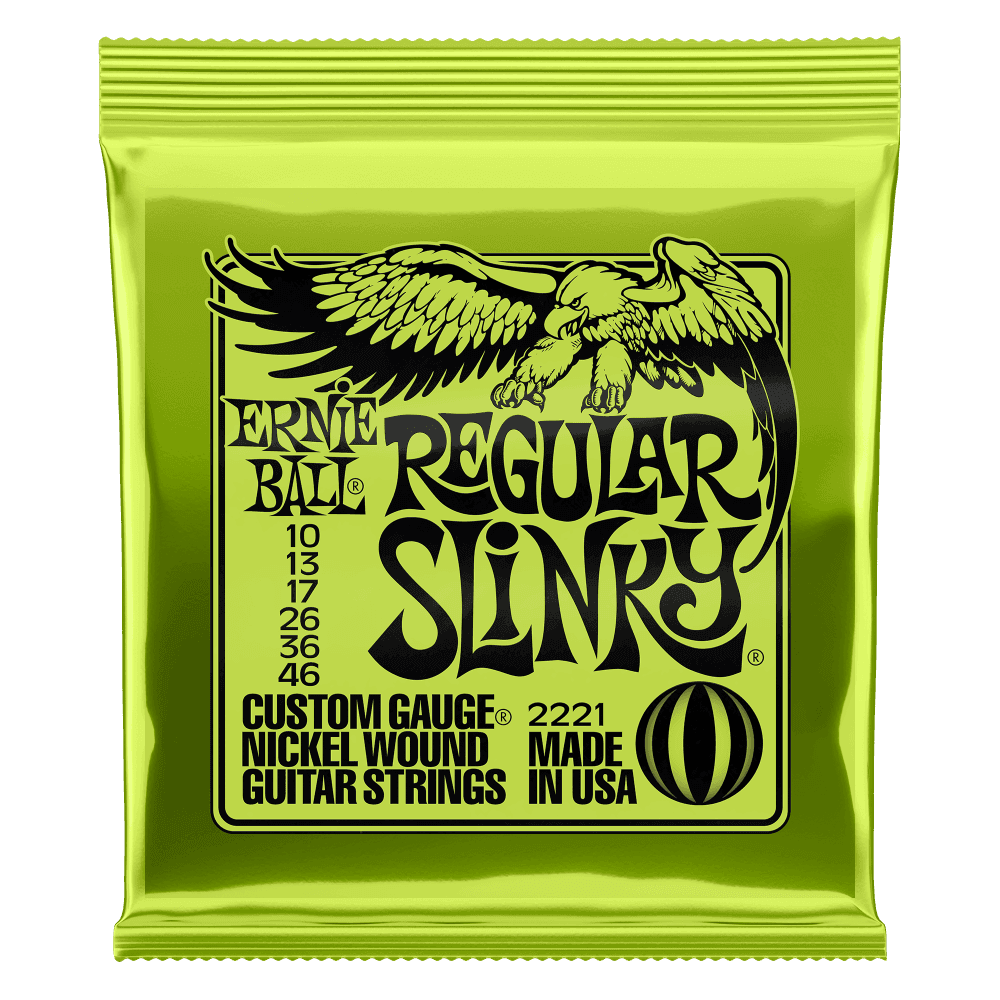
Regular Slinky (.010–.046)
Why this one: The all-purpose standard-tuning default, the set every gauge decision here is measured against. Start here unless you have a reason not to.
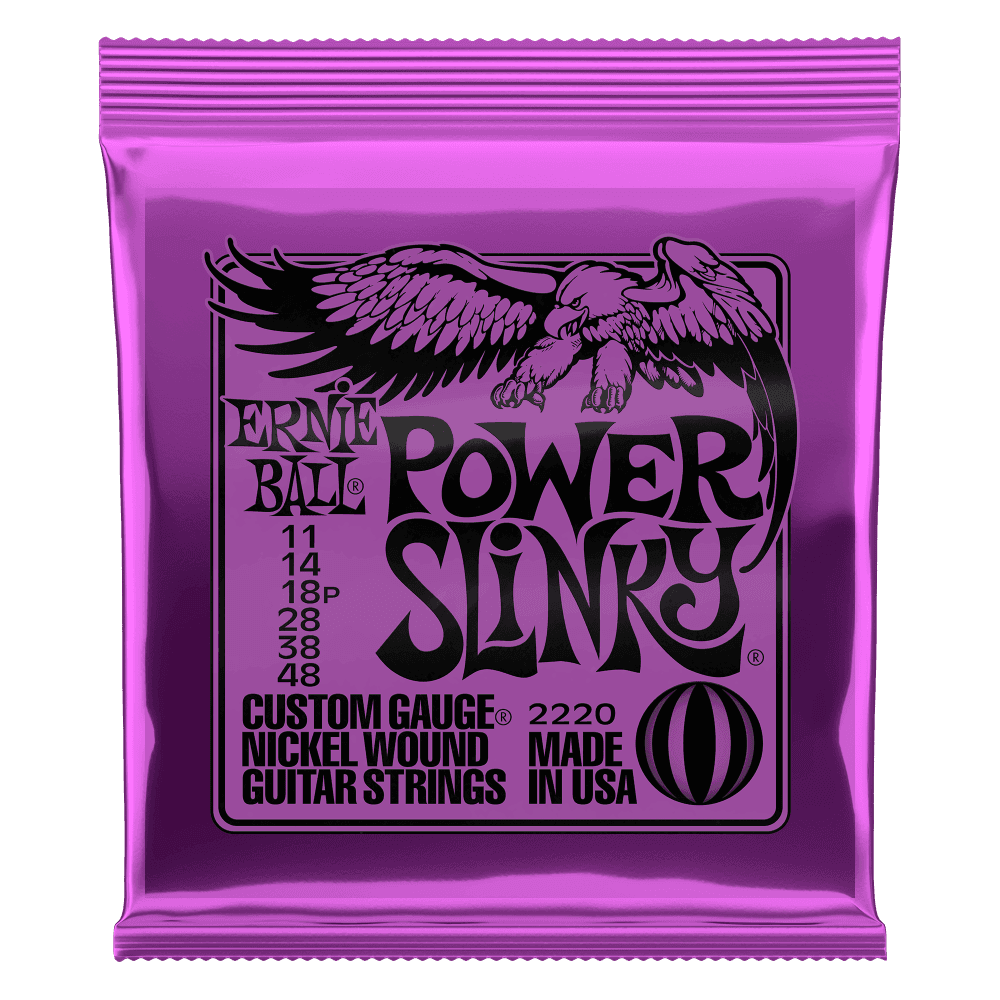
Power Slinky (.011–.048)
Why this one: Heavier: more tension for hard picking and Drop D, with a fuller low end.
Lighter vs heavier: the real tradeoffs
This is the whole decision, so it helps to see both sides plainly. Per Ernie Ball's buying guide, lighter strings are "easier to bend and play, so ideal for beginner guitar players with uncalloused hands," with an even projection and a bright sound. The cost is less low-end weight and a tendency to go slack in low tunings.
Heavier strings pull the other way. The same guide notes they "require more finger pressure to fret and bend notes" and "exert more tension on the guitar neck," but they reward you with a "hotter output with punchy tone" and are "preferred for low tunings such as Drop D, Drop A, etc." As Ernie Ball puts it, "the thickness of an electric guitar string has a large influence on the playability and sound." Nothing here is an upgrade or a downgrade; it is a tradeoff between easy bends and low-end authority.
How to choose: tuning first, scale second, feel last
Work the decision in that order and you will get it right nearly every time.
The order that gets it right
- 1. Tuning sets the floor
- The lower you tune, the heavier you go, so the slack low strings stay tight. A .010 to .046 for E standard, .011 to .048 for Drop D or D standard, .012 and up for Drop C and below. Our Drop C tension chart maps the exact numbers.
- 2. Scale length adjusts it
- A longer scale adds tension to the same gauge, so a long-scale or baritone guitar can run a hair lighter and still feel tight, and a short-scale Gibson can take a step heavier for a firmer feel.
- 3. Feel is the tiebreaker
- Between two workable gauges, pick the one that bends the way you like. Lead players lean lighter for easy bends; hard strummers and low-tuners lean heavier for tension and tone.
If you play extended range, the gauge math changes enough to deserve its own page: see our 7-string gauge guide and 8-string gauge guide. And if you are still unsure where to start, the what gauge should I use FAQ walks through it quickly.
How scale length changes the gauge you need
Gauge does not act alone. Scale length, the vibrating length of the string from nut to bridge, sets how much tension a given gauge is under at a given pitch, and the two work together. A longer scale means more tension for the same gauge, which is why a 27-inch baritone holds a low tuning tight on a gauge that would flop on a normal guitar.
There is real math behind it. String tension rises with the square of the gauge: a plain .011 has about 49 percent more cross-sectional area than a .009, so at the same pitch it pulls roughly that much more tension. Tension also rises with the square of the scale length, which is why the same set feels tighter on a longer-scale guitar. Our scale-length guide breaks down that relationship in full, including why a Fender feels tighter than a Gibson with the identical set. And if you want to understand how gauge and metal shape your actual tone once the tension is sorted, our guide on what shapes your tone covers it.
Related
Frequently asked questions
What do the numbers on guitar strings mean?
They are the thickness of each string in thousandths of an inch. A string marked .010 is ten one-thousandths of an inch thick. A set is named by its thinnest string, the high E, so a '10 set' or '.010 set' has a .010 high E and gets progressively thicker down to the low E. The plain (unwound) strings carry the small numbers, the wound strings the big ones.
What gauge guitar strings should a beginner use?
A light set, usually .009 to .042 or .010 to .046. Ernie Ball's own buying guide calls light gauge strings 'easier to bend and play, so ideal for beginner guitar players with uncalloused hands.' They take less finger pressure, which matters a lot while your fingertips toughen up. Move heavier later only if you tune low or want a fuller tone.
Do heavier strings sound better?
Not better, different. Heavier strings give a hotter output and a punchier tone and hold tension well in low tunings, but they take more finger pressure to fret and bend and put more tension on the neck. Lighter strings bend easily and stay bright. Neither is an upgrade; pick the gauge that fits your tuning and how hard you want to work for a bend.
What is the standard guitar string gauge?
For a 25.5-inch scale electric in standard E tuning, .010 to .046 (a 'regular' or 'light' set) is the default most players compare everything against. Players who want easier bends drop to .009 to .042 (an 'extra light' or Super Slinky set). Players who tune down or pick hard step up to .011 to .048 and beyond.
What gauge do I need for lower tunings?
Heavier, to keep the slack low strings tight. Ernie Ball's guide notes heavier gauges 'are preferred for low tunings such as Drop D, Drop A, etc.' A rough guide: .010 to .046 for E standard, .011 to .048 for Drop D or D standard, and .012 and up for Drop C and below. Our Drop C tension chart maps this exactly.
Does scale length change the gauge I should use?
Yes. A longer scale puts more tension on the same gauge at the same pitch, so a baritone or a 25.5-inch Fender can run a lighter gauge and still feel tight, while a shorter 24.75-inch Gibson can take a step up in gauge for a firmer feel. Match the gauge to the tuning first, then adjust for your scale. Our scale-length guide covers the math.
Will changing gauge require a setup?
A big jump can. Moving up or down more than a gauge or two changes neck tension and string height, so the truss rod, intonation, and sometimes the nut slots may need adjusting. A small change, like .009s to .010s, is usually fine as is, but check your tuning and action after any swap.