Best Guitar Strings for Metal: 7 Picks by Tuning and Style, Compared
Written with AI help · Updated
Ernie Ball M-Steel Regular Slinky (.010 to .046) is the best all-around metal string in 2026. Its Maraging steel core and Super Cobalt wrap add output and tuning stability at a standard gauge. Drop C and lower calls for Ernie Ball Beefy Slinky Cobalt (.011 to .054) instead. James Hetfield's signature Papa Het's Hardwired Master Core (.011 to .050) is the most proven thrash-rhythm set, and Dean Markley Blue Steel is the honest budget pick.
The short answer
There is no single best metal string, because metal is not one tuning. A thrash rhythm player in standard tuning, a djent player in Drop G# on a 7-string, and a neoclassical shredder in Eb standard are all "metal players," and they need different gauges to feel right. We picked one set per real need below, checked the claims against each manufacturer's own product page this week.
| Best for | Gauge | Price | |
|---|---|---|---|
| Ernie Ball M-Steel Regular Slinky | Best overall, standard-tuning stability | .010–.046 | $$ |
| Ernie Ball Beefy Slinky Cobalt | Best for Drop C and Drop C# | .011–.054 | $$ |
| Papa Het's Hardwired Master Core | Most iconic, thrash rhythm | .011–.050 | $ |
| 7-String Skinny Top Heavy Bottom Cobalt | Best for 7-string and djent | .010–.062 | $ |
| Ernie Ball Power Slinky RPS 2242 | Best for breakage resistance | .011–.048 | $ |
| Dean Markley Blue Steel 2552 | Best budget | .009–.042 | $ |
| Fender Yngwie Malmsteen Signature | Best for shred and lead | .008–.046 | $ |
Ernie Ball M-Steel Regular Slinky is the pick if you play standard or near-standard tuning and want one set that outperforms plain nickel without changing your gauge. Per Ernie Ball's own product page, M-Steel wound strings use "a patented Super Cobalt alloy wrapped around a Maraging steel hex core wire, producing a richer and fuller tone with a powerful low-end response." Maraging steel is an aerospace and defense-grade alloy chosen for fatigue resistance, and the plain strings get a patented ball-end winding that reduces slippage and breakage too. Same .010 to .046 gauge as a standard rock set, more output and stability underneath it. Also browse every metal string set filtered to E standard at strings for metal in E standard.
M-Steel Regular Slinky (.010–.046)
Why this one: Our overall pick for metal. Maraging steel core and Super Cobalt wrap add output and tuning stability at a standard gauge.
Best for drop tuning: Ernie Ball Beefy Slinky Cobalt
Drop tuning below D standard punishes a nickel set. The low string turns to mud under gain. Beefy Slinky Cobalt (.011 to .054) fixes that with a cobalt-iron wrap that reads about 2 to 3 dB louder than nickel through a passive pickup, which keeps palm-muted riffs defined instead of collapsing into noise. It is built specifically for Drop C and Drop C#. Dustin Kensrue of Thrice is a documented Cobalt Beefy Slinky player and one of Ernie Ball's own String Theory artists. Browse the whole cell at strings for metal in Drop C.
If your default tuning sits below Drop C, don't force it. Ernie Ball's Cobalt line runs heavier off-the-shelf gauges (Not Even Slinky Cobalt at .012 to .056, Mammoth Slinky Cobalt at .012 to .062), and 7-string players should skip to the djent pick further down this page instead of detuning a 6-string set past what it was built for.
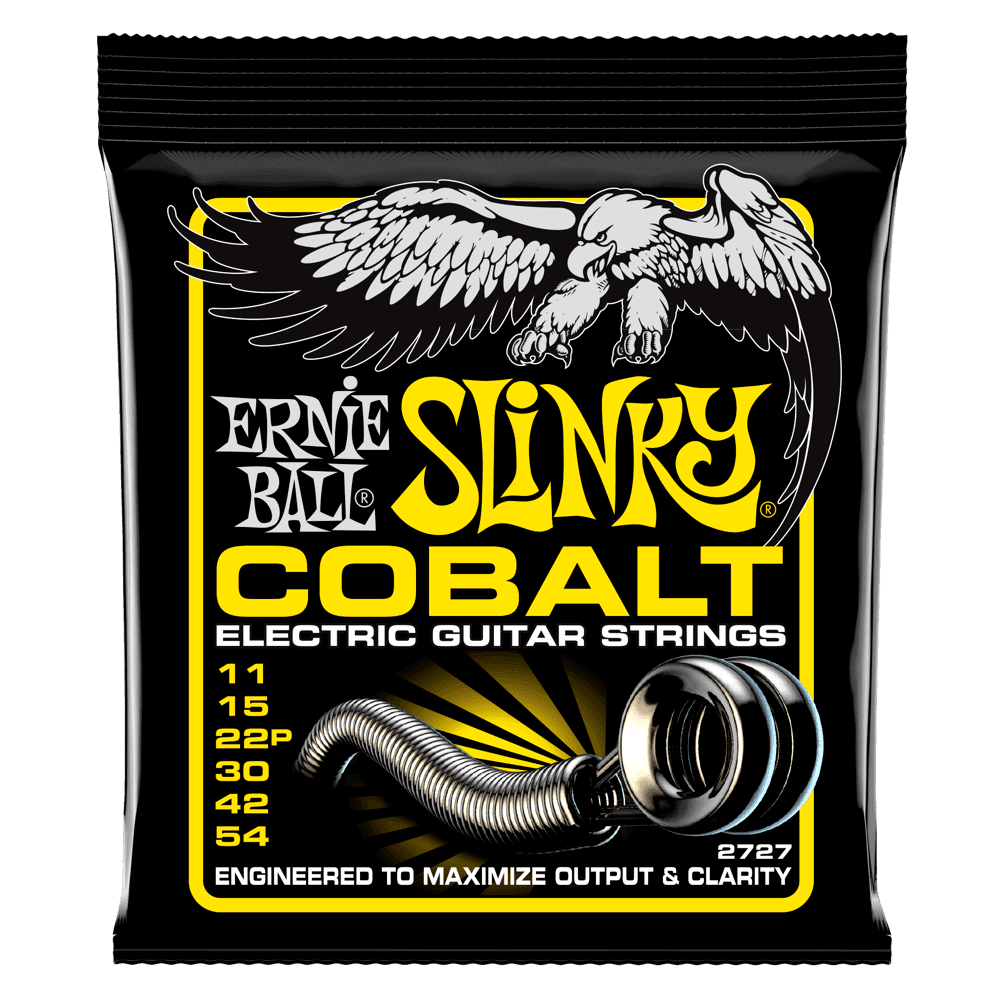
Beefy Slinky Cobalt (.011–.054)
Why this one: Cobalt's tighter low end and stronger pickup output track cleanly into Drop C and Drop C# rhythm work without turning to mud.
Most iconic signature: Papa Het's Hardwired Master Core
James Hetfield's Papa Het's Hardwired Master Core (.011 to .050) is the closest thing metal has to a canonical signature string. Ernie Ball and Hetfield co-developed the set over roughly a decade before its 2022 launch. Per Ernie Ball's own product page, the custom gauge "uses a thicker Paradigm core wire and nickel-plated steel wrap wire," with a heavier core-to-wrap ratio built for "a thicker sound and superior pitch stability under aggressive playing." The plain strings carry brass RPS reinforcement at the ball end, the same breakage-resistant construction covered below, for extra durability under Hetfield's downpicking-heavy rhythm style.
It is not the cheapest or the most exotic-alloy set on this page, but it is the most battle-tested: a working thrash guitarist's actual studio and stage set, refined over ten years before Ernie Ball put a SKU on it. If you want proof a signature string was built for playing, not just marketing, this is it.
Papa Het's Hardwired Master Core (.011–.050)
Why this one: James Hetfield's own signature set, co-developed with Ernie Ball over roughly a decade for pitch stability under aggressive downpicking.
Best for 7-string and djent: 7-String Skinny Top Heavy Bottom Slinky Cobalt
Extended-range metal needs a heavier low string than a 6-string set can offer. 7-String Skinny Top Heavy Bottom Slinky Cobalt (.010 to .062) keeps a familiar .010 top for lead and rhythm vocabulary while stacking mass on the low strings for B standard, Drop A, and Drop G#. The .062 low string holds pitch under palm-muted chugging where a lighter gauge starts to flap, and the cobalt wrap's extra output helps a lead line cut through quad-tracked rhythm walls, the production style modern djent and prog-metal favor.
Mark Holcomb of Periphery is an Ernie Ball Cobalt player, though PRS's own spec sheet for his current signature SVN guitar lists a heavier 10-64 factory gauge at a longer 26.5-inch scale, a different guitar and gauge than this stock set. For a 25.5-inch 7-string in B standard through Drop G#, this is the off-the-shelf equivalent of the heavy-bottom approach extended-range players reach for.
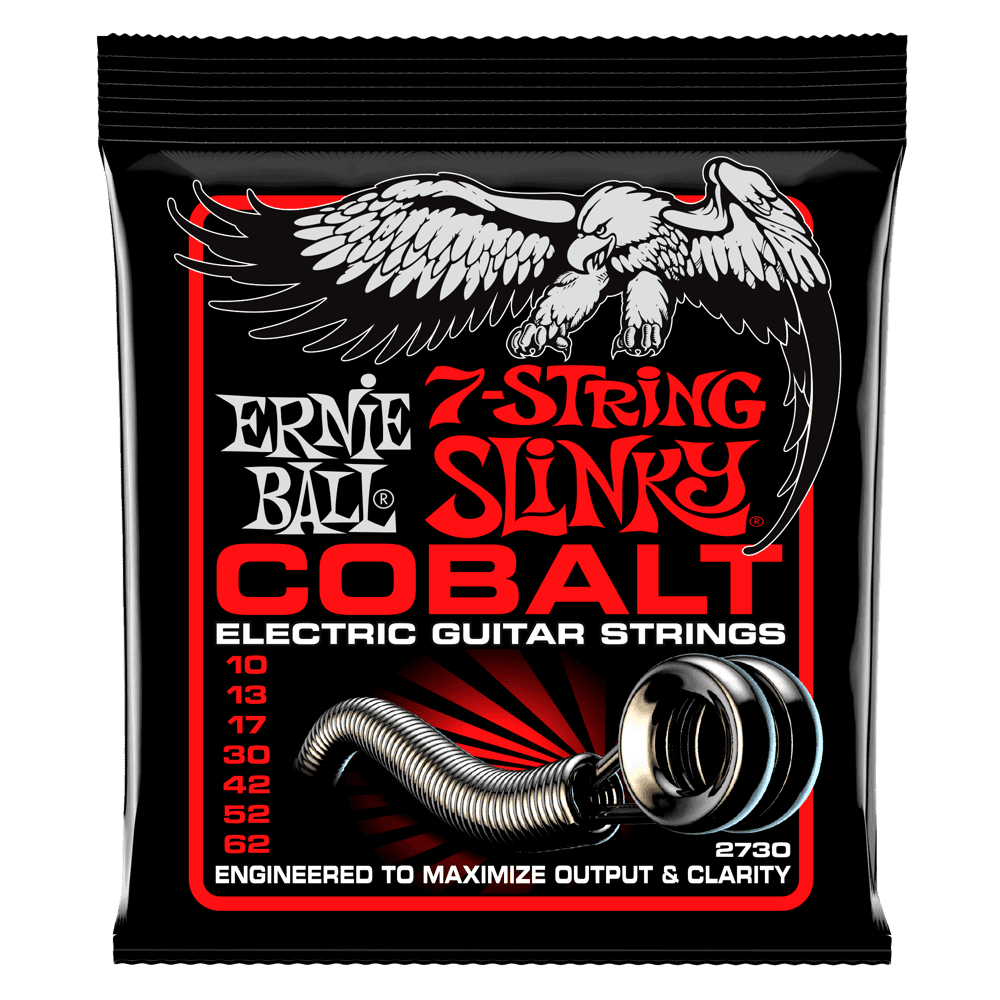
7-String Skinny Top Heavy Bottom Slinky Cobalt (.010–.062)
Why this one: The heavier 7-string Cobalt: a .062 low string that holds definition in Drop A and Drop G# where a lighter gauge starts to flap.
Best for breakage resistance: Ernie Ball Power Slinky RPS 2242
Aggressive palm muting and downpicking stress the ball-end twist on a plain string more than any other point, and that is where most live breakages happen. Power Slinky RPS 2242 (.011 to .048) is built around Ernie Ball's RPS construction, described on the manufacturer's own product page as "a patented winding of brass wire tightly wrapped around the lock twist of the ball end string to minimize slippage and breakage." Same nickel-plated steel wrap and gauge family as a standard Power Slinky, with a real durability upgrade where metal rhythm playing actually punishes a string.
It is also documented as the wound half of Kirk Hammett's hybrid gauge setup. In his own words on Ernie Ball's String Theory series, "the three top strings are from a 10 set and then the bottom three strings are from a 48 set," pairing a lighter plain-string set on top with RPS 2242's heavier wound strings on the bottom. If snapping the third or fourth string mid-set is a recurring problem, this is a cheap, direct fix rather than a tonal upgrade.
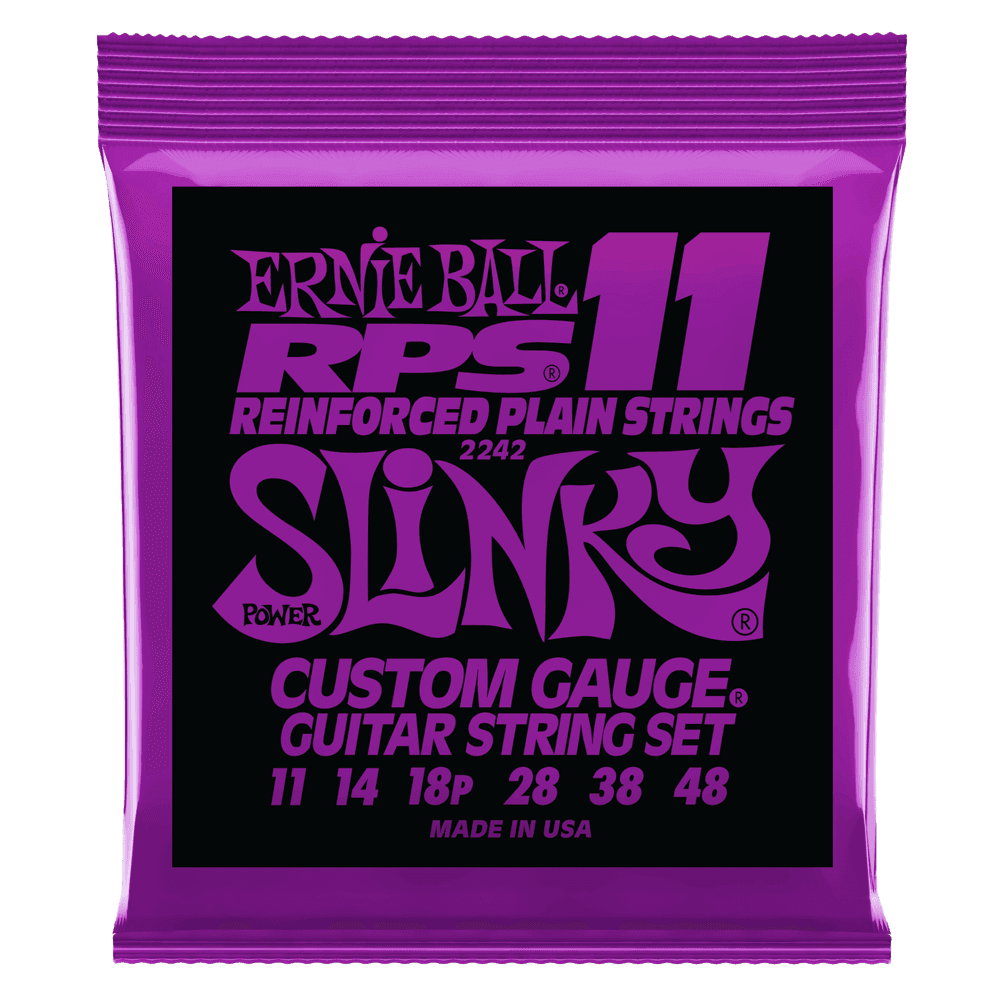
Power Slinky RPS 2242 (.011–.048)
Why this one: Reinforced Plain String construction fixes the single most common breakage point for aggressive metal rhythm playing.
Best budget: Dean Markley Blue Steel 2552
Not every metal player needs a specialty alloy. Dean Markley Blue Steel 2552 (.009 to .042) is not marketed at metal specifically, and we're not going to pretend it is. What it offers instead is honest value: every string is cryogenically frozen to -320°F, a process Dean Markley says tightens the steel's molecular structure for longer life and brighter sustained attack, at a Super Light gauge that suits fast standard-tuning rhythm and lead work.
Skip it if your tuning sits below Eb standard, it is not built for that, and reach for M-Steel or Beefy Slinky Cobalt instead. But for a beginner or budget-conscious player working on speed and standard-tuning riffs, this is the cheapest honest set on the page.

Blue Steel 2552 Cryogenic Light (.009–.042)
Why this one: The cheapest honest set here. Cryogenic treatment adds life and brightness at a fast, standard-tuning-friendly gauge.
Best for shred and lead: Fender Yngwie Malmsteen Signature
Not all metal wants a heavy set. Fender's Yngwie Malmsteen Signature set (.008 to .046) is a wide-spread neoclassical shred gauge, a light .008 top for fast bends and legato paired with a full .046 low E for rhythm body, tuned to Eb standard on Malmsteen's scalloped-fretboard Stratocasters. It proves the point the gauge-vs-genre FAQ below makes directly: metal does not require heavy strings, tuning does.
Pick this over a standard .009 or .010 set if fast bends, wide legato runs, and a slinky feel under the fretting hand matter more to you than the tightest possible palm mute. It is a lead player's metal string, not a rhythm player's.

Yngwie Malmsteen Signature (.008–.046)
Why this one: A wide-spread shred gauge: light .008 top for fast bends, full .046 low E for rhythm body under Eb standard.
How to choose
Pick by your tuning and playing style, not by genre alone
- Standard or Eb standard, no strong opinion yet
- Ernie Ball M-Steel Regular Slinky. Same gauge as a normal rock set, more output and stability underneath.
- Drop C or Drop C# rhythm
- Ernie Ball Beefy Slinky Cobalt. The cobalt wrap keeps a low string defined under gain.
- Want the most proven, road-tested thrash set
- Papa Het's Hardwired Master Core. A decade of development on an actual touring rig.
- 7-string in B standard through Drop G#
- 7-String Skinny Top Heavy Bottom Slinky Cobalt. The .062 low string holds without flapping.
- Snapping strings from aggressive palm muting
- Ernie Ball Power Slinky RPS 2242. Reinforced ball-end construction fixes the actual failure point.
- Tight budget, standard tuning
- Dean Markley Blue Steel 2552. Cryogenic treatment for a longer, brighter life at a fair price.
- Fast lead and shred technique
- Fender Yngwie Malmsteen Signature. Light .008 top, full .046 bottom, built for bends over chug.
Gauge tracks tuning, not genre. Metal skews heavy because metal tunes low, and low tunings bleed tension, so heavier strings claw it back to keep a riff tight instead of floppy. That is a tuning problem, not a genre requirement, and the full breakdown is at string gauge by genre. If you already know your tuning, the CYS gauge guides go deeper: pick your gauge by genre, the full Cobalt gauge family, and the 7-string gauge guide.
Bottom line
If you only want to buy one set and get back to playing, buy Ernie Ball M-Steel Regular Slinky. It matches a standard rock gauge so there is no setup change, and the Maraging steel core plus Super Cobalt wrap genuinely adds output and tuning stability over a plain nickel set. Drop tuned below D standard, switch to Beefy Slinky Cobalt or the 7-string Cobalt set instead, gauge follows tuning first, everything else second.
M-Steel Regular Slinky (.010–.046)
Why this one: Our overall pick. Aerospace-grade Maraging steel core and Super Cobalt wrap for more output and stability at a standard gauge.
Related
Related