Ernie Ball 7-String Skinny Top Heavy Bottom Slinky Cobalt (.010–.062): the Drop G# djent set
Written with AI help · Updated
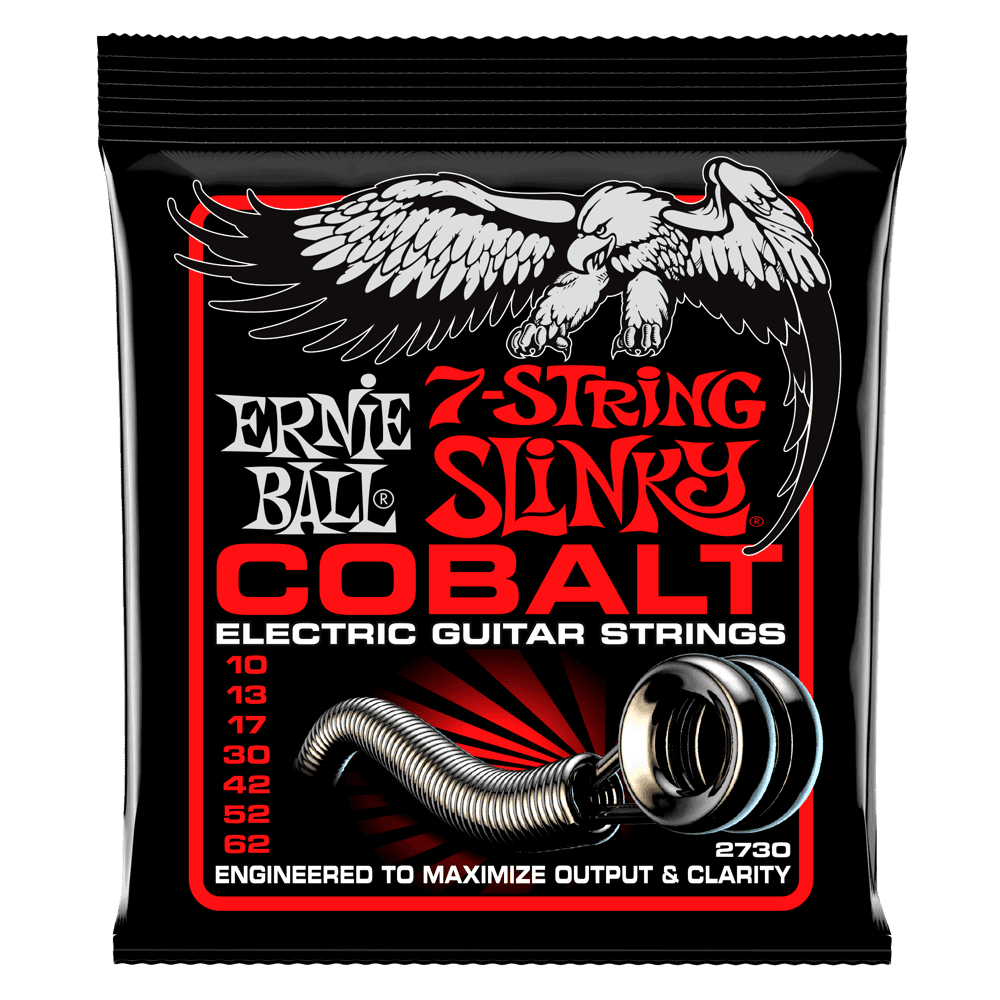
Ernie Ball 7-String Skinny Top Heavy Bottom Slinky Cobalt (2730) is the .010–.062 set for 7-string prog-metal and djent on a 25.5-inch scale. The .062 low string holds B standard, Drop A, or Drop G# without flapping. Cobalt-iron wrap drives passive pickups roughly 2–3 dB louder than nickel, with a tighter upper-midrange that helps rhythm guitar sit forward in dense mixes. It's the stock heavy-bottom 7-string Cobalt, heavier than the 2728 (.010–.056).
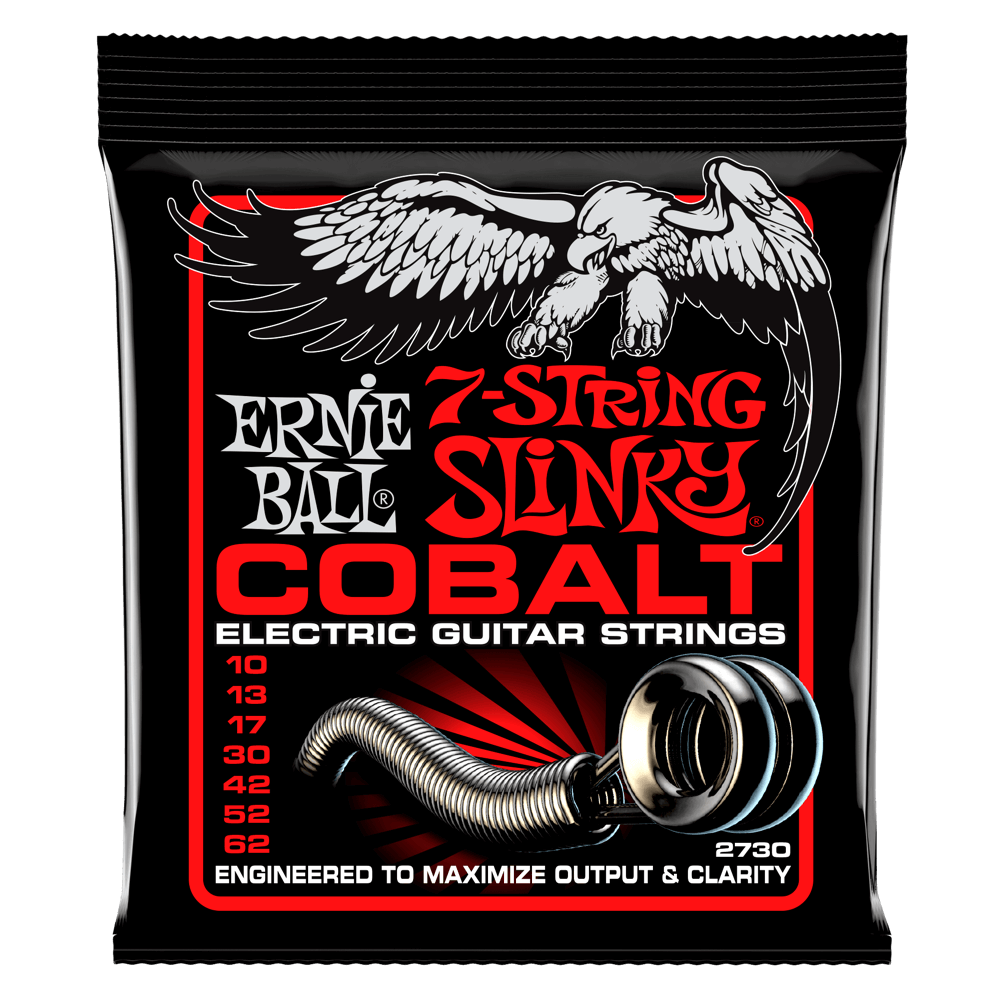
Anatomy
- SKU
- Ernie Ball 2730
- MPN
- P02730
- Gauge
- .010 – .062 (7-string Slinky)
- Gauge set
- .010, .013, .017, .030, .042, .052, .062
- String count
- 7 strings
- Core wire
- Tin-plated hex steel
- Wrap wire
- Cobalt-iron alloy
- Plain strings
- Tin-plated hex-core steel (.010, .013, .017 plain)
- Coating
- None, uncoated
- Winding
- Standard roundwound
- Intended scale
- 25.5" primary; 26.5–27" secondary
- Intended tunings
- B standard, Drop A, Drop G#
- Feel vs. the 2728 (.010–.056)
- Firmer. The heavier .030/.042/.052 wound middles and .062 low string carry more mass than the lighter 2728, the tradeoff for holding pitch down through Drop G#.
- Launched
- 2010s (Ernie Ball expanded the Cobalt line to 7-string for the prog-metal market)
- Package
- Single pack
Tone
Voicing through a passive 7-string pickup (e.g., Fishman Fluence, Bare Knuckle, EMG)
- Output
- 2–3 dB louder than nickel 7-string Slinky. Most pronounced on the wound strings; pronounced enough that EQ that worked on nickel may need backing off the upper mids slightly on Cobalt.
- Low string definition
- .062 cobalt at Drop G# tension reads tighter than nickel at the same gauge. Palm mutes have a more defined transient, less bloom into the next note.
- Upper midrange
- More present 2–4 kHz region, helps the lead voice cut against quad-tracked rhythm walls. Fits the modern djent tonal architecture.
- Bend feel
- .010 plain top is the conventional 6-string-style bending feel translated to 7-string; high-string vocabulary feels familiar.
Where this set sits in the Cobalt range
7-String Skinny Top Heavy Bottom Slinky Cobalt is the heavy-bottom 7-string answer in the Cobalt line:
- 6-string E / Eb / Drop D: Regular Slinky Cobalt (.010–.046).
- 6-string Drop C# / Drop C: Beefy Slinky Cobalt (.011–.054).
- 6-string Drop C / Drop B: Not Even Slinky Cobalt (.012–.056).
- 7-string B standard / Drop A (lighter low string): 7-String Regular Slinky Cobalt (.010–.056, SKU 2728).
- 7-string B standard / Drop A / Drop G# (heavier low string): This set, 7-String Skinny Top Heavy Bottom Slinky Cobalt (.010–.062).
- 7-string lighter top (Hauch style): Custom .009–.062 Cobalt (non-stock SKU).
- 8-string F# standard: No Cobalt 8-string exists; step to the nickel-wound 8-String Slinky (EB 2625, .010–.074) instead.
Who plays this set
Mark Holcomb (Periphery) is an Ernie Ball Cobalt player, but not confirmed on this exact stock set. PRS's own spec sheet for his current PRS SE Mark Holcomb SVN lists a 10-64 factory string gauge on a 26.5-inch scale, heavier and longer-scale than this 2730 set's .010–.062 on 25.5 inches. Holcomb has said in Ernie Ball's own String Theory interview that he asked Ernie Ball to build him gauges "outside of the normal stock string gauges," so his personal set is a custom job rather than an off-the-shelf SKU. This 2730 set is the closest stock equivalent for a 25.5-inch 7-string.
Misha Mansoor (Periphery, Jackson Juggernaut HT7) runs 7-string Cobalt sets in the same family. Wes Hauch runs a custom 7-string Cobalt (.009–.062) for his lighter-top approach.
Cobalt line full roster: Who plays Cobalt Slinky strings.
Best for
- B standard 7-string (B-E-A-D-G-B-E) on 25.5-inch scale. Tight, balanced, the gauge the .062 was tuned for.
- Drop A 7-string (A-E-A-D-G-B-E). The default for Periphery I / II era and most metalcore-era 7-string material.
- Drop G# 7-string (G#-D#-G#-C#-F#-A#-D#). Used on some Periphery material. The .062 holds without flap.
- Modern prog-metal, djent, metalcore, technical metal. Quad-tracked rhythm guitar production lanes.
Worst for
- Drop F# / Drop F or below. The .062 starts to lose pitch definition below G#; step to a .064 or .068 custom or move to 8-string.
- 27-inch+ baritone scale 7-strings. The .062 on a longer scale gets stiffer; consider a .064 or .066 low string instead.
- 6-string E standard players who want 7-string texture occasionally. Don't put a 7-string set on a 6-string; use the 7-string for 7-string material.
Install and break-in
The string spacing on a 7-string nut is closer than on a 6-string, the .062 typically needs a properly cut nut slot. Most production 7-strings (PRS SVN, Schecter, Ibanez RG7, Jackson Juggernaut) ship with nut slots cut for this gauge family. If you're stringing up an aftermarket 7-string with a smaller nut slot, the .062 may need light filing.
Break-in: 30–45 minutes of playing before the initial top end settles. Stretch each string before that.
Verdict
7-String Skinny Top Heavy Bottom Slinky Cobalt is the heavy-bottom 7-string Cobalt for B standard, Drop A, and Drop G# tunings on a 25.5-inch scale. The .062 low string holds Drop G# without flap; the cobalt voicing helps quad-tracked rhythm guitar sit forward in modern prog-metal mixes. It's the stock, off-the-shelf option, one step heavier than the 2728 (.010–.056).
If you play 7-string and your default tuning is anywhere from B standard down to Drop G#, this is the answer. Pick up a 3-pack and don't overthink it.
Related
Related