Ernie Ball M-Steel Regular Slinky (.010–.046): the tuning-stability Slinky
Written with AI help · Updated
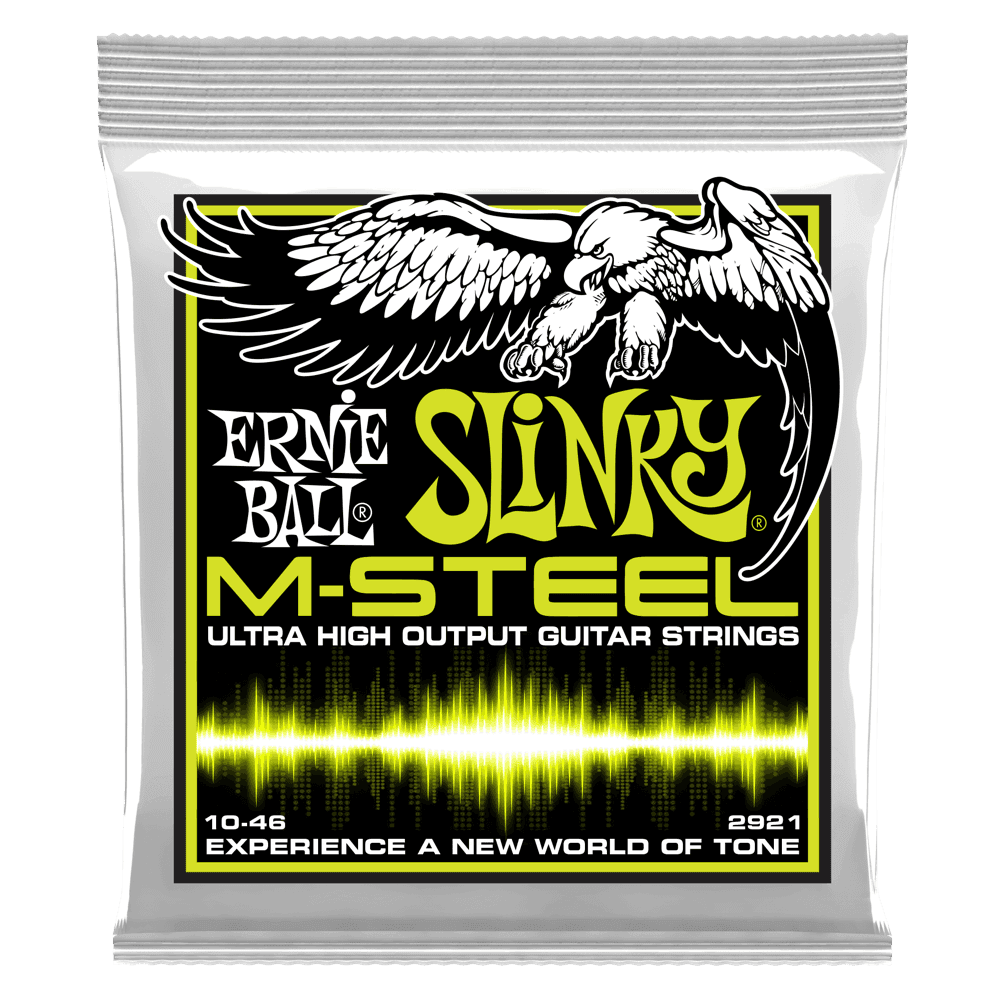
Ernie Ball M-Steel Regular Slinky (P02921) is .010 to .046, the same gauge as nickel Regular Slinky, but built differently at both ends: a patented Super Cobalt alloy wrap wire over a Maraging steel hex core instead of nickel-plated steel over tin-plated steel. Maraging steel is an aerospace-grade tool steel prized for tensile strength and fatigue resistance. Ernie Ball markets the result as richer, fuller tone with a powerful low end and better tuning stability, aimed at rhythm players in Drop D and D standard who want a tighter feel without stepping up a gauge.

What this set is
Ernie Ball M-Steel Regular Slinky is the .010 to .046 entry in Ernie Ball's M-Steel line, the same gauge as nickel Regular Slinky but built from different materials at both ends of the string. The wound strings wrap a patented Super Cobalt alloy around a Maraging steel hex core, instead of nickel-plated steel over tin-plated hex steel. "M" is for Maraging, a low-carbon, nickel-rich tool steel Ernie Ball describes as a superalloy used in aerospace and defense, chosen here for tensile strength and fatigue resistance rather than tone alone.
Ernie Ball's own line page pitches M-Steel as producing "a richer and fuller tone with powerful low end response," and describes the line as among "the loudest, most expressive strings ever created," with increased output, frequency response, and strength over the standard nickel line. The plain strings get their own upgrade too: specially tempered steel for fatigue resistance, plus a patented steel winding around the ball end that Ernie Ball says reduces slippage and breakage compared to a conventional plain string.
Anatomy
- Model
- Ernie Ball M-Steel Regular Slinky
- SKU / MPN
- 2921 / P02921
- Gauge
- .010 – .046 (Regular Slinky gauge)
- Gauge set
- .010, .013, .017, .026, .036, .046
- String count
- 6 strings
- Core wire
- Maraging steel hex core
- Wrap wire
- Super Cobalt alloy (patented)
- Plain strings
- Specially tempered steel, patented ball-end winding for reduced slippage and breakage
- Coating
- None, uncoated
- Winding
- Standard roundwound
- Intended scale
- 25.5" (Strat / Tele / superstrat) and 24.75" (Les Paul / SG / ES-335)
- Intended tunings
- E standard, Eb standard, Drop D, D standard
- Total tension (25.5", E standard)
- Close to nickel Regular Slinky's own ~98 lbs at this gauge, since diameter and scale length drive tension more than the wrap or core alloy
- Made in
- United States (Ernie Ball, Coachella, CA)
- Sibling gauges
- Super Slinky (.009–.042, P02923), Hybrid Slinky (.009–.046, P02922), Power Slinky (.011–.048, P02920), Skinny Top Heavy Bottom (.010–.052, P02915)
Wrap and core, not just wrap
Most Ernie Ball voicing lines change one variable. Cobalt Slinky keeps the same tin-plated hex steel core as nickel Regular Slinky and only swaps the wrap wire for a cobalt alloy, which is why Cobalt reads as a brighter, louder version of the same underlying feel. M-Steel changes both: the wrap wire is a Super Cobalt alloy that Ernie Ball names separately from the Cobalt line's own wrap alloy, and the core swaps from tin-plated steel to Maraging steel, an aerospace-grade tool steel valued for tensile strength and resistance to metal fatigue.
That core swap is the practical difference. A stiffer, higher-fatigue-strength core resists stretching and settling differently than standard hex steel, which is the physical basis for Ernie Ball's tuning-stability claim, particularly under the extra tension and pick attack of drop-tuned rhythm playing. We have not run an independent pitch-drift test against nickel Regular Slinky, so treat "better tuning stability" as Ernie Ball's own engineering claim rather than a CYS-measured result. For a fully measured Cobalt-vs-nickel breakdown (output dB, brightness curve, longevity), see our Cobalt vs nickel Slinky comparison; M-Steel doesn't have an equivalent third-party measurement yet.
| M-Steel Regular Slinky | Nickel Regular Slinky | Regular Slinky Cobalt | D'Addario NYXL1046 | |
|---|---|---|---|---|
| Wrap wire | Super Cobalt alloy (patented) | Nickel-plated steel | Cobalt-iron alloy | Nickel-plated steel |
| Core wire | Maraging steel hex core | Tin-plated hex steel | Tin-plated hex steel | NY Steel hex core |
| Gauge | .010 – .046 | .010 – .046 | .010 – .046 | .010 – .046 |
| Tone character | Full, powerful low end | Bright, balanced default | Louder, tighter upper mids | Bright, modern, high headroom |
| Sold as | Output + tuning stability | The default voicing | Output + brightness | Tuning stability + strength |
| Price tier | $$ | $ | $$ | $$ |
Best for
Rhythm players in Drop D or D standard on a 25.5-inch or 24.75-inch scale electric who want a tighter, more stable feel at .010–.046 rather than sizing up to a heavier set. Players chasing a fuller, more powerful low end than nickel Regular Slinky gives without changing gauge. Anyone curious about Ernie Ball's less common lines who already knows they want E standard or Eb standard gauge feel.
Worst for
Players chasing the specific Cobalt voicing (brighter, more bell-like, per Ernie Ball's own line comparison), who should reach for Regular Slinky Cobalt instead. Anyone who wants longer string life over voicing or stability, Ernie Ball's own longevity answer is Paradigm, not M-Steel. Skeptics of manufacturer stability claims: the tuning-stability pitch is Ernie Ball's own positioning, and CYS hasn't independently measured it against nickel Regular Slinky.
Verdict
M-Steel Regular Slinky is Ernie Ball's stability-and-output answer at the same .010–.046 gauge as its default nickel set, changing both the wrap wire and the core, not just the wrap like Cobalt does. That makes it a reasonable pickup for rhythm players in Drop D or D standard who want more low end and a tighter feel without stepping up a gauge. It isn't a longevity string and it isn't the same voicing as Cobalt, so know which problem you're solving before you buy: brightness and output, reach for Cobalt; life between changes, reach for Paradigm; a fuller, more stable low end at the stock gauge, this is the one.
Related
Related