7-string guitar string gauge guide: the tension math for B standard, Drop A, and extended lows
Written with AI help · Updated
For a 7-string in B standard (B-E-A-D-G-B-E) on a 25.5-inch scale, .010–.059 is the floor, Ernie Ball Regular Slinky 7-string or D'Addario NYXL 10–59. Step up to .010–.062 for Drop A, .011–.064 for Drop G#, .012–.068 for Drop F#. Longer 26.5–27-inch scales let you drop one gauge lighter; shorter 25.5-inch scales may require stepping up to keep the low string articulate under gain.

The one-paragraph answer
Tune your 7-string to B standard on a 25.5-inch scale? Use .010–.059. Drop to A? Step up to .010–.062. Lower than that, Drop G#, Drop G, F# standard, keep stepping up gauges, a whole step of tuning drop for every gauge step heavier. Scale length modulates everything: 26.5-inch and 27-inch scales let you run one gauge lighter than a 25.5-inch reference for the same feel. If you're in B standard on an Ibanez 8-string scale (27"), a .010–.056 can actually work.
The tension targets, 7-string low B
The 7-string's defining string is the low B (or low A for drop-tuned material). That's the string that has to do the work the 6-string's low E does in standard tuning. Gauge math around that note dictates the rest of the set.
| Scale | Low B gauge | Low B tension (B std) | Full-set recommendation | |
|---|---|---|---|---|
| 25.5" Fender/Ibanez RG7 | .059 | ~16 lbs | .010–.059 (Ernie Ball / D'Addario / Elixir) | |
| 25.5", heavy hand | .062 | ~17.5 lbs | .010–.062 (Regular Slinky 7-string, Cobalt 7-string) | |
| 26.5" Schecter / Mayones | .056 or .059 | ~16–17 lbs | .010–.056 or .010–.059 | |
| 27" Kiesel / Jackson baritone-7 | .054 or .056 | ~15–17 lbs | .010–.056 or .009–.054 | |
| Multi-scale (25.5–27.0) | .059 | ~16.5 lbs | .010–.059 at the multi-scale average |
For Drop A on 25.5-inch, replace the low B target with a low A at .062 (~16 lbs) or .064 (~17 lbs). For Drop G#, use .064 or .066. For F# standard on a 7, rare but seen, .068 or .072 is the low-string gauge range, which starts bumping into 8-string territory.
The 7-string sets that actually ship
Stock 7-string sets, ranked by use case
- Ernie Ball Slinky 7-string (Regular, EB 2621), .010–.056
- Nickel-plated steel. The default 7-string electric set. Ships Ibanez factory-strung on some models. Works for B standard with a medium touch; players who palm-mute hard often step up to the .010–.062 variant.
- Ernie Ball Slinky Cobalt 7-string (EB 2730), .010–.062
- The 7-string Cobalt reference, and the closest stock match to Mark Holcomb's custom Ernie Ball gauge (his own personal spec is unpublished, and Ernie Ball's own materials don't confirm Cobalt specifically as his alloy). For anyone running a 7-string in Drop A / Drop G# / B standard under high gain on passive pickups, this is the cleanest answer in the catalog. Noticeably more expensive than the nickel equivalent, similar 1–3 week lifespan.
- Ernie Ball Beefy Slinky 7-string (EB 3626), .011–.064
- One gauge step heavier than Regular. Drop G# and below, or very heavy-handed Drop A rhythm work.
- D'Addario NYXL 7-string (NYXL1059, NYXL1062, NYXL1164)
- High-carbon-core nickel-plated steel. Tighter feel than standard nickel at the same gauge; slightly better tuning stability. The .010–.062 set (NYXL1062) is a commonly chosen NYXL 7-string gauge among djent and prog-metal players.
- Elixir Nanoweb 7-string (.010–.059, .011–.059)
- Coated nickel. 3–5x longer life than uncoated. The right pick for working players who don't want to change strings weekly. Paradigm 7-string doesn't exist as a stock SKU, so Elixir is the longest-lasting 7-string option most places carry.
Pick by tuning
Per-tuning gauge floor on 25.5-inch scale
- B standard (B-E-A-D-G-B-E)
- .010–.059 default; .010–.062 if you're heavy-handed.
- A standard (A-D-G-C-F-A-D)
- .011–.064 minimum. 26.5-inch scale preferred.
- Drop A (A-E-A-D-G-B-E)
- .010–.062 default; .011–.064 for heavy palm-mute rhythm.
- Drop G# (G#-E-A-D-G-B-E)
- .011–.064 or .012–.066.
- Drop G (G-E-A-D-G-B-E)
- .012–.068. Borderline, consider 8-string.
- F# standard (low F# on 7-string)
- Rare on 6/7. This is 8-string territory. See the 8-string high-tension setup guide.
Pick by scale length
A 27-inch scale 7-string (Kiesel, Jackson Pro Series baritone-7, some multi-scales at the low end) effectively lets you run one gauge lighter than a 25.5-inch guitar in the same tuning. A low A at .060 on 27-inch feels similar to a low A at .064 on 25.5-inch. This is the trade most extended-range metal players make: longer scale + lighter gauge = cleaner articulation at low tunings without the finger-fatigue of the heaviest gauges.
A 24.75-inch Gibson-scale 7-string (Les Paul Studio 7, some ESP LTD 7s) is the opposite. Shorter scale means you need to step up a gauge over the 25.5-inch reference to get equivalent tension, which compounds the stiffness problem the short scale is supposed to solve.
The 7-string Cobalt set most pros pick
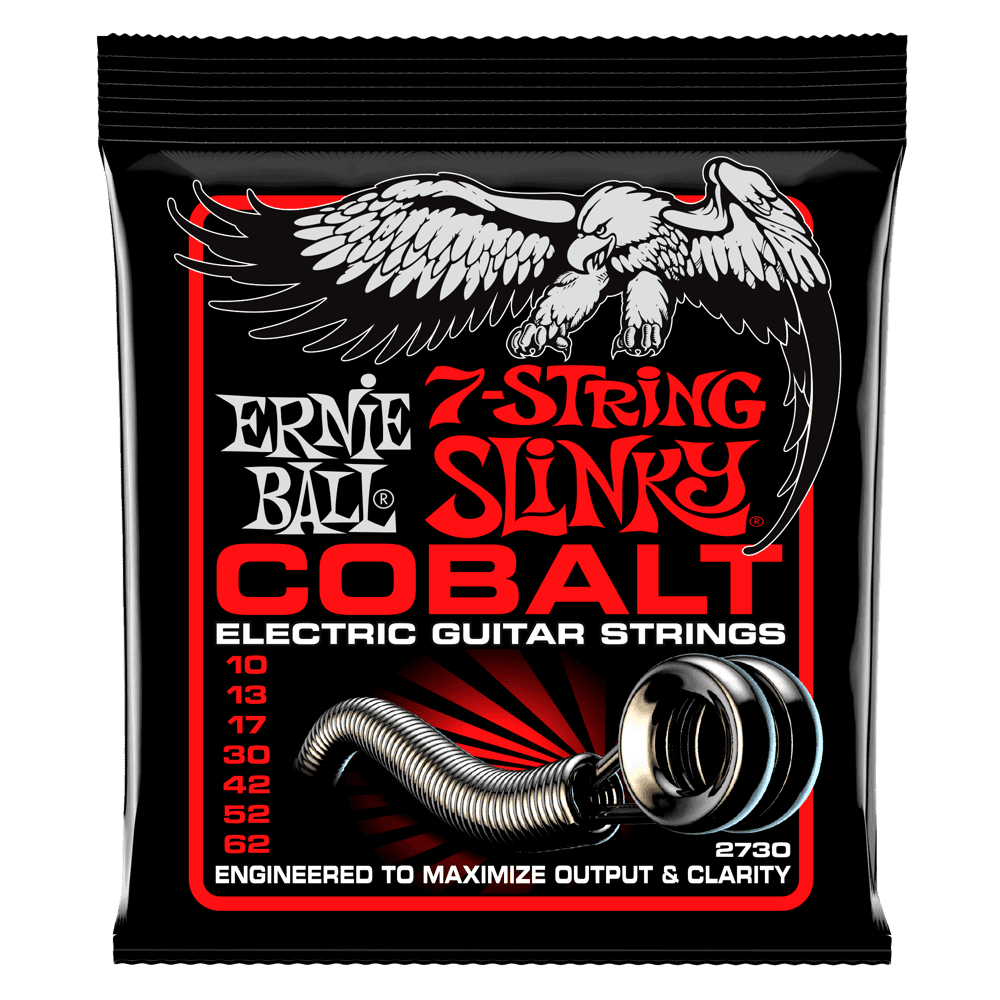
Slinky Cobalt 7-string (.010–.062)
Why this one: The closest stock match to Periphery's Mark Holcomb, who worked with Ernie Ball on a custom, non-stock gauge rather than this exact catalog set. Low .062 holds Drop A and Drop A# cleanly; Cobalt wrap keeps the low string articulate under high gain on passive humbuckers.
Install notes specific to 7-string
Setup-adjustment checklist for 7-string gauge changes
- Nut slots
- Factory 7-string nuts come cut for whatever the factory strings were. Changing from a .056 low to a .062 low requires a nut slot check; if the thicker string rides high in the slot, file to fit. Cross-link to the precision nut filing guide.
- Bridge
- 7-string Tune-O-Matic and Floyd-style bridges usually accept up to a .064 without issue. Above that, check saddle slot tolerance.
- Truss rod
- Most 7-string necks have a single-action or dual-action truss rod sized for the 7-string load. Gauge changes within the 7-string lane usually need the same quarter-turn adjustment as a 6-string gauge change.
- Intonation
- 7-strings lose intonation faster than 6-strings when strings are worn. Plan to re-intonate every 4–6 weeks if you play heavily.
The full setup walk-through applies. See the heavy-gauge install guide for the truss-rod and saddle-height check sequence, and the precision nut filing guide for the slot-cut procedure.
Related
- 8-string, not 7-string? See the 8-string gauge guide and 8-string high-tension setup
- Who's on 7-string? Top 10 7-string players and individual rigs of Mark Holcomb, Keith Merrow, Jason Richardson, Tosin Abasi
- Tunings: B standard, Drop A
- The cross-wire pillar: String gauge and scale length reference
- Comparison: Cobalt vs nickel Slinky
Frequently asked questions
What's the standard gauge for a 7-string guitar?
B standard, 25.5-inch scale: .010–.059. The factory-default reference set across Ernie Ball, D'Addario, and Elixir, ships on most Ibanez / Schecter / Jackson 7-strings. Below B standard, step up one gauge per whole step down.
Do 7-string guitars need a different scale length?
Not strictly, but longer scale lengths help. The 25.5-inch Fender scale works for B standard; most modern 7-strings (Ibanez RG7, Schecter SLS Elite) use 25.5" for familiarity. 26.5-inch (Mayones, Schecter extended) and 27-inch (Jackson Pro Series Soloist 7, Kiesel multi-scale) add tension on the low B, letting you comfortably run lighter top-string gauges.
What gauge for Drop A on 7-string?
25.5-inch scale: .010–.062 minimum for Drop A. The low A at .062 produces about 16 pounds of tension. Ernie Ball 7-String Slinky Cobalt is .010–.062. On 26.5-inch scales, .010–.059 works if your touch is lighter.
Is there a difference between 7-string nickel and 7-string Cobalt?
Same as 6-string. Cobalt gives 2–3 dB more output and tighter low-end articulation through passive pickups. For 7-string rhythm work in B standard or lower, especially under high gain, Cobalt's extra definition helps the low string read as a note rather than a rumble. Most extended-range metal players who care about this pick Cobalt (Mark Holcomb, Keith Merrow) or an equivalent.
Can I put a 7-string set on a 6-string guitar?
No. 7-string sets have seven strings with a specific low-B or low-A gauge that has no home on a 6-string bridge or nut. If you're trying to tune a 6-string down to A or B, you need a dedicated baritone 6-string set (.013–.062 or similar) and probably a longer-scale guitar. See the heavy-gauge install guide for the setup implications.
Which 7-string set is best for Periphery / djent-style rhythm work?
Ernie Ball 7-String Slinky Cobalt .010–.062 is the closest stock match to the territory Mark Holcomb plays in; he's worked with Ernie Ball on a custom, non-stock gauge rather than this exact catalog set. Misha Mansoor uses D'Addario NYXL 10–59 and custom gauges for B standard / Drop G# material. Djent-specifically: gauge floor is .010–.062 on 25.5-inch scale, stepping up to .011–.064 or .012–.068 for the lowest Meshuggah-adjacent tunings.
What tunings are common on 7-string?
B standard (B-E-A-D-G-B-E) is the default. Drop A (A-E-A-D-G-B-E) drops the low B to A for Dream Theater / Periphery / Animals as Leaders-adjacent material. Drop G# and Drop G are heavier. A few players use Drop F# to push into 8-string territory without switching instruments, though most of those players eventually move to 8-string.
Do 7-string strings cost more than 6-string?
About 20–30% more per set. Ernie Ball 7-string Regular Slinky runs roughly $7–9 vs $5–6 for a 6-string equivalent. 7-string Cobalt and Paradigm sets are proportionally more expensive. The cost math still favors single-set 7-string rigs over maintaining a second 6-string tuned permanently to Drop A.