D'Addario vs Ernie Ball: which electric guitar strings should you buy?
Written with AI help · Updated
D'Addario and Ernie Ball are the two default electric string brands, and at the same gauge they are close. The flagship .010 to .046 sets, EXL110 and Regular Slinky, both use nickel-plated steel on a steel core. D'Addario is commonly described as slightly brighter with tight set-to-set consistency. Ernie Ball is often called a touch warmer with more flex under bends. Both are top tier, so most players choose by feel and habit.
The short answer
This is the most common string question there is, and the honest answer is anticlimactic. At the same gauge, D'Addario and Ernie Ball are very close. Their flagship .010 to .046 sets, EXL110 and Regular Slinky, are both nickel-plated steel on a steel core. Same gauge, same wrap material, so the difference comes down to small things: winding feel, a slight lean in brightness, and which brand you already trust.
D'Addario is the one commonly described as a hair brighter, with famously tight wind tolerance and set-to-set consistency. Ernie Ball is more often called a touch warmer, with a bit more flex under bends. Both are top tier. Buy by feel and habit, not by hunting for a winner that mostly does not exist.
The flagship sets, head to head
The fairest fight is the set most people actually buy from each brand, at the size most people actually use. That is D'Addario EXL110 against Ernie Ball Regular Slinky, both .010 to .046 nickel-plated steel.
D'Addario builds the EXL110 on a hex steel core in Farmingdale, New York, and has run the XL line since 1974. The brand's pitch has always been precision: very consistent winding and tuning so every set feels the same. Ernie Ball runs the Regular Slinky on the same .010 to .046 spec with nickel-plated steel wrap, and the Slinky line is the string most associated with rock and the default many players learned on.
Because the recipe is so similar, the differences people report are small and partly subjective. Treat the table below as tendencies, not measurements. We do not run lab tone tests here, so we will not pretend one set is objectively brighter by a number. What we can say is that the gap is smaller than the internet arguments suggest.
| D'Addario EXL110 | Ernie Ball Regular Slinky | How big is the difference? | |
|---|---|---|---|
| Wrap material | Nickel-plated steel | Nickel-plated steel | None. Same wrap recipe. |
| Tone character | Often called slightly brighter, cutting | Often called slightly warmer, rounder | Small. Subjective, and gauge / pickups matter more. |
| Flagship line | XL Nickel Wound | Slinky | Two of the most-played electric sets ever made. |
| Lineup breadth | XL, NYXL, XS coated | Slinky, Cobalt, Paradigm | Comparable. Both cover standard, upgraded, long-life. |
| Price | $ (budget standard) | $ (budget standard) | None meaningful. Both are the cheap default. |
| Feel | Very consistent, tight winding | A bit more flex under bends (commonly reported) | Small. Most players adjust within a song. |
The full lineups, not just the flagships
Most of the real difference between these brands lives above the flagship set, in the upgraded and specialty lines. Both brands stack three tiers, and they map onto each other closely.
D'Addario goes standard, upgraded, then long-life. XL is the everyday nickel wound. NYXL swaps in a high-carbon core for stronger bends and tuning that holds better, which is the upgrade most lead players notice. XS is the thin film-coated set for long life when you do not want to restring often.
Ernie Ball goes standard, alloy, then protected. Slinky is the everyday nickel wound. Cobalt swaps the wrap to a cobalt alloy for higher output and more midrange, which is a bigger tonal change than NYXL's core swap. Paradigm is the treated, reinforced set with a break guarantee for players who are rough on strings or gig constantly.
So if you are choosing the brand by its top end, the question changes shape. Do you want NYXL's bend-and-tuning upgrade, or Cobalt's output-and-midrange voice? Those are genuinely different goals, and they are a more useful thing to compare than EXL110 vs Regular Slinky.
Which should you buy
- Total beginner
- Either. Buy whichever your shop stocks or your favorite player uses.
- Chase brightness and consistency
- D'Addario. The brand's reputation is precision and a slight cutting edge.
- Want a bit more flex and warmth
- Ernie Ball. Commonly described as rounder with more give under bends.
- Bend a lot, hate going flat
- D'Addario NYXL. High-carbon core for stronger bends and stable tuning.
- Want more output and midrange
- Ernie Ball Cobalt. A real tonal change, not a subtle one.
- Already love one brand
- Stay. The gap is not big enough to switch a working setup.
The D'Addario default. The most-played D'Addario electric set, built on the same .010 to .046 spec almost everyone starts with, with the brand's signature tight winding and consistency.

EXL110 XL Nickel Wound (.010–.046)
Why this one: The D'Addario default. Nickel-plated steel on a hex steel core, made in Farmingdale, NY, and the XL line has been the rock and pop standard since 1974. Pick this for a slightly brighter, very consistent set at a budget price.
The Ernie Ball default. The string a generation of rock players learned on, same .010 to .046 gauge, with the slightly warmer, flexible feel the Slinky line is known for.
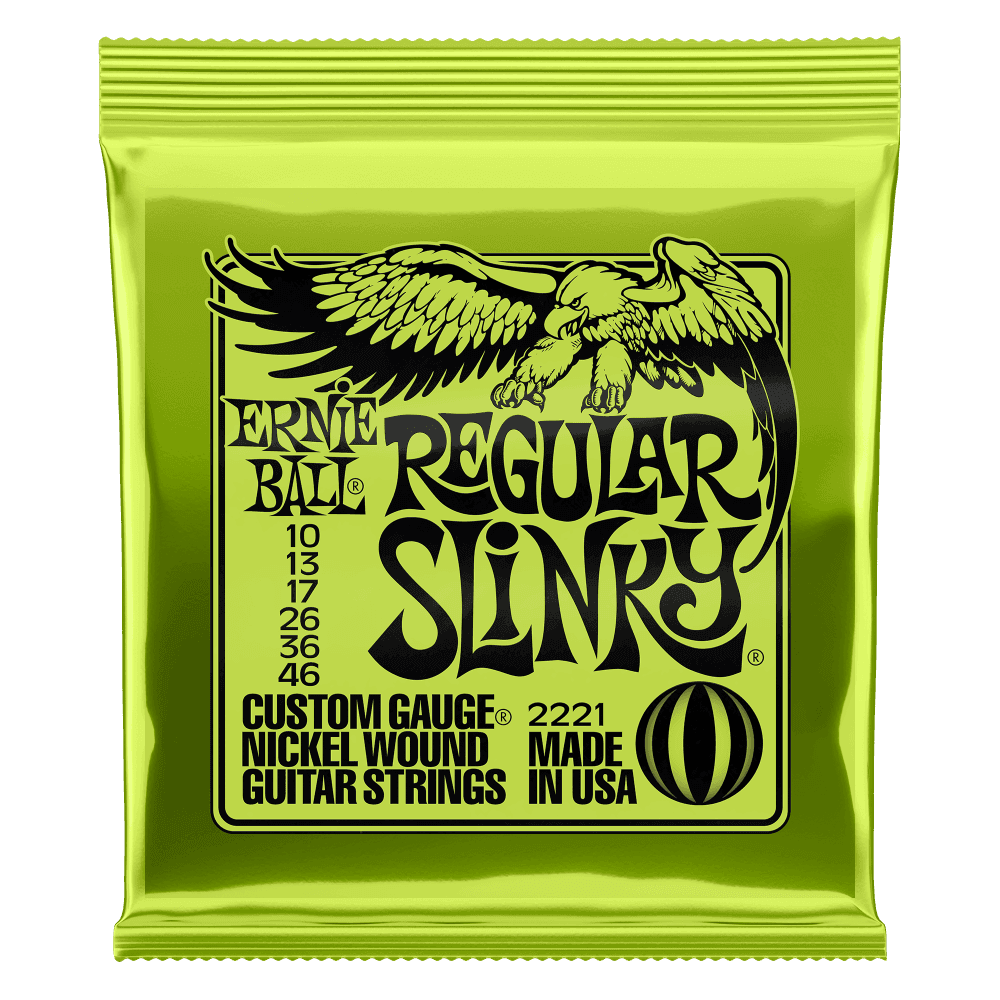
Regular Slinky (.010–.046)
Why this one: The Ernie Ball default and one of the most-played electric sets ever. Nickel-plated steel, .010 to .046, commonly described as a touch warmer and more flexible than the D'Addario equivalent. The other half of the eternal brand debate.
Want to settle it the cheap way? Buy one set of each. A D'Addario EXL110 and an Ernie Ball Regular Slinky together cost less than a tank of gas. Play a week on each, then trust your own hands over any review, including ours.
Related
- The upgrade question inside D'Addario: NYXL vs XL Nickel.
- The same question inside Ernie Ball: Cobalt vs nickel Slinky.
- The flagship sets in full: D'Addario EXL110 and Ernie Ball Regular Slinky.