Ernie Ball Mammoth Slinky Cobalt (.012–.062): the heaviest 6-string Cobalt Slinky Ernie Ball makes
Written with AI help · Updated
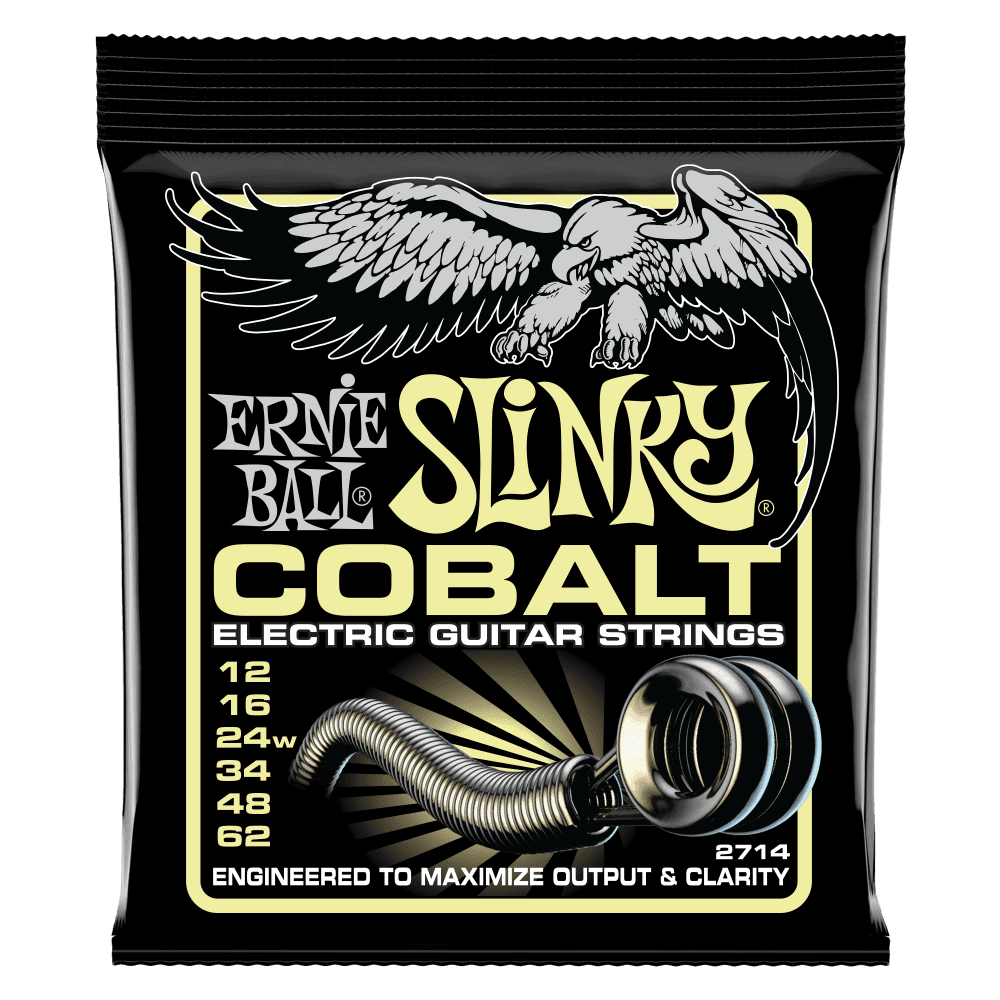
Ernie Ball Mammoth Slinky Cobalt (2714) is the heaviest 6-string Cobalt Slinky gauge Ernie Ball makes: .012–.062, built for Drop B, Drop A#, and baritone territory. The cobalt-iron wrap drives passive pickups louder and brighter than nickel at the same gauge, with the rigidity to keep a detuned .062 low string from flapping. It sits one step above Not Even Slinky Cobalt (.012–.056); go 7-string Cobalt if you tune lower than Drop A.

Anatomy
- SKU
- Ernie Ball 2714
- MPN
- P02714
- Gauge
- .012 – .062 (Mammoth Slinky)
- Gauge set
- .012, .016, .024, .034, .048, .062
- Core wire
- Tin-plated hex steel
- Wrap wire
- Cobalt-iron alloy (the whole point of the line)
- Plain strings
- Tin-plated hex-core steel (.012, .016, .024 plain)
- Coating
- None, uncoated
- Winding
- Standard roundwound
- Intended scale
- 25.5" (Strat/superstrat) primary; a 24.75" Gibson scale runs looser at the same tuning, see the FAQ below
- Intended tunings
- Drop B, Drop A#, baritone B standard
- Position in the Cobalt line
- Heaviest of the twelve standard 6-string Cobalt gauges
- Total tension (25.5", E standard, reference only)
- Not published by Ernie Ball; nobody tunes this set to E. See the FAQ below.
- Collection
- Ships under Ernie Ball's own "Cobalt Expanded Gauges" line, alongside Primo and Burly Slinky Cobalt, not the original 2012 core launch
- Package
- Single pack
Tone
Same cobalt-iron wrap as the rest of the line, more of it. At .062, the low string has more wrap-wire mass moving in the pickup field than any other standard 6-string Cobalt gauge, which pushes the line's signature voicing furthest at this end of the range.
Voicing through a passive pickup
- Output
- About 2–3 dB louder than a same-gauge nickel set through the same passive pickup, the same delta the rest of the Cobalt line shows, just carried by a heavier low string.
- Low end
- Firm, rigid attack on the .062. Palm mutes at Drop B or Drop A# stay defined instead of flapping into mush, the main reason to reach for this gauge over a lighter Cobalt detuned past its comfort zone.
- Top end
- The .012, .016, .024 plain strings read the same crisp, articulate top end as every other Cobalt gauge, the wound-string jump doesn't change how the top three feel.
- Bend feel
- Stiffer than lighter Cobalts, as expected at this gauge and this tuning. Not built for wide bends on the wound strings; the plain top three still bend normally.
For the full measured Cobalt-vs-nickel breakdown (output dB curves, brightness over a tracking week, bend feel, pickup compatibility), see Cobalt vs nickel Slinky: the voicing difference, measured.
Where this set sits in the Cobalt range
Mammoth Slinky Cobalt is the heaviest of Ernie Ball's twelve standard 6-string Cobalt gauges, and the answer for players whose 6-string lives below Drop C:
- E standard / Eb standard: Regular Slinky Cobalt (.010–.046) is the default.
- Drop D / D standard: Power Slinky Cobalt (.011–.048) or Skinny Top Heavy Bottom Cobalt (.010–.052).
- Drop C / C standard: Beefy Slinky Cobalt (.011–.054) or Not Even Slinky Cobalt (.012–.056).
- Drop B / Drop A# / baritone B standard: This set, Mammoth Slinky Cobalt (.012–.062).
- Drop A and below, or an actual 7-string: step into 7-string Cobalt (Regular 7-string .010–.056, Power 7-string .011–.058, or Skinny Top Heavy Bottom 7-string .010–.062) instead of pushing a 6-string past what it's built for.
The full gauge-by-gauge picking guide is at Ernie Ball Cobalt Slinky gauges explained.
Who plays this set
We don't have a primary-source citation for a specific artist on this exact .012–.062 6-string gauge. The documented Cobalt roster skews lighter: Dustin Kensrue (Thrice) runs the two-steps-lighter Beefy Slinky Cobalt (.011–.054), and the players documented on Cobalt in Drop A and below, Jason Richardson among them, are on 7-string Cobalt sets rather than a 6-string pushed to .062.
That's consistent with how the gauge is built: Mammoth Slinky Cobalt is a 6-string answer for Drop B and baritone territory, a smaller slice of the market than standard-tuning or Drop-D-and-up players, so it shows up less often in rig rundowns and artist interviews. If you have a sourced example of a player on this specific set, send it and we'll add it with credit. The full documented Cobalt pro roster, kept current as new citations come in, lives at Who plays Cobalt Slinky strings, the documented roster.
Best for
- Drop B (B-F#-B-E-G#-C#) on a 25.5-inch scale. The set's home tuning.
- Drop A# / baritone B standard on 25.5-inch scale electrics built or set up for the extra tension.
- Doom, sludge, stoner, and modern metal rhythm work tuned a fourth or more below standard, where a lighter Cobalt gauge starts to flap.
- Players who want Cobalt's louder, more upper-mid-forward voicing at the bottom of the 6-string range, instead of switching to nickel or going straight to a 7-string.
Worst for
- E standard or Eb standard. Wildly overbuilt; the .062 low string has no reason to exist at that pitch. Use Regular Slinky Cobalt instead.
- Drop C or C standard. Not Even Slinky Cobalt (.012–.056) or Beefy Slinky Cobalt (.011–.054) sits better; Mammoth's extra gauge step is wasted a full tuning step above where it's built for.
- Drop A and below on a 6-string. At that point you're fighting the instrument. Move to a dedicated 7-string Cobalt set instead of chasing range a 6-string wasn't designed to cover.
- A guitar with no recent setup. Jumping to .062 on the low string from a lighter gauge is a bigger tension swing than most single-gauge jumps in the catalog; skipping a setup pass risks a buzzing, poorly intonated result.
- Floyd Rose floating tremolo without spring recalibration. The tension jump will pull the bridge out of balance until the springs are adjusted to match.
Install and break-in
This is one of the largest gauge jumps in the Ernie Ball catalog if you're coming from a lighter set, plan on a full setup pass: truss rod relief, nut slot width on the wound strings, bridge intonation, and possibly spring tension on a floating tremolo. The truss-rod-aware walkthrough is at Heavy-gauge electric string install guide.
Break-in runs about 30–45 minutes of playing before the bright initial top end settles into its played-in voice. Stretch each string before that: press behind the 12th fret, pull up about an inch, three to four times per string, retune, repeat.
Verdict
If your 6-string lives in Drop B, Drop A#, or baritone B standard and you want Cobalt's louder, more upper-mid-forward voicing at the bottom of that range, Mammoth Slinky Cobalt is the only standard 6-string Cobalt gauge built for it. The .062 low string holds the rigidity that tuning needs; the .012, .016, .024 plain top three still bend like any other Cobalt set.
Don't buy this gauge for anything above Drop C, it's overkill there, and don't push it below Drop A on a 6-string, that's a 7-string Cobalt's job. Match the gauge to the tuning, not the other way around.
Related
Related