Ernie Ball Beefy Slinky Cobalt (.011–.054): the Drop C/C# Cobalt set
Written with AI help · Updated
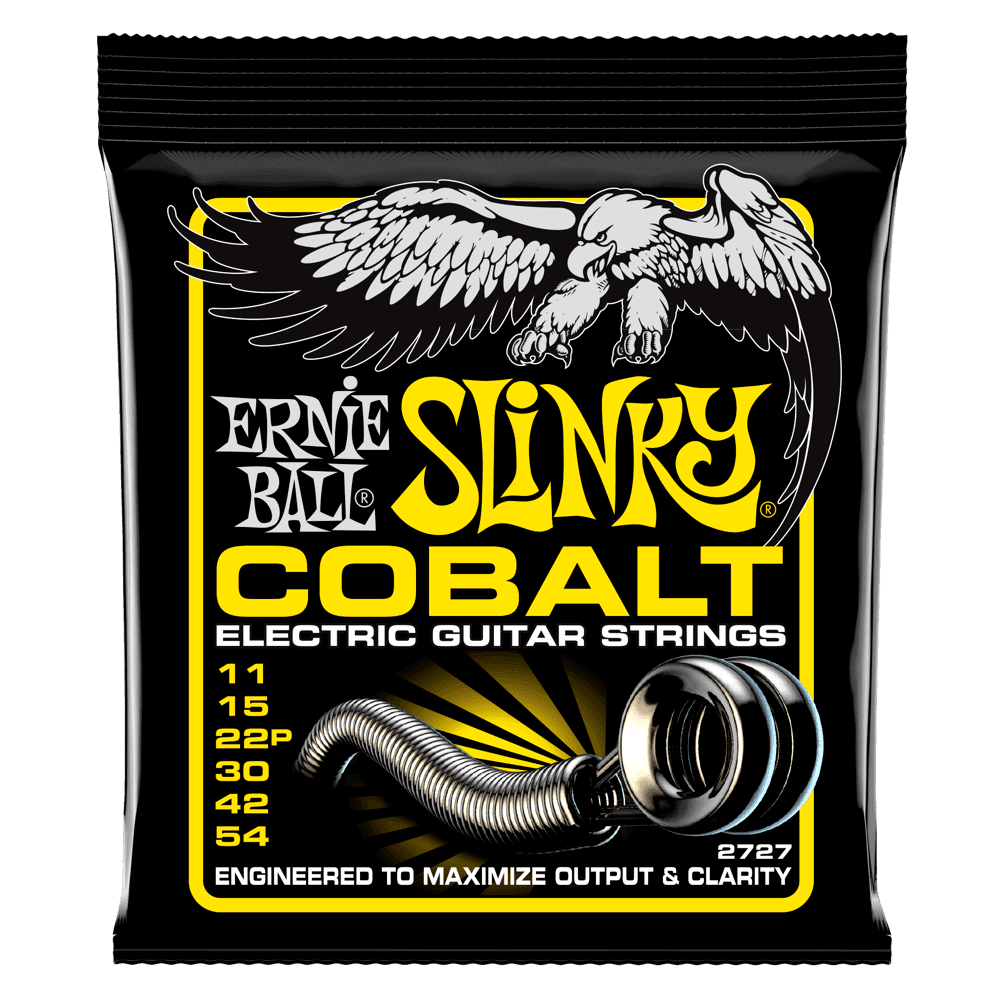
Ernie Ball Beefy Slinky Cobalt (2727) is the .011–.054 set built for Drop C# and Drop C on a 25.5-inch scale. Cobalt-iron wrap drives passive pickups roughly 2–3 dB louder than nickel at the same gauge, with a tighter upper-midrange that holds palm-muted low-string definition under high gain. Sits between Power Slinky Cobalt (.011–.048) and Not Even Slinky Cobalt (.012–.056) in the Cobalt range. Pick it for Drop C# / Drop C rhythm work where .010s flap and .012s feel stiff.

Anatomy
- SKU
- Ernie Ball 2727
- MPN
- P02727
- Gauge
- .011 – .054 (Beefy Slinky)
- Gauge set
- .011, .015, .022, .030, .042, .054
- Core wire
- Tin-plated hex steel
- Wrap wire
- Cobalt-iron alloy (the whole point of the line)
- Plain strings
- Tin-plated hex-core steel (.011, .015, .022 plain)
- Coating
- None, uncoated
- Winding
- Standard roundwound
- Intended scale
- 25.5" (Strat / superstrat) primary; 24.75" (Les Paul) for slightly looser feel
- Intended tunings
- Drop C#, Drop C, D standard, Drop D, Eb standard (with stiffer bending feel)
- Total tension (25.5", Drop C)
- ~93 lbs
- Total tension (25.5", E standard)
- ~105 lbs (stiff, not the intended tuning)
- Launched
- January 2012 (part of the original Cobalt line debut)
- Package
- Single pack and 3-pack available
Tone
The cobalt-iron wrap is where Beefy Slinky Cobalt earns its slot in the catalog. Same gauges as nickel Beefy Slinky, different voicing through the amp.
Voicing through a passive pickup
- Output
- About 2–3 dB louder than nickel Beefy Slinky through the same passive pickup. Most players hear it before they can explain it.
- Upper midrange
- More present at 2–4 kHz. Good for cutting through dense Drop C rhythm guitar mixes.
- Low end
- Tighter palm-mute attack, slightly less bloom on the .054 in Drop C. The kind of definition that survives quad-tracking.
- Bend feel
- .011 plain on top is firm, not stiff. Quarter-step bends on the high strings feel deliberate; full-step bends still come naturally.
For the full measured Cobalt-vs-nickel breakdown (output dB curves, brightness over a tracking week, bend feel, pickup compatibility), see Cobalt vs nickel Slinky: the voicing difference, measured.
Where this set sits in the Cobalt range
Beefy Slinky Cobalt is the lighter half of the "Drop C territory" answer. The Cobalt range covers E standard up through Drop B on 6-string:
- E standard / Eb standard: Regular Slinky Cobalt (.010–.046) is the default.
- Drop D / occasional Eb: Power Slinky Cobalt (.011–.048) or Skinny Top Heavy Bottom Cobalt (.010–.052).
- Drop C# / Drop C (lighter, more bend): This set, Beefy Slinky Cobalt (.011–.054).
- Drop C / Drop B / C standard (heavier rhythm): Not Even Slinky Cobalt (.012–.056).
- Drop A# / baritone B standard: Mammoth Slinky Cobalt (.012–.062) or step into 7-string Cobalt (2730, .010–.062).
The full 8-SKU picking guide lives at Cobalt Slinky gauges explained.
Who plays this set
Dustin Kensrue (Thrice) is the documented anchor user. Featured in Ernie Ball's String Theory video series about his Cobalt rotation, with Beefy Slinky Cobalt (P02727) named directly in Ernie Ball's own companion coverage. Thrice's modern catalog (Major/Minor, Palms, Horizons/East, and 2025's Horizons/West) sits in Drop C# and Drop C on 6-string, which is exactly what the gauge was tuned for.
The line-wide Cobalt pro roster is at Who plays Cobalt Slinky strings, the 30-player roster.
Best for
- Drop C# (C#-G#-C#-F#-A#-D#) on 25.5-inch scale. Sweet spot.
- Drop C (C-G-C-F-A-D) on 25.5-inch scale. Tight without being stiff.
- D standard (D-G-C-F-A-D) on 25.5 or 24.75. Comfortable rhythm tension.
- Modern metalcore, post-hardcore, alt-metal, indie-rock with drop-tuned material. The cobalt voicing's upper-mid push helps the set sit forward in dense, layered productions.
Worst for
- E standard as a daily driver. Total tension is too high for comfortable bending; pick Regular Slinky Cobalt instead.
- Drop B and below. The .054 low string flaps in Drop B; step up to Not Even Slinky Cobalt (.012–.056) or 7-string Cobalt.
- Floyd Rose floating tremolo without a setup pass. Going from .010 to .011 on a floating bridge wants spring tension recalibration.
- Slide players in open tunings. The extra tension fights the slide's natural pressure; use a purpose-built slide set.
Install and break-in
Stepping up from .010s adds roughly 12–15 pounds of total neck tension. Plan a setup pass: truss rod (typically a quarter-turn loosen for relief), nut slots (the .015, .022 wound, and .030 wound may need light filing if you're coming from a .013 plain / .017 plain / .026 wound .010 set), bridge intonation. Walkthrough at Heavy-gauge electric string install guide.
Break-in is 30–45 minutes of playing before the bright initial top end settles into played-in voice. Stretch each string before that (press behind the 12th fret, pull up about an inch, three-to-four times per string, retune, repeat).
Verdict
If your default tuning is Drop C# or Drop C and you're running passive pickups, Beefy Slinky Cobalt is the cleanest single answer in the Ernie Ball catalog. The cobalt wrap's extra output and upper-mid push gives you the rhythm-guitar definition a Drop C tuning needs through high-gain amps without forcing you up to a .012 set that feels stiff for bending. The .011 plain top still bends like a rock string. The .054 bottom holds the chug.
Pick this over nickel Beefy Slinky if you A/B them and hear the difference. Pick nickel Beefy if you don't, or if you prefer the smoother top end nickel gives you. Match the wrap to your taste; match the gauge to your tuning.
Related
Related