Ernie Ball Cobalt Slinky gauges explained: the full 12-set lineup, picked by tuning
Written with AI help · Updated
Ernie Ball ships twelve 6-string Cobalt Slinky sets spanning .008–.038 (Extra) up to .012–.062 (Mammoth). Pick Regular Slinky Cobalt (.010–.046) for E or Eb standard, that's the default. Step up one gauge for every whole-step down: Power Slinky (.011–.048) for Eb / Drop D, Beefy Slinky (.011–.054) for Drop D to Drop C, Not Even Slinky (.012–.056) for Drop C, Mammoth Slinky (.012–.062) for Drop B and below. Lighter gauges (Extra, Super, Primo, Hybrid) are for E standard on faster-playing or lighter-touch setups.
The full Cobalt Slinky gauge lineup
Ernie Ball ships twelve standard 6-string Cobalt sets, plus three 7-string sets and a bass line. All use the same cobalt wrap-wire alloy; the only thing that changes set to set is string gauge. Pick by tuning first, scale length second, hand strength third.
| Set | SKU | Gauge | Total tension (25.5", E std) | Best tuning | |
|---|---|---|---|---|---|
| Extra Slinky Cobalt | EB 2725 | .008–.038 | ~86 lbs | E standard (light touch, shred-friendly) | |
| Super Slinky Cobalt | EB 2723 | .009–.042 | ~93 lbs | E standard (shred-friendly default) | |
| Hybrid Slinky Cobalt | EB 2722 | .009–.046 | ~98 lbs | E standard with heavy low-end | |
| Primo Slinky Cobalt | EB 2712 | .0095–.044 | ~96 lbs | E standard (between Super and Regular) | |
| Regular Slinky Cobalt | EB 2721 | .010–.046 | ~100 lbs | E standard / Eb standard (default) | |
| Ultra Slinky Cobalt | EB 2717 | .010–.048 | ~103 lbs | E standard heavy hand / Eb standard | |
| Power Slinky Cobalt | EB 2720 | .011–.048 | ~107 lbs | Eb standard / Drop D | |
| Burly Slinky Cobalt | EB 2716 | .011–.052 | ~109 lbs | Drop D / D standard | |
| Skinny Top Heavy Bottom Cobalt | EB 2715 | .010–.052 | ~105 lbs | Drop D with light top-end leads | |
| Beefy Slinky Cobalt | EB 2727 | .011–.054 | ~112 lbs | Drop C / C standard | |
| Not Even Slinky Cobalt | EB 2726 | .012–.056 | ~115 lbs | Drop C / C standard | |
| Mammoth Slinky Cobalt | EB 2714 | .012–.062 | ~120 lbs | Drop B / baritone territory |
SKUs and gauges source: Ernie Ball's own Slinky Cobalt category page. Ernie Ball doesn't publish string tension figures; the total tension column is our own engineering estimate for a 25.5-inch scale at E standard, not a manufacturer-published number.
How to pick a Cobalt gauge
Step 1: match gauge to tuning. Every whole step of detuning adds about one gauge step in heavier string requirement. E standard defaults to .010s; Eb or Drop D defaults to .010 to .048 or .011s; Drop D or D standard wants .011s or .010 to .052; Drop C wants .011s or .012s; Drop B wants .012s or a baritone set. Going lighter than this at a given tuning causes flappy low strings, intonation drift under hard picking, and eventual tuning stability issues.
Step 2: adjust for scale length. A 25.5" Fender-scale guitar is the baseline for these recommendations. On 24.75" Gibson scale, tensions drop roughly 6% for the same gauge and tuning (tension scales with the square of scale length: (24.75/25.5)^2 is about 0.94), so you can comfortably run one gauge heavier than the Fender recommendation, a Gibson-scale guitar in Drop D often plays best on Power Slinky (.011 to .048) rather than Regular. On 27" baritone scale, tensions jump enough (roughly 12% by the same math) that you want to drop one gauge lighter than a same-tuning Fender recommendation.
Step 3: adjust for hand strength and playing style. Heavy-handed players and hybrid-pickers push strings harder and can tolerate, or benefit from, the next gauge up. Light-touch fingerstyle players and extreme benders (1.5-step or full-step bends as a default vocabulary) benefit from the next gauge down.
Three-step decision quick reference
- 1. Tuning
- Whole-step detune = one gauge heavier. E std = .010, Drop D = .011, Drop C = .011 or .012.
- 2. Scale length
- Gibson 24.75 = +1 gauge. Baritone 27 = -1 gauge from the Fender recommendation.
- 3. Hand strength
- Heavy hand = +1 gauge. Heavy bender = -1 gauge.
Extra Slinky Cobalt (.008–.038, EB 2725)
The lightest Cobalt gauge. Almost exclusively a shred/speed-metal set for E standard players who want the absolute lightest bending feel. Not recommended below E standard; the low .038 will flap. For reference, Paul Gilbert's documented default is a .009 Super Slinky (RPS); the Extra is one step lighter still.
Super Slinky Cobalt (.009–.042, EB 2723)
The default .009 set across modern shred and fusion. Steve Vai, a long-documented .009 Super Slinky player, demoed the Cobalt version in Ernie Ball's 2012 launch-era videos. If you came up playing EVH, Vai, or Satriani recordings, this is the Cobalt set most likely to match what you were hearing. E standard only; on Eb standard, most players should step to .010 Regular Slinky.
Primo Slinky Cobalt (.0095–.044, EB 2712)
A half-gauge set, .0095 to .044, sitting exactly between Super Slinky Cobalt (.009 to .042) and Regular Slinky Cobalt (.010 to .046). Ernie Ball introduced the Primo/Mega half-gauge concept in its nickel line in 2019 before extending the same .0095-.044 spec into Cobalt under the "Cobalt Expanded Gauges" collection. Worth trying if you've A/B'd .009 and .010 Cobalt sets and landed in between; skip it if you already know which of the two you prefer. Full breakdown: Primo Slinky Cobalt review.
Regular Slinky Cobalt (.010–.046, EB 2721)
The default. What Ernie Ball recommends as the starting Cobalt set for most players. E standard or Eb standard, 25.5-inch scale, rock / blues / hard rock / blues-rock. Steve Lukather demoed this gauge in Ernie Ball's 2012 Cobalt play-test videos. If you don't have a reason to pick a different gauge, pick this one.
Ultra Slinky Cobalt (.010–.048, EB 2717)
Ernie Ball builds this set from Regular Slinky's top three strings (.010, .013, .017) and Power Slinky's low E (.048), a narrower step up from Regular Slinky than going all the way to Power Slinky's .011 top. Best for E standard players who pick hard, or Eb standard players who find a full Power Slinky top too stiff. Full breakdown: Ultra Slinky Cobalt review.
Power Slinky Cobalt (.011–.048, EB 2720)
One step heavier than Regular. The gauge Slash beta-tested at the 2012 Cobalt launch (his current Ernie Ball signature set is an 11–48 Paradigm-core nickel set). Best for Eb standard or Drop D on Fender scale, or E standard for players with a heavy hand who want more low-end definition. Borderline for Drop D on Gibson scale; many players prefer stepping all the way to .011 to .052 Skinny Top Heavy Bottom for Drop D work.
Skinny Top Heavy Bottom Cobalt (.010–.052, EB 2715)
The mixed-gauge specialty set. Light-gauge top three (.010, .013, .017) for leads and bends; heavy-gauge bottom three (.030, .042, .052) for Drop D rhythm. The set of choice for players who live in a mix of E standard and Drop D. Full breakdown: Skinny Top Heavy Bottom Slinky Cobalt review. Frank Carter & The Rattlesnakes guitarist Dean Richardson is Equipboard-documented on this gauge via Instagram; Ryan "Fluff" Bruce, who appears in Ernie Ball's own Cobalt comparison video, is separately credited showcasing it in a 2021 Instagram string guide.
Beefy Slinky Cobalt (.011–.054, EB 2727)
The Drop C default. A step up from Skinny Top Heavy Bottom on the bass side, with a matched .011 top string. Handles Drop C and C standard on 25.5" scale electrics without flapping, without forcing you up to the full .012 Not Even set. Dustin Kensrue's Cobalt gauge of choice on his Thrice rig.
Not Even Slinky Cobalt (.012–.056, EB 2726)
The second-heaviest standard Cobalt set; only the Mammoth Slinky Cobalt (.012 to .062) goes lower. Built for Drop C and C standard. It's the reference for "I play passive pickups and I want the low string to punch through a high-gain mix." Not for E standard, at E, it's uncomfortable for most players and wasteful of the gauge. See our full Not Even Slinky Cobalt review for the full breakdown.
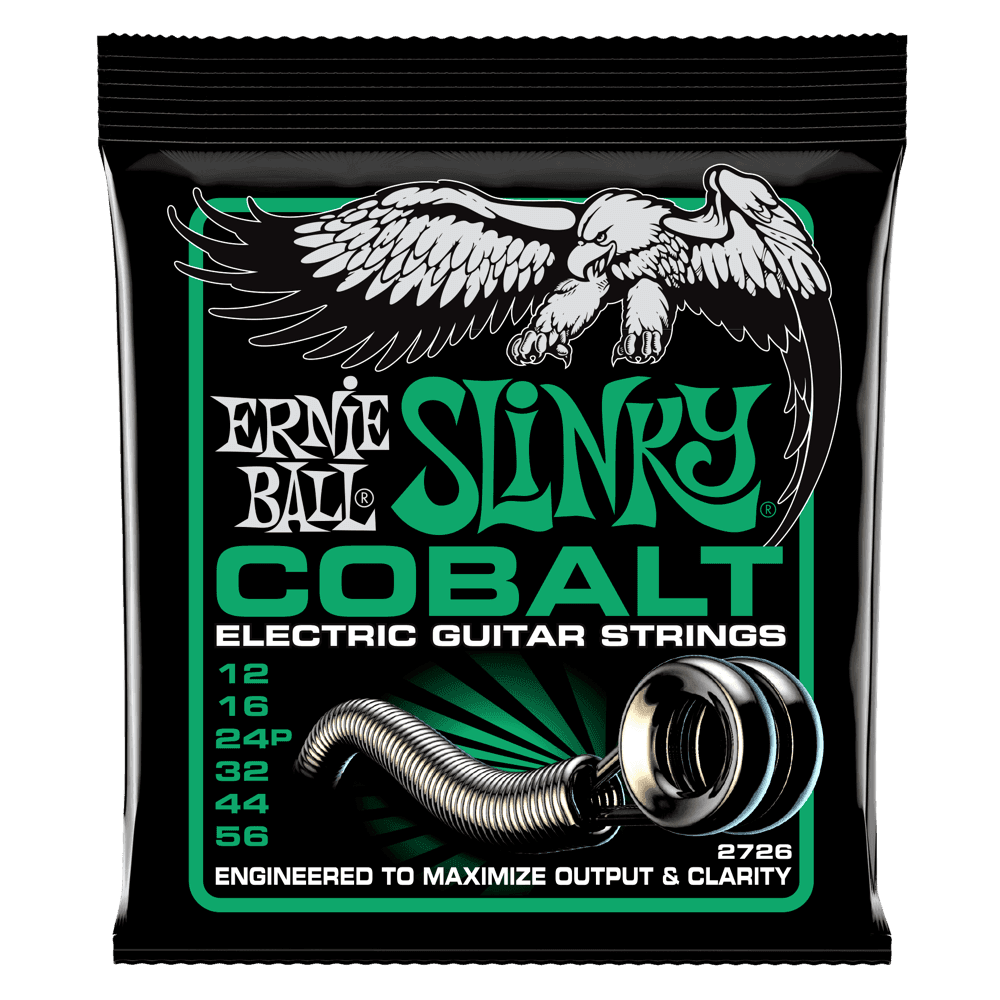
Not Even Slinky Cobalt (.012–.056)
Why this one: The second-heaviest standard Cobalt Slinky, behind only Mammoth Slinky Cobalt. Drop C and lower, 25.5-inch scale, passive pickups that need definition under gain.
Mammoth Slinky Cobalt (.012–.062, EB 2714)
The heaviest standard 6-string Cobalt gauge Ernie Ball makes. Built for Drop B, Drop A#, and baritone B standard on a 25.5-inch scale, a full step below where Not Even Slinky Cobalt starts to feel loose. Ernie Ball lists it under its "Cobalt Expanded Gauges" line, alongside Primo and Burly Slinky Cobalt, rather than the original 2012 core launch. Full breakdown: Mammoth Slinky Cobalt review.
Burly Slinky Cobalt (.011–.052, EB 2716)
Power Slinky Cobalt's .011, .014, .018 top three, carried by a heavier .030, .042, .052 bottom built for Drop D and D standard. The uniformly-heavy counterpart to Skinny Top Heavy Bottom Cobalt, which shares the same .052 low string but keeps a lighter .010 top for leads. No documented anchor artist yet; see the full review for the sourcing detail. Full breakdown: Burly Slinky Cobalt review.
7-string Cobalt
- Regular Slinky Cobalt 7-string (EB 2728, .010 to .056): B standard or Drop A. Jason Richardson's documented Drop A set per Ernie Ball's own podcast.
- Power Slinky Cobalt 7-string (EB 2729, .011 to .058): Richardson's documented Drop G set; the heavier-top sibling. Full breakdown: Power Slinky Cobalt 7-string review.
- Skinny Top Heavy Bottom Slinky Cobalt 7-string (EB 2730, .010 to .062): light top for leads, .062 low for Drop A / Drop G#.
- 8-string: Ernie Ball does not currently ship an 8-string Cobalt set. 8-string players use the nickel-wound 8-String Slinky (EB 2625) or custom singles. (EB 2732 is the Cobalt Regular Slinky bass set, .050 to .105, not a guitar set.)
- Baritone-specific: A 7-string set minus its top string is the common custom build for players tuning below Drop A on 6-string scale.
Picking by tuning, quick reference
Cobalt set by tuning
- E standard (light touch)
- Extra Slinky Cobalt (.008) or Super Slinky Cobalt (.009)
- E standard (medium)
- Regular Slinky Cobalt (.010)
- E standard (heavy hand)
- Hybrid Slinky Cobalt (.009 to .046) or Power Slinky Cobalt (.011)
- Eb standard
- Regular Slinky Cobalt (.010) or Power Slinky Cobalt (.011)
- Drop D
- Power Slinky Cobalt (.011) or Skinny Top Heavy Bottom Cobalt (.010 to .052)
- D standard
- Power Slinky Cobalt (.011) or Beefy Slinky Cobalt (.011 to .054)
- Drop C
- Beefy Slinky Cobalt (.011 to .054) or Not Even Slinky Cobalt (.012 to .056)
- C standard
- Not Even Slinky Cobalt (.012 to .056)
- Drop B
- Mammoth Slinky Cobalt (.012 to .062) or a 7-string set stripped down
- B standard (7-string)
- Regular Slinky Cobalt 7-string (.010 to .056) or STHB Cobalt 7-string (.010 to .062)
Related
- The canonical deep-dive: Not Even Slinky Cobalt (.012 to .056) full review.
- Voicing vs nickel: Cobalt vs nickel Slinky comparison.
- All five Ernie Ball wire lines: Slinky vs RPS vs M-Steel vs Paradigm vs Cobalt.
- Who's on what gauge: the documented Cobalt pro users.
- Tuning targets and scale physics: String gauge and scale length reference.
Frequently asked questions
Which Cobalt Slinky gauge should I buy first?
Regular Slinky Cobalt (.010 to .046, EB 2721) if you play in E or Eb standard on a 25.5-inch scale electric. That's the default Cobalt set Ernie Ball recommends, and it's what most Cobalt players start on. Step heavier or lighter only if you have a specific reason, tuning, hand strength, or scale length.
Read the full Cobalt Slinky review for the voicing breakdown.
Is the .012–.056 Not Even Slinky Cobalt too heavy for E standard?
For most players, yes. At E standard on a 25.5-inch scale, .012–.056 produces roughly 115 pounds of total tension, about 15 pounds more than a .010–.046 set at the same pitch (see the tension column above). That's stiff under bends and harsh on a guitar set up for .010s. Use this gauge for Drop C, Drop B, C standard, or D standard. For E standard, drop to Regular Slinky Cobalt or Power Slinky Cobalt.
What's the difference between Beefy Slinky Cobalt and Not Even Slinky Cobalt?
One gauge step. Beefy Slinky Cobalt is .011–.054 (EB 2727), Not Even Slinky Cobalt is .012–.056 (EB 2726). Beefy is the sweet spot for Drop D and some Drop C setups; Not Even is for Drop C and below where you need the extra low-end rigidity. Most Drop C players run Beefy; most Drop B players run Not Even.
Does Ernie Ball make 7-string Cobalt sets?
Yes, three of them: Regular Slinky Cobalt 7-string (EB 2728, .010 to .056), Power Slinky Cobalt 7-string (EB 2729, .011 to .058), and Skinny Top Heavy Bottom Slinky Cobalt 7-string (EB 2730, .010 to .062). They cover B standard through Drop A and Drop G#. Ernie Ball does not currently ship an 8-string Cobalt set; 8-string players use the nickel-wound 8-String Slinky or custom singles.
Pair with the 7-string gauge guide or 8-string gauge guide to pick the right tuning target.
What about Cobalt bass strings?
Ernie Ball Cobalt Flatwound and Cobalt Roundwound bass sets exist and ship in standard bass gauges (.045–.105, .050–.105, 5-string variants). Tony Levin was among the named beta testers at the 2012 Cobalt launch. The voicing difference, brighter, more output, tighter low end, carries over from the guitar line.
Can I mix gauges across the Cobalt range?
Yes. The Skinny Top Heavy Bottom Cobalt (.010–.052) is the classic mixed set, light top three for leads, heavier bottom three for Drop D rhythm. It's the go-to set for players who want to solo in standard and drop the low E to D mid-song. Dean Richardson and Ryan Bruce both run this set on various guitars.
Does gauge affect Cobalt's voicing characteristics?
The voicing change, louder output, more upper midrange, is inherent to the cobalt wrap alloy, not the gauge. You get the same tonal profile from .008 Extra Cobalt and from .012 Not Even Cobalt. Heavier gauges push it further because there's more wrap-wire mass moving in the pickup field, but the character is the same.