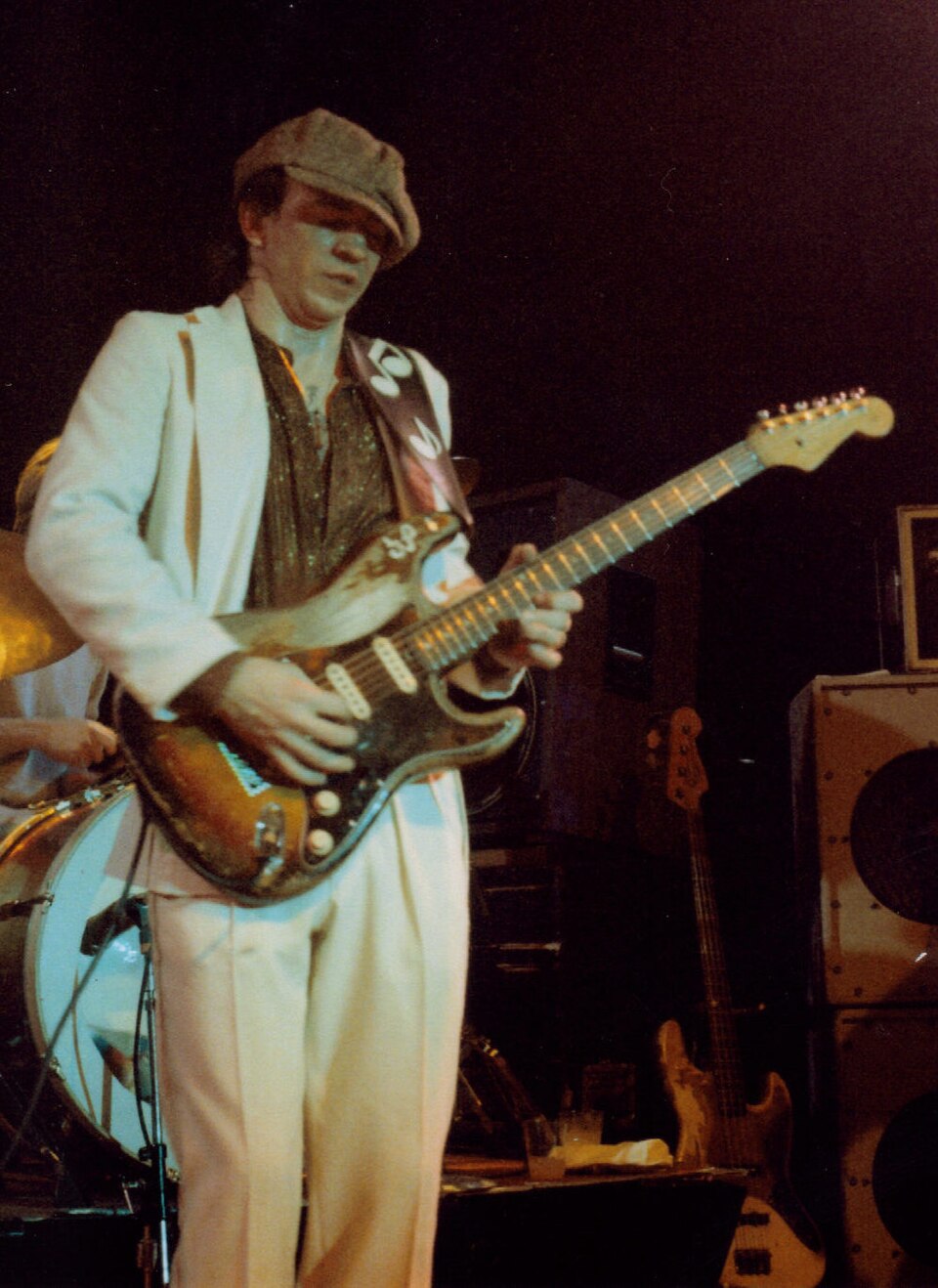
Stevie Ray Vaughan's guitar strings: the Number One Strat rig, sourced
Documented string gauges and tunings Stevie Ray Vaughan used with Double Trouble. GHS Nickel Rockers in a custom heavy set (around .013–.058) on his 1962/63 Stratocaster Number One, tuned to Eb standard. With citations.
Double Trouble / Solo / The Vaughan Brothers · written with AI help · updated
Stevie Ray Vaughan played GHS Nickel Rockers in a custom heavy set documented by his tech Rene Martinez: roughly .013, .015, .019 plain, .028, .038, .058. He dropped the high E toward .011 or .012 late in life after finger injuries. He always tuned a half step down to Eb standard, which kept the tension manageable on the heavier gauges. His primary instrument was 'Number One,' a hybrid 1962/63 Fender Stratocaster he found at Ray Hennig's Heart of Texas Music in Austin in 1973. Vaughan died in a helicopter crash in August 1990 at age 35.
Who Stevie Ray Vaughan was
Stephen "Stevie Ray" Vaughan (October 3, 1954, Dallas, Texas, August 27, 1990, East Troy, Wisconsin, helicopter crash) was the lead guitarist, vocalist, and primary songwriter for Double Trouble, the Austin-based blues-rock trio that broke through with Texas Flood (1983) and reshaped American electric blues for a generation. His five studio records, plus the posthumous Family Style (with his brother Jimmie) and The Sky Is Crying compilation, define the canonical Texas-blues sound of the 1980s.
He's the most-cited modern blues guitarist in any "greatest guitarist" list, both for his technical fluency (the Texas Flood solo, the Couldn't Stand the Weather shuffle, the live Riviera Paradise improvisations) and his role in pulling the major-label industry's attention back to electric blues at a moment when blues was commercially marginal. He died at 35, four hours after a benefit show in East Troy, Wisconsin.
Vaughan idolized Lonnie Mack for years before they ever met, naming Mack's 1963 instrumental "Wham!" as the first single he ever bought; his own "Scuttle Buttin'" is a direct descendant of Mack's "Chicken Pickin'." In 1983, Vaughan convinced Mack to relocate from Indiana to Texas, and the following year he co-produced Mack's Alligator Records comeback album, Strike Like Lightning (1985), playing guitar on several tracks himself.
What he played
GHS Nickel Rockers in a custom heavy set documented by his tech Rene Martinez: .013, .015, .019 plain, .028, .038, .058, always tuned a half step down to Eb standard. The plain unwound .019 third string is the unusual element; most .013 sets ship with a wound third. The plain third bends like an unwound string but rings with single-coil clarity. Late in life, after finger injuries, he moved the high E toward .011 or .012.
His primary instrument was Number One, a hybrid 1962/63 Stratocaster found at Ray Hennig's Heart of Texas Music in Austin in 1973. Alder body (1963), rosewood-fretboard neck (1962-style). Number One is on every Double Trouble record. He also played Lenny (a 1965 Strat given to him by his wife Lenora and friends), Scotch (a 1961 Strat), Red (a 1962 Strat refinished red), and Charley (a white hardtail custom built for him by Charley Wirz of Charley's Guitar Shop in Dallas in 1983, fitted with three Danelectro lipstick pickups).
The signal chain into Fender Vibroverbs and Dumble Steel-String Singers (the Dumble was on his major-label era) drove the saturation. His pedalboard was small: an Ibanez Tube Screamer (the TS-808 / TS-9 cycle), a Fuzz Face, a Vox wah, an Octavia. The harmonic-rich Strat-into-tube-amp tone is the textural baseline.
Why this fits the rig
The .013 set at Eb tunes to roughly the tension a .010 set hits in E standard, so the heavier mass moves more air, drives the pickups harder, and stays in tune under his violent picking attack. SRV's right hand pulls the strings with enough force to detune lighter gauges; the .013 set is mechanically calibrated to his attack. The plain .019 third is the secret detail: plain strings bend more cleanly and ring clearer through single-coil pickups than a wound third at the same gauge.
Number One's pickups are fairly standard early-1960s single-coils (the neck pickup is famously dated 1959), and it is the saturated bridge-Strat-into-tube-amp combination that produces the Texas Flood tone. The heavy strings keep that bright bridge pickup from sounding thin: the higher mass delivers fundamental low-mid weight that a .010 set in the same rig would lose to high-end fizz.
If you want this rig
The closest stock equivalent is the GHS Nickel Rockers 1300 'Low Tune' set tied to him: .011 to .058. That is a touch lighter on top than his earlier .013 set, because it was hand-selected from what he played near the end of his life. If you want the earlier feel, order a custom .013 to .058 Nickel Rockers set.
Tuning to Eb is non-optional if you want to play Vaughan's catalog at the original keys with comparable string feel; the heavy gauges in E standard turn into piano wire on a 25.5-inch scale.

Nickel Rockers 1300 Low Tune (.011–.058)
Why this one: GHS's hand-selected posthumous set drawn from Vaughan's tech Rene Martinez's documented gauges. Closest stock match to the heavy, Eb-tuned rig behind his catalog.