Top 10 7-string guitar players: who plays 7-string and what strings they use
Written with AI help · Updated
The 10 most documented 7-string players: John Petrucci (Dream Theater, Music Man), Mark Holcomb (Periphery, PRS SVN), Misha Mansoor (Periphery, Jackson Juggernaut), Jason Richardson (ex-Born of Osiris), Jeff Loomis (Arch Enemy, Schecter), Keith Merrow (solo, Schecter KM-7), Wes Hauch (Alluvial, Ibanez), James 'Munky' Shaffer (Korn), Chris Broderick (In Flames, ex-Megadeth), Tony MacAlpine (solo). Low-string gauges cluster in the .056 to .062 range for Drop A / Drop G tunings on 25.5 to 26.5-inch scales.
The 7-string canon
7-string guitar adds a low B below the standard E on a 6-string, extending rhythmic range a perfect fourth down. That extra string opened up heavy rhythm voicings for metal that 6-string in Drop D or Drop C couldn't match without further de-tuning. From Steve Vai's Ibanez Universe in 1990 through Korn's A-standard nu-metal in the mid-1990s, through Dream Theater's prog-metal adoption, and into the 2008 to 2016 djent wave, 7-string has been the preferred instrument whenever the composition needs a low note that still reads as a guitar rather than a bass.
This page is the ranked roster of the players who most shaped that history, ten guitarists whose 7-string work either defined a subgenre or whose rig choices now set the reference for what "7-string metal" sounds like.
Ranked top 10 (at a glance)
| Rank | Player | Band/Project | Strings & gauge | Tuning | |
|---|---|---|---|---|---|
| 1 | John Petrucci | Dream Theater | Ernie Ball Petrucci 7-String Regular Slinky (.010–.056) | B standard | |
| 2 | Mark Holcomb | Periphery | Ernie Ball customs (gauges outside stock sets, per Holcomb) | Drop G# | |
| 3 | Misha Mansoor | Periphery | Custom 7-string gauges (publicly cited specs vary) | Drop G# / Drop A | |
| 4 | Jason Richardson | ex-Born of Osiris / solo | Ernie Ball Cobalt, 10–56 (Drop A) / 11–58 (Drop G) | Drop A / Drop G | |
| 5 | Jeff Loomis | Arch Enemy / ex-Nevermore | Von Frankenstein 'Seven Strings of God' signature (9–62) | B standard / Drop A | |
| 6 | Keith Merrow | Conquering Dystopia / solo | Ernie Ball Cobalt custom (9–46 + .062 documented) | Drop A / Drop G | |
| 7 | Wes Hauch | Alluvial / ex-Thy Art Is Murder | D'Addario NYXL 10–52 per PG Alluvial rundown (earlier: custom EB Cobalt) | Drop G / Drop F# | |
| 8 | James 'Munky' Shaffer | Korn | Ibanez APEX-factory / current brand uncited | A standard (whole step below B) | |
| 9 | Chris Broderick | In Flames / ex-Megadeth | Jackson 7-string signature; publicly cited gauges vary | B standard | |
| 10 | Tony MacAlpine | Solo / Planet X | Ernie Ball (aggregators cite ~.009–.052; line unconfirmed) | B standard / E standard |
1. John Petrucci, Dream Theater
The most influential 7-string player in prog-metal. Petrucci adopted 7-string on Falling Into Infinity (1997) and has been on 7-string since. His Music Man Majesty and JP signature lines include 7-string models; his documented 7-string set is the Ernie Ball Petrucci 7-String Regular Slinky (.010 to .056), per his own gear page. His 7-string work is the gold standard for clean technical execution, arpeggios, sweep picking, and riff-melody interplay across the bottom three strings.
See the full Petrucci rig page for gauges by album.
2. Mark Holcomb, Periphery
Periphery is the band modern djent references the most; Holcomb's 7-string work is at the center. He is a documented Ernie Ball artist (his String Theory episode is on Ernie Ball's own site) and has described running custom gauge combinations outside normal stock sets. Periphery's current tuning is 7-string Drop G#; his PRS SE Mark Holcomb SVN signature runs a 26.5-inch scale to hold that tuning without baritone compromise. Current SVN models ship with his Seymour Duncan Scarlet & Scourge signature pickups (earlier runs carried his Alpha / Omega set).
See the full Holcomb rig page.
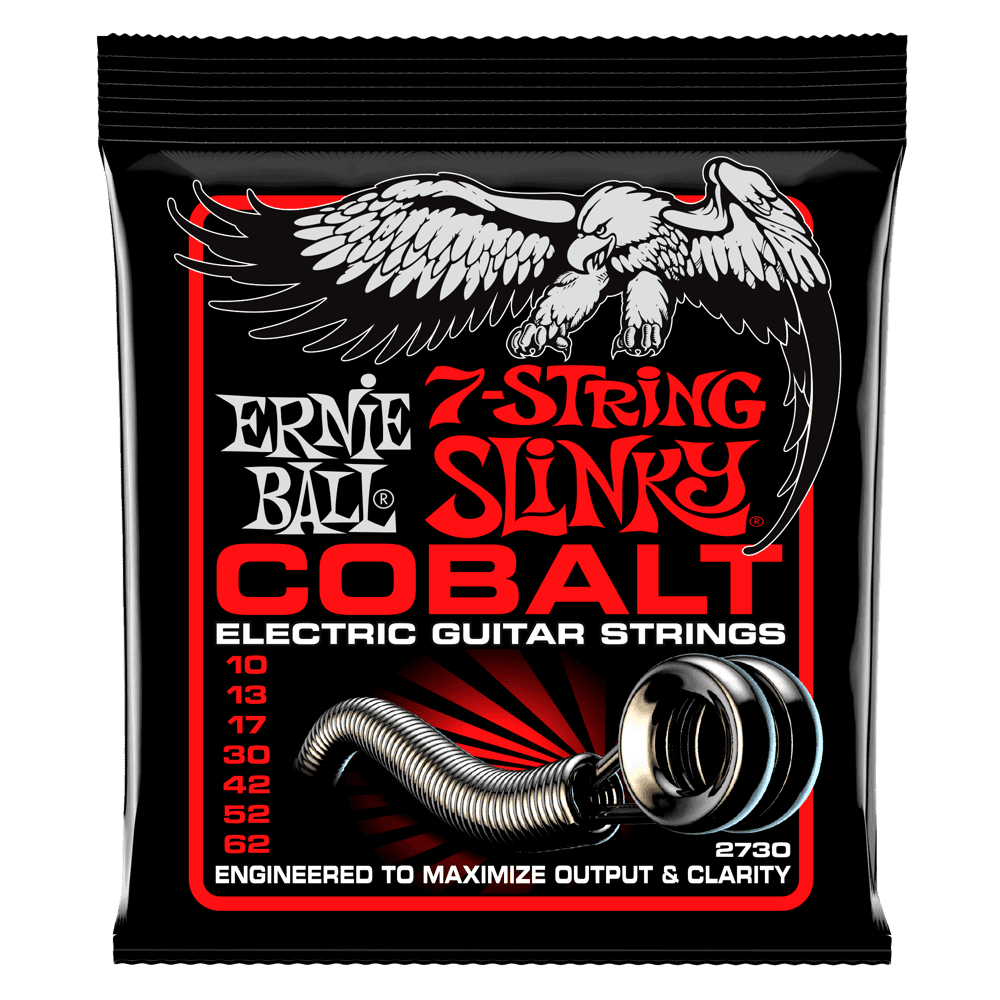
Skinny Top Heavy Bottom Slinky Cobalt 7-String (.010–.062)
Why this one: The heaviest stock 7-string Cobalt set Ernie Ball ships (EB 2730), built for the Drop G# / Drop A territory this roster lives in.
3. Misha Mansoor, Periphery
Periphery's founding member, primary songwriter, and the other half of Periphery's 7-string guitar pair. Mansoor's Jackson Juggernaut signature is the reference modern metal superstrat. His string gauges are less publicly documented brand-by-brand than his bandmate's; publicly cited specs vary, so we don't assert a set here. Mansoor is also the principal at GetGood Drums (with Nolly) and runs Horizon Devices, his signal-processing company.
4. Jason Richardson, ex-Born of Osiris / solo
Richardson's solo catalog (Jason Richardson, II) and his earlier work with Born of Osiris, Chelsea Grin, and All That Remains put him on 7-string extensively. Music Man Cutlass 7 signature is his primary guitar. His documented strings, in his own words on Ernie Ball's Striking A Chord podcast: "primarily the Cobalts," 10 to 56 for Drop A and 11 to 58 for Drop G. Known for high-difficulty lead passages layered over djent-adjacent rhythm beds.
See the full Richardson rig page.
5. Jeff Loomis, Arch Enemy / ex-Nevermore
Loomis's Nevermore catalog and his current Arch Enemy work (since 2014) put him in the technical-death-metal-adjacent 7-string lane. Schecter Jeff Loomis 7 signature guitar. His solo work (Zero Order Phase, Plains of Oblivion) documents his lead vocabulary. His signature 7-string set is Von Frankenstein Monster Gear's "The Seven Strings of God" (.009/.011/.016/.026/.036/.046/.062): a light top for his lead vocabulary over a heavy low string for the B.
6. Keith Merrow, Conquering Dystopia / solo
Merrow's Schecter KM-7 MKIII signature is a reference instrument for Drop G / Drop F# 7-string work. Ernie Ball Cobalt 7-string gauge documented across his rig rundowns. His YouTube content is a significant education source for modern djent rhythm technique. Conquering Dystopia (with Jeff Loomis, Alex Webster, Alex Rüdinger) is his highest-profile band context.
7. Wes Hauch, Alluvial / ex-Thy Art Is Murder
Hauch is the 7- and 8-string technical-death-metal player whose work sits at the intersection of djent rhythm technique and tech-death composition. Premier Guitar's Alluvial Rig Rundown documents him on Ibanez 7-strings (Prestige RG, Iceman) strung with D'Addario NYXL 10 to 52. Earlier coverage (Wired Guitarist, 2017) documented custom Ernie Ball Cobalt gauges, 9 to 46 plus a .062 on 7-strings. His string choice has moved across brands; the rundown is the current reference.
See the full Hauch rig page.
8. James 'Munky' Shaffer, Korn
Shaffer (with Brian "Head" Welch) brought 7-string into nu-metal on Korn's 1994 self-titled debut, tuned a whole step below B standard to A standard. Ibanez APEX and earlier K7 signature guitars. Shaffer's 7-string work is rhythm-forward, riff-based, and defined the low-tuning wall-of-sound that characterizes Korn's catalog. Gauge specifics for current Korn output are uncited as of this page's review, no fresh primary-source rig rundown on file.
9. Chris Broderick, In Flames / ex-Megadeth
Broderick's Megadeth tenure (2008 to 2014) is his highest-profile credit; he has played with In Flames since 2019, joining as a full member in 2022 and appearing on 2023's Foregone. Jackson signature guitars including 7-string configurations. Known for technical precision across both 6- and 7-string contexts. Publicly cited gauge specs vary; we don't assert a set without a primary source.
10. Tony MacAlpine, solo / Planet X
MacAlpine has played 7-string on solo material and with Planet X (the Derek Sherinian / Virgil Donati supergroup). He is an Ernie Ball player whose publicly cited gauges vary across sources, aggregators list sets around .009 to .052, lighter than most djent peers, reflecting his tuning preference (often B standard or even E standard on 7-string rather than Drop A). No primary source confirms the specific line. MacAlpine's technical vocabulary is neoclassical-shred-adjacent; his gauge choice supports the legato and sweep-picking vocabulary he's known for.
What all ten have in common
Looking across the ten: most use a .010 high E (Loomis and Merrow run .009 tops). Low string gauges cluster at .056 to .062 for Drop A / Drop G territory. Scale lengths run 25.5 to 26.5 inches, with the djent-era signatures (Schecter KM-7, PRS SVN) at the long end. String-brand affiliation splits across Ernie Ball (Petrucci, Richardson, Merrow documented; Holcomb on customs), D'Addario NYXL (Hauch, current), and Von Frankenstein (Loomis), with factory-strung Jackson / Ibanez for the rest. Tuning is dominated by Drop A / Drop G#, B standard is now the minority even in prog-metal.
Engineering takeaways
- Low string gauge
- 14 to 16 lbs tension target. .062 for Drop A on 25.5 inch is the reference.
- Scale length
- 25.5 inches unless you specifically need longer-scale feel.
- High string gauge
- Match picking and bending preference, .010 is the modal choice.
Strings that fit this lane
Skinny Top Heavy Bottom Slinky Cobalt 7-String (.010–.062)
Why this one: The heaviest stock 7-string Cobalt set Ernie Ball ships (EB 2730). Jason Richardson's documented 10-56 Drop A set is the Regular Slinky Cobalt 7-string sibling one step lighter.
Related
- Full gauge guide: 7-string guitar string gauge guide.
- 8-string sibling page: Top 10 8-string players.
- Tunings: Drop A, B standard.
- Individual rigs: John Petrucci, Mark Holcomb, Jason Richardson, Keith Merrow, Wes Hauch.
- Related producer pages: Adam "Nolly" Getgood (Periphery context), Ermin Hamidovic (prog-metal mix lane).
Frequently asked questions
Who played 7-string first in popular metal?
Steve Vai is the pop-culture starting point. His signature Ibanez Universe (UV7) appeared in 1990 and was the first mass-production 7-string electric. Korn's James "Munky" Shaffer and Brian "Head" Welch then brought 7-string into nu-metal on their 1994 self-titled record, turning the 7-string from a prog-rock curiosity into a mainstream metal tool. John Petrucci adopted 7-string around Falling Into Infinity (1997) and has been on 7-string ever since.
What's the most common 7-string tuning in metal?
B standard (B-E-A-D-G-B-E) and Drop A (A-E-A-D-G-B-E) are the two dominant tunings. Drop A takes the low B down a whole step to A, giving chord-shape parity with 6-string Drop D. Dream Theater uses B standard on most 7-string material; Periphery and most modern djent is Drop A or Drop G#. Korn originally tuned to A standard (A-D-G-C-F-A-D, a whole step below B standard) on their debut.
See the 7-string gauge guide for tension targets at each tuning.
What gauge does Mark Holcomb play?
Custom gauges. Holcomb is a documented Ernie Ball artist (his String Theory episode is on Ernie Ball's site), and he has described using custom gauge combinations outside normal stock sets rather than an off-the-shelf SKU. Periphery plays in 7-string Drop G# (G#-D#-G#-C#-F#-A#-D#) on most current material.
Read the full Slinky Cobalt review.
Does John Petrucci play 7-string on every Dream Theater record?
Since Falling Into Infinity (1997), most Dream Theater records have included 7-string material. His Music Man Majesty and JP signature guitars ship in 6- and 7-string configurations. His documented 7-string set is the Ernie Ball Petrucci 7-String Regular Slinky (.010–.056), per his own gear page. His 7-string work is predominantly tuned to B standard.
What scale length do most 7-string guitars use?
25.5 inches is the common default, same as a Strat / Tele, and Ibanez RG 7-strings use it. But the djent-era signatures often go longer: the Schecter KM-7 MK-III and the PRS SE Mark Holcomb SVN are both 26.5-inch scale for firmer low-string tension in Drop A and below. Multi-scale 7-strings (fanned-fret) taper from around 25.5 on the treble side to 26.5 or 27 on the bass side.
See the string gauge and scale length reference for the physics.
Are 7-string players all in metal?
No, but the overwhelming majority are. John Petrucci's prog-metal work is the most well-known non-djent 7-string catalog. Steve Vai uses 7-string in instrumental rock contexts. Charlie Hunter plays a custom Novax 8-string (3 bass strings + 5 guitar strings) in jazz. The 7-string is genre-heavy-metal-coded in 2026 because that's where the rhythmic demand for extended low range is highest.
Is James 'Munky' Shaffer of Korn an Ernie Ball artist?
Shaffer is an Ibanez signature artist (K7 / APEX series) and his public string-brand affiliation has shifted over Korn's career. Korn's early 7-string work used heavier gauges than typical B-standard 7-strings because the band tuned down to A standard, a whole step below B standard. Current gauge specifics for both Korn guitarists are outside the primary-source evidence bar for this page without a fresh rig rundown.
Sourcing note: Korn gauge specifics uncited as of 2026-04-20, no current primary-source quote on file.
What's the difference between Jeff Loomis's 7-string work and Jason Richardson's?
Loomis is a Schecter signature artist (Schecter Jeff Loomis 7) with a long-running reputation for technical solo work in the neoclassical-meets-death-metal lane: Nevermore and Arch Enemy. Richardson is a Music Man signature artist (Cutlass 7) whose catalog is more djent-and-prog-pop: Born of Osiris, Chelsea Grin, solo. Loomis's signature 7-string set (Von Frankenstein "The Seven Strings of God") runs 9 to 62, a light top over a heavy low string. Richardson, per Ernie Ball's own podcast, runs Cobalts at 10 to 56 for Drop A and 11 to 58 for Drop G.
Who plays 7-string in prog-rock that isn't Dream Theater?
Haken, The Contortionist, Between the Buried and Me, Intervals, Scale the Summit, Plini, and Polyphia all feature 7-string work. Polyphia's Tim Henson is a 6-string player but collaborator Scott LePage plays 7-string on some material. The prog-rock 7-string lane sits adjacent to djent but often runs lighter gauges because tunings rarely go below Drop A.