Ernie Ball string lines compared: Slinky vs RPS vs M-Steel vs Paradigm vs Cobalt
Written with AI help · Updated
Ernie Ball's five core electric string lines: Regular (nickel-plated) Slinky is the default voicing; RPS is nickel Slinky with reinforced plain strings for fewer breaks; M-Steel wraps a patented Super Cobalt alloy over a Maraging steel core for more output and stability; Paradigm is plasma-treated for extended life with a 90-day breakage guarantee; Cobalt is the cobalt alloy wrap for louder, brighter output. Pick nickel for most things, Paradigm for longevity, Cobalt for high-gain definition, M-Steel for stability, RPS for break-prevention. (Ernie Ball also ships smaller lines: Slinky Stainless Steel, Cobalt Flatwound, and RPS Coated Titanium.)
The five-line family
Ernie Ball's electric string catalog has two axes: the base construction (nickel-plated steel, cobalt alloy, M-Steel's Super Cobalt over Maraging core) and the preservation technology (none, RPS reinforcement, Paradigm treatment). These five are the core lines; smaller lines (Slinky Stainless Steel, Cobalt Flatwound, RPS Coated Titanium) sit alongside them.
| Line | Wrap wire | Core / plain strings | Treatment | Key differentiator | |
|---|---|---|---|---|---|
| Regular Slinky | Nickel-plated steel | Tin-plated hex steel | None | The default, voicing baseline since 1962 | |
| RPS Slinky | Nickel-plated steel | Tin-plated hex core + brass-reinforced plain | None | Plain strings don't break at the ball-end | |
| M-Steel Slinky | Super Cobalt alloy (patented) | Maraging steel hex core | None | Fuller tone, powerful low end, stable at low tunings | |
| Paradigm Slinky | Plasma-treated wrap | RPS-reinforced plain + Everlast nanotreatment | Plasma + nano-coat | Extended lifespan; 90-day breakage/rust guarantee | |
| Cobalt Slinky | Cobalt alloy | Tin-plated hex steel | None | Hotter output, tighter low-end articulation |
Source: Ernie Ball's own line pages for M-Steel, Paradigm, and Cobalt.
Regular Slinky, the baseline
Built since 1962, Regular Slinky is the reference voicing against which the other four lines are judged. Nickel-plated steel wrap, tin-plated hex-core steel on the plain strings, no coating. It's the sound on most of the last 60 years of rock, blues, country, and session records, and the set generations of gigging rock players started on. (For who's documented on which Ernie Ball line, see the artist roster pages; we keep per-artist claims sourced there.)
When to pick it: almost always, unless you have a specific reason to pick a different line.
When to skip it: if your application is high-gain Drop C (Cobalt wins), or if you can't or don't want to change strings every 1–2 weeks (Paradigm wins), or if your plain strings break at the ball-end regularly (RPS wins).
RPS Slinky, break-prevention variant
Identical to Regular Slinky on the wound strings; the plain strings (.009 or .010 to .013/.017) have a brass wrap around the ball-end. The ball-end is the stress concentration point where most plain-string breaks actually happen, the wire is crimped against the ball, and fatigue failures start there. RPS's reinforcing wrap distributes that stress over a longer section, which shifts the failure mode from "frequent ball-end breaks" to "the string dulls first, then you change it."
Paul Gilbert is a documented RPS endorser, on Super Slinky RPS per Ernie Ball's own String Theory series. If you break high-E strings every session or two, RPS costs the same as Regular Slinky and fixes the problem.
When to pick it: you break plain strings frequently at the ball-end.
When to skip it: you don't break plain strings, or you break them at a fret rather than the ball (RPS doesn't help with fret-end breaks).
M-Steel Slinky, the stability line
"M" for Maraging, a low-carbon, nickel-rich tool steel used in aerospace applications. Per Ernie Ball's own line page, M-Steel winds a patented Super Cobalt alloy wrap wire around a Maraging steel hex core. Ernie Ball pitches the result as richer, fuller tone with powerful low end, plus markedly better tuning stability at heavy gauges and drop tunings.
It's a niche line compared to the mainline Slinky or Cobalt; availability is narrower, and some retailers only stock the heavier gauges.
When to pick it: you want tighter feel at a given gauge without bumping to a bigger set, especially for heavy rhythm work in drop tunings.
When to skip it: you're happy with the feel of Regular Slinky, or you need coated-string longevity.
Paradigm Slinky, the longevity line
Ernie Ball's answer to Elixir. A plasma-based surface treatment is applied to the wire before winding, combined with Everlast nanotreatment and RPS-reinforced plain strings. Ernie Ball claims 35% more tensile strength and 70% more fatigue strength than standard strings and backs the line with a 90-day breakage and rust replacement guarantee; in practice it extends life well past the 1–3 weeks of an uncoated set. The voicing is nearly identical to Regular Slinky once the strings are broken in.
Stephen Carpenter (Deftones) is a documented Paradigm player per his Ernie Ball String Theory episode. The line is particularly popular among touring players who want to reduce string-change frequency on the road. Some retailers discount Paradigm below Elixir's equivalent Optiweb line, which makes the cost-per-week-of-use math attractive.
When to pick it: you change strings every 1–2 weeks and would prefer far longer between changes.
When to skip it: you already prefer the fresh-uncoated feel of Regular Slinky and don't mind changing often, or you need a specific voicing (Cobalt, M-Steel) that Paradigm doesn't replicate.
Cobalt Slinky, the voicing line
Announced at NAMM in January 2012, on shelves that March. The wrap-wire alloy is a cobalt alloy rather than nickel-plated steel. Cobalt is more magnetically permeable than nickel, so the string reads louder and brighter through the same pickup. Ernie Ball and player reviews consistently describe that output jump as noticeable, but we couldn't find a documented dB measurement behind it, so treat "louder" as a real, widely reported difference in degree rather than a precise number. Players commonly describe the brightness as sitting more in the upper midrange than the top octave, with tighter low-end articulation under gain.
Per Guitar World's launch coverage, the named beta testers were Slash, John Petrucci, Steve Morse, Tony Levin, and Randy Jackson. Full roster is in our documented Cobalt user list. Cobalt is particularly effective for Drop C and lower tunings where nickel's natural low-end bloom becomes mud under high gain.
When to pick it: high-gain passive-pickup rigs in drop tunings, session situations where you want the guitar forward without compression.
When to skip it: active pickups (redundant gain/brightness), vintage-tone applications (wrong voicing), or budget-constrained players (it costs noticeably more than Regular Slinky).
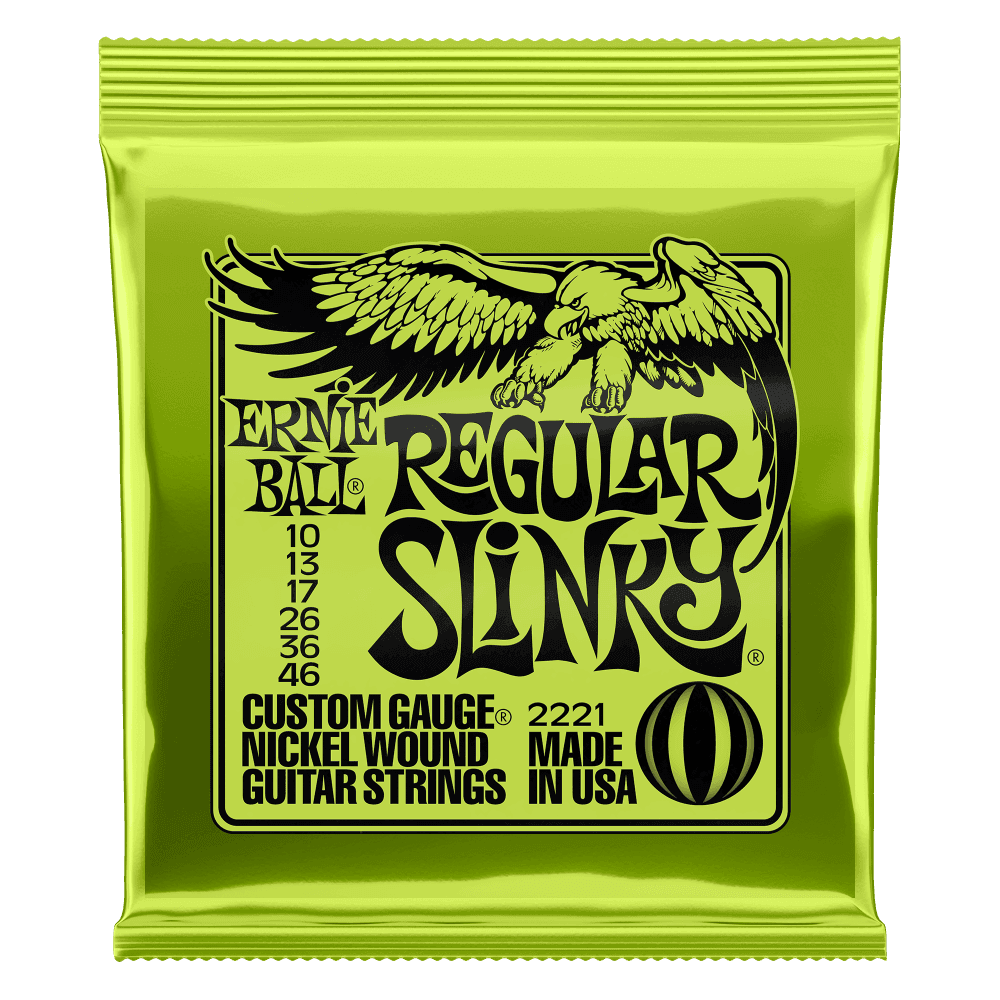
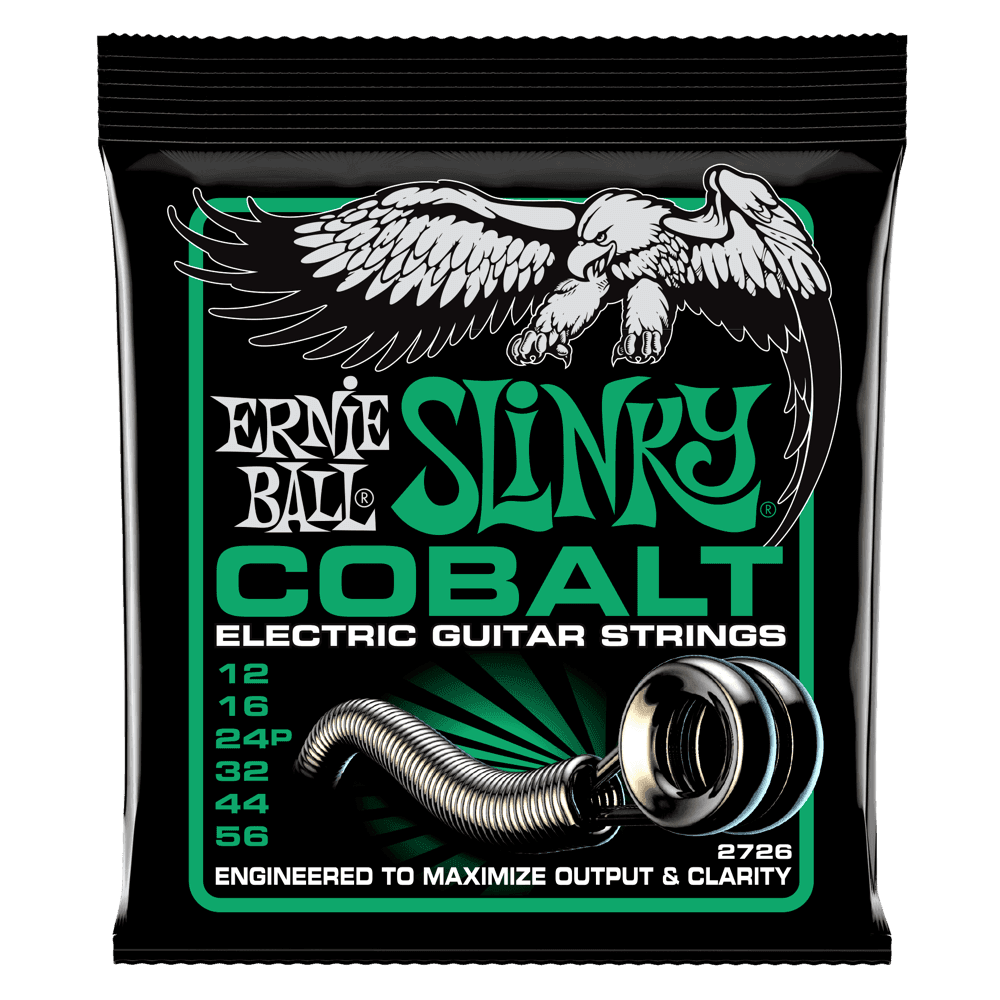
Not Even Slinky Cobalt (.012–.056), heavy Cobalt
Why this one: The Cobalt line at its highest-gain, tuned-down use case.
Which line for which player
- Rock, blues, classic, session, E standard: Regular Slinky. Default.
- E standard but I keep breaking high E strings: RPS Slinky.
- Drop D and low tunings, want tighter feel at a given gauge: M-Steel Slinky.
- Tour-heavy player, want fewer string changes: Paradigm Slinky.
- High-gain Drop C / Drop B with passive pickups: Cobalt Slinky.
- Don't want to decide: Regular Slinky. Change your mind in six months.
Related
- Review pages: Regular Slinky review, Not Even Slinky Cobalt review, M-Steel Regular Slinky review.
- Paradigm reviews: Paradigm Super Slinky (.009–.042), Paradigm Regular Slinky (.010–.046), Paradigm Ultra Slinky (.010–.048).
- Voicing head-to-head: Cobalt vs nickel Slinky.
- Gauge picker: Gauge and scale length reference, Cobalt Slinky gauges explained.
- Artist rosters: documented Cobalt users.