Ernie Ball Regular Slinky Cobalt (.010–.046): the default 6-string Cobalt
Written with AI help · Updated
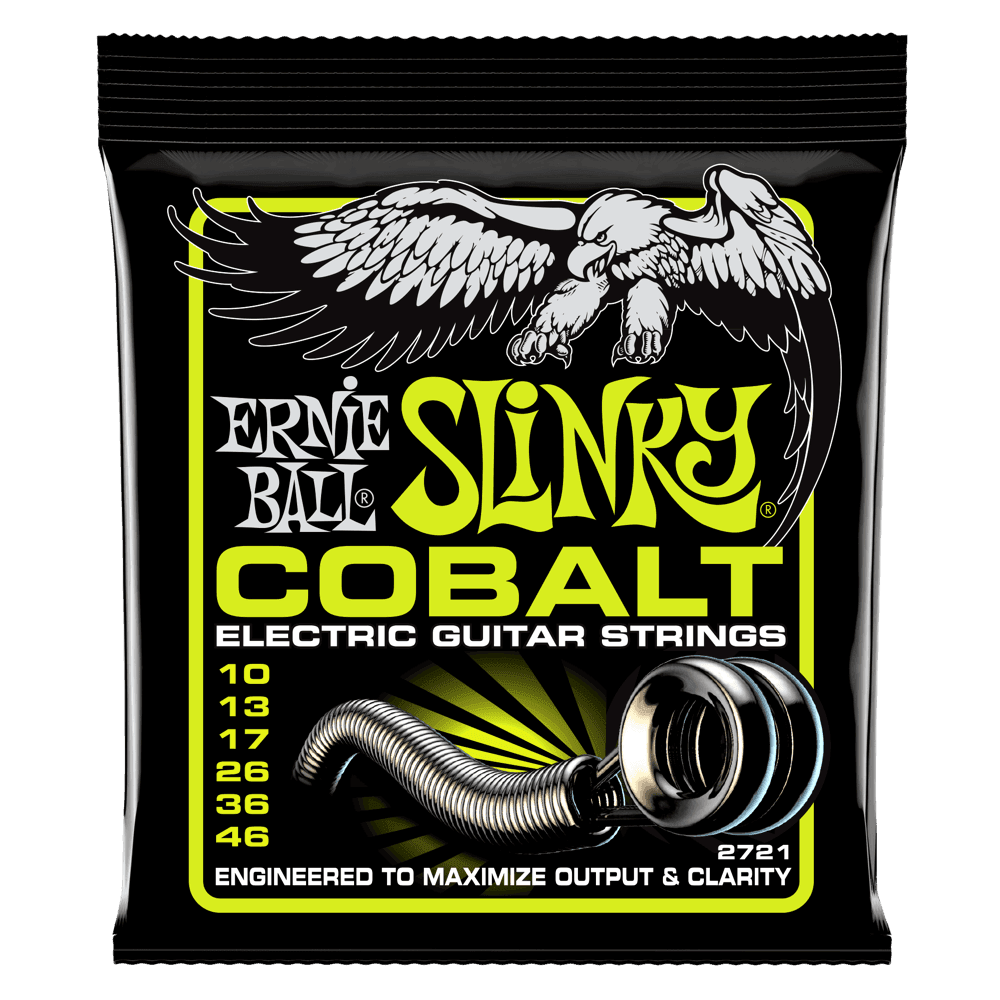
Ernie Ball Regular Slinky Cobalt (2721) is the .010–.046 flagship of the Cobalt line: a tin-plated steel hex core wrapped with a cobalt-iron alloy instead of nickel-plated steel. Cobalt is more magnetically reactive than nickel, so the set commonly reads 2–3 dB louder with a tighter upper midrange than same-gauge Regular Slinky. Pick it for E standard, Eb standard, or Drop D on a 25.5-inch scale electric where you want the Slinky feel with more amp attack.

Anatomy
- SKU
- Ernie Ball 2721 (single), 3721 (3-pack)
- MPN
- P02721
- Gauge
- .010 – .046 (Regular Slinky)
- Gauge set
- .010, .013, .017, .026, .036, .046
- Core wire
- Tin-plated high-carbon steel hex core
- Wrap wire
- Cobalt-iron alloy (the whole point of the line)
- Plain strings
- Tin-plated hex-core steel (.010, .013, .017 plain)
- Coating
- None. Uncoated.
- Winding
- Standard roundwound
- Intended scale
- 25.5" (Strat/superstrat) and 24.75" (Les Paul). Factory default gauge for both.
- Intended tunings
- E standard, Eb standard, Drop D
- Total tension (25.5", E standard)
- ~98 lbs
- Total tension (24.75", E standard)
- ~92 lbs
- Launched
- January 2012 (Cobalt line debut, NAMM)
- Package
- Single pack (2721), 3-pack (3721), bulk 6-pack available
Regular Slinky Cobalt (.010–.046)
Tone
Cobalt is the biggest voicing change Ernie Ball has made to the Slinky line since the original Slinky debuted in 1962. Swapping the nickel-plated steel wrap for a cobalt-iron alloy bumps the string's magnetic permeability, which is why players commonly report a real difference through a passive pickup. The figures below are our editorial assessment plus commonly reported player comparisons, not manufacturer-published lab measurements.
Voicing through a passive pickup
- Output
- Commonly reported 2–3 dB louder than same-gauge nickel Slinky through the same passive pickup, the first thing most players hear in an A/B.
- Top end
- More present upper midrange and a tighter high end. Not glassy. Punchy.
- Low end
- Firmer attack, less bloom on the low E. Palm mutes sound more defined.
- Dynamic range
- Wider. Pick lightly and they sit back; dig in and they bite harder than nickel at the same gauge.
The .010–.046 gauge is the universal "standard rock feel" set. Where the heavier Cobalt gauges (.012–.056 Not Even Slinky, .011–.054 Beefy Slinky) exist to suit tuned-down rhythm work, the Regular Slinky Cobalt does what the original nickel Regular Slinky does, just louder and brighter. It's the set most players meeting Cobalts for the first time should start with.
For the full breakdown of Cobalt vs nickel Slinky (output, brightness, longevity, bend feel, pickup compatibility), see Cobalt vs nickel Slinky: the voicing difference, explained.
Who plays Regular Slinky Cobalt (.010–.046)
- J Mascis (Dinosaur Jr.): primary set. Featured in Ernie Ball's String Theory series. Mascis moved from standard nickel Slinky to Cobalt specifically to compensate for his Fender Jazzmaster's lower-output single coils without swapping pickups.
Players you may have seen listed here before, moved for accuracy: Slash plays his own Ernie Ball signature set (.011-.048, Paradigm construction), not this one. Steve Vai's documented sets run lighter custom gauges. Tim Henson plays his 2025 signature set (Cobalt wrap on a Paradigm core, .0095-.046). Each profile has the sourced breakdown.
See Who plays Cobalt Slinky strings for the full documented list with sourcing.
Best for
- E standard on a 25.5-inch scale electric. The set's primary lane. Strat, Tele, superstrat. Factory gauge.
- E standard on 24.75-inch Gibson scale (Les Paul, SG, ES-335). Feels a touch looser than on 25.5"; acceptable for most players.
- Eb standard on either scale length.
- Drop D with .010–.046 works for most pickstyle rhythm and lead playing. For heavier drop work, move up to .011–.048 or .010–.052.
- Rock, indie rock, shoegaze, blues-rock, classic rock. Any lane where the Regular Slinky feel is the target but you want more top-end presence through the amp.
- Guitars with low-output pickups (vintage-voiced Jazzmaster, Jaguar, Mustang; PAF-style vintage-wound humbuckers). The Cobalt output bump compensates without a pickup swap.
Worst for
- Drop C or lower. Too slack on the low E. Use .011–.054 or .012–.056.
- Players who want the classic nickel Slinky warmth. Cobalt is brighter and more aggressive. If you already love the warmth of nickel Slinky through your rig, Cobalt is a voicing change, not an upgrade.
- Humid climates with heavy sweat. Player reports on Cobalt's corrosion resistance are mixed: some see rust or tarnish within weeks, others get long life with no issues. Wipe after every session if you sweat heavily, or move to Paradigm.
- Slide players. Cobalt's extra attack fights a slide's natural compression. Use a nickel set.
Install and break-in
Regular Slinky gauges are the factory-stock default on most 25.5" and 24.75" electrics, so moving from nickel .010–.046 to Cobalt .010–.046 requires no setup changes. Break-in is roughly 20 to 30 minutes of playing before the bright top end settles. Stretch each string (press behind the 12th fret and pull up about an inch, 3 to 4 times per string, retune, repeat) before you start break-in playing.
Changing to Cobalt from a heavier gauge set means the guitar will read slightly sharper at the bridge. Plan on a 5-minute intonation pass.
Verdict
Regular Slinky Cobalt (.010–.046) is the default 6-string Cobalt set. If you've been curious about the Cobalt line but unsure which gauge to try, this is the one. It's the Slinky feel at the Slinky gauge with the Cobalt voicing bolted on: louder, tighter, more articulate through the same pickups.
It is not a heavy-tuning string. Anything below Drop D needs a step up. And it is a voicing decision, not a universal upgrade. If your rig is already on nickel Slinky and everything sounds great, Cobalt is for a specific problem (low-output pickups, rhythm definition, upper-mid presence), not a general tonal "better."
Related
Related