Ernie Ball Power Slinky Cobalt (.011–.048): the Eb-standard Cobalt set
Written with AI help · Updated
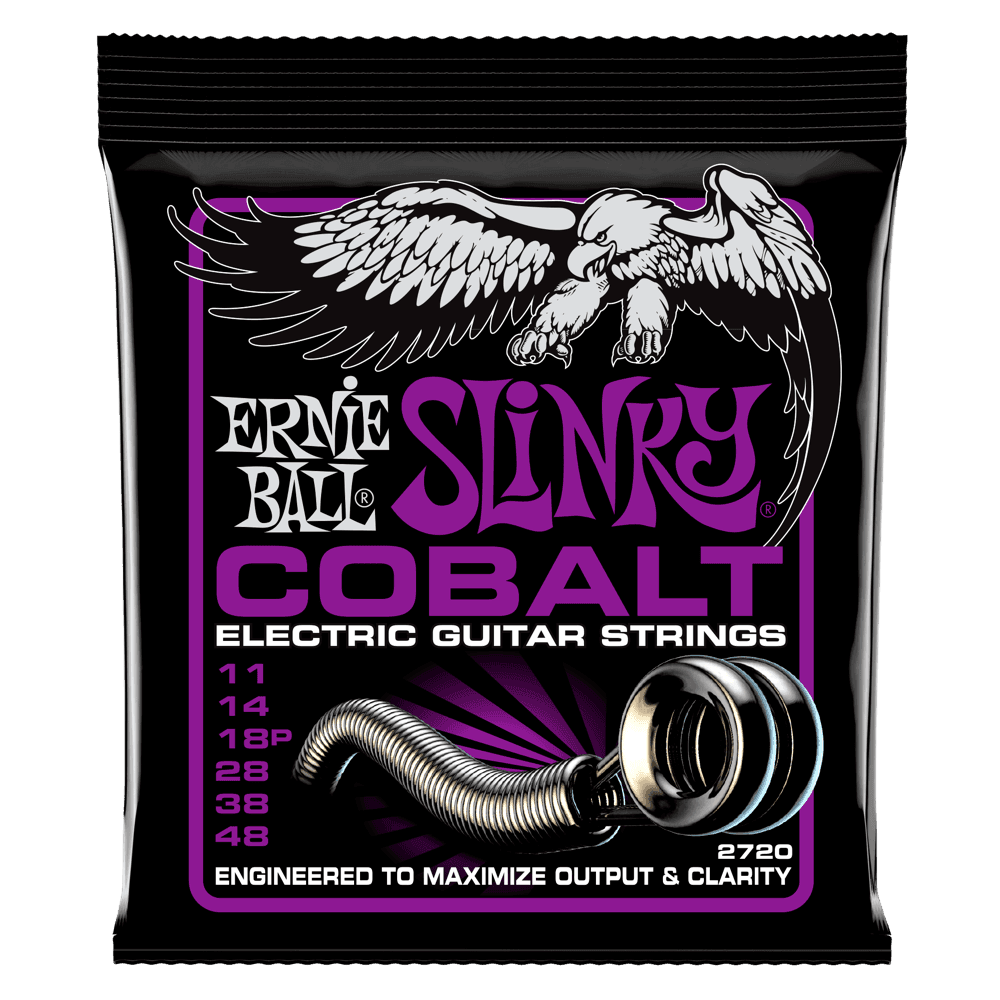
Ernie Ball Power Slinky Cobalt (2720) is the .011–.048 set for Eb standard and Drop D on a 25.5-inch scale. Cobalt wrap wire gives a stronger magnetic response than nickel Power Slinky, for more output and a touch more top-end presence that holds rhythm definition under gain. Slash played and endorsed Cobalt at its 2012 launch; his current Ernie Ball signature set uses Paradigm core, not Cobalt. Pick this when .010s feel floppy in Eb and .012s feel stiff for bends.

Anatomy
- SKU
- Ernie Ball 2720
- MPN
- P02720
- Gauge
- .011 – .048 (Power Slinky)
- Gauge set
- .011, .014, .018 plain, .028, .038, .048
- Core wire
- Tin-plated hex steel
- Wrap wire
- Cobalt-iron alloy
- Plain strings
- Tin-plated hex-core steel (.011, .014, .018 plain)
- Coating
- None, uncoated
- Winding
- Standard roundwound
- Intended scale
- 25.5" (Strat / superstrat) and 24.75" (Les Paul) both work
- Intended tunings
- Eb standard, Drop D, E standard with firmer feel
- Total tension (25.5", Eb standard)
- ~95 lbs
- Total tension (25.5", E standard)
- ~103 lbs (firm but playable)
- Launched
- January 2012 (Cobalt line debut)
- Package
- Single pack and 3-pack
Tone
Cobalt voicing through a Les Paul or Strat-style guitar with passive humbuckers or single coils:
Voicing
- Output
- Noticeably louder than nickel Power Slinky through the same passive pickup. Ernie Ball attributes this to Cobalt's stronger magnetic response with pickups than any alloy they'd previously offered; Cobalts drive the front end of a Marshall harder, which is part of why classic-rock players hear the change.
- Top end
- More present highs, per Ernie Ball's own description of the Cobalt alloy's tonal character. Bends sing more.
- Low end
- Firmer attack on the wound strings. Palm mutes have a tighter envelope.
- Bend feel
- .011 plain on top means full-step bends take more pull-strength than .010s, but the cobalt-wrap response makes the bend more vocal at the same volume.
The Cobalt voicing change is exactly the same character regardless of gauge in the line, what changes between Regular, Power, and Beefy Slinky Cobalt is tension and tuning fit, not voicing. Detailed voicing comparison at Cobalt vs nickel Slinky: the voicing difference, measured.
Where this set sits in the Cobalt range
Power Slinky Cobalt is the Eb-standard answer in the Cobalt range. The Cobalt 6-string lineup in tuning order:
- E standard: Regular Slinky Cobalt (.010–.046).
- Eb standard / occasional Drop D: This set, Power Slinky Cobalt (.011–.048).
- E with light top, drop-D rhythm: Skinny Top Heavy Bottom Cobalt (.010–.052).
- Drop C# / Drop C: Beefy Slinky Cobalt (.011–.054).
- Drop C / Drop B / C standard: Not Even Slinky Cobalt (.012–.056).
Full picking guide at Cobalt Slinky gauges explained.
Who plays this set
Slash (Guns N' Roses, Velvet Revolver, Slash featuring Myles Kennedy and the Conspirators) is the documented user this set is built around. Slash has been an Ernie Ball artist since the 1980s, and Ernie Ball featured him playing and discussing the Cobalt strings at the line's January 2012 launch, quoted as saying Cobalts "sound and feel better than anything I've ever played." His primary tuning across his catalog is Eb standard on Gibson Les Paul, the gauge fit this set was built for.
As of this writing, Slash's current Ernie Ball signature product is the Slash Signature Set (.011–.048), a Paradigm-core set, not Cobalt. Power Slinky Cobalt remains the closest CYS-reviewed match to the Cobalt voicing he helped popularize at launch. Full sourcing on both sets: Slash's rig, sourced.
Cobalt line roster: Who plays Cobalt Slinky strings.
Best for
- Eb standard (Eb-Ab-Db-Gb-Bb-Eb) on 24.75" Les Paul / 25.5" Strat. Sweet spot.
- Drop D from an Eb default without changing strings. The .048 low string handles Drop D firmly.
- E standard with firmer feel. If your bending vocabulary wants .011 stiffness in E.
- Hard rock, classic rock, blues-rock, modern rock. The cobalt push helps the lead voice cut through dense band mixes.
Worst for
- Drop C and below. The .048 flaps in Drop C; step up to Beefy Slinky Cobalt (.011–.054) or Not Even Slinky Cobalt.
- Floyd Rose set up for .010s without a spring-tension recalibration.
- Players who prize light bending feel above all else. Stay on Regular Slinky Cobalt or Hybrid Slinky Cobalt.
Install and break-in
Coming from .010s, the .011 plain top adds roughly 4 pounds of single-string tension; total set adds about 8–10 pounds. Most setups handle this without a truss-rod adjustment, but check relief after the first day of play. Nut slots usually accommodate the bumps without filing. Intonation should be reset.
Break-in: 30–45 minutes of play before the initial top-end brightness settles in.
Verdict
Power Slinky Cobalt is the set Slash helped popularize when Ernie Ball launched the Cobalt line in 2012. It's a sensible default for any rock or blues-rock player whose home tuning is Eb on a Les Paul or 25.5-inch scale: the gauge brings the Eb feel back to the comfort zone of .010s in E, and the cobalt wrap makes the upper-mid push that helps the lead voice carry through a high-gain rig.
Pick it over nickel Power Slinky if you A/B them and prefer the cobalt voicing. Pick nickel if you prefer the slightly smoother top end. Match the wrap to your taste; match the gauge to your tuning.
Related
Related