Best Strings for Les Paul and SG: 5 Picks for 24.75-Inch Guitars
Written with AI help · Updated
D'Addario NYXL1046 (.010 to .046) is the best all-around set for a Les Paul or SG. It fits 24.75-inch guitars without setup changes and holds tuning well. If .010s feel slack to you, step up to Ernie Ball Power Slinky (.011 to .048). For Drop D and Drop C, run Ernie Ball Beefy Slinky Cobalt or Not Even Slinky Cobalt.
The short answer
A Les Paul or SG feels slinkier than a Strat. That is not your imagination. It is the scale length, and it changes which strings are best.
Gibson lists both the Les Paul Standard and the SG Standard '61 at 628.65mm / 24.75in on its own product pages. Most Fender electrics run 25.5 inches. Our scale length guide puts that gap at roughly 6 percent in tension at the same pitch and gauge. You feel it in the bends and in the low strings.
So we picked five sets, all already reviewed in full on CYS, that suit the shorter scale: three nickel and one coated at .010 and .011, plus a cobalt set at .011 for Drop D and a heavier one at .012 for Drop C.
| Best for | Gauge | Price | |
|---|---|---|---|
| D'Addario NYXL1046 | Best overall, .010 set | .010–.046 | $$ |
| Elixir Nanoweb 12052 | Best coated, .010 set | .010–.046 | $$ |
| Ernie Ball Power Slinky 2220 | Firmer rock and blues feel, .011 set | .011–.048 | $ |
| Ernie Ball Beefy Slinky Cobalt | Drop D and Drop C#, .011 set | .011–.054 | $$ |
| Ernie Ball Not Even Slinky Cobalt | Drop C, .012 set | .012–.056 | $$ |
D'Addario NYXL1046 is the set to buy if you want one answer. It is the standard .010 to .046 gauge, and the page says it fits a Les Paul, SG or ES-335 without setup changes. D'Addario's own testing puts its tuning stability about 131% above the standard EXL110. That matters on a Gibson, where a tune-o-matic bridge and a long headstock angle can make tuning drift a real annoyance.

NYXL1046 Nickel Wound (.010–.046)
Why this one: Our overall pick. The standard .010 gauge on a Gibson-scale guitar, with the best tuning stability of any mainstream set per D'Addario.
Why a shorter scale feels slacker
String tension depends on three things: pitch, gauge and scale length. Hold pitch and gauge steady and a shorter scale means less tension. That is why a 24.75-inch Les Paul bends easier than a 25.5-inch Strat with the same set.
Less tension has upsides and downsides.
What the shorter scale does to your strings
- Easier bends
- The same .010 set takes less finger pressure on a Gibson than on a Fender. Blues players often love this.
- Slinkier chords
- Open chords and power chords feel looser. Hard pickers can push strings sharp.
- Floppier low strings
- The wound strings feel it most. Palm mutes can lose definition, especially in drop tunings.
- Warmer, rounder tone
- Our scale-length guide notes shorter scales lean warmer and more compressed. That is part of the Les Paul sound.
None of this means a Les Paul needs different strings. A .010 to .046 set is the safe default, and our string gauge and scale length reference says a short-scale Gibson can take a step up in gauge for a firmer feel. Match gauge to your tuning first, then adjust for your scale.
Which gauge compensates
Our gauge guide lists safe zones for Gibson-scale guitars by tuning. These are the ones that matter most:
| Tuning | Gibson-scale gauge | Matching pick | |
|---|---|---|---|
| E standard | 10–46 | NYXL1046 or Nanoweb 12052 | |
| Eb standard | 11–48 | Power Slinky 2220 | |
| Drop D | 10–52 | Beefy Slinky Cobalt (.011 set) | |
| Drop C | 12–56 | Not Even Slinky Cobalt |
Read that table as a starting point. If .010s feel loose to you in E standard, go to .011. If you are tuning down a half step, .011 is the better default, and our Eb standard page covers why. The further down you go, the more the extra gauge pays off.
For the full gauge logic, see our guitar string gauge chart.
Best .010 coated: Elixir Nanoweb 12052
Elixir Nanoweb 12052 is the coated pick. It is the same .010 to .046 gauge as NYXL1046, with a coating over the whole string surface. Elixir says that coating gives 3 to 5 times longer tone life than uncoated strings, based on its own testing. The page confirms it fits a Les Paul or SG without setup changes.
Why it suits a Gibson: a Les Paul already leans warm, and Nanoweb is described on its page as balanced and warm, so it will not push your guitar into dull territory. The trade-off is a slightly smoother feel than a raw nickel set, and a bit less pick bite when fresh. If you chase maximum brightness, pick an uncoated set. If you hate changing strings, buy this one.

Nanoweb Light (.010–.046)
Why this one: The coated pick. Same .010 gauge, with a coating Elixir says lasts 3 to 5 times longer in tone than uncoated.
Best .011 for rock and blues: Ernie Ball Power Slinky 2220
Ernie Ball Power Slinky 2220 (.011 to .048) is the cheap, simple fix for a Gibson that feels a bit loose. Its page lists it as fitting both 25.5-inch Strat and Tele guitars and 24.75-inch Les Paul, SG and ES-335 guitars. Intended tunings are E standard, Eb standard, Drop D and D standard.
One gauge step up on a Gibson gets you roughly back to the feel many players associate with a Fender in .010s. That is the logic behind this pick. You get chunkier rhythm, more attack and a firmer bend, without leaving standard nickel-plated steel wrap on a hex steel core. It is also the set we would try first on an SG, which is lively and light and often benefits from a little extra string pull.
It suits rock, hard rock, blues and classic rock best. If you play a lot of big bends with a light touch, stay at .010.
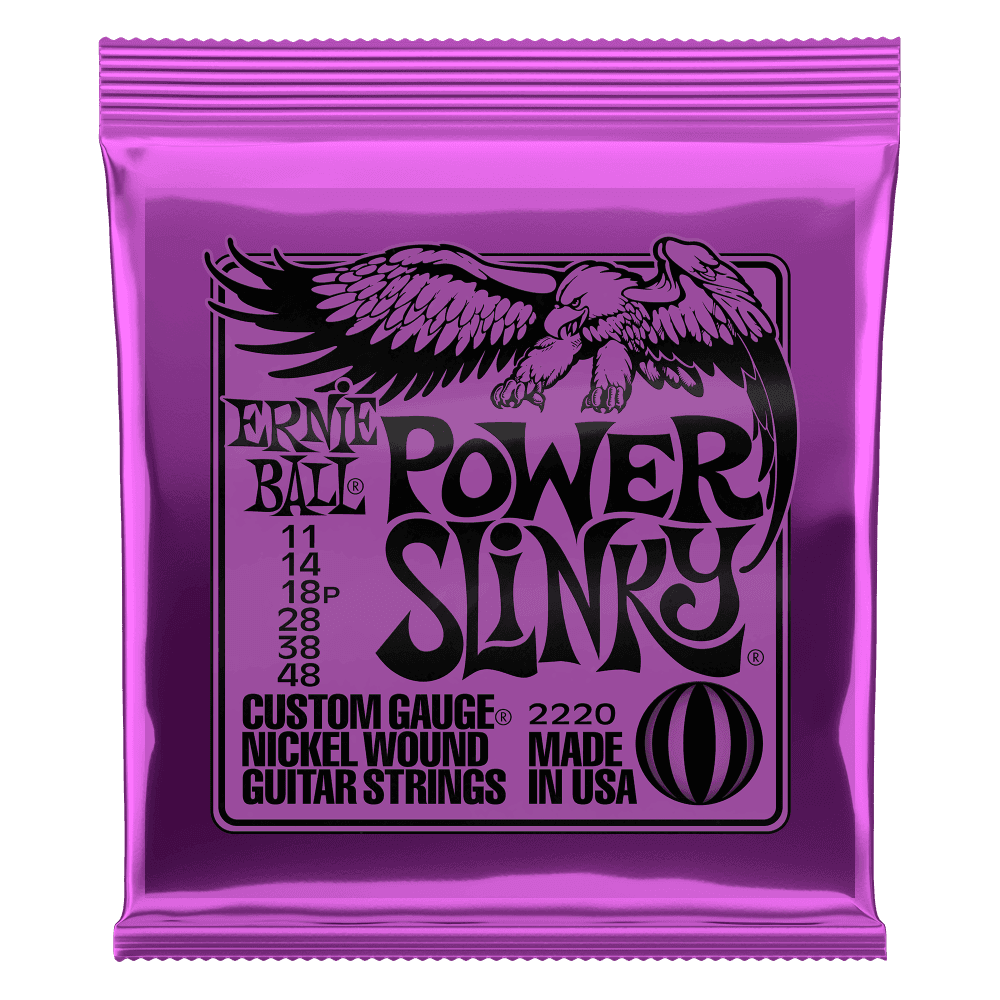
Power Slinky 2220 Nickel Wound (.011–.048)
Why this one: A firmer .011 set that its own page says fits Les Paul and SG alike. The easy fix for a slack-feeling Gibson.
Drop tunings on a 24.75-inch guitar
This is where scale length bites hardest. Tune down on a Gibson and the low strings go slack faster than they would on a Strat. The fix is gauge. Our drop tunings FAQ covers the basics.
Two of our picks are built for it.
Ernie Ball Beefy Slinky Cobalt (.011 to .054) lists Drop C#, Drop C, Drop D, D standard and Eb standard as its intended tunings. Its page notes it is primarily meant for 25.5-inch guitars, with a Les Paul giving a slightly looser feel. Its cobalt-iron wrap runs about 2 to 3 dB louder than nickel through a passive pickup, per the page, with more presence in the upper mids at 2 to 4 kHz. On a warm Gibson, that helps a palm-muted riff cut through. For Drop D and Drop C#, it is the one to try.
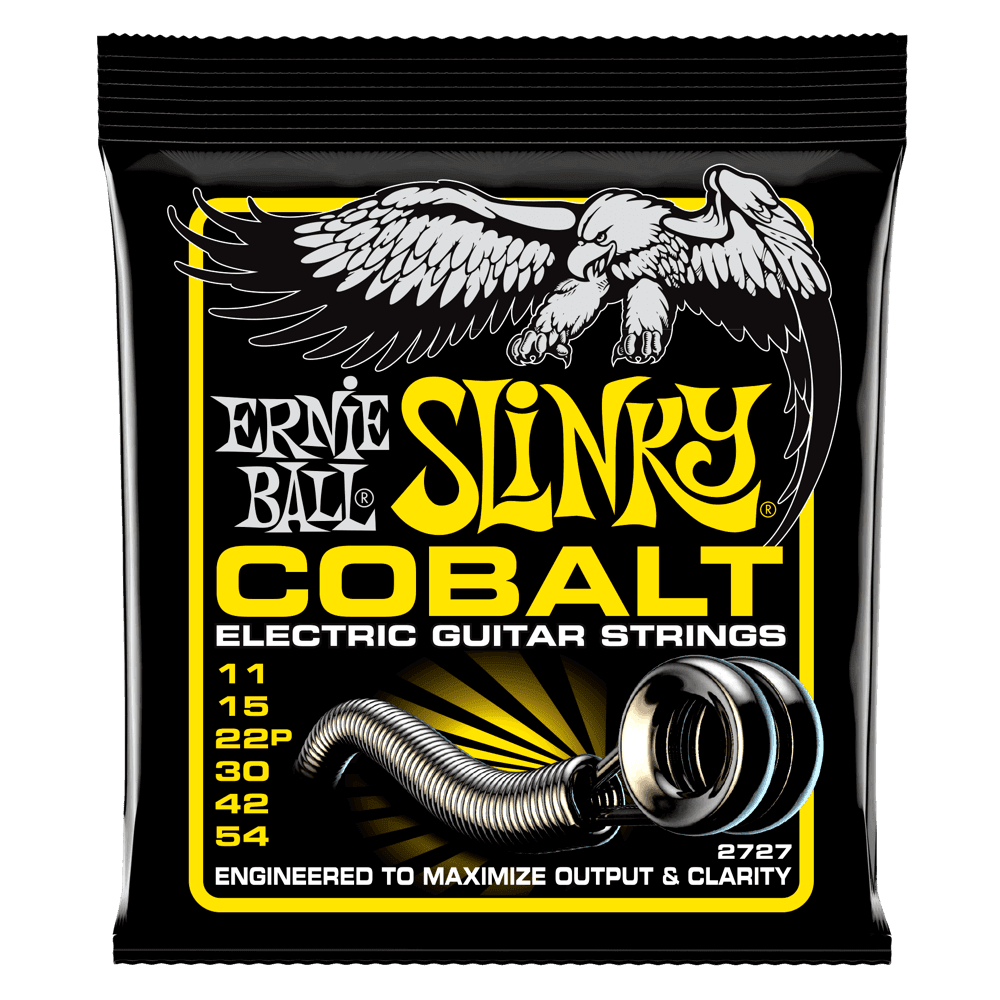
Beefy Slinky Cobalt (.011–.054)
Why this one: Cobalt wrap for tight, defined low end. Built for Drop C# and Drop C, and it also covers Drop D and D standard.
Ernie Ball Not Even Slinky Cobalt (.012 to .056) is the set for Drop C and below on a Gibson. Our Drop C page suggests .012 to .054 for 24.75-inch guitars, and our gauge guide lists 12-56, so this set sits right in the zone. Its page says it works on a 24.75-inch Les Paul in C standard, and its listed tunings include Drop C, Drop B, C standard and D standard. Treat Drop B on a Les Paul as the edge of what the scale handles comfortably.
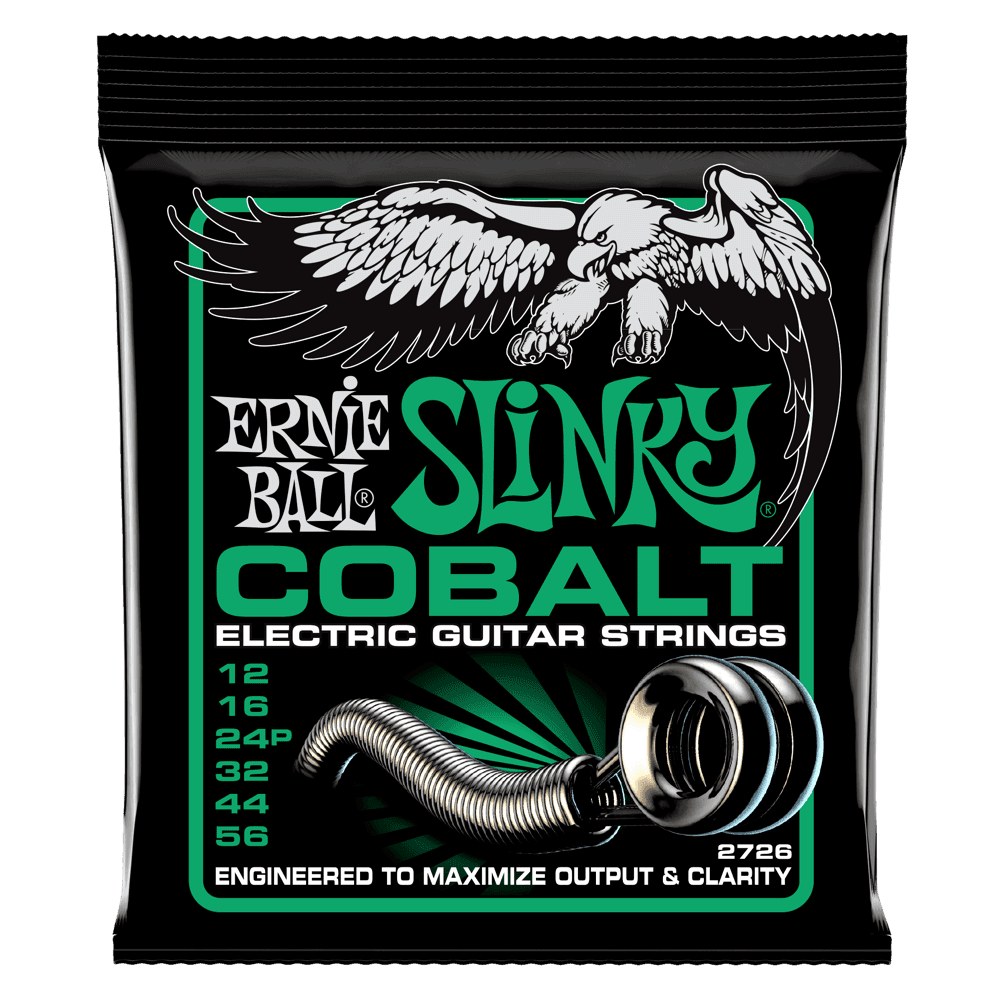
Not Even Slinky Cobalt (.012–.056)
Why this one: The .012 option for a Gibson in Drop C. Heavy enough to keep the low strings from going floppy on a shorter scale.
Below Drop C, a Gibson scale runs out of road. Our gauge guide gives no Drop G recommendation for a 24.75-inch guitar because it is too slack regardless of gauge. If you live down there, a baritone is the right tool. See our best baritone guitars guide.
Pick by style
Match the set to how you play
- Classic rock and blues, E standard
- NYXL1046 if you like .010s, Power Slinky if you want more bite and resistance.
- Hard rock and heavier rhythm
- Power Slinky 2220 in E or Eb, or Beefy Slinky Cobalt if you drop to D or Drop D.
- Metal and Drop C
- Not Even Slinky Cobalt, or Beefy Slinky Cobalt if you want a lighter feel for solos.
- Gigging and touring
- NYXL1046 for tuning stability, or Nanoweb 12052 if you want longer life between changes.
- Bluesy bends and light touch
- Stay at .010. A Les Paul already bends easily, and an extra gauge works against you.
For more genre-specific picks, our best strings for metal guide goes deeper on heavy tunings. For the broader field, see best electric guitar strings.
What to check after you switch gauge
A heavier set is not a free swap on a Gibson. Three things are worth a look.
First, the nut. A .054 or .056 low string is fatter than the .046 the slot was cut for, and a pinched string can ping and stick, hurting tuning. If you step up by one gauge you usually get away with it. If you go up by more, ask a tech to check the slot.
Second, neck relief. More string pull means a little more neck bow. Check relief after the strings settle and adjust the truss rod if needed.
Third, intonation. A new gauge shifts your pitch up the neck. Check the twelfth fret against the open string and set the saddles on your tune-o-matic or wraparound bridge.
None of this is hard. It is a ten-minute job, and it turns a good set into a great one.
Bottom line
If you play a Les Paul or SG and want one set, buy D'Addario NYXL1046. If your guitar feels slack, go to Ernie Ball Power Slinky 2220. If you tune down, go to Beefy Slinky Cobalt for Drop D and Drop C#, or Not Even Slinky Cobalt for Drop C. If you hate changing strings, buy Elixir Nanoweb.
NYXL1046 Nickel Wound (.010–.046)
Why this one: Our overall pick for Gibson-scale guitars.