Guitar String Gauge Chart: Every Gauge in Inches and Millimeters
Written with AI help · Updated
A guitar string gauge chart converts every diameter, from a .007 plain high E to a .105 bass low E, into millimeters using one formula: inches times 25.4. Standard electric is .010 to .046, standard acoustic is .012 to .053, and standard 4-string bass is .045 to .100. This chart lists every plain gauge (.007-.026) sold as a single by Ernie Ball or D'Addario, plus every wound gauge (.018-.105) from Ernie Ball's own singles catalog.

How to read this chart
Every guitar string gauge is a diameter, measured in thousandths of an inch. A pack labeled .010 to .046 has a .010-inch high E and a .046-inch low E, with four strings filling the gap in between. This page is the raw lookup table: every plain and wound gauge that Ernie Ball or D'Addario sells as an individual string, in inches and millimeters, pulled straight from both manufacturers' own singles catalogs.
For what gauge actually changes in tone and feel, and the standard set for each instrument, our full gauge guide covers that ground. This page just gets you the number fast.
If you already know you want the standard electric set, skip the chart:
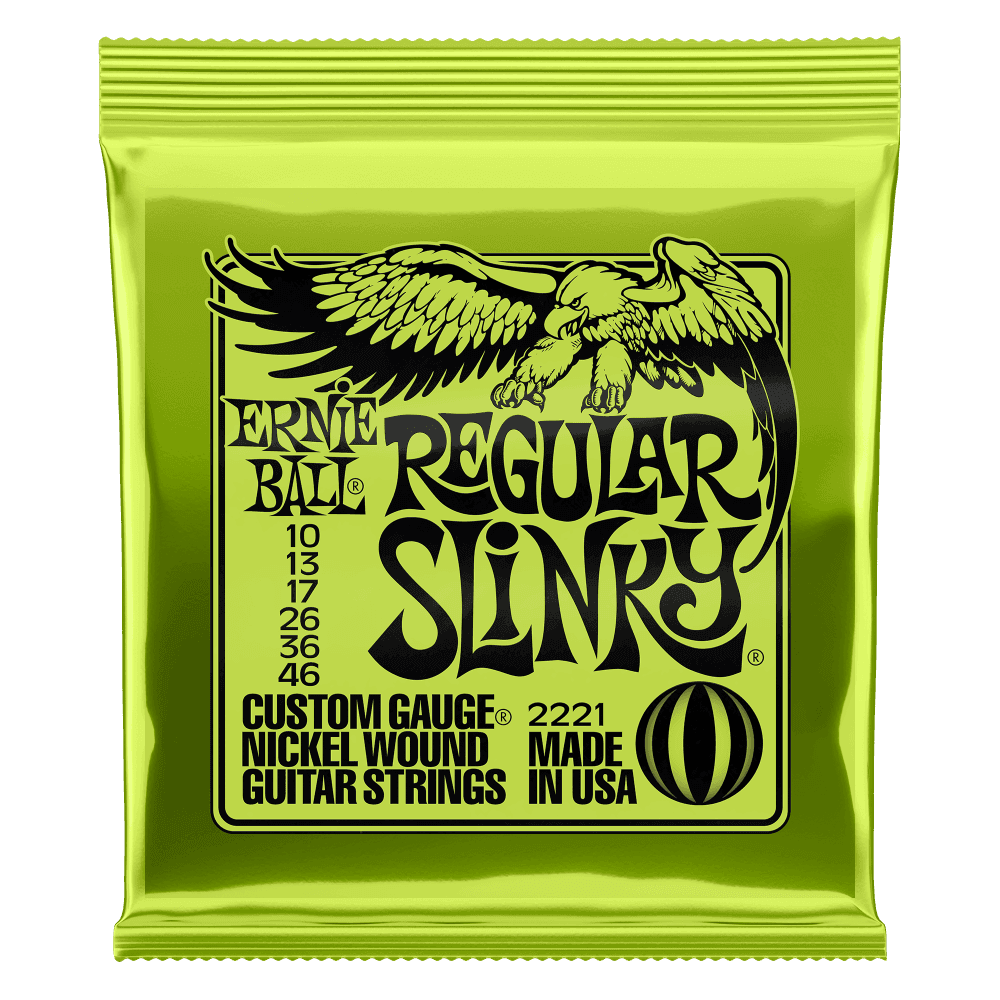
Regular Slinky (.010–.046)
Why this one: The .010 high E and .046 low E on this chart are the two ends of the most common electric gauge on the market. The safe default when you're not sure which gauge you need.
Plain (unwound) string gauges, in inches and millimeters
Plain strings are a single strand of steel wire, no wrap. Ernie Ball's and D'Addario's plain lineups both start at .007 and top out between .024 and .026, covering the top two or three strings on most electric and acoustic sets. The table below is the union of both manufacturers' own plain-singles catalogs.
| Millimeters | |
|---|---|
| .007 | 0.178 mm |
| .008 | 0.203 mm |
| .0085 | 0.216 mm |
| .009 | 0.229 mm |
| .0095 | 0.241 mm |
| .010 | 0.254 mm |
| .0105 | 0.267 mm |
| .011 | 0.279 mm |
| .0115 | 0.292 mm |
| .012 | 0.305 mm |
| .0125 | 0.318 mm |
| .013 | 0.330 mm |
| .0135 | 0.343 mm |
| .014 | 0.356 mm |
| .0145 | 0.368 mm |
| .015 | 0.381 mm |
| .0155 | 0.394 mm |
| .016 | 0.406 mm |
| .0165 | 0.419 mm |
| .017 | 0.432 mm |
| .0175 | 0.445 mm |
| .018 | 0.457 mm |
| .019 | 0.483 mm |
| .020 | 0.508 mm |
| .021 | 0.533 mm |
| .022 | 0.559 mm |
| .024 | 0.610 mm |
| .026 | 0.660 mm |
Ernie Ball's own product page for these puts it plainly: "Ernie Ball revolutionized the market by offering Custom-Gauge single string options allowing guitarists to create personalized string sets" (Ernie Ball). D'Addario's plain lineup covers the same range and adds a few extra half-steps Ernie Ball's plain singles skip: .019, .021, and .026 (D'Addario).
Most of these gauges never ship inside a standard set; they exist mainly so you can build a custom one string at a time. The one place the plain range matters most is the third string. A plain third in the .017 to .020 range bends more freely and rings brighter than a wound third at the same nominal gauge, which is why B.B. King favored a plain third his entire career, a .017 on his later Gibson signature set.
Wound string gauges, in inches and millimeters
Wound strings wrap a wire around a steel core, which adds mass without adding stiffness, the only practical way to build a low string that stays flexible. The plain-to-wound crossover sits between .018 and .026, where both formats exist at the same nominal size (see the table above). Past .026, every gauge on the market is wound. This table runs Ernie Ball's own wound-singles catalog from .018 up to .105, the standard low E on a 4-string bass.
| Millimeters | |
|---|---|
| .018 | 0.457 mm |
| .020 | 0.508 mm |
| .022 | 0.559 mm |
| .024 | 0.610 mm |
| .026 | 0.660 mm |
| .028 | 0.711 mm |
| .030 | 0.762 mm |
| .032 | 0.813 mm |
| .034 | 0.864 mm |
| .036 | 0.914 mm |
| .038 | 0.965 mm |
| .040 | 1.016 mm |
| .042 | 1.067 mm |
| .044 | 1.118 mm |
| .046 | 1.168 mm |
| .048 | 1.219 mm |
| .050 | 1.270 mm |
| .052 | 1.321 mm |
| .054 | 1.372 mm |
| .056 | 1.422 mm |
| .058 | 1.473 mm |
| .060 | 1.524 mm |
| .062 | 1.575 mm |
| .064 | 1.626 mm |
| .066 | 1.676 mm |
| .068 | 1.727 mm |
| .070 | 1.778 mm |
| .072 | 1.829 mm |
| .074 | 1.880 mm |
| .075 | 1.905 mm |
| .080 | 2.032 mm |
| .090 | 2.286 mm |
| .100 | 2.540 mm |
| .105 | 2.667 mm |
Need something heavier for Drop C or below? Step up to a purpose-built set like the Ernie Ball Not Even Slinky Cobalt (.012–.056) rather than assembling one gauge at a time; our Drop C tension chart shows why. D'Addario and other major brands publish an equivalent wound-singles ladder; we cite Ernie Ball's here because it's the one we fetched and verified end to end this review.
Matching the chart to a standard set
Every number above is a raw measurement. Standard sets bundle six (or four, or five) of them together and give the bundle a name. The .010 and .046 rows are the two ends of the Ernie Ball Regular Slinky and the D'Addario NYXL1046, the two most-played electric sets on the market. Step up to .012 and .056 and you're at Not Even Slinky Cobalt territory, a Drop C and below set. On acoustic, .012 and .053 is the D'Addario EJ16 Light set, the acoustic default. On 4-string bass, .045 and .100 is the D'Addario EXL170, the bass equivalent of the Regular Slinky.
One honest caveat: the half-step gauges, .0105, .0115, .0125, and similar, rarely show up in a shelf-stock set. They exist mainly as singles, inside a signature set like John Mayer's .0105-based Silver Slinky, or for building a fully custom gauge string by string. If you just want a working set today, stick to the whole-number gauges, they're what's actually in stock at any guitar shop.
The complete string-gauge library. This page is the conversion reference: every diameter in inches and millimeters. If you want the plain-English explainer first, what the numbers mean and how to choose, start with guitar string gauges explained, then come back here for the exact mm figures. Go deeper by instrument, tuning, and use case: standard gauge sets by instrument, string gauges by tuning, the Drop C gauge and tension chart, 7-string gauges, 8-string gauges, acoustic gauges by body shape, bass string gauges, and the Cobalt Slinky gauges breakdown. Whatever you settle on, browse it and buy it from the full strings catalog.
For the full standard-set ladder by instrument, with feel and tone notes for each rung, see our complete gauge guide. For 7-string, 8-string, and baritone gauges beyond this chart's electric range, see the 7-string, 8-string, and baritone guides.
Related
- Guitar string gauges explained, the full guide: what gauge means, standard sets by instrument, and how to choose
- Drop C string gauge and tension chart, exact tension targets by scale length
- String gauges by tuning, every common tuning mapped to a gauge
- 7-string guitar string gauge guide
- 8-string guitar string gauge guide
- Baritone guitar strings explained
- The full CYS string catalog, sorted by brand and gauge
Frequently asked questions
What is a guitar string gauge chart?
A gauge chart lists string thicknesses, in thousandths of an inch and in millimeters, so you can compare sizes across brands and instruments. Gauge is just wire diameter: a .010 is ten thousandths of an inch thick, a .046 is forty-six thousandths. This chart covers every plain gauge from .007 to .026 and every wound gauge from .018 to .105, the full range Ernie Ball and D'Addario sell as individual strings.
What is a .010 gauge string in millimeters?
A .010 gauge string is 0.254 mm in diameter. The conversion is always the same: multiply the inch gauge by 25.4. A .009 is 0.229 mm, a .011 is 0.279 mm, and a .046 low E is 1.168 mm. US brands print the inch number; some European packs print the millimeter figure instead, same string either way.
How do I convert string gauge to millimeters?
Multiply the gauge in inches by 25.4. A .012 string is .012 times 25.4, or 0.305 mm. A .056 string is .056 times 25.4, or 1.422 mm. It works in reverse too: divide a millimeter figure by 25.4 to get inches. Every value on this chart is already converted for you.
What is the difference between a plain and a wound gauge at the same size?
Plain (unwound) strings top out around .026; above that, a wrap wire gets added for flexibility, so plain and wound versions overlap between .018 and .026. A guitarist can choose either at those sizes: a plain string bends more freely and sounds brighter, a wound string holds pitch better under heavier picking. B.B. King favored a plain third his entire career, a .017 on his later Gibson signature set, for exactly that reason.
Is the gauge chart the same for electric, acoustic, and bass strings?
Yes. Gauge measures wire diameter, not the instrument it's built for, so the inch-to-mm conversion never changes. What differs is which gauges each instrument typically uses: electric sets run roughly .008 to .056, acoustic sets .010 to .056, and 4-string bass .040 to .105. Our full gauge guide breaks down the standard set for each instrument with feel and tone notes.
Are string gauges standardized across brands?
Yes, gauge is a physical measurement, not a brand-specific spec. Ernie Ball and D'Addario both sell nearly identical single-string ladders: Ernie Ball's plain singles run .007 to .024, with wound singles from .018 to .105, and D'Addario's plain singles cover the same range plus a few extra half-steps, .019, .021, and .026, that Ernie Ball's plain lineup skips.
What gauge should I use for drop tunings?
Go heavier than standard as you tune lower. Drop D is fine on a stock .010 or .011 set. Drop C or Drop B want at least .011 to .054, or a dedicated skinny-top-heavy-bottom set. Our Drop C gauge and tension chart runs the exact numbers by scale length.
What's the heaviest gauge on this chart, and what is it for?
The heaviest single gauge either brand sells is .105, the standard low E on a 4-string bass in Medium gauge (a Regular Light 4-string set runs .045 to .100). Past .105, extended-range and 5- or 6-string bass sets move into custom-gauge territory outside a standard singles ladder.