Best Clip-On Guitar Tuners for Drop and Alternate Tunings, Compared
Written with AI help · Updated
Peterson StroboClip HD is the best clip-on tuner for drop and alternate tunings. Per Peterson, it is a true strobe tuner with 0.1-cent accuracy, drop tuning and capo settings, and a frequency response down to 16 Hz. If you want a cheaper chromatic option, Korg PitchCrow-G, Snark SN-5X, and D'Addario Micro all read notes outside standard tuning.
The short answer
Pick a tuner by the lowest note you play and by how much precision you want. Standard tuning is easy for any clip-on. Drop C, Drop B, baritone and 7-string tunings are where tuners start to differ. We compared five popular headstock tuners using each manufacturer's own page, and we have not hands-on tested them.
Our pick is the Peterson StroboClip HD. Per Peterson, it lists drop tuning and capo settings, a 7ST preset for seven-string guitars, and tracking "down to 16Hz." It also lists 0.1-cent accuracy. It sits in a higher price tier than the rest, so the budget picks below are real alternatives, not consolation prizes.
| Best for | Low-end and tuning notes (per manufacturer) | Price | |
|---|---|---|---|
| Peterson StroboClip HD | Best overall, strobe accuracy | Drop tuning and capo settings, 16 Hz to 1975 Hz response | $$ |
| Korg PitchCrow-G | Best for flat tuning and capo offsets | Chromatic from A0, flat tuning 1 to 5 semitones | $ |
| Snark SN-5X | Best budget chromatic | Chromatic, reads any note you play | $ |
| D'Addario Micro Headstock Tuner | Best compact | Chromatic headstock tuner, 410 to 480 Hz calibration | $ |
| Fender FT-1 Pro | Best for switching modes | Five modes including chromatic, B0 to B7 range | $ |
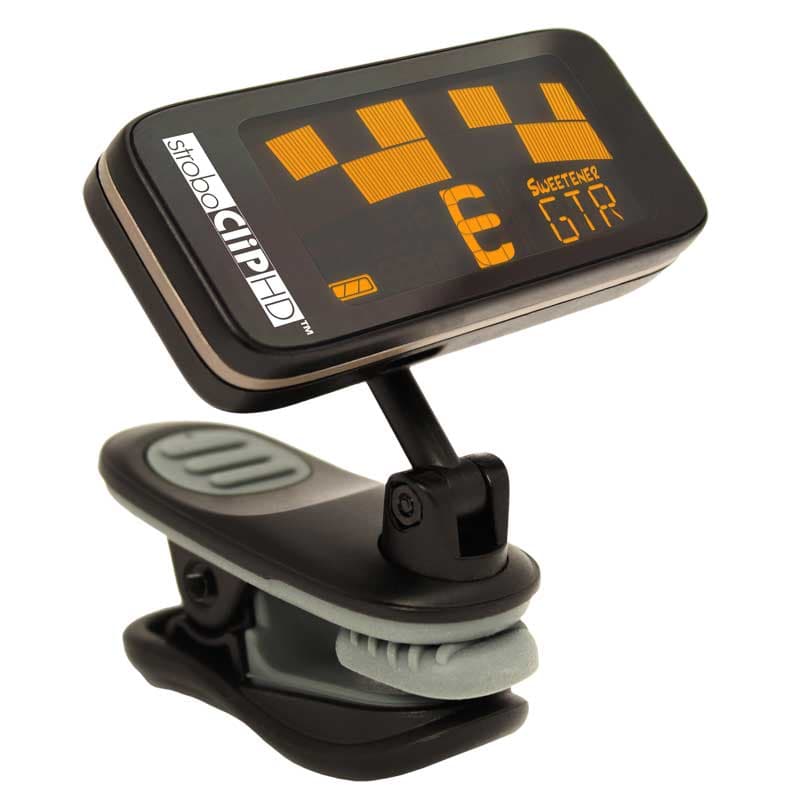
StroboClip HD
Why this one: Our overall pick. Strobe accuracy, drop tuning and capo settings, and a response range that reaches low B and below.
What a tuner needs to handle drop and alternate tunings
A clip-on tuner has to do two things for a lowered or altered tuning. It has to hear the note, and it has to show you which note it is hearing. Three features decide that.
First, chromatic detection. A chromatic tuner reads any pitch, sharp or flat, instead of snapping to E A D G B E. That is what you need when your low string is D, C or B. Snark's own manual says it plainly: because the tuner is chromatic, you can deal with non-standard tunings, and it will read any note you play.
Second, low-note range. Standard Drop C puts your lowest string at C2, and a 7-string in standard puts low B at B1. Your tuner's listed range must reach there. Check the number on the manufacturer's page, not the box. See our Drop C tuning page for the notes.
Third, offsets and presets. Some tuners let you shift the whole reference down by semitones. Korg calls this flat tuning. Others add a capo setting. These save you from doing mental math when the whole guitar sits a half step or a whole step low, as it does in Eb standard or D standard.
One more point. A tuner only reports pitch. If your drop tuning feels floppy, the tuner is not the problem. Our drop tunings and low tunings explainer and the Drop C gauge and tension chart cover string choice.
Best overall: Peterson StroboClip HD
Peterson's StroboClip HD is a true strobe tuner in a clip-on body. Strobe tuners show a moving pattern that stops when you are on pitch. Per Peterson, it lists 0.1-cent accuracy, a backlit high-definition LCD, and a piezo pickup with no microphone.
The low-tuning features are the reason it wins here. Peterson lists a frequency response of 16 Hz to 1975 Hz and says tuning "that low B will never be a problem." The feature list names drop tuning and capo settings. The presets include "7ST" for seven-string guitars and "BF7" for the Buzz Feiten system on seven-string electrics.
It also lists 50 sweetened tunings and adjustable Hz calibration across a concert A range of 390 Hz to 490 Hz. Note selection is automatic. It runs on one CR2032 and weighs 1.3 oz, per Peterson.
The tradeoff is cost and complexity. You are paying for precision that a casual player may never use. If you set intonation, record, or play a 7 or 8-string, it is the one to buy.
StroboClip HD
Why this one: Our overall pick. Strobe accuracy, drop tuning and capo settings, and a response range that reaches low B and below.
Best for flat tuning and capo offsets: Korg PitchCrow-G
Korg's PitchCrow-G is the tuner to pick if your guitar lives in a lowered tuning. Per Korg, it has a chromatic mode, a guitar mode that shows the string number, and a bass mode. Flat tuning works in guitar and bass modes, and a capo setting is available in guitar mode.
Korg's specifications give the numbers. Flat tuning runs 1 to 5 semitones. Capo tuning runs 1 to 7 semitones. Chromatic range starts at A0 (27.50 Hz), and the guitar-mode range starts at 46.25 Hz. A standard 7-string low B sits near 62 Hz, so it clears that floor on paper. Reference tone adjusts from 436 Hz to 445 Hz.
Accuracy has two settings. The ±1 cent mode is standard. The fine-tuning strobe meter reaches ±0.1 cent. Korg also lists a first-string over-winding warning in guitar mode, meant to help you avoid snapping a plain string. Battery life is roughly 24 hours of continuous use on a CR2032.
The tradeoff is settings. With strobe, flat and capo options, expect more to learn than on a basic LED clip. It is worth the effort if you tune lower than E standard.
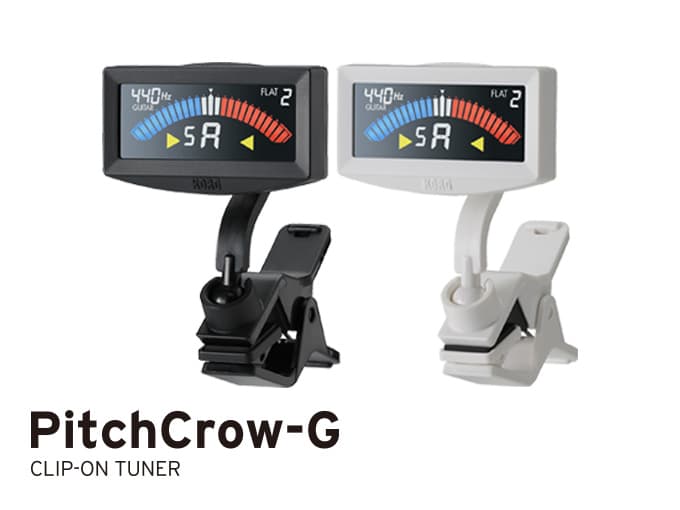
PitchCrow-G
Why this one: Chromatic, guitar and bass modes, flat tuning of 1 to 5 semitones, and a 0.1-cent strobe meter at a modest price tier.
Best budget chromatic: Snark SN-5X
The Snark SN-5X is the budget chromatic pick. Snark lists it as a clip-on guitar, bass and violin tuner. Snark's instructions say it is chromatic and senses the vibrations of the instrument it is attached to.
For alternate tunings, that is the key line: because it is chromatic, it will read any note you play. The body rotates 360 degrees, and the color display shows red for flat, yellow for sharp and green when you are in tune. It uses one CR2032 and dims after about 5 seconds without sound, then shuts off after about 2 minutes.
What Snark does not publish is a low-note range. The product page does not list one. If you play below Drop C or on a 7-string, test it against your lowest open string before a gig, or step up to the Peterson or Korg.
Read the finish warning too. Snark advises against use on nitrocellulose, polyurethane, French polish and oil finishes, and on nitro-finished Gibsons, unless you accept the risk of dents. That applies to the rubber pad of any clip-on, not just this one.
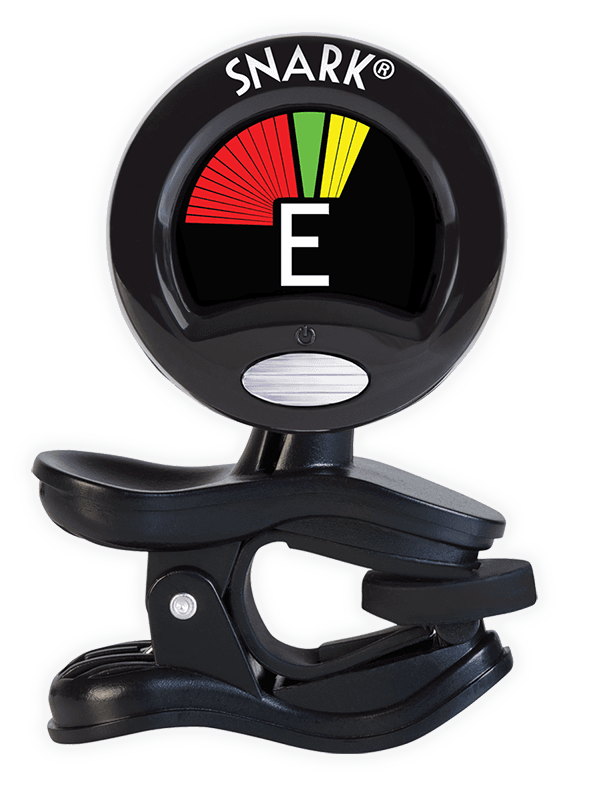
SN-5X Clip-On Tuner
Why this one: Chromatic, vibration-sensing, and rotates 360 degrees. A no-fuss budget tuner that reads any note you play.
Best compact: D'Addario Micro Headstock Tuner
D'Addario's Micro Headstock Tuner (PW-CT-12) is the compact pick. D'Addario describes it as a tuner your audience will never see, and calls it a chromatic headstock tuner with a full-color display and four selectable viewing angles: two vertical and two horizontal.
D'Addario lists a calibration range of 410 Hz to 480 Hz and says improved piezo control allows a better tuning experience in noisy environments. A ratchet clamp holds it on during a live set. It runs on one CR2032, and D'Addario includes a 1-year limited warranty.
Be honest about the gap. D'Addario's page does not list a low-note range or mention drop tunings. It is chromatic, so alternate tunings should read fine in normal guitar range, but check the lowest note you need before relying on it for baritone or extended-range guitars.

Micro Headstock Tuner PW-CT-12
Why this one: Tiny full-color display with four screen orientations and piezo control built for noisy rooms, per D'Addario.
Best for switching modes: Fender FT-1 Pro
Fender's FT-1 Pro suits players who tune more than one instrument. Fender lists Guitar, Bass, Ukulele, Violin and Chromatic modes, with a tuning range of B0 to B7 and A440 calibration.
The range is the useful part. B0 is low enough for a 5-string bass low B, so a guitar in Drop B or lower is covered on paper. The dual-hinge clip mounts on either side of the headstock. A built-in vibration sensor handles noisy settings, and the backlight turns green when the note is in tune. Power is one CR2032.
The caveats are small. Fender lists A440 calibration without describing an adjustable range, so check that if you tune to a different reference pitch. Fender's own page listed it as sold out when we last checked, so confirm Amazon stock before you plan around it.

FT-1 Pro Clip-On Tuner
Why this one: Guitar, bass, ukulele, violin, and chromatic modes with a B0 to B7 range and a green in-tune backlight, per Fender.
How to choose
Pick by your lowest string and your budget
- You play 7-string, 8-string or baritone
- Peterson StroboClip HD. It lists a 7ST preset and a response down to 16 Hz.
- Your guitar lives a step or two below E standard
- Korg PitchCrow-G. Flat tuning of 1 to 5 semitones is built in.
- You want a cheap tuner that reads any note
- Snark SN-5X. Chromatic, vibration-sensing, and rotates 360 degrees.
- You want it small enough to leave on the headstock
- D'Addario Micro. Four screen orientations and piezo control.
- You tune a guitar, bass and ukulele
- Fender FT-1 Pro. Five listed modes and a B0 to B7 range.
Match the tuner to your lowest open string. Then match your tuning to your strings. A tuner can read a note, but it cannot give a slack string enough tension to hold it. If you are moving into Drop C or lower, read the string gauge and scale length guide and make sure your set suits the tuning. For standard tuning, see E standard.
Bottom line
Buy the Peterson StroboClip HD if you play low, extended-range or you care about precision. Buy the Korg PitchCrow-G if you want flat and capo offsets at a lower price tier. Buy a Snark SN-5X, D'Addario Micro or Fender FT-1 Pro if you want a chromatic tuner that clips on and gets out of the way. Check the finish warning before you leave any of them on a nitro guitar.
Per each manufacturer's pages, all of these are chromatic or list a chromatic mode. The difference is how low they read and how many tuning aids they include.
StroboClip HD
Why this one: Our overall pick. Strobe accuracy, drop tuning and capo settings, and a response range that reaches low B and below.