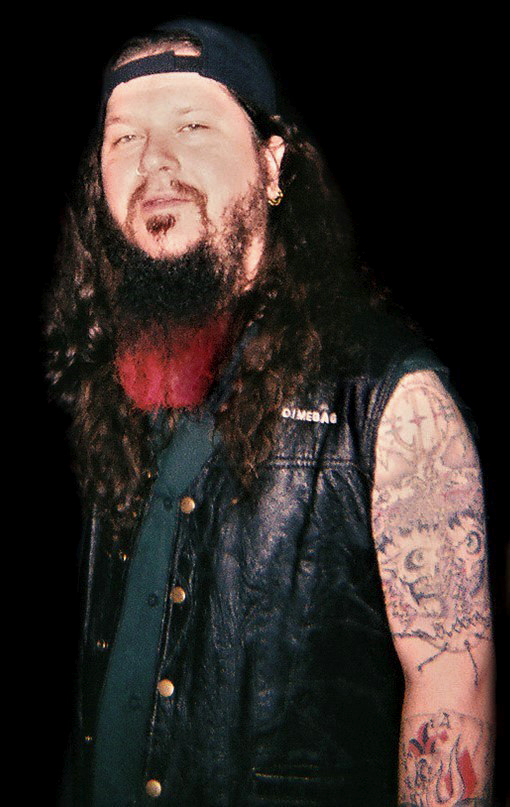
Dimebag Darrell's guitar strings: the Pantera rig, sourced
Documented strings and tunings Dimebag Darrell used with Pantera and Damageplan. He played DR Strings (his Dimebag Hi-Voltage signature set) on Dean ML and Washburn instruments, plus the Dean Razorback he co-designed but never lived to play. With citations.
Pantera / Damageplan · written with AI help · updated
Dimebag Darrell played DR Strings, his Hi-Voltage signature set, in gauges from roughly .009 up to .010-.052 depending on tuning, a relationship dating to 1995. He played a 1981 Dean ML 'Dean From Hell' and Washburn Dime 333 guitars, and co-designed the Dean Razorback though he never lived to play the finished guitar. Pantera's tunings deepened over the catalog. Darrell was murdered on stage in December 2004 at age 38.
Who Dimebag Darrell was
Darrell Lance Abbott (August 20, 1966, Ennis, Texas, December 8, 2004, Columbus, Ohio, murdered on stage during a Damageplan performance) was the founding lead guitarist of Pantera (1981-2003) and, with his brother and drummer Vinnie Paul, of Damageplan (2003-2004). Pantera's catalog from Cowboys from Hell (1990) through Reinventing the Steel (2000) is foundational to groove-metal as a sub-genre, and Darrell's lead playing across those records is among the most-studied lead-guitar bodies of work in modern metal.
He was murdered on December 8, 2004, in Columbus, Ohio, by a gunman who walked on stage during the opening minute of a Damageplan show at the Alrosa Villa nightclub. He was 38 years old.
What he played
DR Strings, his DR Dimebag Darrell Hi-Voltage signature set, was his documented string brand from 1995 forward (his own quote, "I've been playin' the strings of strength since 1995," anchors the relationship). The line ships in several gauges, roughly .009-.042 through .010-.052, and he scaled up for lower tunings.
His instruments moved across three eras: the original 1981 Dean ML he nicknamed the "Dean From Hell," a roughly ten-year Washburn signature run (the Dime 333 / Dimebolt) starting in 1994 when Dean ceased production, and a 2004 return to Dean where he co-designed the Razorback with Dean Zelinsky. He never played the finished Razorback himself: he approved a prototype about a month or two before his death, and Dean released the production guitar posthumously. The Bill Lawrence L500XL high-output humbucker in the bridge position is the constant pickup spec across the guitars he actually played, paired with a Floyd Rose tremolo.
His signal chain on the classic Pantera records was anchored by Randall solid-state amps (the RG100ES, later the Century 200 and Warhead variants), with a Furman parametric EQ in the loop for tone shaping and an MXR Six Band EQ for the boost. The Krank tube head came later, in 2004; it is not part of the classic-era recorded tone. The solid-state-into-Bill-Lawrence-L500XL combination is the canonical Pantera lead-tone formula.
Tunings ranged from standard E on Cowboys from Hell through progressively deeper down-tunings (D standard, Drop D, and lower) on later records.
Darrell was a fixture of the same shred-guitar scene as Michael Angelo Batio, who filmed a tribute medley of "Cemetery Gates," "This Love," and "Cowboys from Hell" alongside Dean Guitars CEO Elliott Rubinson after his death.
Strings
DR's Hi-Voltage Dimebag Darrell signature line, in the gauges he's documented using across standard and lower tunings.
His documented standard-tuning gauge
DR Hi-Voltage Dimebag Darrell DBG-9/46 (.009-.011-.016-.026-.036-.046)
Hexagonal core with nickel-plated steel wrap, treated with DR's StringLife protectant. Ground Guitar's account ties this 9-46 gauge specifically to his standard-tuned guitars, both the E standard of Pantera's earliest records and the D standard of later material.
DR's current flagship listing
DR Hi-Voltage Dimebag Darrell DBG-9/50 (.009-.011-.016-.028-.038-.050)
Hexagonal core with nickel-plated steel wrap, treated with DR's StringLife protectant. Darrell's own quote: "I'm using two different custom-gauged sets of DR strings... one set is .009-.046 and the other is .009-.050. I use the heavier strings on the lower tunings." Ground Guitar's account ties this 9-50 gauge specifically to his drop-D guitars.
Lower-tuning gauge
DR Hi-Voltage Dimebag Darrell DBG-10/52 (.010-.052)
Same construction, heavier bottom end for the deeper down-tunings on later Pantera material and Damageplan. DR also sells the line in .009-.042, .009-.046, and .010-.046 for lighter tunings.
Sources: DR Strings product page, Ground Guitar: DR HI-VOLTAGE Electric Guitar Strings.
The Dean from Hell
Darrell won the guitar that would become his signature instrument at a guitar contest in 1981, the same day his father bought him a sunburst Dean ML. At sixteen, wanting a car more than a second guitar, he sold the contest-won Dean for $600 and put the money toward a Pontiac Firebird.
The guitar passed to his friend Buddy Webster, a Texas luthier known as Buddy Blaze, who repainted it with the blue-and-white lightning bolt graphic, installed a Bill Lawrence L500XL pickup in the bridge and a Seymour Duncan SH-1 '59 in the neck, fitted a Floyd Rose tremolo, and gave the finished guitar back to Darrell as a surprise. It became the Dean From Hell, his main guitar through Cowboys from Hell and Vulgar Display of Power.
The guitar went missing for a stretch too. After a Philadelphia show in August 1994, on Darrell's birthday, it ended up doubling as a table at his own birthday party, was mistaken for junk by a cleaning crew, and left a garage before MTV ran a $2,500-reward newsflash and it was returned. Today it's kept at the Abbott family's Dalworthington Gardens, Texas property, alongside the rest of his collection.
Source: Ground Guitar, Dimebag Darrell's 1981 Dean ML "Dean from Hell".
Electric guitars
Every guitar he's documented actually playing, plus the one he co-designed but never played, sourced from Ground Guitar's gear archive and MusicRadar's signature-gear guide.
Won 1981 · Nickname "Dean from Hell"
1981 Dean ML
Repainted by luthier Buddy Blaze with the lightning-bolt graphic, a Bill Lawrence L500XL bridge pickup, a Seymour Duncan SH-1 '59 in the neck, and a Floyd Rose tremolo. Main guitar on Cowboys from Hell (1990) and Vulgar Display of Power (1992). Now kept at the Abbott family's Texas property.
Signed 1994 · ~10-year run
Washburn Dime 333 / Dime 3
Signed with Washburn after Dean paused production in 1994. The 333 shipped with a licensed Floyd Rose and Washburn Eliminator humbuckers; the US-made flagship Dime 3 upgraded to Seymour Duncan pickups and an original Floyd Rose. Most famous finish: "Dimeslime." Main guitars from Far Beyond Driven (1994) through Reinventing the Steel (2000).
Source: MusicRadar: complete guide to Dimebag Darrell signature gear.
Co-designed 2004 · Released posthumously, never played by Darrell
Dean Razorback
A hot-rodded ML with barbed cutaways and bevelled edges, co-designed with Dean Zelinsky after Darrell's 2004 return to Dean. He approved a prototype and had ideas for finishes ready to go, but he died before the production model was finished. Dean released it after his death, in mahogany, maple, or basswood body options with EMG, DiMarzio, or Seymour Duncan pickup choices.
Source: Ground Guitar: Dean Razorback.
Amps
Solid-state Randalls for nearly the whole career, with one late tube-amp curveball.
Acquired late 1980s · 150W solid-state
Randall RG100ES
Used on Cowboys from Hell (1990), his breakthrough tone. Switched to a Century 200 for the next two albums, then per Darrell's own account: "I ended up using the old, carpeted Randall RG-100 head I recorded Cowboys From Hell with" on The Great Southern Trendkill (1996). Two channels, built-in reverb, standard EQ.
Source: Ground Guitar: Randall RG100ES.
1992-1996 · Vulgar Display / Far Beyond Driven era
Randall Century 200
His main head for Vulgar Display of Power (1992) and Far Beyond Driven (1994), between his two RG100ES eras.
Source: MusicRadar: complete guide to Dimebag Darrell signature gear.
Released 2000 · 300W, Dime-approved
Randall Warhead
Sweepable mids, a nine-band graphic EQ, and 16 onboard effects presets. The manual carried a Darrell sign-off: "Crank this mutha up, feel the inspiration and blow everybody away!!" A simplified Warhead X2 followed in 2004, dropping the graphic EQ and effects but keeping the mid sweep.
Source: MusicRadar: complete guide to Dimebag Darrell signature gear.
Switched 2004 · Final touring amp, Damageplan era
Krank Revolution ("KranKenstein")
A tube amp, a genuine surprise from a player known as one of the loudest voices in the solid-state camp. Four 5881 power tubes for 100 watts, four 12AX7 preamp tubes, separate "Kleen" and "Dime" channels each with its own three-band EQ.
Source: MusicRadar: complete guide to Dimebag Darrell signature gear.
Effects
His rack stayed relatively simple: EQ shaping and a couple of modulation effects, not a pedalboard full of gain stages, since the Randall-into-L500XL combination supplied the distortion.
9V pedal-format boost
MXR MX-109 Six Band EQ
A small blue 9-volt unit he called one of the most vital parts of his tone, pushed into the front of the amp for the lead-tone boost on top of the Randall's own gain.
~1991 onward, later the PQ-3
Furman PQ-4 Parametric EQ
Final tone-shaping filter before the amp, in his rig from around 1991, roughly when Vulgar Display of Power was recorded. Swapped for the Furman PQ-3 toward the late 1990s.
Octave-up "squeal"
Digitech WH-1 Whammy
Used for quick two-octave-up pitch jumps, most famously the "squeal" sound on the "Becoming" riff from Far Beyond Driven (1994), distinct from the Floyd Rose tremolo's own dives.
In his rig from ~1991
MXR MX-126 Flanger/Doubler
Audible on the "Cowboys from Hell" intro and on "Slaughtered" and "Hellbound." He also mentioned using it occasionally on The Great Southern Trendkill (1996), without specifying exactly where.
The Dunlop Cry Baby From Hell wah was Dime-designed and released during his lifetime: a six-range selector plus a switchable 16dB gain boost. The MXR Dime Distortion pedal, released after his death, is a tribute built to approximate his amp tone; he had no hand in designing it.
Why this fits the rig
The Bill Lawrence L500XL pickup is voiced with more high-frequency content than typical humbuckers, which keeps his lead tone articulate even under high-saturation Randall solid-state amplification. Solid-state amps tend to produce harsher distortion than tube saturation, and the L500XL's harmonic clarity counterbalances that. Lighter top gauges supported the right-hand picking speed and left-hand fluidity the Pantera lead vocabulary depends on, while heavier bottoms held tension when the band tuned lower.
The Dean ML's body shape (a Flying-V variant with a flared lower wing) provides the visual identity, but the technical signature is the L500XL-into-Randall combination: the saturation, the harmonic content, the dynamic response. Players replicating the Dimebag tone always start with that pickup-and-amp pairing.
Picks
Most-used gauge and color
Dunlop Tortex Standard .88mm Green
His main pick, usually printed with custom Pantera or Damageplan artwork. He was also seen with black picks carrying custom prints, though their thickness isn't documented.
Source: Ground Guitar: Dunlop Tortex Standard .88mm Green picks.
If you want this rig
A Dean Dimebag signature ML or Razorback (continued posthumously in production), a Bill Lawrence L500XL pickup in the bridge position, a Randall solid-state head (RG100ES or a Warhead variant), and DR Strings in the Dimebag signature gauges gets you the canonical Pantera-era configuration.
Hi-Voltage Dimebag Darrell DBG-9/50 (.009-.050)
Why this one: Darrell's own signature line, documented since 1995, and DR's current flagship gauge for the set. Lighter DBG-9/46 and heavier DBG-10/52 gauges cover standard tuning and the lower-tuned Pantera and Damageplan material.
Related
Related