Ernie Ball Skinny Top Heavy Bottom Slinky Cobalt (.010–.052): the hybrid-gauge Drop D Cobalt set
Written with AI help · Updated
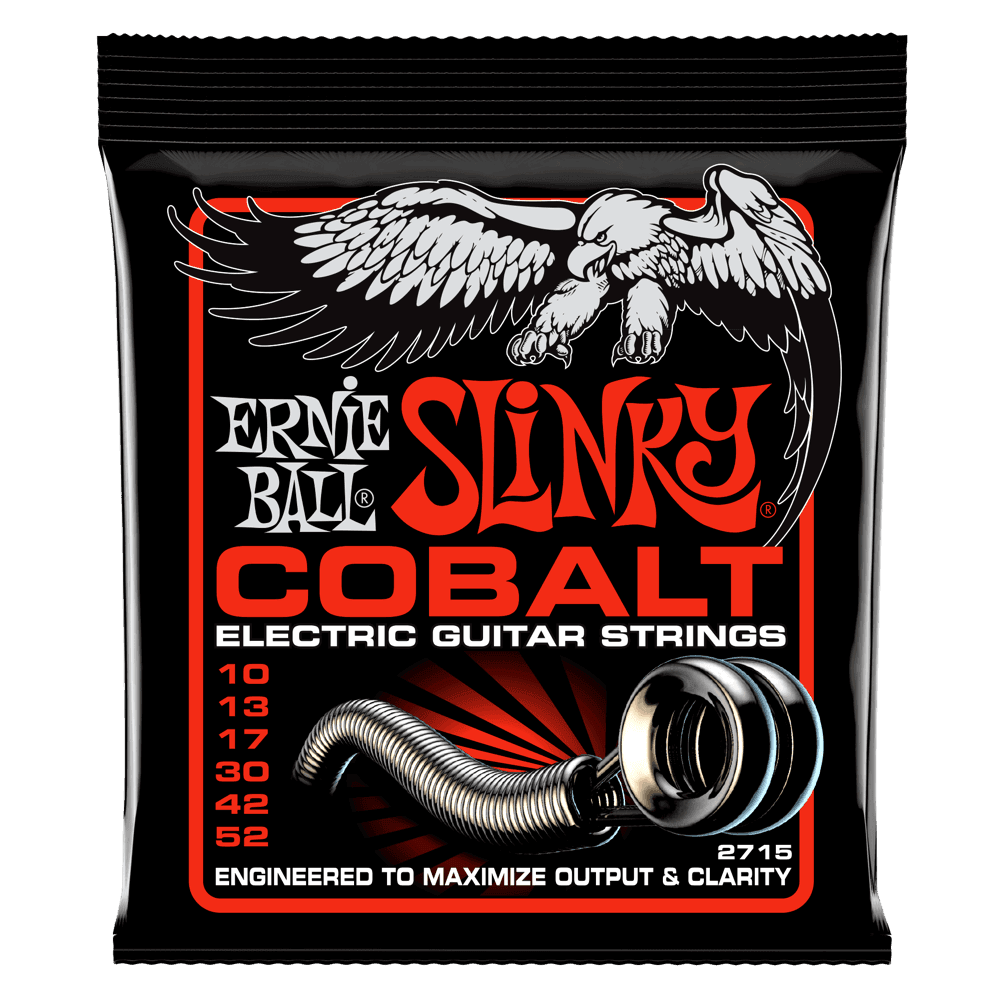
Ernie Ball Skinny Top Heavy Bottom Slinky Cobalt (2715) pairs a standard .010 top three with a heavier .030–.052 bottom three, so leads keep a light .010 feel while the low strings hold up in Drop D. The cobalt-alloy wrap adds output and a tighter low end over the nickel version of the same gauge. Pick it for Cobalt voicing; pick nickel for a smoother top end.

What this set is
Ernie Ball Skinny Top Heavy Bottom Slinky Cobalt (2715) is the cobalt-wrap version of Ernie Ball's mixed-gauge hybrid set: a standard-gauge top three (.010, .013, .017) paired with a bottom three (.030, .042, .052) that runs heavier than even Power Slinky Cobalt's .028, .038, .048. Same tin-plated hex-steel core as the rest of Ernie Ball's Slinky line, wound with cobalt alloy instead of nickel-plated steel.
The nickel version of this exact gauge, Skinny Top Heavy Bottom (2215), is the set Adam Jones of Tool named in Guitar World. This page covers the Cobalt-wrap sibling: same .010–.052 spread, different wrap alloy, different voicing.
Anatomy
- SKU
- Ernie Ball 2715
- MPN
- P02715
- Gauge
- .010 – .052 (hybrid)
- Gauge set
- .010, .013, .017, .030, .042, .052
- Core wire
- Tin-plated hex steel
- Wrap wire
- Cobalt alloy
- Coating
- None, uncoated
- Winding
- Standard roundwound
- Intended scale
- 25.5" (Strat / superstrat) and 24.75" (Les Paul) both work
- Intended tunings
- E standard, Eb standard, Drop D
- Total tension (25.5", E-standard-equivalent)
- ~105 lbs, CYS engineering estimate, not an Ernie Ball published figure
- Package
- Single pack (multi-packs also sold by third-party retailers)
Tone
Per Ernie Ball's own product description, the cobalt alloy wrap changes the voicing versus nickel in three specific ways:
Voicing (Ernie Ball's own description)
- Output
- Ernie Ball's own product page states the magnetic properties of Cobalt provide more output than nickel wound offerings, a stronger magnetic response with pickups than any other alloy Ernie Ball has previously offered.
- Highs
- More defined highs than the nickel wrap, per Ernie Ball. Bends and single-note leads on the light .010 top read more clearly.
- Low end
- Increased low-end response per Ernie Ball. On a Drop D low string this reads as a firmer, less woolly attack under palm mutes.
- Feel
- Cobalt Slinkys are wound for added flexibility. String bending on the .010 top strings feels the same as any other Cobalt Slinky; the change is magnetic and tonal, not mechanical.
Full head-to-head against nickel Slinky: Cobalt vs nickel Slinky, the voicing difference.
Where this set sits in the Cobalt range
Skinny Top Heavy Bottom Cobalt is the mixed-gauge specialty set in the Cobalt lineup, for players who split time between standard-tuning leads and Drop D rhythm:
- E standard / Eb standard leads: Power Slinky Cobalt (.011–.048) if you want a uniformly heavier set instead.
- Light top, heavy Drop D bottom: This set, Skinny Top Heavy Bottom Cobalt (.010–.052).
- Drop D / D standard with a matched top: Burly Slinky Cobalt (.011–.052), one gauge step up on the top three.
- Drop C# / Drop C: Beefy Slinky Cobalt (.011–.054).
Full lineup and tension table: Cobalt Slinky gauges explained.
Who plays this set
Dean Richardson, guitarist for Frank Carter & The Rattlesnakes, is credited by Equipboard with this exact set via an Instagram post thanking Ernie Ball for tour support. Ernie Ball's own 2021 artist blog feature on the band lists their electric strings only as "Skinny Top Heavy Bottom," without specifying Cobalt versus the standard nickel wrap, so this is socially documented rather than interview-confirmed. Frank Carter & The Rattlesnakes are a confirmed Ernie Ball act either way.
Ryan "Fluff" Bruce appears in Ernie Ball's own "String Shootout" video comparing Super Slinky, M-Steel, and Cobalt lines, a real Ernie Ball artist relationship around the Cobalt range generally. Equipboard separately credits him with showcasing this specific Skinny Top Heavy Bottom Cobalt gauge in a 2021 Instagram string-guide video.
Full Cobalt roster, confirmed and provisional: Who plays Cobalt Slinky strings.
Best for
- Drop D from an E or Eb default. The .052 low string holds pitch and articulation without giving up the light .010 top for leads.
- Players who switch tunings mid-set. Solo in standard, drop the low E for a heavier rhythm section, without a guitar swap.
- Rock, hard rock, punk, and metal rhythm-and-lead hybrid parts. The cobalt push helps single-note lines cut while the heavy bottom carries the low end.
Worst for
- Straight E standard with no down-tuning. The .030 D string feels stiffer than Regular Slinky Cobalt's .026 for no tonal benefit if you never touch the low string.
- Drop C and below. The .052 starts to flap; step to Beefy Slinky Cobalt (.011–.054) or heavier instead.
- Players who want the smoothest possible top end. The nickel version of this same gauge reads slightly smoother; Cobalt trades that for more output and top-end definition.
Install and break-in
Coming from a straight .010 set, the top three strings are a drop-in match, no setup change there. The heavier .030–.052 wound strings add extra downward pressure at the bridge and more mass in the nut slots; check neck relief and intonation after the first day of play, and confirm the low-E nut slot clears the .052 without binding.
Break-in: 30–45 minutes of play before the cobalt top-end brightness settles in.
Verdict
Skinny Top Heavy Bottom Slinky Cobalt solves the same problem as its nickel sibling, a low string that holds up in Drop D without making the top strings feel like a different guitar, and adds the Cobalt line's extra output and low-end push on top. Frank Carter & The Rattlesnakes are a documented Ernie Ball act, with Dean Richardson specifically tied to this gauge through social media rather than a formal interview.
Pick this over the nickel version if you've A/B'd Cobalt and prefer the voicing. Pick nickel Skinny Top Heavy Bottom if you want the smoother top end. Either way, match the gauge to your tuning split first.
Related
Related