Best Strings for Stratocaster: 6 Sets by Gauge and Tremolo Setup
Written with AI help · Updated
Ernie Ball Super Slinky (.009 to .042) is the best all-around string for a Stratocaster with a floating tremolo. Fender installs .009 to .042 on its Player II Stratocaster, and the light gauge keeps vibrato and bends easy. Choose Regular Slinky for a firmer feel, D'Addario NYXL0946 for light top and full bottom, John Mayer's Silver Slinky for in-between tension, and GHS Nickel Rockers 1300 for heavy Texas blues.
The short answer
A Stratocaster is a different string question from a Telecaster. Both have a 25.5 inch scale. But a Strat usually has a tremolo, and the tremolo ties your gauge to your setup.
Fender's spec sheet for the Player II Stratocaster lists a 25.5 inch scale, a 2-Point Synchronized Tremolo with bent steel saddles, and Fender USA 250L Nickel Plated Steel, .009 to .042. So the factory baseline for a modern Strat is a light gauge, and that is where we start.
| Best for | Gauge | Price | |
|---|---|---|---|
| Ernie Ball Super Slinky | All-around, easy bends and trem use | .009–.042 | $ |
| Ernie Ball Regular Slinky | Firmer feel, classic rock and blues | .010–.046 | $ |
| D'Addario NYXL0946 | Light bends, full low end | .009–.046 | $$ |
| Ernie Ball Silver Slinky (John Mayer) | Tension between 10s and 11s | .0105–.047 | $$ |
| GHS Nickel Rockers 1300 | Heavy Texas blues, Eb tuning | .011–.058 | $$ |
| DR Pure Blues PHR-11 | Heavier, warmer vintage tone | .011–.050 | $$ |
Ernie Ball Super Slinky is the pick for most Strats. It matches the gauge Fender itself lists, bends easily and lets the tremolo move freely. Step up if it feels loose.
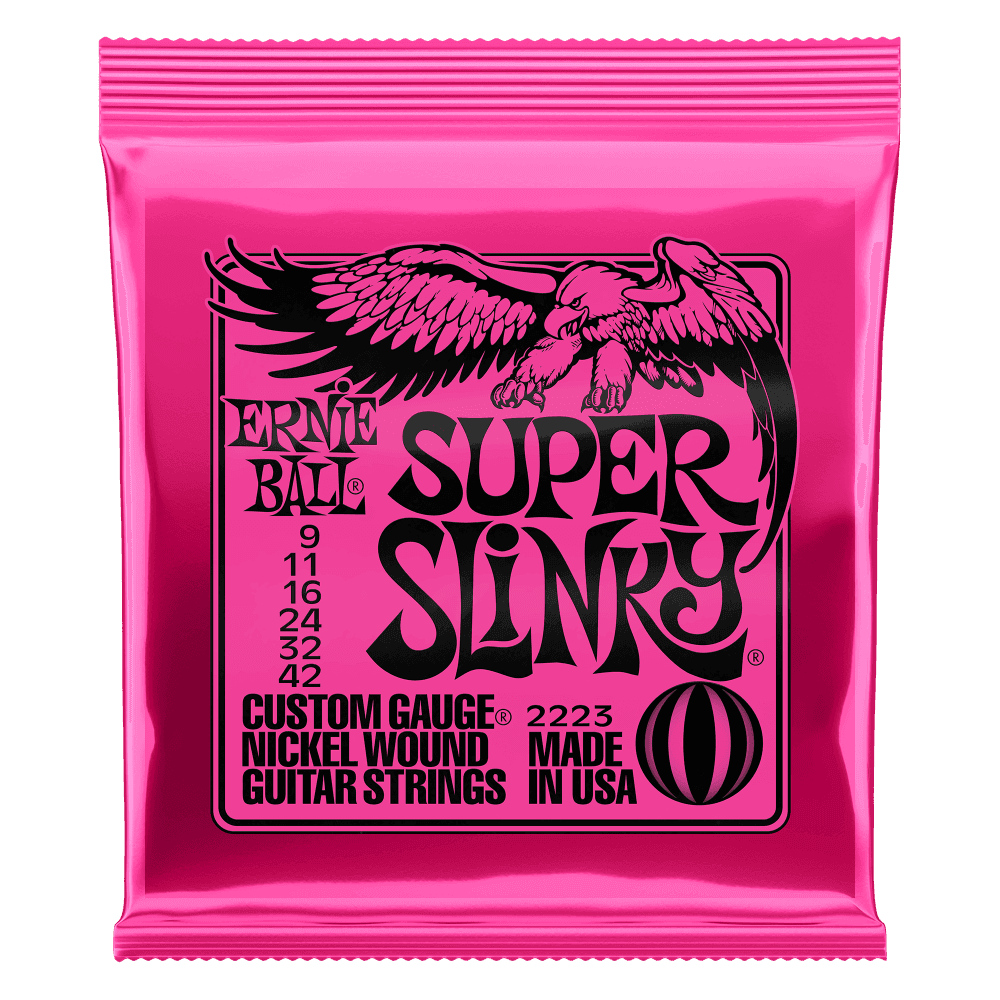
Super Slinky (.009–.042)
Why this one: The famous 9s. Same light gauge Fender lists on the Player II Strat, and the easiest set to bend and vibrato on.
How the tremolo changes your gauge choice
Scale length is the same as a Tele, so our scale length guide applies: a 25.5 inch scale runs about 6 percent tighter than a 24.75 inch Gibson at the same gauge and tuning. The new variable on a Strat is the bridge.
Fender describes the Player II Strat bridge as a 2-point synchronized tremolo. In plain terms, the bridge pivots on two points and is held in balance by springs in the back cavity. Your strings pull one way. The springs pull the other. The bridge sits level when those forces match.
That balance is why gauge matters more on a Strat than on a Tele:
What gauge does to a floating tremolo
- Heavier strings
- More pull on the bridge. It tilts forward unless you tighten the springs.
- Lighter strings
- Less pull. The bridge tilts back unless you loosen the springs.
- Same gauge, new set
- No setup change. This is the easy path.
- Big gauge jump
- Plan to adjust spring tension, then check intonation and action.
This is general setup physics, not a specific measurement. For your guitar, adjust by ear and by eye, in small steps. A decked bridge (resting on the body) or a hard-tail changes the picture, and so does a locking system. The simple rule: pick a gauge, then set the guitar up for it.
Vintage and modern trems follow the same logic. A vintage-style six-screw bridge and a modern two-point bridge both float against springs, so both react to gauge. Fender's Player II page lists the modern two-point style. Your own guitar may differ, so check what you have before you assume.
Read string gauge and scale length for the general rule and keep the string gauge chart handy for exact diameters.
Firmer default: Ernie Ball Regular Slinky
If .009s feel loose, go up one step. Ernie Ball Regular Slinky (.010 to .046) is the standard answer for a 25.5 inch scale electric in E standard or Eb, per our review. It uses nickel-plated steel wrap on a tin-plated hex core, uncoated, with a bright, balanced tone.
Our page lists the genres as rock, classic rock, blues, blues-rock, country-rock and indie, and notes that Ernie Ball's artist roster names Eric Clapton and Billie Joe Armstrong on this set. That is a statement about the set, not about their Stratocasters.
The tradeoff against Super Slinky: more tension, so slightly harder bends, but a fuller sound and steadier tuning under hard picking. On a tremolo Strat, going from nines to tens is a small change, so you may only need a small spring tweak. If you have never changed gauge, try this and see how your bridge sits.
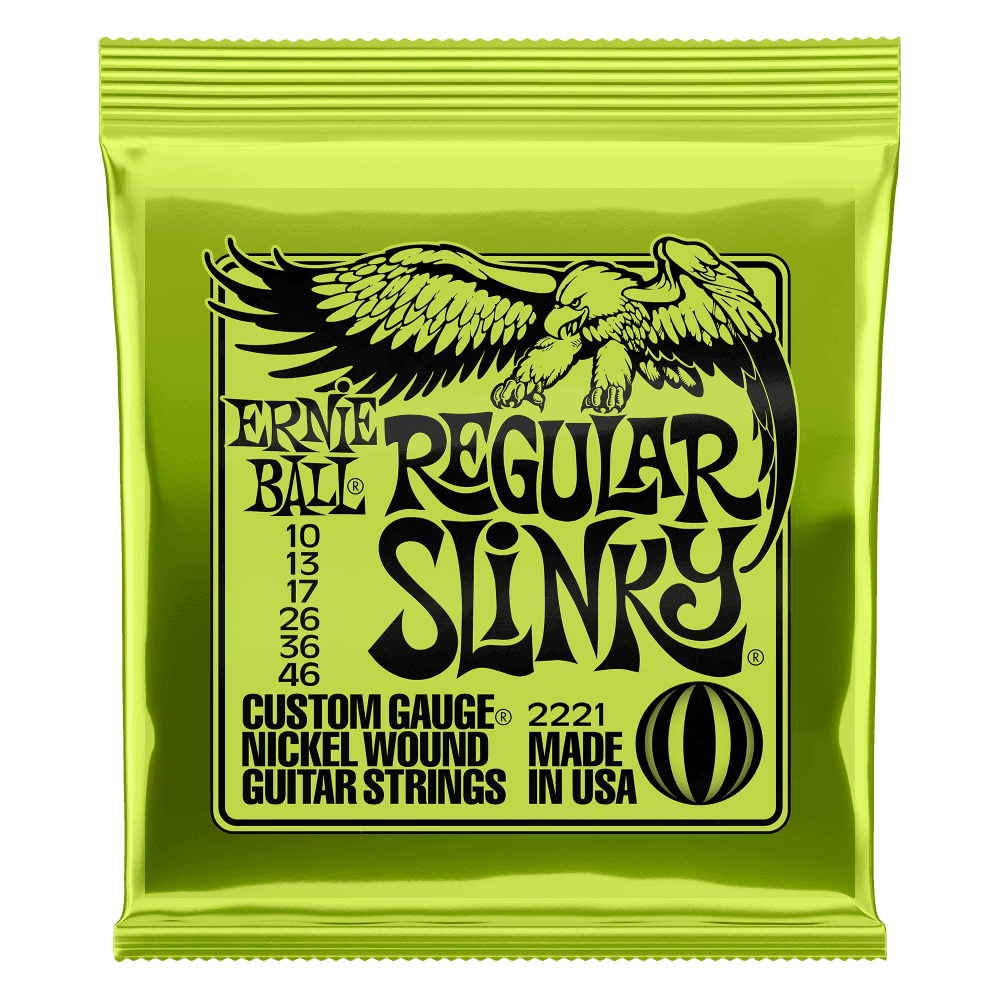
Regular Slinky (.010–.046)
Why this one: The all-purpose standard-tuning default. A step firmer than Super Slinky for steadier rhythm playing.
Light top, full bottom: D'Addario NYXL0946
Many Strat players want easy bends on top and real body underneath. D'Addario NYXL0946 is built for that: .009, .011 and .016 on top, and .026, .036 and .046 below.
Per our review, the set uses D'Addario's NY Steel core and Fusion Twist plain strings, and totals 92.9 pounds of tension in E standard, about 9 pounds less than a straight .010 set. All of that difference is in the top three strings. The bottom three match the NYXL1046 set exactly.
For a Strat, this matters because the low strings carry most of the pull against the tremolo springs, while the high strings do most of the bending. You get a light feel where you bend and a normal feel where you play chords. It costs more than a Slinky and lists rock, classic rock, blues-rock, hard rock and pop.

NYXL0946 Nickel Wound (.009–.046)
Why this one: Super light .009 top with a regular .046 bottom. Easy bends, full low end, strong tuning stability.
In-between tension: Ernie Ball Silver Slinky
Maybe tens feel a hair stiff and nines a hair loose. Ernie Ball Silver Slinky is built for that gap.
It is John Mayer's signature set: .0105, .0135, .0175, .027, .037 and .047. Per our review, it sits exactly between a .010 and an .011 set, and it carries Reinforced Plain Strings for tuning stability on a tremolo guitar. The name nods to the PRS Silver Sky. It is uncoated nickel-wound, not a silver alloy.
Our page explains the idea in Mayer's terms: on a vibrato-heavy Strat-style guitar, thin plain strings can feel loose and slip pitch under sustained bends, while an .011 set fights vocal bends. This set lifts every string by roughly half a gauge to split the difference. It is a $$ tier set, and it lists blues-rock, soul-rock, pop-rock and singer-songwriter.
Heavy Texas blues: GHS Nickel Rockers 1300
Some Strat players want a fat, hard-hit single-coil sound. The GHS Nickel Rockers 1300 Low Tune is the heavy end of this page: .011, .015, .019 plain, .028, .038, .058, in rollerwound pure nickel.
Per our review, GHS ties this set to Stevie Ray Vaughan and built it from the lighter gauges he moved to late in life. It is designed for Eb standard, a half step down. That drop is what makes the heavy mass playable. The plain .019 third bends cleaner and rings with more single-coil clarity than a wound third at that gauge.
Be clear about the limits. Our review notes that this is not the exact set from his early career, which used a .013 high E. On a tremolo Strat, a set this heavy is a real setup project: more pull on the bridge, more spring tension needed, and a check of the nut slots for the .058. It is also the opposite of easy bends. Buy it for the sound, not for comfort.

Nickel Rockers 1300 Low Tune (.011–.058)
Why this one: Heavy rollerwound pure nickel with a plain .019 third, made for Eb standard Texas blues on a single-coil Strat.
Warmer and heavier: DR Pure Blues PHR-11
Not everyone wants the full SRV commitment. DR Pure Blues PHR-11 is a .011 to .050 set with a pure nickel wrap on a round core. It is heavier than Regular Slinky and much lighter than the 1300.
Per our review, DR calls the sound warm and balanced with rich overtones and a vintage vibe, and the set supplies the .011 and .014 top strings in Derek Trucks's own long-running custom Pure Blues gauge. That is a detail about his mix, not a claim about a Strat. For a bright Strat, the pure nickel takes the edge off the bridge pickup without dulling the neck pickup. It lists blues, blues-rock, classic rock, rock and country, in E standard or Eb.
The tradeoff is price tier and a softer attack. If you want brightness, stay with nickel-plated steel.
How to choose
Pick by how you play your Strat
- Floating trem, lots of bends
- Ernie Ball Super Slinky. The factory-style light gauge.
- Rhythm-heavy, want a firmer feel
- Ernie Ball Regular Slinky. One step up, still easy to set up.
- Easy top, full bottom
- D'Addario NYXL0946. Light bends, regular low strings.
- Between tens and elevens
- Ernie Ball Silver Slinky. Even half-gauge bump.
- Heavy Texas blues in Eb
- GHS Nickel Rockers 1300. Plan a setup.
- Warmer, heavier, vintage
- DR Pure Blues PHR-11. Pure nickel, .011 to .050.
Compare this with the other classic Fender: our Telecaster string guide covers country and jazz sets and a fixed bridge that lets you ignore the tremolo question. For the full field of sets, see best electric guitar strings.
Tuning matters too. In E standard, any set above works. If you tune down a half step to Eb standard, you can go a gauge heavier and keep the same feel.
Bottom line
Start with Super Slinky if you use the trem and like easy bends. Move to Regular Slinky for a firmer feel. Only go heavy if you are ready to set up the bridge for it.
Super Slinky (.009–.042)
Why this one: Our pick for most Stratocasters. Light, familiar, and easy on a floating tremolo.