Ernie Ball Super Slinky (.009–.042): the original light-gauge electric set
Written with AI help · Updated
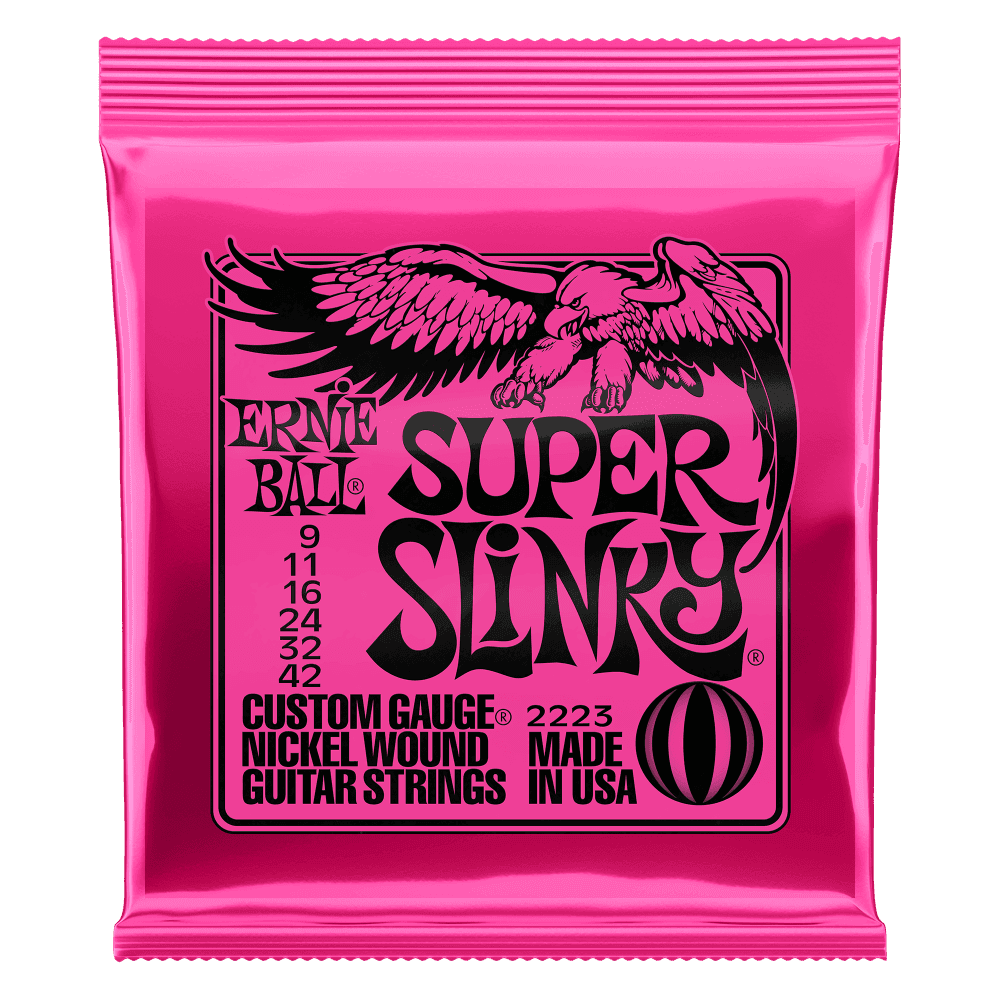
Ernie Ball Super Slinky (.009–.042) is the original light-gauge electric set, the famous 9s. Nickel-plated steel wrap on a tin-plated hex steel core, the same build as Regular Slinky but a step lighter for easier bends and lower tension. It is the default answer for shred, lead-heavy rock, and any player who wants the top strings to move with less effort. In E standard or Eb. Step up to Regular Slinky if it feels too loose.

What this set is
Ernie Ball Super Slinky is the original light-gauge electric set, the 9s that a huge slice of rock and shred was recorded on. Gauge .009 to .042, nickel-plated steel wrap on a tin-plated hex steel core. It is built exactly like a Regular Slinky, just one step lighter across the board.
That one step is the whole point. Lighter strings need less force to fret and far less force to bend. For a lead player who lives on the top three strings, that lower tension is the difference between a vibrato that sings and one that fights back. Ernie Ball has sold the Super Slinky as a core gauge for decades, and it sits right next to Regular Slinky as the other default a guitarist might hand you with no explanation.
Anatomy
- Model
- Super Slinky
- Gauge
- .009 – .042
- Gauge set
- .009, .011, .016 (plain), .024, .032, .042 (wound)
- String count
- 6 strings (3 plain, 3 wound)
- Wrap wire
- Nickel-plated steel
- Core wire
- Tin-plated hex steel
- Plain strings
- Tin-plated high-carbon steel
- Coating
- None. Uncoated, fast feel, low price.
- Intended tuning
- E standard, Eb standard
- Part number
- 2223 (P02223), single set
- Price tier
- Budget ($)
- Made in
- United States (Ernie Ball, Coachella, CA)
Per Ernie Ball's own spec, the wound strings are nickel-plated steel wire wrapped around a tin-plated hex-shaped steel core, and the plain strings are specially tempered tin-plated high-carbon steel. It is the same recipe as the rest of the nickel Slinky family. The number on the pack is the only thing that changes between Super Slinky and Regular Slinky.
Tone
Bright, snappy, and quick to respond. Nickel-plated steel is the wrap most classic pickups were voiced around, so a Super Slinky plugged into a single-coil or a PAF gives you the tone the amp designer expected, with a little extra top-end zing because the strings are thin.
The flip side of light gauge is body. Compared to a set of 10s, the 9s give up a touch of low-mid weight and sustain. That is rarely a problem for lead work, where clarity and bend feel matter more than thickness, and it is part of why the gauge became the shred standard. For heavy rhythm in standard tuning, some players prefer the slightly fuller 10s.
| Super Slinky (.009) | Regular Slinky (.010) | Power Slinky (.011) | |
|---|---|---|---|
| Gauge | .009 – .042 | .010 – .046 | .011 – .048 |
| Bend effort | Lowest | Medium | Higher |
| Low-end body | Lighter | Fuller | Fullest |
| Best tuning | E / Eb | E / Eb / Drop D | Eb / Drop D |
| Price tier | $ | $ | $ |
Best for
Lead and shred players who bend constantly and want the top strings to move with the least effort. Beginners whose hands are still building strength. Light-touch rhythm players in E standard or Eb. Strat and Tele players chasing classic single-coil snap. Anyone who finds 10s slightly stiff and wants the same Slinky voice with a faster, looser feel.
Worst for
Drop tuners and down-tuned metal. At .042 the low E goes slack below Drop D, so a heavy chug loses definition. Reach for Power Slinky or a heavier set for tunings below Eb. Players who attack hard with a thick pick may also find 9s buzz or feel flimsy, and will be happier on Regular Slinky 10s.
Who uses them
The 9s are a deep well. Ernie Ball's own product copy lists Super Slinky as the set played by Jimmy Page, Iron Maiden, and Angus Young, among legions of others.
The clearest documented case is Steve Vai. On Ernie Ball's String Theory page he describes his gauges in his own words: he is "basically a nine through 42 guy," staying at nines on top and only beefing up the wound strings on a long tour as his hands get stronger. Angus Young of AC/DC is a long-running Super Slinky user too, confirmed by his guitar tech in a Premier Guitar Rig Rundown. For the full breakdown of how Vai builds his rig around this gauge, see our Steve Vai strings guide.
Verdict
If Regular Slinky is the baseline 60 percent of guitarists would land on, Super Slinky is the other default, the one lead players reach for the moment bending feel matters more than low-end body. Same classic Slinky voice, same proven build, one step lighter. It is cheap, it is everywhere, and it has been on more shred records than almost any string in history. Buy 9s for feel and easy bends. Buy 10s if the top strings feel too loose under your pick.