Ernie Ball Silver Slinky (.0105–.047): John Mayer's signature set, decoded
Written with AI help · Updated
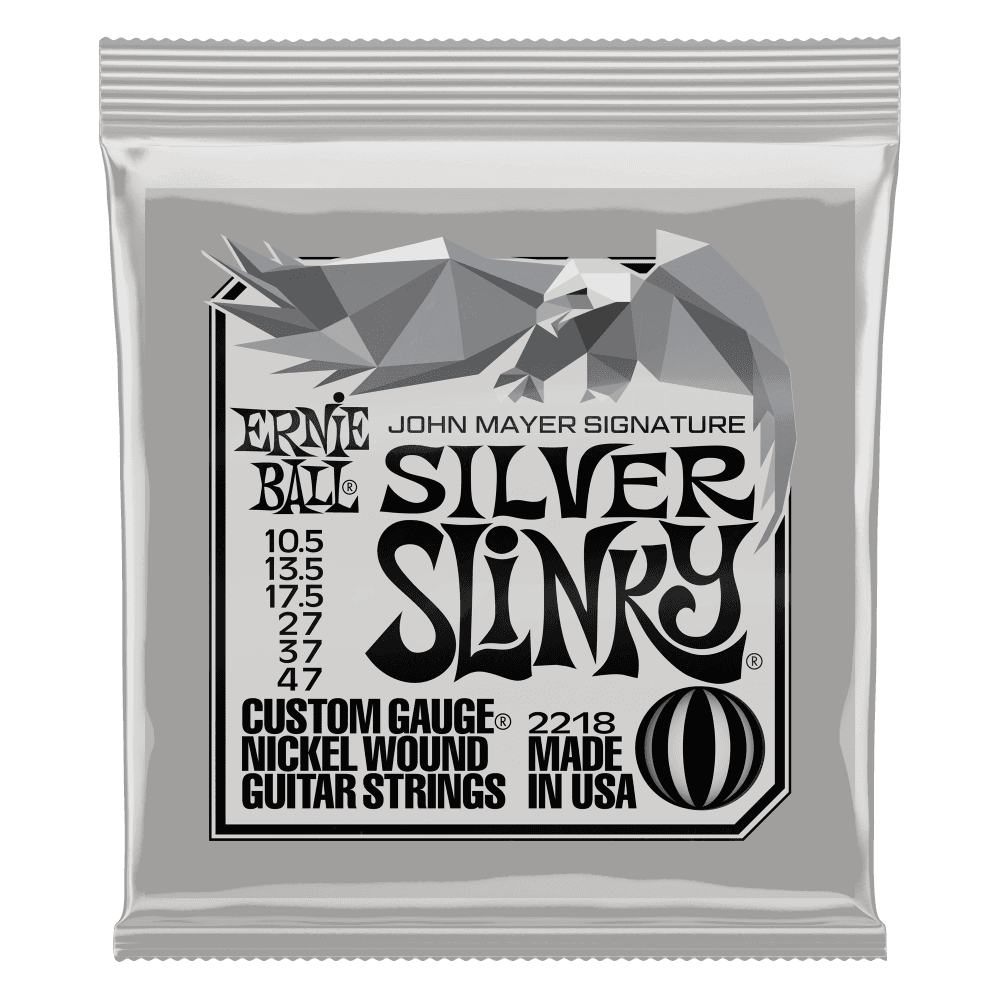
Ernie Ball Silver Slinky is John Mayer's signature set, gauge .0105 to .047. The gauges sit deliberately between a standard .010 and an .011 set, tuned for consistent tension and vocal-style bends. It is uncoated, nickel-wound, with Reinforced Plain Strings for tuning stability on a tremolo guitar like his PRS Silver Sky. The name nods to the Silver Sky, not a silver coating.
What this set is
The Ernie Ball Silver Slinky is John Mayer's signature electric set, gauge .0105 to .047. Ernie Ball built it around one request: a tension that sits exactly between a standard .010 set and an .011 set, the gauge Mayer says he chased for years before this existed.
It is a nickel-wound set, uncoated, with Reinforced Plain Strings. The "Silver" in the name points at the PRS Silver Sky, the guitar he designed it for. It is not a coated string and not a silver alloy. Think of it as a precise custom gauge that Ernie Ball decided to make a stock product.
Anatomy
- Model
- Silver Slinky (John Mayer Signature)
- Signature artist
- John Mayer
- Gauge
- .0105 – .047
- Gauge set
- .0105, .0135, .0175p, .027w, .037, .047
- String count
- 6 strings (3 plain, 3 wound)
- Core wire
- Tin-plated hex high-carbon steel
- Wrap wire
- Nickel-plated steel
- Plain strings
- Reinforced Plain Strings (brass lock twist)
- Coating
- Uncoated
- Designed for
- PRS Silver Sky (vintage tremolo)
- Intended tuning
- E standard
- Part number
- P02218 (single), P03818 (3-pack), P03817 (6-pack)
- Made in
- United States (Ernie Ball, Coachella, CA)
The gauge story: why .0105
Most players think in whole gauges. You run tens, or you run elevens. Mayer's whole argument is that the honest answer for his playing lives in the gap between them.
A standard .010 set is fast and easy to bend, but on a vibrato-heavy Strat-style guitar the thin plain strings can feel loose and slip pitch under sustained bends. A jump to .011 fixes the tension and tightens the low end, but now the high strings fight you on the vocal bends that are the core of his vocabulary. Neither is wrong. Neither was right for him.
The Silver Slinky bumps every string up roughly half a gauge from a .010 set. The high E goes from .010 to .0105. The B from .013 to .0135. The G from .017 to .0175. The wound strings shift up to .027, .037, and .047. Because the bump is even across the whole set, the tension balance between strings stays consistent, which is what keeps chords feeling in tune and bends feeling predictable. This is a tension set, not a brightness set or a stiffness set.
What 'Silver' means, and what RPS does
Two things on this set get misread constantly, so here they are plainly.
The name is not a material. "Silver Slinky" is a nod to the PRS Silver Sky, Mayer's signature electric. The strings are ordinary nickel-plated steel wound over a steel core, the same wrap alloy as a regular Slinky. There is no silver plating and no special coating. If you came here expecting a coated, long-life string, this is not that.
The construction that does matter is RPS, Reinforced Plain Strings. Ernie Ball adds a brass lock twist at the ball end of each plain string so the wire cannot stretch through or creep under load. On a hardtail it is a small nicety. On a vintage-tremolo guitar like the Silver Sky, where the plain strings move every time you touch the bar or lean into vibrato, it is the difference between staying in tune across a set and chasing your tuner between songs. It is the same RPS build as the Regular Slinky RPS 2241, applied to a heavier custom gauge.
Where it sits: .010 vs .0105 vs .011
Every set here is a nickel-wound Ernie Ball electric string. The only real variables are gauge and whether the plain strings are reinforced.
| Silver Slinky | Regular Slinky (.010) | Power Slinky (.011) | Regular Slinky RPS (.010) | |
|---|---|---|---|---|
| Gauge | .0105 – .047 | .010 – .046 | .011 – .048 | .010 – .046 |
| High E | .0105 | .010 | .011 | .010 |
| Wrap wire | Nickel-plated steel | Nickel-plated steel | Nickel-plated steel | Nickel-plated steel |
| Plain ends | RPS reinforced | Standard | Standard | RPS reinforced |
| Tension feel | Between 10 and 11 | Standard slinky | Stiffer | Standard slinky |
| Signature | John Mayer | None | None | None |
| Price tier | $$ | $ | $ | $ |
If you already run a standard Regular Slinky 2221 and wish the high strings held tune just a touch better under hard bends, the Silver Slinky is the natural step up without going all the way to elevens. If you run an Power Slinky 2220 and find the high E a little stiff for vocal bends, the Silver Slinky steps you back down half a gauge. And if you only want the tuning-stability half on a plain .010 gauge, the Regular Slinky RPS 2241 gives you the reinforced plain strings at the lower price.
Best for
Single-coil and Strat-style players in E standard who live on vocal-style bends and want even, predictable tension. Silver Sky owners who want the exact gauge the guitar was voiced around. Anyone who has bounced between tens and elevens for years and never found either quite right. Tremolo players who want the RPS plain strings to hold tune through heavy bar and vibrato use.
Worst for
Drop-tuned and metal players who need a tighter low end than a .047 low E gives below Drop D. Players chasing a long-life coated string, since this set is uncoated and will age like any nickel set. Budget players who restring often and would not notice the half-gauge difference, a plain Regular Slinky is cheaper and close enough. Heavy-handed pickers who already prefer the stiffness of a full .011 set.
Verdict
The Silver Slinky is a real gauge with a real argument behind it, not a celebrity relabel. The .0105 to .047 spread genuinely solves the tens-versus-elevens problem for single-coil players who bend a lot, and the Reinforced Plain Strings earn their keep on a tremolo guitar. The catch is the obvious one: you pay a signature-set premium for a gauge you could once only get by buying singles, and the set is uncoated, so longevity is ordinary. For Strat players chasing John Mayer's feel, or anyone who has always wished a .010 set held tune a little better, it is a smart, honest buy. For drop tuners, coated-string loyalists, and players happy on stock tens, the cheaper Slinky neighbors are the better call.