Best Tuner Pedals for Guitar and Bass, Compared for Low Tunings
Written with AI help · Updated
Peterson StroboStomp HD is the best tuner pedal if you play low. Per Peterson, it lists 0.1-cent strobe accuracy, a C0 to A#8 note range, true bypass or buffered output, and presets for 7-string and baritone guitar. Boss TU-3 is the cheaper stage standard, with 7-string and 5- and 6-string bass support, buffered bypass, and flat tuning modes.
The short answer
A tuner pedal has one job: tell you the truth fast, in the dark, without hurting your tone. Standard tuning is easy for any of them. Drop A, baritone, 7-string and bass are where pedals start to differ. We compared four pedals using each manufacturer's own page. We have not hands-on tested them.
Our pick is the Peterson StroboStomp HD. Per Peterson, it lists 0.1-cent accuracy, a C0 to A#8 note range, and sweetened tunings for 7-string and baritone guitar. It also gives you a choice of true bypass and buffered output. The Boss TU-3 is the pick if you want the stage standard in a lower price tier.
We left out some well-known names. TC Electronic PolyTune 3 pedals and Korg Pitchblack models did not pass our availability check on Amazon when we looked, so we do not recommend a link we cannot stand behind. See the note at the bottom.
| Best for | Low-end and tuning notes (per manufacturer) | Price | |
|---|---|---|---|
| Peterson StroboStomp HD | Best overall, strobe accuracy | C0 to A#8 note range, 0.1-cent accuracy, 7ST and BRT presets | $$ |
| Peterson StroboStomp Mini | Best compact strobe | Same C0 to A#8 range and 0.1-cent accuracy, smaller case | $$ |
| Boss TU-3 | Best stage standard | C0 to C8 range, 7-string guitar and 5- and 6-string bass support, flat modes | $ |
| Boss TU-3S | Best for switching systems | Same tuning as TU-3, no footswitch, AC power only | $ |
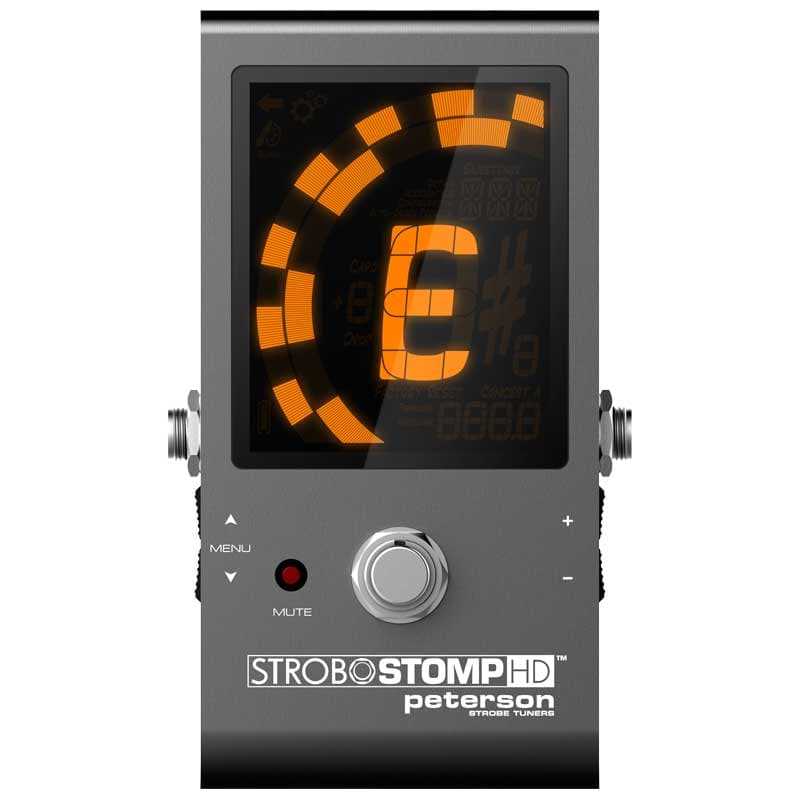
StroboStomp HD
Why this one: Our overall pick. 0.1-cent strobe accuracy, pop-less true bypass or buffered output, and presets for 7-string and baritone guitar, per Peterson.
What a tuner pedal needs to handle low tunings
Four things matter once you leave E standard.
First, range. Your tuner has to hear your lowest note. A 7-string in standard tuning has low B near 62 Hz. Drop A on a 7-string sits at A1, 55 Hz. A 5-string bass low B is near 31 Hz. Every pedal here lists a floor of C0, which is 16.35 Hz, so the range is not the bottleneck on paper. Look at the number on the manufacturer's page, not the box.
Second, chromatic reading. A chromatic tuner shows any note, sharp or flat. That is how you get through Drop C, Drop B or a baritone tuning without fighting a preset. Boss lists a default Chromatic mode on the TU-3. Peterson lists standard chromatic tuning with equal temperament, which it says suits regular or alternate tuning. See our Drop C tuning page and Drop A tuning page for the notes.
Third, offsets and presets. Some pedals let you shift the whole reference down. Boss calls this flat tuning. Peterson uses transposition and a library of guided tunings. These save mental math when the whole guitar sits a step low.
Fourth, the way the pedal treats your signal. More on that in the bypass section below.
A tuner reads pitch. It cannot give a slack string enough tension to hold a low note. If your drop tuning feels floppy, read our drop tunings and low tunings explainer and the Drop C gauge and tension chart before you blame the tuner.
Best overall: Peterson StroboStomp HD
The StroboStomp HD is a real strobe tuner in a stainless steel pedal. Per Peterson, it lists 0.1-cent accuracy, a 417-segment LCD with a user-selectable LED backlight color, and a C0 to A#8 note range. The frequency response is listed as 16.35 Hz to 7302 Hz.
The low-tuning features are what put it first here. Peterson lists sweetened tunings including 7ST for seven-string guitars and BRT for baritone guitars. It also lists a Guided Tuning mode for 6 and 7-string guitars, and standard tuning presets from E down to F sharp for 6, 7, 8 and 9-string guitars. Named presets include Drop D, Drop C, and Drop A for 7-string. In total Peterson lists over 135 tunings and unlimited user presets.
It has three performance modes. Per Peterson, you can pick pop-less true bypass, buffered output, or monitor mode where the tuning screen stays visible. The mode switch sits in the battery box.
Power comes from a 9V battery that Peterson says is included, or from a 9VDC negative-center adapter. There is a power-out jack rated for 9VDC at 1A. Peterson lists a 3-year warranty.
The tradeoffs are size and menus. It is a bigger pedal than the Boss, and the preset list is long. If you only tune to E standard, you are paying for features you will not use.
StroboStomp HD
Why this one: Our overall pick. 0.1-cent strobe accuracy, pop-less true bypass or buffered output, and presets for 7-string and baritone guitar, per Peterson.
Best compact strobe: Peterson StroboStomp Mini
The StroboStomp Mini is the pick for a crowded board. Per Peterson, it keeps the 0.1-cent strobe accuracy and the C0 to A#8 note range of the HD. Peterson lists a 224-segment display, over 80 sweetened and guided tunings, and a Concert A range of 390 Hz to 490 Hz.
The case is 94 mm by 46 mm by 33.5 mm without the switch, and it weighs 0.56 lb, per Peterson. Jacks sit on the top edge, which Peterson says was the most requested feature from customers.
It lists the same 7ST and BRT sweeteners as the HD, plus pop-less true bypass, a buffered output mode, and an always-on monitor mode. It runs on a 9VDC negative-center adapter or USB-C bus power. Peterson lists no battery and no power-out jack, so you cannot use it to feed other pedals.
The tradeoff is clear. You give up the power-out jack and the battery for a smaller footprint. Choose it if board space matters more than either.
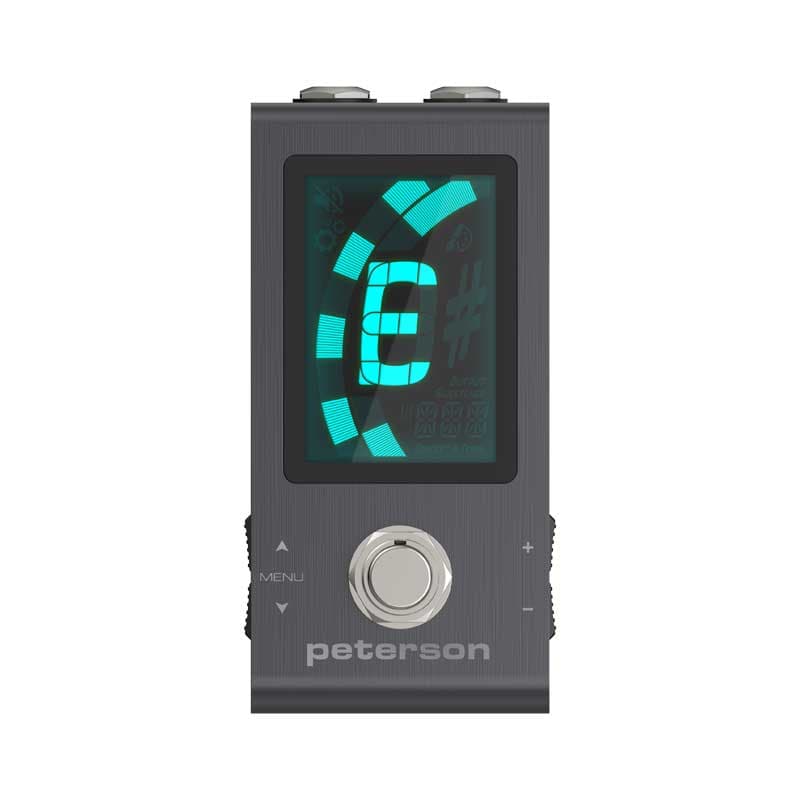
StroboStomp Mini
Why this one: The same 0.1-cent strobe engine as the HD in a smaller case with top-mounted jacks, per Peterson.
Best stage standard: Boss TU-3
Per Boss, the TU-3 is the world's best-selling stage tuner. Per Boss, it has a 21-segment LED meter with brightness control, accuracy of plus or minus 1 cent, and a tuning range of C0 (16.35 Hz) to C8 (4,186 Hz).
Boss lists three mode families: Chromatic, Guitar and Bass, each with flat options. Guitar mode supports 7-string guitars. Bass mode supports 5- and 6-string basses. Flat tuning goes up to six semitones below standard pitch in Guitar mode and three semitones in Bass mode. That covers Drop C and Drop B on a six-string, and the common lowered tunings, without a menu dive.
The display has Cent and Stream modes. Stream is a strobe-style view. Boss also lists an Accu-Pitch Sign function that shows a streaming indicator when you hit your target, and a High Brightness mode for outdoor stages.
Bypass is the one design choice to know. Boss lists buffered bypass, with a mute function when the tuner is engaged. That helps with long cable runs. If you are a true-bypass purist, look at the Peterson pedals. Power is a 9V battery or an AC adaptor. Boss lists roughly 5 hours on carbon-zinc and 21 hours on alkaline, and a 5-year warranty.
The tradeoff is precision. Plus or minus 1 cent is fine for live work. It is not the 0.1-cent strobe that Peterson lists.
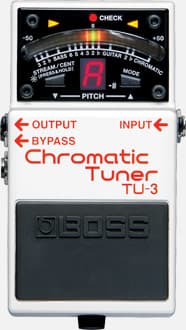
TU-3 Chromatic Tuner
Why this one: The stage-standard pedal tuner. 21-segment LED meter, buffered bypass, and flat modes that cover drop tunings, per Boss.
Best for switching systems and tight boards: Boss TU-3S
The TU-3S is a TU-3 with the footswitch removed. Per Boss, the display and tuning functions are identical to the TU-3. It is always on, which suits switching systems like the Boss ES-8 and ES-5, and any board where space is tight.
Boss lists the same C0 to C8 range, the same Chromatic, Guitar and Bass modes, and the same buffered bypass. The product page highlights support for 7-string guitars and 6-string basses, and drop tunings up to six semitones below standard in Guitar flat mode.
The catch is power. Boss lists an AC adaptor, sold separately, and no battery. If you do not run a power supply, this is not your pedal. You also lose the foot-operated mute, so you will need a switcher or another way to engage it.
It is an easy choice if you already run a switching system. It is a poor one if you want a stand-alone pedal you can toss in a gig bag.
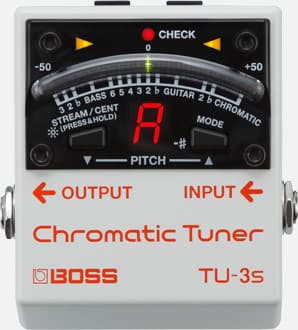
TU-3S Chromatic Tuner
Why this one: TU-3 tuning and display in a smaller case with no footswitch, built for switching systems, per Boss.
Accuracy, bypass and stage visibility
Accuracy first. Peterson lists 0.1 cent on both StroboStomp pedals. Boss lists plus or minus 1 cent on the TU-3 and TU-3S. One cent is already finer than most players hear in a band mix. The finer figure helps most when you set intonation, record, or tune a low string where small errors are easy to see on a strobe.
Bypass second. Peterson lists switchable pop-less true bypass and a pure buffered mode. Boss lists buffered bypass only. A buffer helps if you run a long cable or many true-bypass pedals. It is a non-issue for a short chain. Pick based on your board.
Visibility third. Boss uses a 21-segment LED meter with brightness control and a High Brightness mode for outdoor stages. Peterson uses a multicolor backlit LCD, and its page says the colors flatten to monochrome in direct sunlight so the strobe and note name stay readable. Peterson also lets you assign display colors to individual tunings, so you can tell Drop C from E standard at a glance.
Finally, check your cabling. A tuner pedal sits early in your chain, so a good cable matters. See our best guitar cables comparison.
How to choose
Pick by how low you play and how much board you have
- You play 7-string, baritone or tune very low
- Peterson StroboStomp HD. It lists 7ST and BRT presets and a C0 to A#8 note range.
- You want strobe accuracy in a small case
- Peterson StroboStomp Mini. Same 0.1-cent accuracy, top-mounted jacks, no battery.
- You want a proven stage tuner
- Boss TU-3. LED meter, buffered bypass, and flat modes for guitar and bass.
- You run a switching system
- Boss TU-3S. Same tuning as TU-3, no footswitch, AC power only.
- You would rather clip it on
- Skip the pedal and read our clip-on tuner comparison.
If you would rather not put a tuner on the floor, our best clip-on guitar tuners page covers headstock options for drop and alternate tunings. For lower tunings in general, check the string gauge and scale length guide so your set suits the tuning. For standard tuning, see E standard.
Bottom line
Buy the Peterson StroboStomp HD if you play low, extended-range, or care about precision. Buy the StroboStomp Mini if you want the same engine in less space. Buy the Boss TU-3 if you want the stage standard and do not need a strobe. Buy the TU-3S if you run a switching system.
We did not include TC Electronic PolyTune 3 or Korg Pitchblack pedals. Both are respected, and TC lists polyphonic tuning that none of these pedals offer. They did not pass our Amazon availability check when we reviewed this page, so we have no link to give you. Check the maker pages if you want them.
StroboStomp HD
Why this one: Our overall pick. 0.1-cent strobe accuracy, pop-less true bypass or buffered output, and presets for 7-string and baritone guitar, per Peterson.