Ernie Ball Paradigm gauges compared: which one should you buy?
Written with AI help · Updated
Regular Slinky Paradigm (.010–.046) is the safe default for most E-standard players. Ernie Ball's Paradigm electric line spans 10 six-string gauges, from Super Slinky (.009–.042) to Not Even Slinky (.012–.056), plus two 7-string sets, all sharing Everlast nano-treatment, RPS reinforcement, and a 90-day breakage guarantee. Three gauges, Hybrid, Ultra, and Burly, are literal hybrids of two other Paradigm sets. Pick by your current gauge or tuning, not the name.
The short answer
Ernie Ball's Paradigm electric line is one construction, Everlast nano-treatment, RPS reinforced plain strings, an ultra-high-strength steel core, and a 90-day breakage-and-rust guarantee, sold across 10 six-string gauges and 2 seven-string gauges. Nothing about the durability tech changes between them. The only variable is thickness, and three of the ten six-string gauges are literal combinations of two other sets in the lineup.
If you already know your gauge, match it: Regular Slinky Paradigm (.010–.046) if you currently play standard nickel Regular Slinky, Power Slinky Paradigm (.011–.048) if you play Power Slinky, and so on down the line. If you don't know your gauge, start with Regular Slinky, it's the set most electrics ship set up for, and the rest of this page will tell you when you'd want something else.
All 12 Paradigm gauges at a glance
| Gauge | Built from | Best for | |
|---|---|---|---|
| Super Slinky | .009–.042 | Base gauge | Lead, shred, E standard |
| Primo Slinky | .0095–.044 | Base gauge, half step above Super | E standard, in-between feel |
| Hybrid Slinky | .009–.046 | Super's top three + Regular's bottom three | E standard, touring durability |
| Regular Slinky | .010–.046 | Base gauge, the standard default | E standard, the default |
| Ultra Slinky | .010–.048 | Regular's top three + Power's bottom three | E standard, extra low end |
| Power Slinky | .011–.048 | Base gauge | Eb standard, Drop D |
| Skinny Top Heavy Bottom | .010–.052 | Regular's top three + its own heavier bottom | Drop D |
| Burly Slinky | .011–.052 | Power's top three + Skinny Top Heavy Bottom's bottom three | Drop D, D standard |
| Beefy Slinky | .011–.054 | Base gauge, unique top three | Drop C floor (25.5" scale) |
| Not Even Slinky | .012–.056 | Base gauge, heaviest 6-string | Drop C, heavy rhythm |
| Regular Slinky 7-String | .010–.056 | 6-string Regular's exact gauge + a .056 seventh string | 7-string, standard tuning |
| Skinny Top Heavy Bottom 7-String | .010–.062 | 6-string STHB's exact gauge + a .062 seventh string | 7-string, drop tunings |
Every gauge lists at $14.99 for the 6-string sets and $16.99 for the 7-string sets, per Ernie Ball's own catalog page. All 12 carry the same 90-day breakage-and-rust guarantee.
Three gauges are hybrids of two others
Ten of Ernie Ball's Paradigm gauges look like independent products, but three of them are literally built by splicing the top half of one Slinky gauge to the bottom half of another. Ernie Ball confirmed this directly when Ultra and Burly launched in 2019, the brand's first new gauges in over a decade. Per MusicRadar's coverage at the time, "the Ultra set combines Regular and Power Slinky sets" while "the Burly set combines Power and Skinny Top Heavy Bottom Slinky sets."
The same pattern shows up a third time in Hybrid Slinky: its .009, .011, .016 top three matches Super Slinky exactly, and its .026, .036, .046 bottom three matches Regular Slinky exactly, verifiable directly from each set's own published gauge numbers.
| Full gauge | Top three (from) | Bottom three (from) | |
|---|---|---|---|
| Hybrid Slinky | .009–.046 | .009/.011/.016 (Super Slinky) | .026/.036/.046 (Regular Slinky) |
| Ultra Slinky | .010–.048 | .010/.013/.017 (Regular Slinky) | .028/.038/.048 (Power Slinky) |
| Burly Slinky | .011–.052 | .011/.014/.018 (Power Slinky) | .030/.042/.052 (Skinny Top Heavy Bottom) |
The other seven six-string gauges, Super, Primo, Regular, Power, Skinny Top Heavy Bottom, Beefy, and Not Even, are standalone gauges, not combinations. Beefy Slinky in particular is easy to mistake for "Burly plus one step": its .030, .042, .054 bottom is close to Burly's .030, .042, .052, but its .011, .015, .022 top doesn't match Power or Burly's .011, .014, .018 top at all. Beefy is its own gauge, not a third combination.
Which gauge fits your tuning
Paradigm gauge by tuning
- E standard, light feel
- Super Slinky (.009–.042) or Primo Slinky (.0095–.044). Easiest bending, best for lead-heavy playing.
- E standard, the default
- Regular Slinky (.010–.046). What most electrics ship strung with out of the box.
- E standard, want more low end
- Ultra Slinky (.010–.048). Keeps Regular's easy top, adds Power Slinky's heavier bottom three.
- Eb standard or light Drop D
- Power Slinky (.011–.048) or Hybrid Slinky (.009–.046) if you want a lighter top.
- Drop D, uniform heavy feel
- Burly Slinky (.011–.052). Same gauge feel across all six strings in Drop D.
- Drop D, lighter top for lead
- Skinny Top Heavy Bottom (.010–.052). Standard top three, heavy bottom three.
- Drop C
- Beefy Slinky (.011–.054) is the floor on a 25.5-inch scale; Not Even Slinky (.012–.056) is the heavier rhythm option.
- 7-string, standard tuning
- Regular Slinky 7-String (.010–.056), the 6-string Regular gauge plus a .056 low string.
- 7-string, drop tunings
- Skinny Top Heavy Bottom 7-String (.010–.062), the 6-string STHB gauge plus a .062 low string.
For the full tension math behind the Drop C recommendation, gauge, scale length, and tuning all factor in, see our Drop C gauge and tension chart. The tension target holds regardless of which Ernie Ball wrap alloy you choose; it's a function of thickness and scale length, not the Paradigm treatment.
The two 7-string Paradigm sets
Ernie Ball extends Paradigm to 7-string guitars with two sets, both priced at $16.99, two dollars more than any 6-string Paradigm gauge. Regular Slinky 7-String (.010–.056, SKU P02028 on Amazon) is exactly the 6-string Regular Slinky gauge with a .056 low string added underneath. Skinny Top Heavy Bottom 7-String (.010–.062, SKU P02030 on Amazon) does the same with the 6-string Skinny Top Heavy Bottom gauge, adding a heavier .062 seventh string built for drop tunings.
Neither has a dedicated CYS review yet. If you're a 7-string player who currently plays either gauge in a non-Paradigm build and wants the same durability tech the 6-string sets carry, both are confirmed on Ernie Ball's own catalog page with the same Everlast nano-treatment, RPS reinforcement, and 90-day guarantee as the rest of the line.
Which should you buy
Match your current gauge first. If you don't have one, Regular Slinky Paradigm is the lowest-risk default; step up to Ultra, Power, or Burly only once you know you want more low end or a lower tuning.
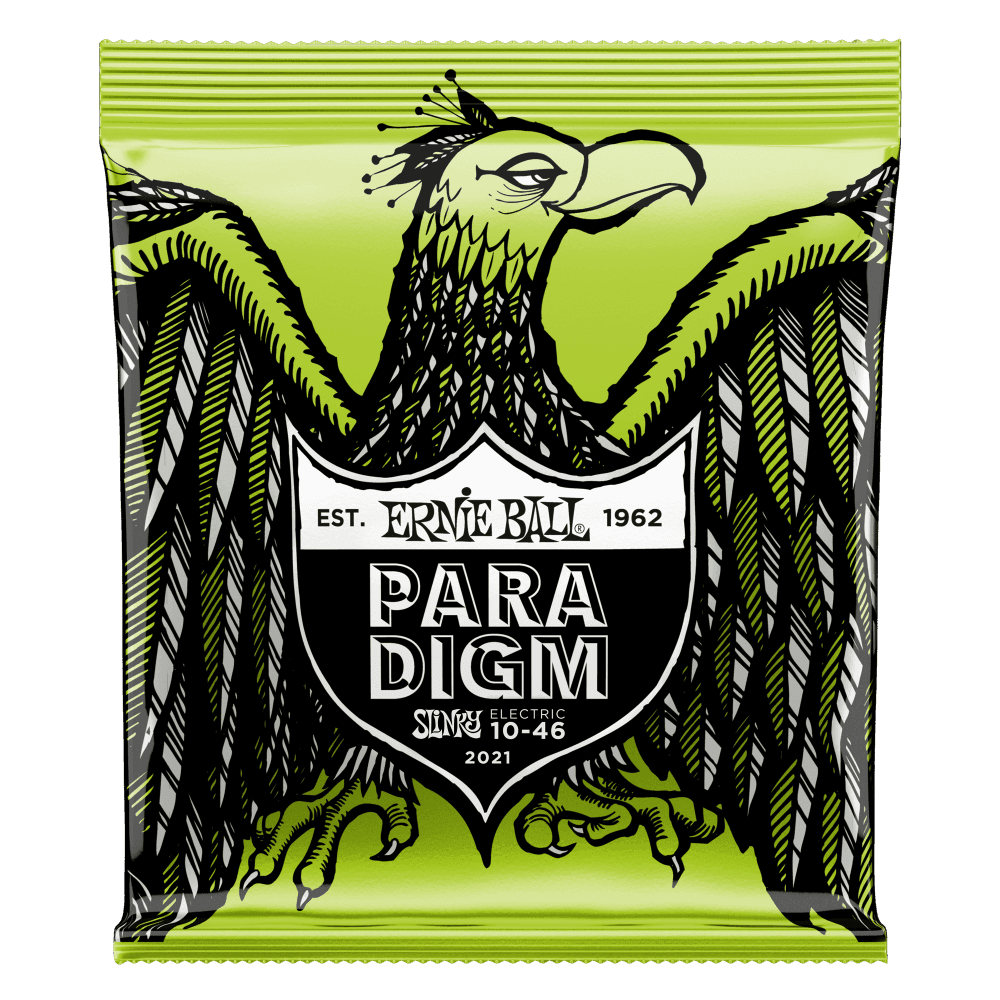
Paradigm Regular Slinky (.010–.046), the default
Why this one: Ernie Ball's standard gauge since the 1960s, and the one most electrics are already set up for. The lowest-risk starting point in the whole Paradigm lineup.
Paradigm Not Even Slinky (.012–.056), the heavy end
Why this one: The heaviest 6-string Paradigm gauge Ernie Ball sells. Built for Drop C rhythm players who pick hard and don't want the low string to flap. No dedicated CYS review yet, this card links straight to Amazon.
Related
- Individual Paradigm reviews: Super Slinky, Primo Slinky, Hybrid Slinky, Regular Slinky, Ultra Slinky, Power Slinky, Skinny Top Heavy Bottom, Burly Slinky.
- Line-level comparison: Ernie Ball string lines compared, Slinky vs RPS vs M-Steel vs Paradigm vs Cobalt.
- Tension math: Drop C string gauge and tension chart.
- Tuning references: E standard, Eb standard, Drop D, D standard, Drop C.
- The full catalog: the Change Your Strings string database.