Best Guitar Strings for Beginners: 6 Easy-Play Picks for Electric, Acoustic and Nylon
Written with AI help · Updated
D'Addario EXL110 (.010 to .046) is the best all-around beginner electric set: standard gauge, low price tier, and available everywhere. Want it easier on your fingers? Ernie Ball Super Slinky (.009 to .042) is lighter. On acoustic, D'Addario EJ10 Extra Light (.010 to .047) is the gentlest start, and D'Addario EJ45 Normal Tension is the nylon-string default.
The short answer
Beginners do not need fancy strings. You need strings that match your guitar, feel comfortable, and cost little enough that you will change them on time. That is the whole brief.
We picked six sets already reviewed on CYS, two or three for each guitar type: electric, steel-string acoustic and nylon-string. Every spec below comes from those reviews and the manufacturers' own pages. We have not tested these sets ourselves.
| Guitar | Gauge | Why it suits a beginner | Price | |
|---|---|---|---|---|
| D'Addario EXL110 | Electric | .010–.046 | Standard Regular Light default | $ |
| Ernie Ball Super Slinky | Electric | .009–.042 | Lightest, easiest to bend | $ |
| Ernie Ball Regular Slinky | Electric | .010–.046 | Classic, beginner-friendly | $ |
| D'Addario EJ10 | Acoustic | .010–.047 | Extra Light, lowest tension | $ |
| D'Addario EJ16 | Acoustic | .012–.053 | Standard Light, all-purpose | $ |
| D'Addario EJ45 Pro-Arte | Nylon-string | Normal tension | Best-selling classical set | $ |
Every set here sits in the lowest price tier. That is deliberate. You will break a string, you will forget to wipe them down, and you will want to experiment. Cheap sets make that painless.

EXL110 XL Nickel Wound (.010–.046)
Why this one: The best all-around beginner electric set. Standard Regular Light gauge, made in Farmingdale, NY since 1974, and the default most guitars are set up around.
How to choose beginner strings
Three things matter: the string type, the gauge and the price. Get the first one right and the rest is preference.
Match the string type to the guitar. Electric, steel-string acoustic and nylon-string guitars each need their own strings. Do not mix them. Our EJ45 review notes that nylon sets are built for a classical guitar's tie-block bridge and are not a fit for a steel-string acoustic or electric.
Go light, within reason. As common guidance, lighter gauges take less finger pressure to fret and bend, which helps while your fingertips toughen up. The tradeoff is real: lighter strings can sound thinner and feel slack. Our light vs heavy gauge FAQ says to pick the lightest set that still feels tight at your tuning. For gauge basics, see what gauge strings should I use.
Stay in standard tuning. Every set on this page is built for standard tuning, so tune to E standard and learn there. Our E standard page explains the setup.
Buy cheap, uncoated sets first. Coating is a nice upgrade. It is not a beginner need.
Best for electric: D'Addario EXL110
D'Addario EXL110 is the safe starting point. It is Regular Light, .010, .013, .017, .026, .036 and .046, with a nickel-plated steel wrap on a hex steel core. D'Addario has made it in Farmingdale, NY since 1974.
Why it suits a beginner: it is the standard gauge. Our review says it fits Stratocaster, Telecaster and Les Paul-style guitars without setup changes, and that most production electrics ship factory-strung at either .009 to .042 or .010 to .046. If your guitar came strung with tens, this is the like-for-like restring.
The review lists a daily player getting two to six weeks from a set, depending on hand chemistry, picking style and humidity. Casual players will get longer. It is uncoated, so it will dull sooner than a coated set. At this price tier, that is fine.
Skip it if your hands find tens stiff. Go to the next pick instead.
Lightest electric set: Ernie Ball Super Slinky
Ernie Ball Super Slinky (.009–.042) is the famous 9s. The gauges are .009, .011, .016, .024, .032 and .042, on the same nickel-plated steel wrap and tin-plated hex steel core as Regular Slinky. Ernie Ball lists it as SKU 2223, one full step lighter than Regular Slinky.
Our review answers the beginner question directly: the lighter gauge is the easiest to fret and bend, which helps new hands, and many teachers start students on 9s for that lower-effort reason. The caveat is that 9s buzz more easily with a heavy pick attack and feel slightly loose to some players.
It is happiest in E standard and Eb. For Drop D and below, the low string goes slack at .042, so look at a heavier set later.
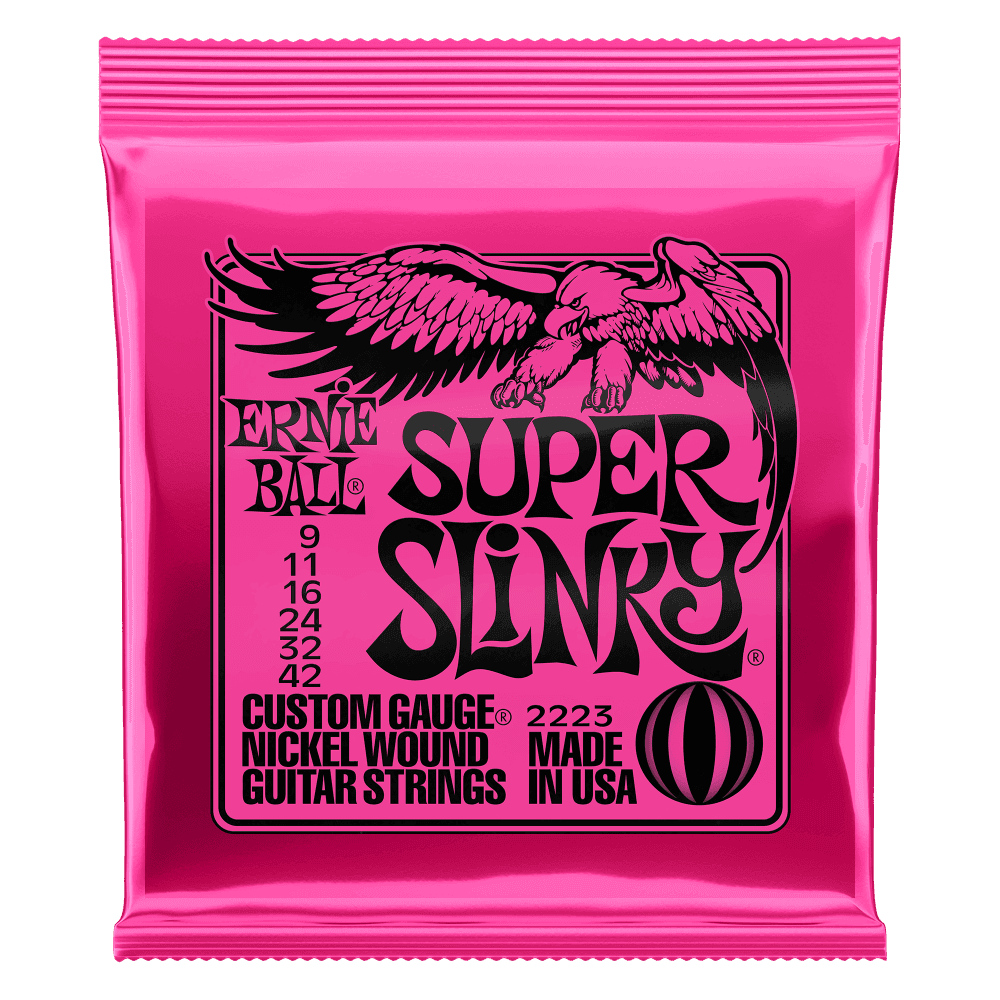
Super Slinky (.009–.042)
Why this one: The lightest electric set here. A full step lighter than Regular Slinky, with easier bends and lower tension for new hands.
Classic electric default: Ernie Ball Regular Slinky
Ernie Ball Regular Slinky (.010–.046) is the other standard tens set. Nickel-plated steel wrap on a tin-plated hex core, with a bright, balanced tone and comfortable bending tension, per our review.
On the beginner question, the review is blunt: tens on a standard-scale electric are the most bendable gauge most beginners can tolerate without buzzing out, and they break less often than nines. Ernie Ball's artist roster lists Eric Clapton and Billie Joe Armstrong on this set.
EXL110 or Regular Slinky? Our D'Addario vs Ernie Ball comparison covers it. For a first set, pick whichever you can find. The gauge is the same.
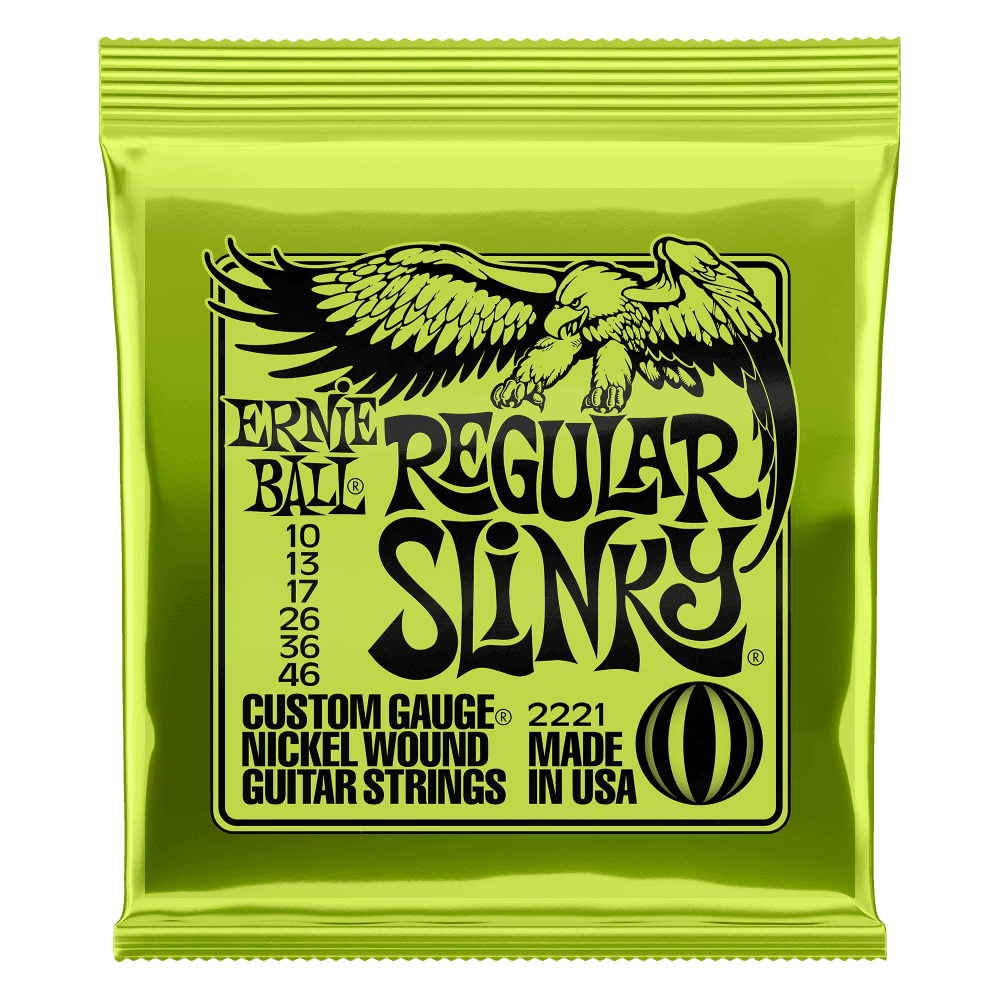
Regular Slinky (.010–.046)
Why this one: Ernie Ball's classic tens. The reference electric set, and a gauge our review calls the most bendable most beginners can handle without buzzing.
Best for acoustic: D'Addario EJ10 and EJ16
Steel-string acoustics are harder on fingertips than electrics. Higher tension and a higher action are common reasons. So acoustic beginners get two good options.
Easiest: D'Addario EJ10 80/20 Bronze Extra Light. The gauges are .010, .014, .023, .030, .039 and .047, on a hex high-carbon steel core, uncoated and made in the USA. D'Addario's own tension chart lists 16.2 lbs on the plain high E, and calls this the lowest overall tension in its 80/20 Bronze line. Our review calls Extra Light often the easiest starting gauge, especially on smaller parlor-style guitars. The tradeoff: a quieter, less full sound on a full dreadnought. 80/20 bronze is also the brightest acoustic alloy, and it mellows faster than phosphor bronze.
Standard: D'Addario EJ16 Phosphor Bronze Light. The gauges are .012, .016, .024, .032, .042 and .053. Our review calls it the all-purpose acoustic gauge, with warm, balanced tone, and says most acoustics ship factory-strung at .012 to .053 phosphor bronze. If your guitar came with Lights, this is the like-for-like restring. For help choosing, read light vs medium acoustic strings.
EJ10 80/20 Bronze Extra Light (.010–.047)
Why this one: D'Addario's lowest-tension 80/20 Bronze set. Often the easiest starting gauge, especially on smaller-body acoustics.

EJ16 Phosphor Bronze Light (.012–.053)
Why this one: The standard Light acoustic set. Warm, balanced tone, and the gauge most acoustics ship with.
Best for nylon-string: D'Addario EJ45 Pro-Arte
Nylon strings are gentler on the fingertips than steel. That is a big reason nylon-string guitars are a popular first instrument. Our pick is D'Addario EJ45 Pro-Arte Normal Tension.
It is D'Addario's best-selling classical set. The basses are silver-plated copper wound over a multifilament nylon core. The trebles are clear nylon monofilament. It is uncoated and uses tie-end construction. D'Addario specs it by tension, 85.8 lbs total across the set. It is also the set Rodrigo y Gabriela use, per Premier Guitar's rig rundown.
Our review calls Normal tension D'Addario's default recommendation, the standard starting point before you have a reason to go Hard for volume or Light for an easier feel. Buy EJ45 only for a classical or flamenco guitar with a tie-block bridge.
Pro-Arté Nylon Classical, Normal Tension (EJ45)
Why this one: D'Addario's best-selling classical tension and its default recommendation for a starting point.
How often should a beginner change strings?
Less often than you might think, and more often than most beginners do. Our string-change guide says casual at-home players should change every one to three months, daily practicers every two to three weeks, and that you should trust your ears over the calendar.
Signs it is time: the strings sound dull or flat, they will not hold their tune, they look discolored, or they feel rough under your fingers. A broken string is an easy sign.
Coated strings stretch those windows, per the same guide. They cost more. For your first year, an uncoated set at the lowest price tier is the better value. Wiping the strings down after playing, as common advice goes, helps any set last.
What you need to change them
Changing strings is a skill, and it is easier with the right tools. Start with the guide for your guitar: how to change electric guitar strings or how to change acoustic guitar strings.
Two cheap tools make the job faster. A string winder speeds up the tuning pegs, and cutters trim the ends cleanly. See our best guitar string winders and cutters. After a change, new strings go out of tune for a while as they stretch, so a clip-on tuner is worth having. See the best clip-on guitar tuners.
Sore fingertips in the first weeks are normal. Light gauges help. So does short, regular practice, and our guide to building calluses goes into more detail.
Our verdict
Electric player: buy D'Addario EXL110 and move to Super Slinky 9s only if tens feel stiff. Acoustic player: start with D'Addario EJ16 if your guitar came with Lights, or EJ10 if you want the easiest start. Nylon-string player: D'Addario EJ45.
Do not overthink it. The best beginner string is the one that fits your guitar, feels comfortable, and gets changed on time.