Best Bass Guitar Strings: 7 Picks by Buyer Need, Compared
Written with AI help · Updated
D'Addario EPS170 ProSteels (.045 to .100) is the best all-around 4-string bass string in 2026: D'Addario's most popular bass gauge, bright and versatile stainless roundwound. Ernie Ball Regular Slinky Bass is the iconic cheaper nickel default, Fender Super 7250 the factory-spec budget pick, GHS Bass Boomers Flea Signature the funk and slap choice, Ernie Ball Hybrid Slinky Cobalt Bass the metal pick, and Ernie Ball 5-String Regular Slinky and Dean Markley SR2000 the 5-string and 6-string picks.
The short answer
There is no single best bass string. There is a best string for what you are actually playing: standard 4-string rock, a tight budget, slap-heavy funk, a down-tuned metal rig, or a 5-string or 6-string extended-range bass. We picked one set per buyer need, all seven already reviewed in full on CYS, and checked the claims below against each manufacturer's own product page this week.
| Best for | Gauge | Price | |
|---|---|---|---|
| D'Addario EPS170 ProSteels Bass | Best overall, most popular gauge | .045–.100 | $$ |
| Ernie Ball Regular Slinky Bass | Most iconic, classic nickel tone | .050–.105 | $ |
| Fender Super 7250 Bass | Best budget, factory-spec | .045–.105 | $ |
| GHS Bass Boomers Flea Signature | Best for slap and funk | .045–.105 | $ |
| Ernie Ball Hybrid Slinky Cobalt Bass | Best for metal, aggressive tone | .045–.105 | $$ |
| Ernie Ball 5-String Regular Slinky Bass | Best for 5-string bass | .045–.130 | $ |
| Dean Markley SR2000 6-String | Best for 6-string bass | .027–.127 | $$$ |
D'Addario EPS170 ProSteels is the pick if you play a standard 4-string and want one set that works everywhere. Per D'Addario's own XL ProSteels family page, ProSteels is the brand's brightest bass line, built from a stainless steel wrap over D'Addario's Hex-Core for "harmonically rich, brilliantly penetrating highs, combined with pronounced, tight-and-tough lows." D'Addario names the .045 to .100 Regular Light gauge, this set, as its "most popular bass gauge." D'Addario's own bass artist roster, one of the deepest in the industry, includes Robert Trujillo, Jason Newsted, and Frank Bello, though CYS has not confirmed which of D'Addario's bass lines each of them plays on a given tour.

EPS170 XL ProSteels Bass Regular Light (.045–.100)
Why this one: D'Addario's own most popular bass gauge: bright, versatile stainless roundwound that covers rock, funk, and prog without a specialty alloy upcharge.
If you down-tune below Eb or want more low-end authority at the same bright stainless voicing, D'Addario's own Heavy gauge, EPS230 ProSteels (.055–.110), is the direct step up.
Most iconic: Ernie Ball Regular Slinky Bass
Ernie Ball Regular Slinky Bass (.050–.105) is the bass-string counterpart to the guitar Regular Slinky that made the Slinky name famous, and it is Ernie Ball's default 4-string bass gauge for the same reason: nickel-plated steel on a hex steel core, wound "for a bright, balanced tone" per Ernie Ball's own product page. It has been the working bassist's factory default for decades.
It is also a documented touring gauge, not just a catalog listing. Premier Guitar's Rig Rundown covered Tim Commerford, the Rage Against the Machine and Prophets of Rage bassist, and Ernie Ball Music Man's own recap of that rundown names this exact set: Commerford "plays custom Ernie Ball Music Man StingRay basses and Ernie Ball Regular Slinky bass strings."
Regular Slinky Bass (.050–.105)
Why this one: Ernie Ball's default 4-string bass gauge and Tim Commerford's documented Rage Against the Machine touring set.
Best budget: Fender Super 7250 Bass
Fender Super 7250 (.045–.105) is the set that ships factory-strung on most production Fender Precision and Jazz Basses, which makes it the default a huge share of working bassists have played without ever choosing it. Nickel-plated steel on a hex steel core, warmer and less aggressive than a stainless round, and priced to match a beginner's budget.
It is also Mike Dirnt's documented standard set across Green Day's catalog, on his fleet of vintage Fender Precision Basses and his signature Road Worn P-Bass. If you want brighter, stainless-wrapped tone at the same price tier, step to Rotosound Swing Bass 66 instead; if you want the classic Ernie Ball voicing, Regular Slinky Bass above costs the same.
Super 7250M Bass (long-scale, .045–.105)
Why this one: The factory-strung default on most production Fender basses, and Mike Dirnt's documented Green Day set.
Best for slap and funk: GHS Bass Boomers Flea Signature
GHS Bass Boomers Flea Signature (M3045-F, .045–.105) is built on GHS's standard Boomers formula, nickel-plated steel, with what GHS's own product page describes as "a special combination of stainless steel and nickel-plate on the low E string," specifically to keep the bottom end defined under slap technique. GHS's own copy puts it plainly: "The Red Hot Chili Peppers count on Flea to provide that hard driving bottom end and these strings are a crucial part of that signature sound."
Flea's name on the pack is not just branding, it is his current production SKU on GHS's own artist roster. The bright top end and slap-friendly attack sit between the warmer Fender 7250 and the brighter, stainless Rotosound Swing Bass 66, which makes Boomers the pick when you want snap without full stainless brightness.

Bass Boomers Flea Signature M3045-F (.045–.105)
Why this one: Flea's own production SKU on GHS's artist roster. A stainless-and-nickel low E built specifically for slap attack that stays defined.
Best for metal and aggressive tone: Ernie Ball Hybrid Slinky Cobalt Bass
Standard nickel strings can lose definition on a heavily palm-muted low string under high gain. Ernie Ball Hybrid Slinky Cobalt Bass (.045–.105) fixes that with a cobalt-alloy wrap instead of nickel-plated steel. Per Ernie Ball's own product page, the Cobalt line is engineered "to maximize output and clarity," with a stronger magnetic relationship to a passive pickup than any other alloy the company has shipped, plus extended dynamic range and increased low end.
Rex Brown, Pantera's bassist, strings his signature Gibson Thunderbird with this exact set. Premier Guitar's 2024 Rig Rundown on Pantera states it directly: "This one (and other 4-strings) ride with Ernie Ball 2733 Hybrid Slinky Cobalt Electric Bass strings." Cobalt costs more than an equivalent nickel set, but for standard-tuned metal and hard rock that wants extra bite without stepping up a gauge, it is CYS's editorial pick among bass alloys.
Hybrid Slinky Cobalt Bass (.045–.105)
Why this one: Rex Brown's documented Pantera gauge. Cobalt's tighter low end and stronger pickup output keep a palm-muted string defined under gain.
For the fully measured Cobalt vs nickel breakdown, see Cobalt vs nickel Slinky and Cobalt Slinky gauges explained.
Best for 5-string bass: Ernie Ball 5-String Regular Slinky Bass
Step up to five strings and Ernie Ball 5-String Regular Slinky Bass (.045–.130) is the industry-default gauge, per Ernie Ball's own 5-string Slinky catalog. Nickel-plated steel on a hex steel core, with the .130 low B most working 5-string players settle on: heavy enough to hold B standard cleanly, light enough that it does not go stiff under fast pick attack.
Ernie Ball's own String Theory feature documents Dream Theater's John Myung as a Slinky bass family endorser at brand level. His own signature basses are 4- and 6-string though: Music Man's own spec sheet ties his 6-string Bongo 6 HH to the Cobalt alloy, not this nickel 5-string set, so treat the family-level connection as documented, not a gauge match for this specific product.
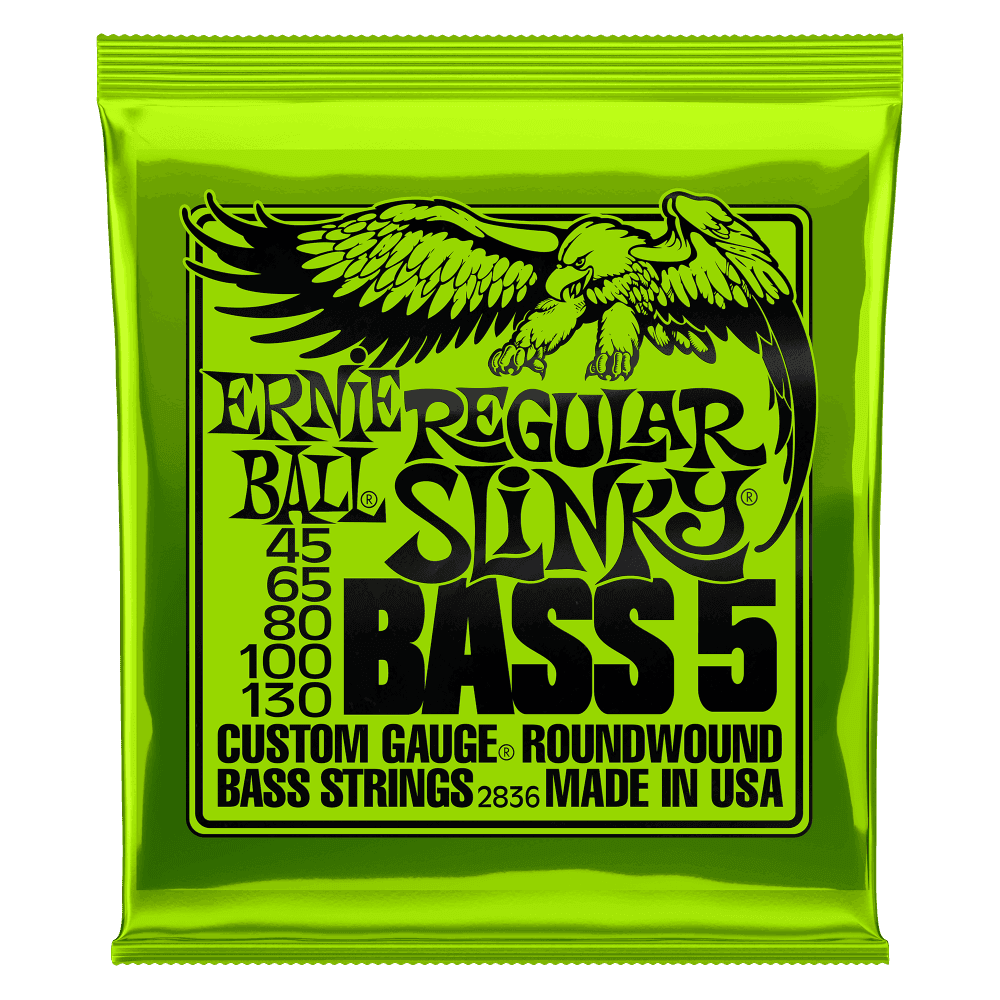
5-String Regular Slinky Bass (.045–.130)
Why this one: The industry-default 5-string gauge. A .130 low B that holds B standard without flopping, at a standard-nickel price.
Best for 6-string bass: Dean Markley SR2000 Medium Custom
A 6-string bass needs a gauge spread that works at both extremes at once, thin enough on top to stay playable, thick enough on the bottom to hold pitch. Dean Markley SR2000 Medium Custom (.027–.127) is built for exactly that: a compound-wound stainless steel set, multiple cross-hatched wrap layers instead of one thick wrap, which Dean Markley's own product page says keeps the surface smoother and the core more flexible at heavy gauges.
It is also a documented studio choice. Thundercat reaches for this exact gauge, per Mixdown Magazine's gear rundown, when tracking on his custom 6-string Ibanez, a brighter, more standard roundwound attack than the La Bella flatwound and tapewound sets he runs live on the same bass. If you want his actual live tone, the flatwound route is the one to chase instead; SR2000 is the studio half of that split.
SR2000 Medium Custom, 6-string (.027–.127)
Why this one: Thundercat's documented studio gauge for 6-string bass. Compound-wound stainless for a brighter attack than a flatwound or tapewound live rig.
How to choose
Pick by what you actually need
- Standard 4-string, no strong opinion yet
- D'Addario EPS170 ProSteels or Ernie Ball Regular Slinky Bass. Both cover E standard cleanly.
- Spending as little as possible
- Fender Super 7250. The factory-default nickel round, cheap and everywhere.
- Slap and funk technique
- GHS Bass Boomers Flea Signature. Built for snap on the low E without losing warmth.
- Drop tuning, metal, or hard rock
- Ernie Ball Hybrid Slinky Cobalt Bass. The cobalt wrap keeps a palm-muted low string defined under gain.
- Playing a 5-string bass
- Ernie Ball 5-String Regular Slinky Bass. The .130 low B is the industry-default gauge.
- Playing a 6-string bass
- Dean Markley SR2000 Medium Custom. Compound-wound stainless built for the wide gauge spread.
Not sure whether you want a bright roundwound or a warm flatwound? See our flatwound vs roundwound bass strings breakdown. Curious how nickel and steel wraps differ in general? Read nickel vs steel strings. New to restringing a bass? Follow how to change bass strings.
Bottom line
If you play a standard 4-string bass and want one set that works everywhere, buy D'Addario EPS170 ProSteels. It is not the cheapest pick here and it is not the most iconic, but it is D'Addario's own most popular bass gauge for a reason: bright, articulate, and versatile enough for rock, funk, and prog without committing to a specialty alloy.
EPS170 XL ProSteels Bass Regular Light (.045–.100)
Why this one: Our overall pick. D'Addario's own most popular bass gauge: bright, articulate stainless roundwound for rock, funk, and prog.
Related
Related