Dean Markley SR2000 Medium Custom 6-String Bass (.027–.127): Thundercat's studio set
Written with AI help · Updated

Dean Markley SR2000 Medium Custom is a 6-string bass set gauged .027 to .127, built from compound-wound stainless steel over a steel core for a bright, sustained tone. It's the studio set Thundercat reaches for on his custom Ibanez 6-string, swapping in from his usual La Bella flatwounds when a session wants a standard roundwound's top-end definition, per Mixdown Magazine's gear rundown. Still listed on Dean Markley's own current site.
What this set is
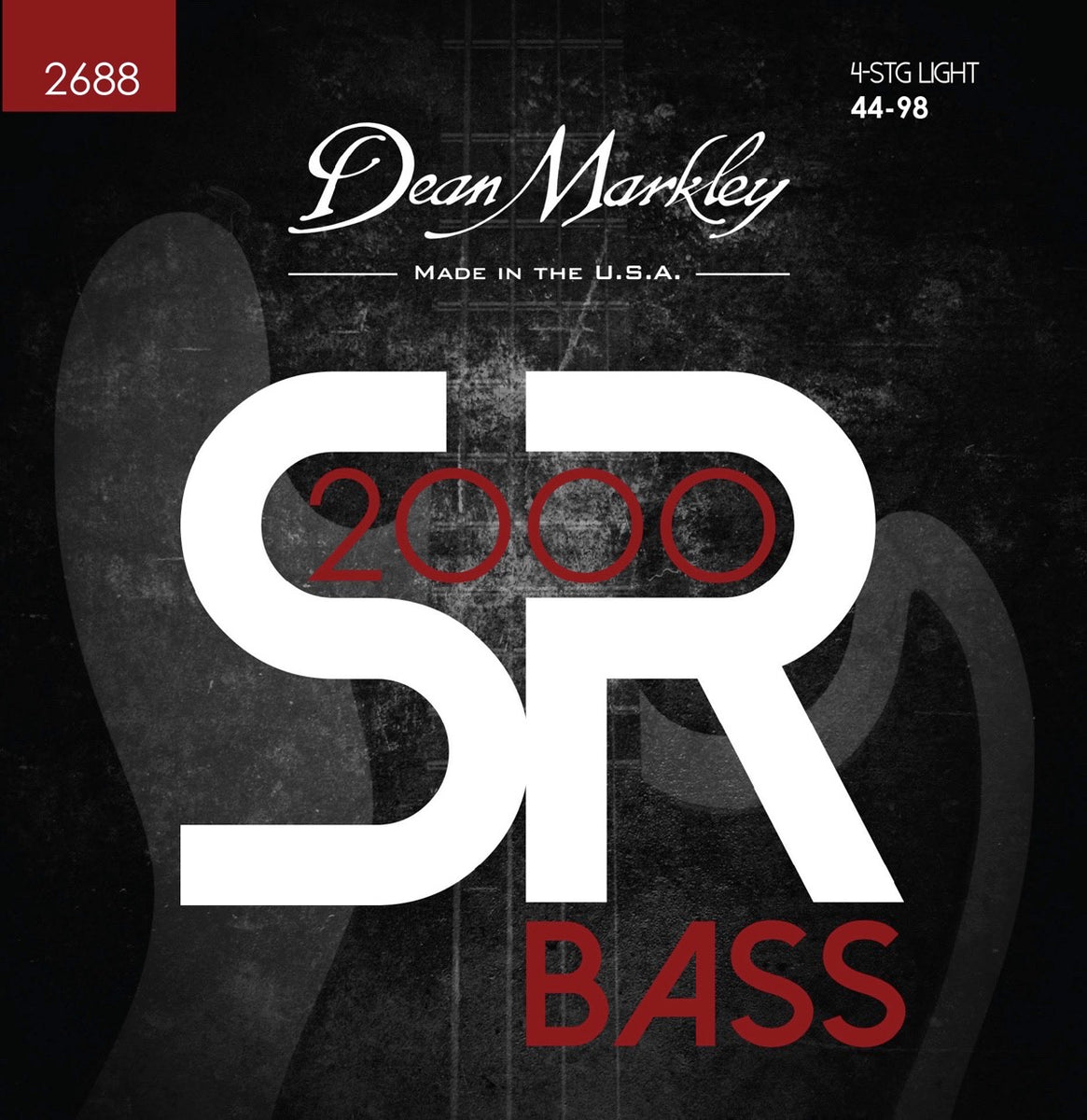
Dean Markley SR2000 Medium Custom is a 6-string bass set gauged .027 to .127: .027, .047, .067, .087, .107, .127. It's a stainless steel, compound-wound set, built the way Dean Markley builds most of its heavier bass gauges: multiple cross-hatched layers of wrap wire instead of one thick wrap, with the winding direction reversed between layers to smooth the surface.
Dean Markley's own copy for the line promises "big, meaty bass that roars and feels like a smooth running machine," built for players who "thump 'em, slap 'em, pick 'em, caress 'em." Underneath the marketing language is a real stated engineering approach: the company says its designs keep roughly 60 percent of the core wire's breaking tension in reserve, borrowing loosely from a century-old piano-string rule of thumb that caps tension at 66 percent of breaking strength.
It's also a documented studio choice, not just a catalog listing. Thundercat (Stephen Bruner) reaches for this exact gauge when he's tracking, switching in from the flatwound and tapewound La Bella sets he runs live on the same 6-string Ibanez, per Mixdown Magazine's gear rundown on him.
Anatomy
- Model
- Dean Markley SR2000 Medium Custom, 6-string
- SKU
- 2698
- Gauge
- .027 – .127 (Medium Custom, 6-string)
- Gauge set
- .027, .047, .067, .087, .107, .127
- String count
- 6 strings
- Core wire
- Steel (specific alloy not published by Dean Markley)
- Wrap wire
- Stainless steel, compound wound, cross-hatched layers
- Coating
- None, uncoated
- Winding
- Compound wound: 2+ layers above .050, more on the thickest strings
- Intended scale
- Long scale, standard 6-string bass length
- Intended tunings
- B-E-A-D-G-C (BEADGC) extended range; top four strings also suit standard E-A-D-G
- Made in
- United States, per Dean Markley's Amazon listing
- Package
- Single pack (B0002H0PA6)
Why compound winding matters
Most manufacturers cap a bass string's wrap at two or three layers, even on their heaviest gauges. Dean Markley says it goes further on this set: two wraps above .050, three around .095, four at .120, more layers than the company says most competitors use at the same thickness. The point isn't just adding mass. More, thinner layers let Dean Markley keep the final, outermost layer smaller, which keeps the string's surface smoother under the hand, and lets the whole assembly use a thinner, more flexible core wire than a single thick wrap would need at the same overall gauge.
How compound winding changes the string
- Layer count
- Two wraps above .050, three around .095, four at .120, per Dean Markley's own description of the SR2000 construction process.
- Surface feel
- A smaller final layer keeps the outer surface smoother than a single thick wrap of the same total gauge would produce.
- Core flexibility
- Compounding lets Dean Markley use a thinner, more flexible core wire, which the company says improves playability at heavier gauges.
- Tension design
- Dean Markley targets roughly 60 percent of the core's breaking tension in reserve, its own stated design rule, tighter than the 66 percent ceiling common in early-1900s piano-string design.
The tradeoff to know going in: this is still an uncoated stainless steel string, not a coated one. Dean Markley's pitch for tone and feel rests on the winding geometry itself, not a polymer barrier like Elixir or D'Addario XT/XS use. Expect standard uncoated wear characteristics: oils and grime reach the wrap wire from day one, the same as any bare roundwound.
Where this sits in Dean Markley's SR2000 line
SR2000 Medium Custom isn't only a 6-string gauge. Dean Markley's own current site lists the same Medium Custom tension profile across four string counts:
| 4-string | 5-string | 6-string (this set) | 7-string | |
|---|---|---|---|---|
| Gauge range | .047–.107 | .047–.127 | .027–.127 | .022–.127 |
| Thickest string | .107 | .127 | .127 (low B) | .127 (low B) |
| Thinnest string | .047 | .047 | .027 (high C) | .022 (high C) |
The 6-string spread needs both ends usable at once: thin enough on the .027 high C to stay playable for fast chordal work, thick enough on the .127 low B to hold pitch under tension. The 7-string version pushes the top string even thinner, to .022, to make room for its extra high string.
Within the 6-string count specifically, Medium Custom sits in the middle of Dean Markley's own tension options: Light and Medium Light both list at .030 to .125, this Medium Custom at .027 to .127, and a heavier Medium at .035 to .128.
Who plays it: Thundercat's studio rig
Thundercat strings his custom 2012 Ibanez 6-string Artcore, tuned BEADGC, with this exact gauge for studio sessions. Mixdown Magazine's gear rundown lays out the split directly: live, he runs two La Bella sets (Deep Talkin' Bass Flats and 750G-CB Nylon Tapewound), and "often uses medium-light Dean Markley SR2000 strings (.027, .047, .067, .087, .107, .127) for studio work."
That's a verified-use citation, not a paid endorsement. Nothing in Mixdown's reporting, or anywhere else CYS has sourced, describes a formal Dean Markley artist relationship with Thundercat, unlike his documented La Bella and Aguilar deals. It's a working studio choice: a brighter, more standard roundwound attack when a session wants more top-end definition than his flatwound and tapewound live tone gives up.
Best for
- Studio and session bassists on 6-string who want a brighter, more standard roundwound attack than a flatwound or tapewound live tone. Thundercat's own documented split, flats and tapewounds live, SR2000 in the studio, is the clearest working example.
- Players building a wide-range 6-string rig who want a proven gauge spread: thin enough on top for fast chordal runs, thick enough on the low B to stay in tune under tension.
- Anyone who wants compound-wound smoothness with roundwound brightness, rather than choosing between a fully coated set and a basic single-wrap roundwound.
Worst for
- Players chasing flatwound or tapewound warmth. SR2000 is a bright stainless roundwound; see our flatwound vs roundwound bass strings comparison if a smoother, darker tone is the goal.
- 4-string or 5-string players. This exact SKU is the 6-string Medium Custom gauge. Dean Markley's own site lists separate 4-string and 5-string Medium Custom sets at lighter overall ranges.
- Budget-first buyers. A compound-wound 6-string set costs more than a standard single-wrap 4-string set of the same brand tier; the extra strings and construction complexity both add cost.
Verdict
SR2000 Medium Custom is a real working studio gauge, not just a catalog filler: it's the exact set a documented, high-profile 6-string player reaches for when a session wants more top-end definition than his live flatwound rig gives up. The compound-wound construction is genuine engineering, more layers than Dean Markley says most competitors use at the same thickness, built to stay smooth and flexible at gauges this heavy.
If you're already running a 6-string bass and want to try a brighter roundwound alternative to flatwounds or tapewounds, this is a well-documented, easy place to start. If you're chasing Thundercat's actual live tone instead, look at his La Bella flatwound and tapewound sets first; this SR2000 is the studio half of his rig, not the stage half.