Nickel vs steel guitar strings: what's the difference?
Written with AI help · Updated
Nickel-plated steel (most common): bright, balanced, fret-friendly, the working default for rock and blues. Pure nickel: warmer, vintage-flavored, slightly less output, used by Yngwie Malmsteen and many classic-rock players. Stainless steel: bright, cuts through, longer-lasting, harder on frets and fingers, common on bass. Cobalt (Ernie Ball Slinky Cobalt): higher magnetic output than nickel, brighter, more articulate at gain, the modern alternative to nickel-plated. The right choice is the one that matches your pickups, your amp, and your hands.
The short version
For most rock and blues electric guitar players in standard E tuning: nickel-plated steel is the default. It's bright but not harsh, balanced but not muddy, fret-friendly, and stocked everywhere.
If you want a vintage flavor: pure nickel sounds warmer and rolls off the high end naturally.
If you want maximum brightness and longevity: stainless steel delivers both at the cost of harder fret wear.
If you want maximum pickup output and high-gain articulation: cobalt (Ernie Ball Slinky Cobalt) gives you the modern-metal version of nickel-plated tone.
For clean jazz and dense chord work: pure nickel or flatwound for the warmest, least-cutting voicing.
For acoustic: phosphor bronze is the working-pro default; 80/20 bronze when you want maximum brightness.
For bass: covered in the bass-specific FAQ: stainless for cut, nickel for warmth, flatwound for smooth.
What actually changes when you swap material
Tone. Pure nickel rolls off treble; nickel-plated steel sits balanced; cobalt and stainless emphasize treble. Most-noticeable difference: the high E and B strings.
Output. Cobalt produces ~30% more pickup output than equivalent-gauge nickel-plated steel. Stainless is similar. Pure nickel is slightly lower output than NPS.
Longevity. Stainless and pure nickel oxidize slowest; nickel-plated steel is in the middle; cobalt oxidizes fastest of the common materials.
Fret wear. Stainless > cobalt > NPS > pure nickel (least wear).
Cost. Pure nickel and NPS are the cheapest; cobalt costs ~50% more; coated sets (Elixir, Paradigm, XT) cost ~2x more.
The set we restock with
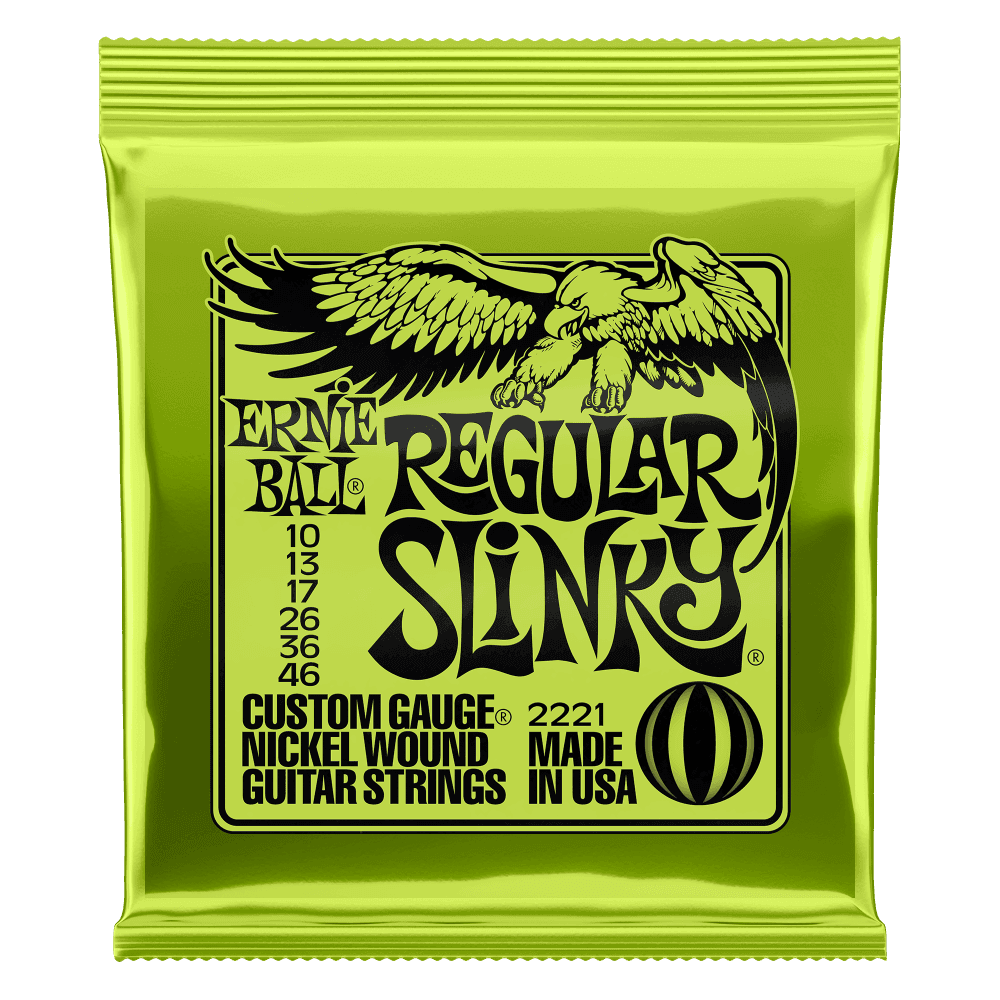
Regular Slinky (.010-.046)
Why this one: The default nickel-plated steel set. Balanced tonal signature, fret-friendly, stocked everywhere. The benchmark every other material gets compared against.