Ernie Ball 5-String Regular Slinky Bass (.045–.130): the prog-metal 5-string canon
Written with AI help · Updated
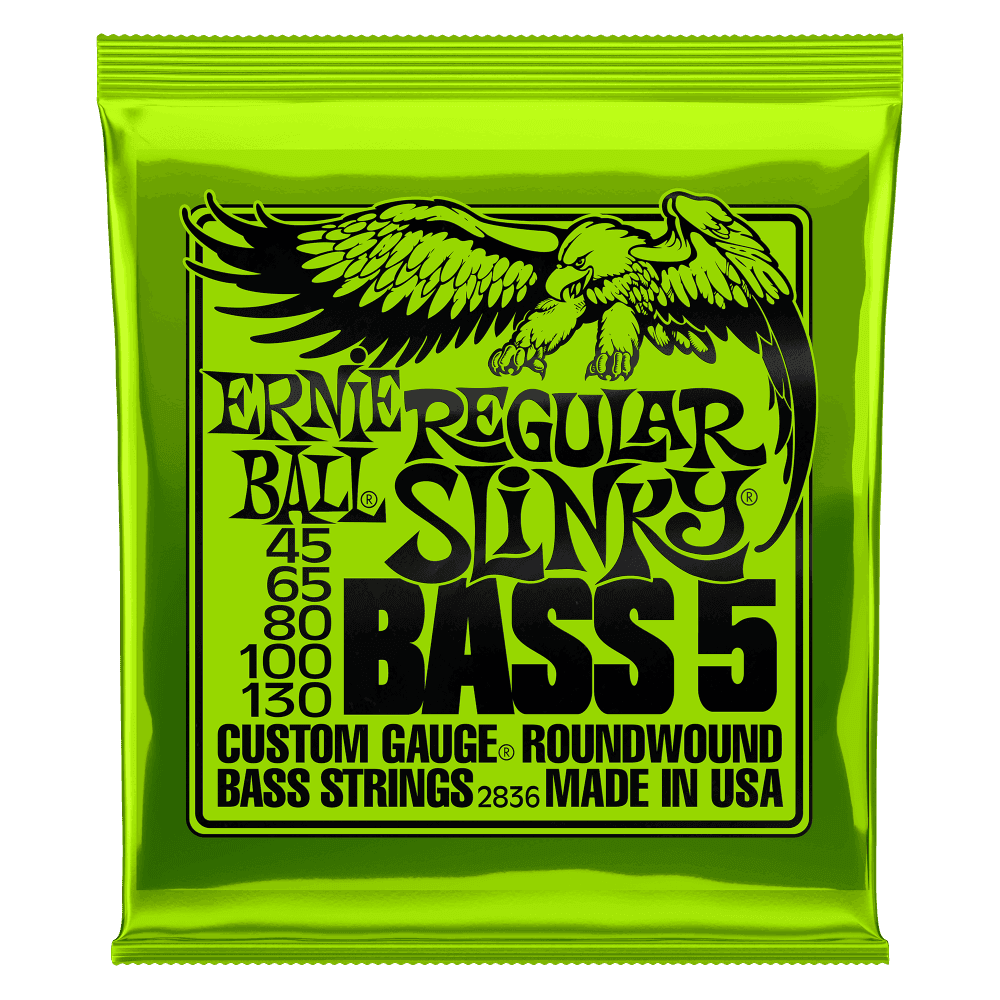
Ernie Ball's 5-String Regular Slinky Bass (.045 to .130, P02836) is the most-played 5-string bass set in prog-metal and modern rock. Nickel-plated-steel roundwound on hex steel core, long-scale, with the .130 low-B that 5-string players need for B standard tuning. Pick this set when you want a working-pro 5-string spec without specialty pricing or specialty alloys; this is the gauge the prog-metal genre is built around.
Anatomy
- Model
- Ernie Ball P02836 5-String Regular Slinky Bass
- Family
- Ernie Ball Slinky Nickel Wound Electric Bass (5-string)
- Variants
- Super (.040-.125, P02834), Regular (.045-.130, this set), Power (.050-.135, P02832), Cobalt 5 (.045-.130, P02817), Coated (.045-.130, P03836)
- Gauge
- .045 – .130 (Regular)
- Gauge set
- .045, .065, .080, .100, .130
- String count
- 5 strings
- Core wire
- Hex steel
- Wrap wire
- Nickel-plated steel
- Coating
- None, uncoated
- Winding
- Standard roundwound
- Intended scale
- Long-scale (34") fits Music Man Bongo, Yamaha BB / TRBX, Fender American Pro V, Spector NS-2 5, Ibanez SR series
- Intended tunings
- B standard primary; handles Drop A and B-Eb-A-D-G with the .130 low-B
- Tension behavior
- Medium tension; the .130 low-B holds B standard cleanly without flopping
- Made in
- United States (Ernie Ball manufacturing in San Luis Obispo, California)
- Package
- Single pack
Why this is the prog-metal 5-string default
- Industry-default 5-string gauge
- .045 to .130 is the canonical 5-string bass gauge most working players default to. The .130 low-B holds B standard tuning cleanly; lighter low-Bs (.125 or under) start to flop on aggressive pick attack. Heavier (.135) feels rigid and is harder to play fast.
- Slinky family consistency
- Ernie Ball Slinky bass strings have been the working-pro default since the 1970s. The 5-string variant extends that consistency to the prog-metal canon that grew up on the family.
- Rock-canon nickel alloy
- Nickel-plated-steel wrap is the warmer, rounder, less aggressive bass roundwound material. For prog-metal that doesn't want stainless-steel brightness fighting the twin-guitar layer, the Slinky family is the sweet spot.
- Predictable supply
- Ernie Ball ships through every guitar retailer in North America. Never on backorder, never specialty pricing. The 5-String Regular Slinky is the bass-equivalent of a Regular Slinky 6-string, the safe, reliable default.
Tone
The 5-String Regular Slinky sounds like the canonical prog-metal 5-string: balanced top end (not as bright as stainless or Cobalt), mid-forward, with the .130 low-B holding pitch under fast pick attack across drop-tuned passages. It's the gauge profile most working session bassists default to before reaching for specialty alloys.
Compared to the other Tier-1 5-string bass options:
| Slinky 5-string | Cobalt Slinky 5-string | D'Addario EXL170-5 | |
|---|---|---|---|
| Wrap material | Nickel-plated steel | Cobalt-iron alloy | Nickel-plated steel |
| Brightness | 6/10 | 8/10 | 6/10 |
| Mid-range character | Warmer, rounded | Brighter, harmonic-rich | Comparable to Slinky |
| Best lane | Prog-metal, rock, fusion | Djent, modern prog-metal | Working session, all-purpose |
| Price tier | $ | $$ | $ |
| Documented users | Broad working-pro roster | Various djent bassists | Robert Trujillo, Frank Bello, broad D'Addario roster |
Best for
- Prog-metal + modern metal 5-string bass in B standard (Dream Theater, Periphery, Tool, modern prog catalogs)
- Working session 5-string bass across rock, fusion, and pop where the bottom-string B is needed
- Players who want the Slinky family feel on a 5-string without stepping to specialty alloys
Worst for
- Slap-heavy funk: Slinky 5-strings are good for slap but the dedicated slap-funk lane (Flea / GHS Boomers M3045-F-5) has more snap on the high strings
- Vintage Motown or jazz fingerstyle: flatwound 5-strings (La Bella) are the lane
- Drop-tuned 5-string metal below B standard: step to Power Slinky (.050-.135) for more bottom-string tension
Verdict
The 5-String Regular Slinky Bass is the working-pro prog-metal 5-string spec. Nickel-plated, .045-.130, the canonical gauge most 5-string players default to. Many working prog-metal and modern-rock bassists sit on the Slinky family broadly; our 5-string and 6-string bass players guide documents who. This 5-string extends that consistency to B standard. If you want maximum brightness, step to the Cobalt 5-string variant at the same gauge.