Mark Holcomb's guitar strings: the Periphery djent rig, sourced
Documented string gauges, brands, and tunings Mark Holcomb uses with Periphery and on his PRS SE Mark Holcomb SVN signature. With citations.
Periphery · written with AI help · updated
Mark Holcomb is a documented Ernie Ball artist who worked with the company on a custom, non-stock 7-string gauge set, in his own words, gauges "outside of the normal stock string gauges." His PRS SE Mark Holcomb SVN ships with 10-64 gauge strings at 26.5-inch scale, tuned to 7-string B standard, per PRS's own spec sheet. His exact personal gauge isn't published; the closest off-the-shelf match is Ernie Ball's 7-String Slinky Cobalt (.010–.062).
What's on the guitar
Mark Holcomb's rig is one of the most deliberately engineered djent signal chains in modern metal, and Holcomb himself is unusually specific about why each piece is there:
- Guitars: PRS SE Mark Holcomb SVN (7-string signature, 26.5-inch scale), PRS SE Mark Holcomb (6-string signature, 25.5-inch scale).
- Strings: Custom, non-stock Ernie Ball gauge built to his own specification, exact recipe and alloy line unpublished. Closest stock match: Ernie Ball 7-String Slinky Cobalt (.010–.062).
- Tuning: Varies by song. Drop A and Drop G# are common on his 7-string Periphery material; PRS's own spec sheet lists 7-string B standard (B-E-A-D-G-B-E) as the SVN's reference tuning.
- Pickups: Seymour Duncan Mark Holcomb "Scourge" (bridge) + "Scarlet" (neck), his current signature set.
- Amp: Fractal Audio Axe-Fx III. No separate physical amp is documented in current use.
Periphery is the band that defined modern djent production. In Ernie Ball's String Theory feature, Holcomb describes asking the company for gauges "outside of the normal stock string gauges" so his rig could handle everything from ordinary drop tunings to the unique open tunings he writes individual songs in, "no compromises" across bending styles and tuning scenarios. If you want a stock 7-string Cobalt set built around similar territory, the 2730 Slinky Cobalt is the closest off-the-shelf match. Buy it on Amazon.
Holcomb runs two distinct PRS signature models side by side rather than one guitar for everything: the 6-string SE Mark Holcomb at a 25.5-inch scale, and the 7-string SE Mark Holcomb SVN at a longer 26.5-inch scale that adds tension headroom for the extra low string. Both currently ship with the same Seymour Duncan Scarlet and Scourge pickup pairing, so the two guitars sit closer in voicing than their different scale lengths might suggest.
Endorsed vs. verified use
Holcomb is a documented Ernie Ball artist, featured in the company's own String Theory series. That's a genuine, sourced relationship, but it's specifically about custom gauge development, not a confirmed catalog SKU. Ernie Ball's transcript has him describing the collaboration directly: he reached out asking for "really weird funky gauges," and Ernie Ball built them to his spec. Neither Ernie Ball's nor PRS's own product pages name a specific Ernie Ball catalog set as what ships on his signature guitar; PRS's spec sheet lists only a 10-64 gauge, no brand.
His signature gear on the guitar and pickup side is easier to pin down exactly because it's sold as-is: the PRS SE Mark Holcomb SVN and Seymour Duncan Scarlet/Scourge pickup set are both named, current, documented products with manufacturer spec pages. PRS periodically refreshes both signature models with new finishes, most recently a new color option on the 6-string SE Mark Holcomb that Holcomb discussed alongside the Scarlet/Scourge pickup swap in the same Fractal Audio feature (crafted for Periphery's 2024 tour) cited below.
Why Cobalt for djent
Djent depends on rhythm-guitar clarity at speed. Palm-muted sixteenth-note runs on a low string need to read as individual attacks through high gain, and that's the engineering case behind Ernie Ball's Cobalt line on 7-string sets like the 2730 Slinky Cobalt (.010–.062): nickel-plated steel produces usable tone on a heavy low string, but it smears more easily than Cobalt's higher magnetic read, which translates to a more defined palm-mute attack. That's the same reasoning behind Holcomb's custom Ernie Ball gauges, even though his exact personal recipe isn't published.
For the higher strings, the same clarity argument applies to lead work layered over dense rhythm tracks. Periphery's material is built around three guitars occupying a mix at once, so string definition matters as much on the melodic end as the rhythm end.
Sources
- PRS Guitars: SE Mark Holcomb SVN official spec sheet (26.5-inch scale, 10-64 factory strings, B-standard 7-string tuning, Seymour Duncan Scarlet/Scourge pickups).
- Ernie Ball: String Theory with Mark Holcomb (his own account of requesting custom, non-stock gauges).
- G66.eu: Fractal Tone Tour with Mark Holcomb (Axe-Fx III live rig and Scarlet/Scourge pickup names, both in his own words).
Re-verified 2026-07-08: PRS's and Ernie Ball's own pages were checked and found to contradict the prior "ships factory-strung with Ernie Ball 2730" claim on gauge, scale, and tuning grounds. Re-verify on the next PRS spec refresh or Periphery album cycle.
If you want this rig
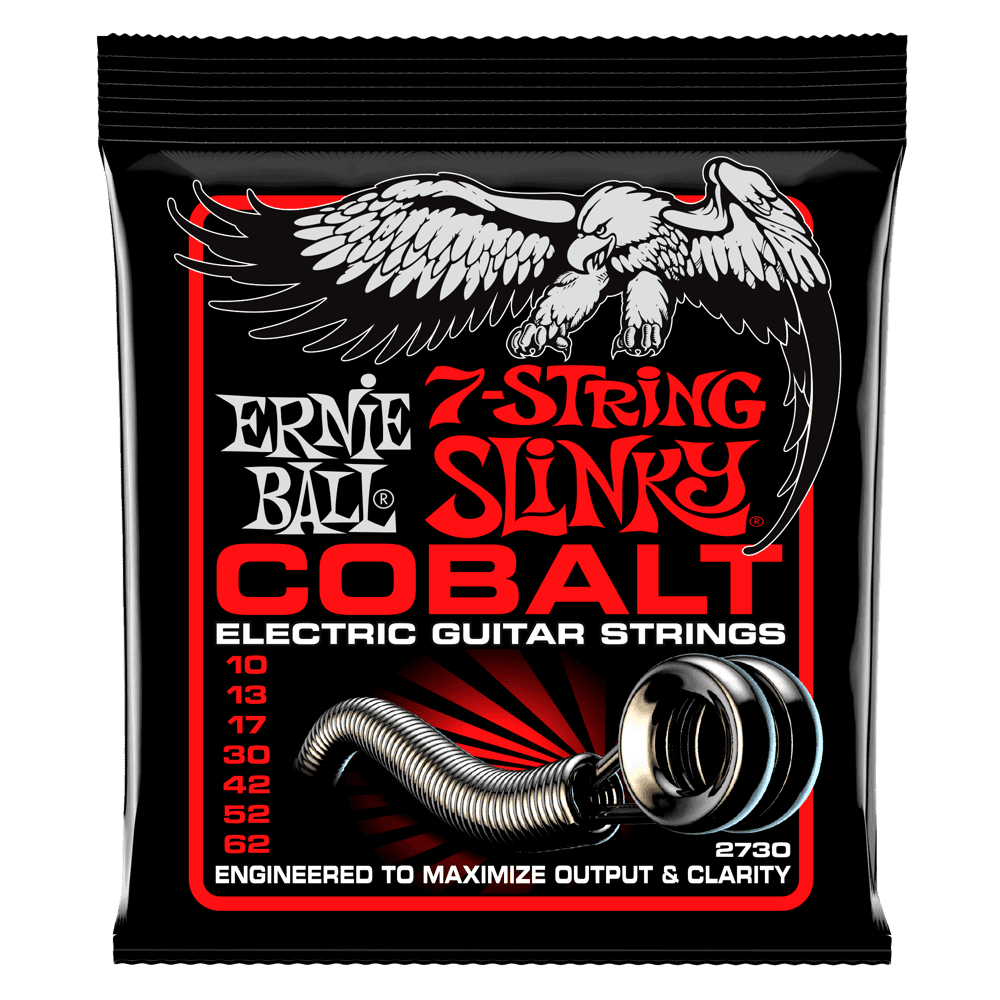
7-String Slinky Cobalt (.010–.062)
Why this one: The closest stock match to Holcomb's custom Ernie Ball gauge philosophy: a heavy-bottom 7-string Cobalt set built for B standard through Drop G#. Not confirmed as his personal gauge, but the same design lane.
Related
Related