Adam 'Nolly' Getgood: djent producer, bass-first tone engineer
Adam Getgood, ex-Periphery bassist, GetGood Drums co-founder, and producer for Architects, Devin Townsend, and Monuments. What strings fit his production lane.
Written with AI help · Updated
Adam 'Nolly' Getgood, ex-Periphery bassist, producer, and GetGood Drums co-founder, is known for records that prioritize clarity and low-string articulation over brute tension. His productions (Architects' Holy Hell, Devin Townsend, Monuments, Haken) favor 7-string sets in 9–52 or 10–59 gauges on extended-range guitar, and taper-core bass strings in the Kalium 6-string range for the low B/F# territory.
Who Adam Getgood is
Adam "Nolly" Getgood is a British producer, mixer, and bassist. He was Periphery's bassist from 2012 through 2017, appearing on Juggernaut: Alpha and Juggernaut: Omega, Periphery III: Select Difficulty, and the first two tracks of Periphery IV. He left the band to focus on production and on GetGood Drums, the drum sample library he co-founded with Mark Holcomb.
As a producer / mixer, he's credited on Architects' Holy Hell (a landmark 2018 record), multiple Devin Townsend Project records, Monuments, Northlane's later catalog, Haken, and Animals As Leaders adjacent work. His public profile sits at the intersection of "musician who can mix" and "mixer who understands the performance side", rare.
He is also one of the more publicly communicative producers in modern metal. His YouTube channel breaks down bass DI, production techniques, and gear, which makes him one of the easier names on this list to source honestly.
Production signatures
Three hallmarks of a Nolly-mixed record:
- Bass you can hear on a phone speaker. This is his calling card. The bass mid-range (100–500 Hz) is present enough to carry the rhythm of the song even when low-end reproduction is absent.
- Djent chug definition. The palm-muted rhythm guitar doesn't turn into mud when stacked. Quad-tracking doesn't erase the pick attack. Gauge choice on the guitar side matters here because lighter gauges sound cleaner through fresh pick attack, and Nolly mixes like he knows that.
- Low-end clarity below 50 Hz. High-pass filtering is conservative; the kick-and-bass coexist territory stays articulate instead of being carved apart. This is only possible if the bass is tracked with strings that have real fundamental content down there.
Strings that fit the Nolly-mix lane
Extended-range guitar (7-string, 8-string)
The surprise for new djent producers: Nolly's lane prefers lighter gauges than bedroom-forum consensus. For a 7-string in Drop A or Drop G#, he has publicly discussed 9–52 or 10–54 sets. The clarity cost of a thicker low string, reduced pick attack harmonic content, matters more than the modest pitch-stability gain.
D'Addario NYXL 7-string, Ernie Ball Regular Slinky 7, and Elixir Nanoweb 7-string sets in those ranges are the lane. Coated sets for multi-day tracking.
6-string in Drop C / Drop B
.011–.054 to .012–.060 depending on scale length. Longer scale lengths (26.5" baritone, 27.5" multi-scale) tolerate lighter gauges; 25.5" standard scale needs the full .012+ set for anything below Drop C.
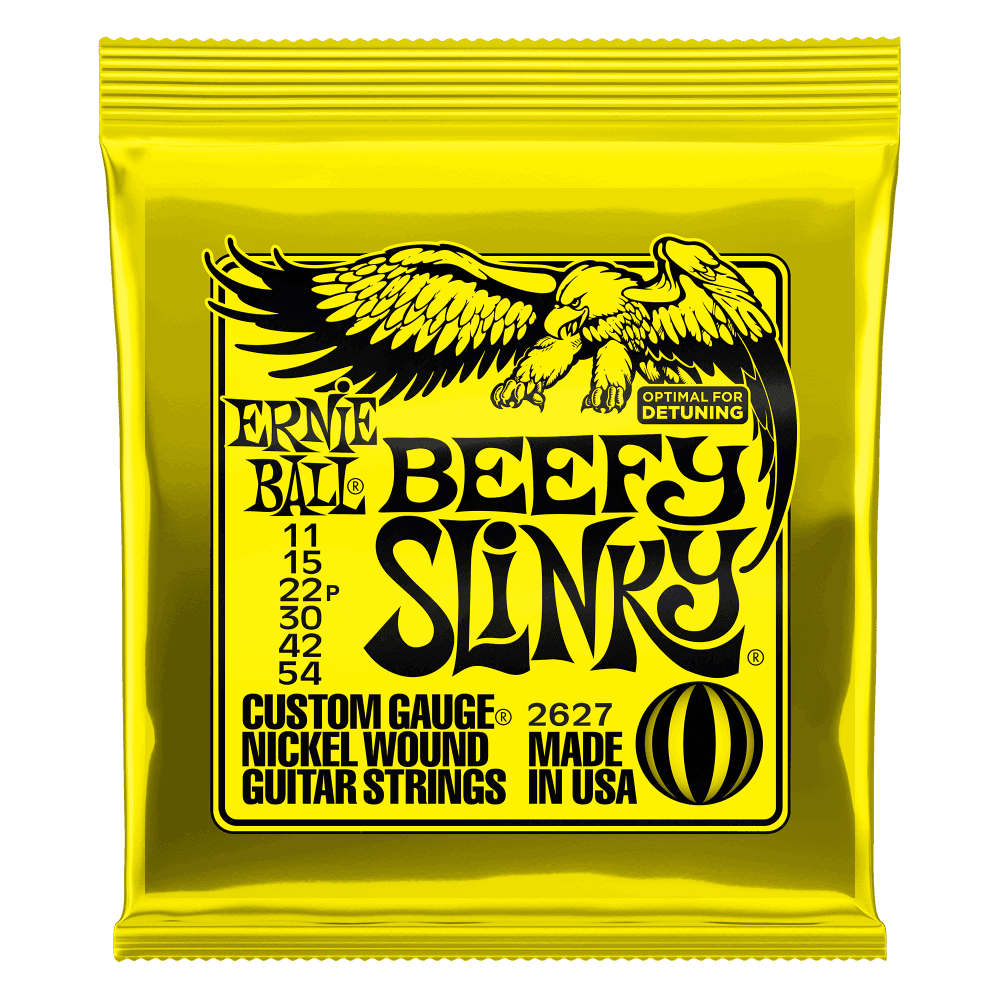
Beefy Slinky (.011–.054)
Why this one: Entry-point heavy gauge for Drop C on a 25.5-inch scale guitar, the lane Nolly's productions tend to live in.
Bass (5- and 6-string, extended range)
Stainless-steel taper-core sets for the low B and low F#. Kalium Strings is the lane Nolly has publicly discussed; D'Addario XL Pro Steels and La Bella RX Stainless also fit the taxonomy. The low B string should be .130 minimum; the low F# benefits from .175 or heavier on a long-scale bass.
Why scale length matters more than gauge for extended range
One of the most-cited pieces of Nolly's public content: if you want clear low strings for drop-tuned djent, you need to fix the scale length before you fix the gauge. A .068 low string at 25.5" in Drop A is not the same instrument as a .060 low string at 27.5" in Drop A, the longer scale gives the string more physical room to vibrate under tension, which is what produces a musical note instead of a wet slap.
String choice is the last variable, not the first. Tune up your scale length, your pickup choice, and your picking technique before you argue with a bedroom forum about 10–52 vs. 10–56.