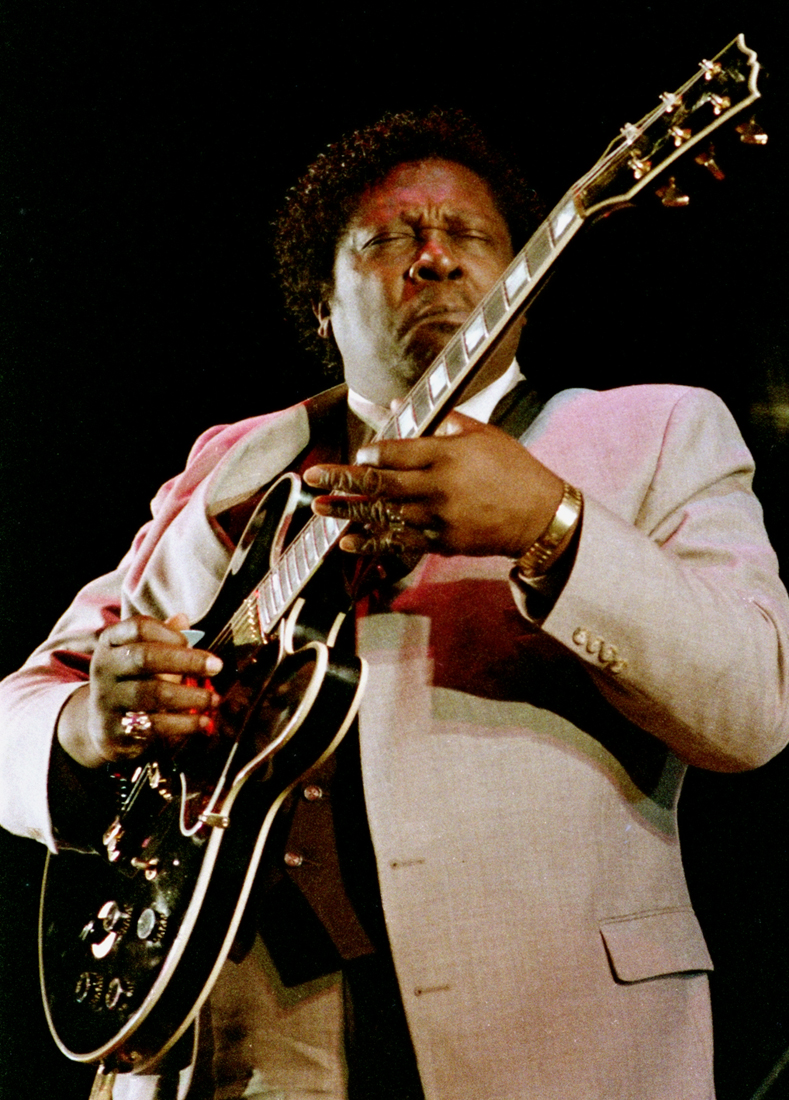
B.B. King's guitar strings: the gauge he played on Lucille, sourced
B.B. King's documented guitar string gauge: Gibson signature SEG-BBS (.010-.054, pure nickel) and the earlier Fender Rock 'n' Roll strings he played on Lucille, his Gibson ES-355. With citations.
Solo / The B.B. King Blues Band · written with AI help · updated
B.B. King's guitar string gauge was .010, .013, .017 plain, .032, .045, .054, the Gibson B.B. King Signature Strings (SEG-BBS), a pure nickel set on a Swedish steel hex core with a light .010 top and a heavy .054 low E. In the 1960s he played Fender Rock 'n' Roll strings because he liked an unwound G. Always standard E, on a Gibson ES-355 he named Lucille. The set is discontinued.
Who B.B. King was
Riley B. "B.B." King (September 16, 1925, Itta Bena, Mississippi, May 14, 2015, Las Vegas, Nevada) was one of the most-influential blues guitarists in recorded history, a sixty-six-year career from his first single in 1949 through his retirement in 2014. The "B.B." was for "Blues Boy," the on-air name he used as a Memphis radio DJ at WDIA in the late 1940s. The signature instrument family, all named Lucille, were Gibson semi-hollow electrics, and the Lucille signature ES-355 has been a Gibson Custom Shop catalog model since the 1980s.
His 15 Grammy Awards, the Presidential Medal of Freedom (2006), and his role in opening the door for the postwar electric-blues canon (Albert King, Buddy Guy, Eric Clapton, Stevie Ray Vaughan) make him the load-bearing figure in the genre's modern history.
What he played
Gibson B.B. King Signature Electric Guitar Strings (SEG-BBS, .010, .013, .017p, .032, .045, .054) on a Gibson ES-355 Lucille tuned to E standard. Gibson built the set to B.B. King's own gauge: a pure nickel wrap on a premium Swedish steel hex core, light at the top, heavy at the bottom. Gibson has since discontinued it. The unwound .017 third is the detail that matters: his butterfly vibrato sits mostly across the third and second strings, and a plain third bends more freely and rings brighter than a wound third at the same gauge.
Earlier in his career, through the 1960s, he played Fender Rock 'n' Roll strings, for the same reason: he liked an unwound G. A December 1969 Guitar Player interview quotes him on it directly, and Gibson print advertising from the following years had him "wailin' on Gibson strings." The signature SEG-BBS set followed.
His signal chain was simple: Lucille into a Lab Series L5 (the solid-state amp he leaned on from the 1970s onward) or a Fender Twin Reverb in earlier years. A clean, reverb-rich tone with very little overdrive is where his lead vocabulary lives; the saturation comes from picking attack into a clean amp, not from gain.
The Gibson signature set is long discontinued. Want to try his gauge spread today? The closest off-the-shelf match is Ernie Ball's Regular Slinky (.010 to .046): Buy on Amazon. It matches King's light top and unwound third, though its .046 low E runs lighter than his .054. Full breakdown below.
If you want this rig
The Gibson B.B. King Signature set (SEG-BBS) is discontinued, so sealed packs are now a collector buy rather than shelf stock. For a current set with the same feel, any light pure-nickel or nickel-plated set with a plain .017 or .018 third string gets close. The one trade-off: most stock .010 sets stop at a .046 low E, lighter than King's .054 bottom.
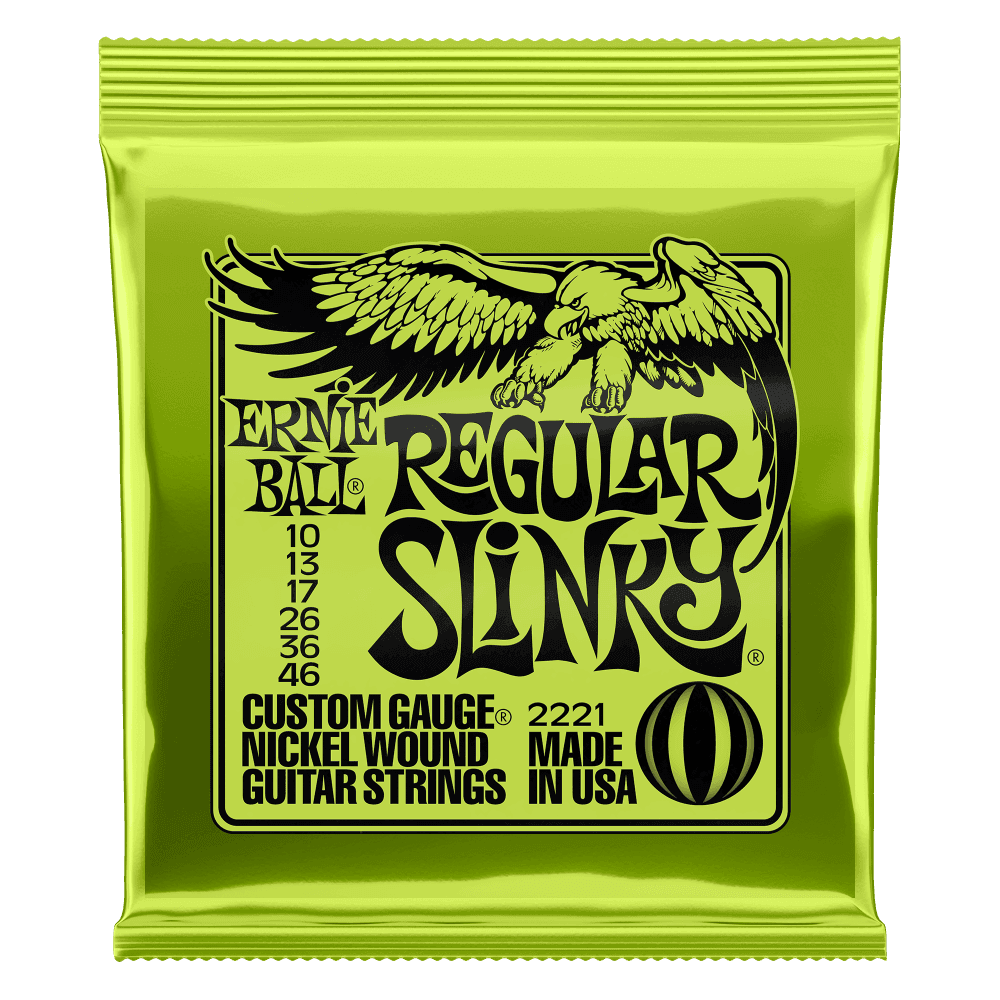
Regular Slinky (.010–.046)
Why this one: Modern equivalent at the .010 light-gauge mark, with an unwound .017 third matching King's bend-vocabulary spec. Lighter low E than King's SEG-BBS set (.046 vs .054), so the bottom isn't quite as anchored, but the top-three-strings feel matches.
Why this fits the rig
The genuinely distinctive part of the set is the spread: a light .010 top paired with a heavy .054 low E, well above the .046 most .010 sets carry. The asymmetry is on purpose. Light enough at the top for the butterfly vibrato, his most-imitated signature, and heavy enough at the bottom for chord-anchor stability and a thick low end on the ES-355. The .017 G is plain, the unwound third he favored his whole career.
The semi-hollow ES-355 with closed F-holes resists feedback at high stage volume, which is why the signature Lucille has the closed body; his typical performance volumes would have made an open-F-hole 335 howl. The Vari-Tone six-position tone-shaping switch gave him preset tonal options for different songs without changing knob settings between numbers.
Further reading and listening
Go deeper on B.B. King. Books and Audible audiobooks on Amazon, so you can read or listen.
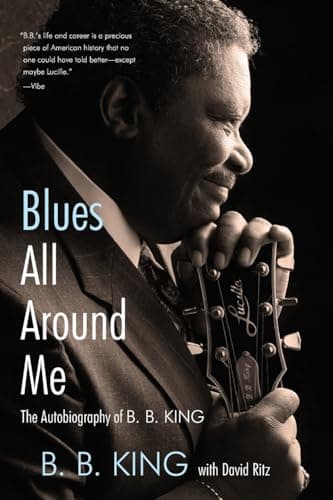
Blues All Around Me: The Autobiography of B.B. King
by B.B. King and David Ritz
B.B. King's autobiography: the life behind Lucille and the blues.