Ernie Ball Turbo Slinky (.0095–.046): Primo's top, Regular's bottom
Written with AI help · Updated
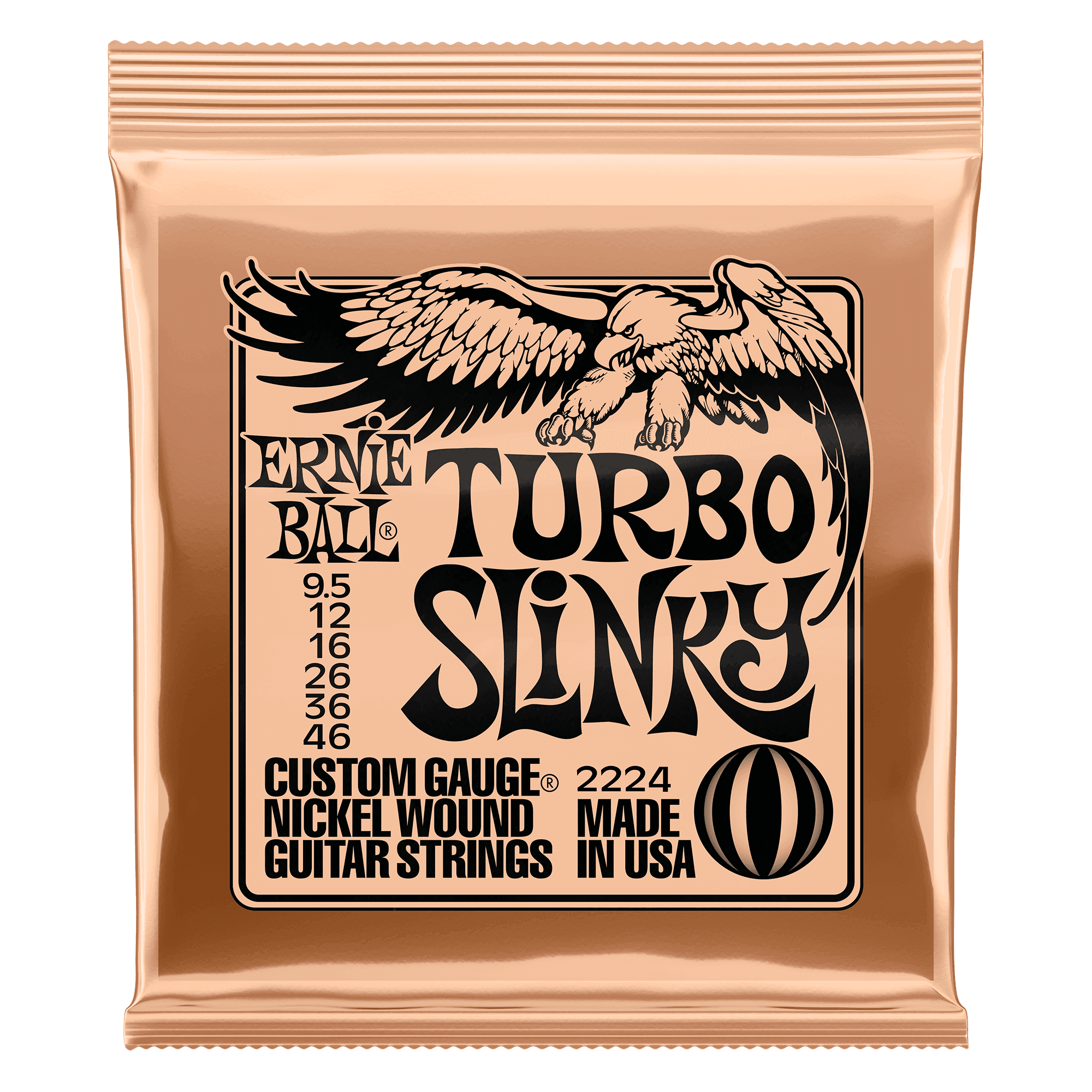
Ernie Ball Turbo Slinky Nickel Wound (2224/P02224) runs .0095 to .046, pairing Primo Slinky's .0095/.012/.016 top three with Regular Slinky's .026/.036/.046 bottom three. Launched in 2020 alongside Mighty, Mondo, and Skinny Top Beefy Bottom Slinky, it's the one gauge in this neighborhood Ernie Ball hasn't extended to Cobalt or Paradigm construction. No documented pro anchors this exact gauge, but it holds a perfect 5.0 rating across 10 Sweetwater reviews.

What this set is
Ernie Ball Turbo Slinky Nickel Wound runs .0095 to .046, a mixed gauge built by combining two of the brand's own named sets rather than inventing a new one. The top three strings (.0095, .012, .016) are lifted straight from Primo Slinky. The bottom three (.026, .036, .046) come straight from Regular Slinky. Nickel-plated steel wrap wire over a tin-plated hex steel core, the same construction as every other set in Ernie Ball's Slinky Nickel Wound line.
Ernie Ball's own product copy for the whole nickel-wound family reads the same across every gauge: "made from nickel plated steel wire wrapped around tin plated hex shaped steel core wire," with plain strings of "specially tempered tin plated high carbon steel." Turbo Slinky doesn't get unique marketing copy either, it's positioned as one gauge option among twenty in the same family, listed under SKU 2224 (packaging code P02224). Ernie Ball introduced it in March 2020, alongside three other new gauge combinations built the same combinatorial way.
Anatomy
- SKU
- Ernie Ball 2224
- MPN
- P02224
- Gauge
- .0095 – .046 (Turbo Slinky)
- Gauge set
- .0095, .012, .016, .026, .036, .046
- Core wire
- Tin-plated hex steel
- Wrap wire
- Nickel-plated steel
- Plain strings
- Tin-plated hex-core steel (.0095, .012, .016 plain)
- Coating
- None, uncoated
- Winding
- Standard roundwound
- Intended scale
- 25.5" (Fender-scale) primary; 24.75" Gibson-scale playable, slightly looser top
- Intended tunings
- E standard, Eb standard; light-duty Drop D (shares Regular Slinky's .046 low E)
- Total tension
- Not published by Ernie Ball as a blanket chart; the company provides unit weights on individual request instead (see FAQ)
- Package
- Single pack (P02224), 3-pack (P03224)
Two ways to build an in-between gauge
Ernie Ball solves the gap between a .009 that feels thin and a .010 that feels stiff two different ways, and Turbo Slinky and Hybrid Slinky are the results. Turbo Slinky splices Primo Slinky's uniform half-gauge top (.0095, .012, .016) onto Regular Slinky's bottom three. Hybrid Slinky instead splices Super Slinky's lighter top (.009, .011, .016) onto that same Regular Slinky bottom. Both land on an identical .046 low E; the only real difference between Turbo, Hybrid, and Regular Slinky is what happens on the top three strings.
Turbo Slinkys sit neatly between the popular Regular Slinky and Hybrid Slinky strings while providing a balanced, comfortable feel across all six strings.
Official product description
| Turbo Slinky (this set) | Primo Slinky | Hybrid Slinky | Regular Slinky | |
|---|---|---|---|---|
| Gauge | .0095–.046 | .0095–.044 | .009–.046 | .010–.046 |
| Gauge set | .0095/.012/.016/.026/.036/.046 | .0095/.012/.016/.024/.034/.044 | .009/.011/.016/.026/.036/.046 | .010/.013/.017/.026/.036/.046 |
| Top three from | Primo Slinky | Its own uniform half-gauge | Super Slinky | Its own uniform gauge, the line default |
| Bottom three from | Regular Slinky | Its own uniform half-gauge (lighter, .044 low E) | Regular Slinky | Its own uniform gauge, the line default |
| SKU / MPN | 2224 / P02224 | 2212 / P02212 | 2222 / P02222 | 2221 / P02221 |
| Cobalt version | Not offered | Yes, Primo Slinky Cobalt | Yes, Hybrid Slinky Cobalt | Yes, Regular Slinky Cobalt |
| Paradigm version | Not offered | Yes, Paradigm Primo Slinky | Yes, Paradigm Hybrid Slinky | Yes, Paradigm Regular Slinky |
| Best known for | Primo's top, Regular's bottom | Uniform half-gauge, the lightest bottom three of the four | Super Slinky's top, Regular's bottom | The standard default gauge |
Every row above traces back to gauges Ernie Ball fetched and confirmed on its own catalog page, cross-referenced string by string. The takeaway: if you already know you like Regular Slinky's low end but want an easier-bending top, Turbo Slinky and Hybrid Slinky are both worth trying, they just borrow that lighter top from two different donor sets, half a thousandth apart.
Why there's no Cobalt or Paradigm Turbo Slinky
Every immediate neighbor of Turbo Slinky ships in three constructions: plain nickel, Cobalt, and Paradigm. Turbo Slinky doesn't. We checked Ernie Ball's Cobalt and Paradigm catalog pages directly: the Cobalt lineup runs Primo Slinky Cobalt (.0095–.044) straight to Hybrid Slinky Cobalt (.009–.046), and the Paradigm lineup does the same, skipping the .0095–.046 gauge entirely in both cases.
At least one buyer has noticed the same gap. A Sweetwater reviewer wrote in August 2023: "I really hope in the future they make these in Cobalt and Paradigm versions, and come in larger then 3 packs." As of this review, that hasn't happened.
That leaves Turbo Slinky as the plain-nickel-only member of its own family, for now. If you want this exact top-three feel with more output or a longer bright window, Primo Slinky Cobalt and Paradigm Primo Slinky get close, same top three, a slightly lighter .044 bottom instead of .046. If you want the .046 low E specifically with more output or a breakage guarantee, Hybrid Slinky Cobalt and Paradigm Hybrid Slinky or the Regular Slinky Cobalt and Paradigm builds cover that gauge instead.
What buyers actually say
Sweetwater's own customer reviews are a useful real-world demand signal for this gauge. Turbo Slinky holds a perfect 5.0-star average across 10 reviews on Sweetwater, with every single review five stars going back to the set's first review in June 2020.
The reviews cluster around one specific problem this gauge solves: players stuck between .009 and .010 sets. Reviewer "The S." wrote in August 2023: "Gibson or Fender this gauge feels perfect!! 9's too light? 10's to heavy? TRY THESE!!!" Reviewer JKC, August 2021, switched after finding standard .010s felt stiffer on a longer-scale Stratocaster than on a shorter-scale SG: "Switched to the Turbo Slinky and now my Strat feels like my SG that has 10s on it." A reviewer named Ryan, June 2021, switched over from Hybrid Slinky specifically after its lighter top three strings proved hard to control: "the Hybrid Slinky set was too light, I couldn't control the top 2-3 strings very well... This Turbo Slinky set is just right for where I'm at right now."
That last review is worth flagging on its own: it's a real, dated, independent account of a player trying Hybrid Slinky first and switching to Turbo Slinky, the exact comparison this page's own info-gain angle is built around, arrived at independently by a buyer years before we wrote it up.
Best for
- Players who've tried both .009 and .010 nickel sets and want Primo Slinky's easy-bending top paired with Regular Slinky's tighter, rhythm-ready bottom three.
- Long-scale (25.5") guitars where a straight .010 set starts to feel stiffer than the same nominal gauge does on a shorter-scale instrument.
- E standard or Eb standard rock, blues-rock, and classic rock players who don't want to compromise lead-string comfort for rhythm-string tightness.
- Players switching over from Hybrid Slinky who found its .009 top too loose to control, a switch multiple Sweetwater reviewers made and confirmed in writing.
Worst for
- Drop C and lower. The .046 low string is a standard-tuning gauge, the same ceiling as Hybrid and Regular Slinky. Step up to Skinny Top Heavy Bottom or a dedicated drop-tuning set instead.
- Anyone who wants a breakage guarantee or more output at this exact gauge. Turbo Slinky has no Cobalt or Paradigm version, unlike every immediate neighbor in its family.
- Anyone chasing a specific documented pro's exact rig. No sourced player anchors this gauge in the materials we could find.
- Players who already know they prefer straight .009 or .010. Several Sweetwater reviewers only found this gauge after trying both neighbors first, not by guessing; it's a refinement, not a default first purchase.
Who plays this set
We could not confirm a documented guitarist citing this exact plain-nickel .0095–.046 gauge in a sourced interview, rig rundown, or official artist page. The same sourcing gap shows up on both Primo Slinky and Hybrid Slinky, Turbo Slinky's closest relatives, so it isn't specific to this set.
For a documented roster in the wider nickel Slinky family this set belongs to, Regular Slinky's page lists Eric Clapton, Billie Joe Armstrong, and John Mayer on Ernie Ball's general artist roster (Mayer's own named signature set is the lighter Silver Slinky), and Super Slinky's page lists Angus Young on an even lighter .009 gauge. None of them is documented on this specific spliced gauge, so treat those as neighbors, not citations for Turbo Slinky.
Verdict
Turbo Slinky earns its spot for one specific reader: someone who has tried both .009 and .010 nickel sets, wants Primo Slinky's exact easy-bending top three, and doesn't want to give up Regular Slinky's tighter low end to get it. Real buyers back this up with a perfect 5-star record on Sweetwater since 2020, including reviewers who arrived here after Hybrid Slinky's top three felt too loose.
It's not the set to reach for if you want a documented pro's exact rig, nobody's sourced on this gauge, a breakage guarantee, or more output. Turbo Slinky has no Paradigm or Cobalt version, unlike its Primo, Hybrid, and Regular Slinky neighbors, all of which offer both at their own gauge.
Related
Related