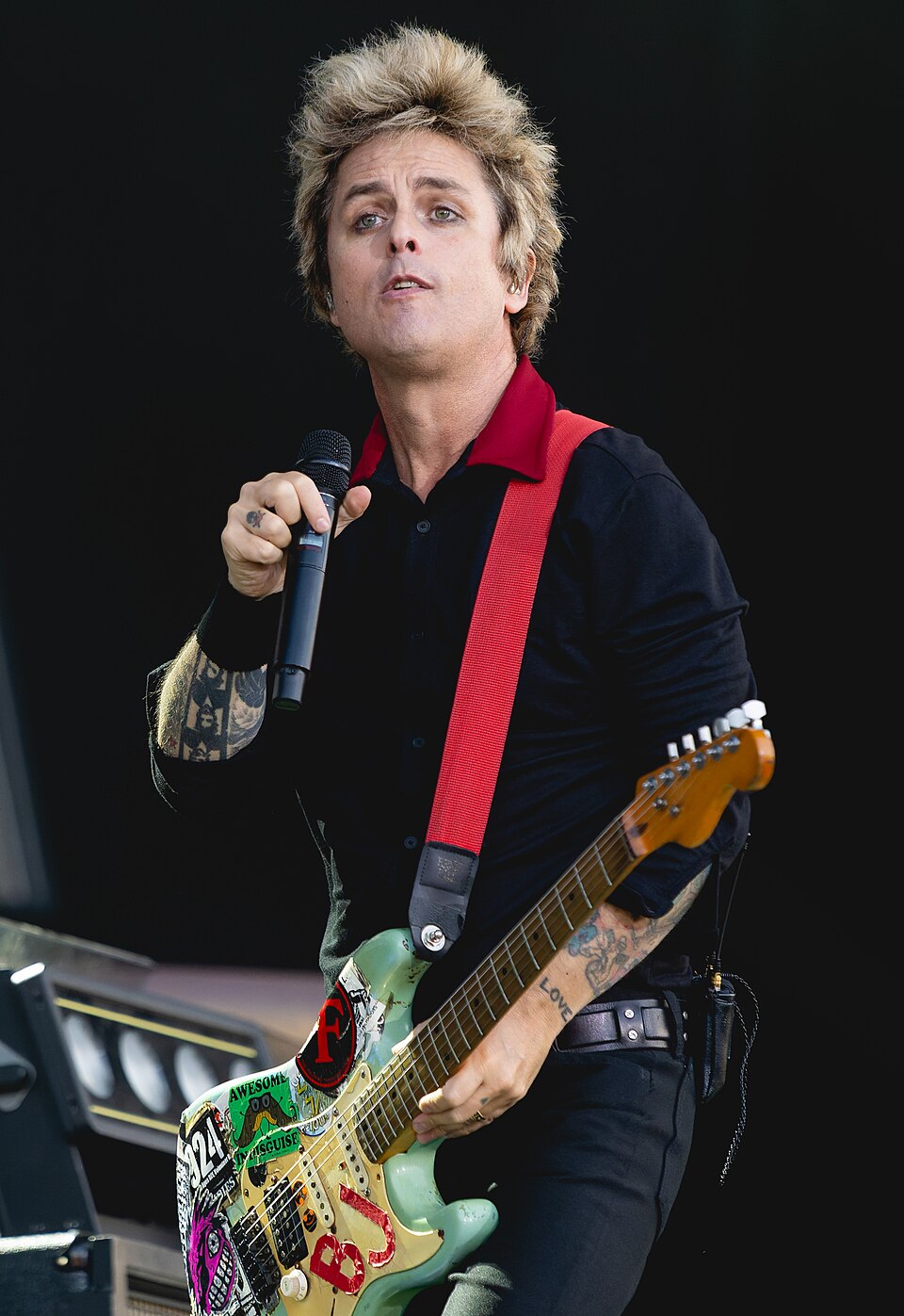
Billie Joe Armstrong's guitar strings: the Green Day rig, sourced
Documented string gauges, brands, and tunings Billie Joe Armstrong uses with Green Day on Blue (his '56 Fernandes Strat copy) and his Gibson Les Paul Juniors. Ernie Ball Regular Slinky / Paradigm (.010–.046). With citations.
Green Day · written with AI help · updated
Billie Joe Armstrong uses Ernie Ball Regular Slinky (.010–.046) on his electric guitars: the same set across Blue (his '56 Fernandes Strat copy that's appeared on every Green Day record) and his Gibson Les Paul Juniors including 'Floyd,' the 1956 Sunburst Junior he found at a San Rafael guitar show in 2000. More recently he's been seen with Ernie Ball Paradigm Regular Slinky for road durability under his heavy down-strumming. He released his Gibson Les Paul Junior signature model in March 2023, the production version of Floyd's spec.
Who Billie Joe Armstrong is
Billie Joe Armstrong is the founding guitarist, lead vocalist, and primary songwriter of Green Day, the California trio he formed in 1986 in Berkeley with bassist Mike Dirnt, completed by drummer Tré Cool in 1990. The band's catalog from Dookie (1994) through Saviors (2024) is one of the most commercially successful in punk-adjacent rock: 75+ million records sold, Rock and Roll Hall of Fame inductees in 2015, five Grammy Awards including 2005 Record of the Year for "Boulevard of Broken Dreams."
He fronts the band, writes the songs, and plays the rhythm guitar parts. The down-stroke discipline of his right hand is the rhythmic foundation underneath Mike Dirnt's locked-pocket bass; if Mike Dirnt is the band's metronome, Billie Joe is the snare on every eighth note. His vocal-and-guitar songwriter setup is rare in modern rock for being three-piece-true: no second guitarist hides the rhythm part on a Green Day record.
What he plays
Ernie Ball Regular Slinky (.010, .013, .017, .026, .036, .046) on his electric guitars: Blue, his Les Paul Juniors, and the Gibson signature. The Paradigm Regular Slinky touring variant ships in the same gauge with longer life for heavy down-strumming.
The current rig, sourced
- Strings
- Ernie Ball Regular Slinky (.010–.046) standard; Paradigm Regular Slinky (.010–.046) for touring durability. Same gauge across both. Documented across the Green Day catalog and his entire guitar fleet.
- Primary guitars
- Blue (heavily-modified 1950s Fernandes Stratocaster copy, on every Green Day record from 39/Smooth in 1990 through Saviors in 2024) and Floyd (1956 Sunburst Gibson Les Paul Junior, primary from the Warning era forward).
- Signature production model
- Gibson Billie Joe Armstrong Les Paul Junior, released March 2023. Production version of Floyd's spec: P-90 single-coil bridge pickup, mahogany body, wraparound bridge.
- Amp
- Two Marshall 1959SLP plexi reissues, nicknamed 'Pete' (Dookie crunch mod) and 'Meat' (SE Lead mod), both modified by Martin Golub at L.A. Sound Design. Custom Audio Electronics 3+ SE rackmount tube preamp for clean tones. All routed through two Marshall 1960B cabs with Celestion Vintage 30s. The Junior into 'Pete' is the canonical Floyd-era Green Day signal chain.
Blue, Floyd, and the Junior signature
Two guitars carry the catalog. Blue came first.
Blue is a 1950s Japanese Fernandes Stratocaster copy Armstrong bought as a teenager. It's been the primary Green Day stage instrument for over three decades, modified continuously: pickups swapped for Seymour Duncans, body covered in stickers, hardware replaced piece by piece. Per Guitar World, Blue has appeared on every Green Day record from 39/Smooth (1990) through Saviors (2024). The Strat copy gives the pre-American Idiot Green Day catalog its bright, bell-like single-coil rhythm tone, the Dookie / Insomniac / Nimrod sound.
Floyd is a 1956 Sunburst Gibson Les Paul Junior, found at a San Rafael, California guitar show in 2000 right before Green Day went into the studio for Warning. The single P-90 bridge pickup, mahogany body, and wraparound bridge geometry give Armstrong the harder, more aggressive midrange snarl that fits the rock-opera arrangements of American Idiot (2004) forward. Quoted at the 2023 Gibson signature launch: "It's a simple, raw, and powerful guitar that has a sound that just can't be beat! Plug it straight into any tube amp, crank it, and it will roar!"
The Gibson Billie Joe Armstrong Les Paul Junior signature (released March 2023) is the production version of Floyd's spec, available in Silver Mist and other finishes. Same P-90, same wraparound bridge, same mahogany body. The signature exists because Floyd has become as iconic in modern rock as Blue was in 1990s pop-punk.
Why this fits the rig
A Les Paul Junior with a single P-90 pickup at .010 gauge in E standard is the canonical punk rhythm voicing. The P-90 delivers midrange snarl that twin-coil humbuckers don't, and the .010 high E reads as a clear guitar attack rather than a bassy chunk. The wraparound bridge geometry stays in tune under Armstrong's heavy strumming attack better than a Stratocaster-style tremolo block would.
Same setup ships factory on the signature Junior. The gauge, the bridge geometry, and the pickup output are all in mutual lock; you can't mix a heavier gauge with a hotter humbucker on a Floyd-spec instrument and expect the same voice.
The Paradigm coated variant solves the road-life problem. Armstrong's strumming attack burns through standard Slinky strings faster than a typical lead-guitar use case (sweat plus down-stroke abrasion is the killer combo). Paradigm's Everlast nano-treatment buys him more shows per change without altering the tonal character of the standard Slinky. Same .010-.046 gauge, longer life, same voice.
Style signatures
Three things across Green Day's catalog you can identify as Armstrong's:
-
Down-stroke discipline. Armstrong plays nearly every Green Day rhythm part with all-down-stroke right-hand technique, no alternate picking on rhythm parts. The technique gives the eighth-note pulse a uniform attack the way most punk rhythm guitarists can't sustain past about 180 BPM. He runs faster than that. The gauge supports this: heavy enough to feel under hard down-strokes, light enough that the attack doesn't fatigue the wrist.
-
The pre-chorus mute lift. Across the Dookie and Insomniac catalog, the verse-to-pre-chorus pivot is often a palm-mute that lifts on the upbeat into open chords on the chorus. The technique is dynamic-range vocabulary that pop-punk has copied wholesale; Armstrong was an early architect.
-
Lead lines as composed events. Armstrong's lead breaks are short, melodic, and structurally placed. "Boulevard of Broken Dreams," "Wake Me Up When September Ends," and "American Idiot" all have lead figures that function as compositional hooks rather than improvisational displays. The Junior's P-90 is the right instrument for this: it has enough sustain to hold a sung-style lead line without compressing flat.
Electric guitars
The full electric stable, sourced from Premier Guitar Rig Rundowns (2013, 2017, 2021), Gibson interviews, the 2017 Reverb auction listings, and Ground Guitar's gear archive.
Acquired 1983 · Nickname "Blue"
Fernandes RST-50 Stratocaster
11th-birthday gift from his mother, arranged by guitar teacher George Cole, who picked it up from Santana bassist David Margen. Used continuously from 39/Smooth (1990) through Saviors (2024). Originally fitted with a Bill Lawrence L-500XL bridge pickup; swapped to a Seymour Duncan SH-4 JB after 1995.
Acquired 2000 · Nickname "Floyd"
1956 Gibson Les Paul Junior (Sunburst)
Found at a San Rafael, CA guitar show right before Warning sessions. Single P-90 bridge, mahogany body, wraparound bridge. The root of the post-2000 Green Day rhythm tone (American Idiot, 21st Century Breakdown, Saviors). Basis for the 2023 Gibson BJA signature production model.
Acquired ~mid-2000s · Nickname "Virgin Mary"
1955 Gibson Les Paul Junior (Black, Mary sticker)
Black-finished single-cut Junior with a Virgin Mary sticker on the bass-side body below the bridge. Standard '50s spec: dog-ear P-90, wraparound bridge, mahogany body. Confirmed in Premier Guitar's 2013 Rig Rundown; still part of the live arsenal as of recent Instagram posts.
Source: Ground Guitar: 1955 Les Paul Junior.
Acquired 2009 · Nickname "Class of 13"
1970 Fender Stratocaster
Olympic White (aged to cream). Set up to mirror Blue: neck and middle pickups disconnected, leaving only the Seymour Duncan JB SH-4 humbucker in the bridge. Distinctive "Class of 13" sticker behind the bridge. Touring backup for Blue during 21st Century Breakdown era.
Acquired 2005 · Prototype
Gibson Les Paul Special Doublecut (white, custom)
Two-year prototype collaboration with Gibson to recreate a 1950s-spec Junior in doublecut format. White with tortoise pickguard, skull spray-paint behind the bridge, single P-90. Touring main during 2010. Prototype basis for the 2012 production BJA Les Paul Junior Doublecut.
Acquired 2013 · Live primary on later tours
Rickenbacker 360
Mostly stock; all controls except master volume removed (covered with tape, later a custom pickguard). Two Hi-Gain single-coil pickups. Studio: through a Divided By 13 head.
Source: Ground Guitar: Rickenbacker 360.
Tour use 2010+ · "Blue backup"
Custom Black Telecaster (built by his tech)
Direct backup for Blue: black body, single Seymour Duncan JB SH-4 humbucker angled in the bridge, single volume control, aftermarket WD pickguard. Multiple builds floating around; many ended up handed to fans after shows.
Source: Ground Guitar: Billie Joe Armstrong gear archive (blackout Telecaster entry).
Launched July 23, 2026 · Import, $649 · Limited edition
Epiphone Billie Joe Armstrong Les Paul Junior, Radiant Red
The affordable half of Armstrong's 2026 signature-gear wave: the same single-P-90, mahogany-body, wraparound-bridge formula as his USA-made Gibson signature, built to a lower price and finished only in Radiant Red. Ships strung .010-.046, matching his own Ernie Ball Regular Slinky gauge.
Source: Gibson/Epiphone product page, Premier Guitar.
Acoustic guitars
Acquired 2011 · Signature model
Gibson BJA J-180 Signature
Based on the Everly Brothers J-180 with star inlays (instead of diamonds), tortoiseshell double pickguards, "Billie Joe" engraved truss-rod cover. Sitka spruce top, Eastern maple back/sides, mahogany neck, Indian rosewood fingerboard, Fishman Matrix VT preamp + piezo. Built in Bozeman, MT in a 100-piece limited run. Main acoustic since 21st Century Breakdown tour.
Source: Ground Guitar: BJA Gibson J-180 signature page (Hans tech quote).
Amps
Top head · Nickname "Pete" · Dookie / Bradshaw crunch mod
Marshall 1959SLP Plexi 100W reissue
Modified by Martin Golub at L.A. Sound Design with the "Dookie mod" (also called the Bradshaw gain mod), which increases gain and yields cleaner distortion at lower volume. Per the Premier Guitar 2024 Rig Rundown, Pete and Meat have been Armstrong's go-to amps since their iconic appearance at Woodstock '94. The Dookie / Insomniac / Nimrod tone reference.
Bottom head · Nickname "Meat" · SE Lead mod
Marshall 1959SLP Plexi 100W reissue (second head)
Second 1959SLP modified by Martin Golub at L.A. Sound Design with the SE Lead mod, which adds another preamp tube for more gain and sustain than Pete's Dookie mod. American Idiot / 21st Century Breakdown era live partner to Pete: Pete handles rhythm crunch, Meat handles push and arena-fill.
Speaker cabinets · Both heads + CAE preamp
Marshall 1960B 4×12 with Celestion Vintage 30s
Two Marshall 1960B straight 4×12 cabinets loaded with Celestion Vintage 30s. Both Marshall heads (Pete and Meat) and the Custom Audio Electronics 3+ SE preamp run through the same pair of cabs. The V30 is the canonical British-voiced rock cabinet speaker; the 1960B straight (vs. 1960A angled) sits flat on stage for stack-style spread.
Announced July 13, 2026 · On sale July 21, 2026 · Production model, not his stage rig
Marshall 1959BJA Billie Joe Armstrong Artist Signature
Marshall's first artist signature amp in 14 years: a 100W hand-wired head on the 1959HW Plexi platform, built with Armstrong and fitted with a custom "Dookie Mod" based on the tone he and producer Rob Cavallo shaped while making Dookie (1994). Baby-blue finish with brass and silver panel details, a nod to Blue, his first guitar. Head only, $3,999.99, on sale July 21, 2026. This is Marshall's production version of that tone, not a reissue of Pete or Meat, the two 1959SLP heads he actually tours with.
Source: Marshall's own launch announcement, Premier Guitar, Variety (July 21 on-sale date).
Acquired 2003 · 50W with Dookie mod
Park 75
Second principal amp on American Idiot alongside Pete. Butch Vig (21st Century Breakdown producer) described it as "like a Marshall, only more dialed up." Floyd → Park amp was the rhythm doubling spec on those records.
Source: Ground Guitar: Park 75, Guitar World: making of American Idiot.
Acquired 2004 · Two units (Clean Vicky / Dirty Vicky)
Victoria 80212-T
Used during American Idiot recording. Clean Vicky stock with Jensen speakers; Dirty Vicky modded by Chris Barnett with a Dumble-style circuit and Eminence 1258 speakers. ~80W tweed-twin spec (5F8A circuit, 4× 6L6, GZ34 rectifier). High-headroom clean machine. A third smaller Victoria 35210 ("Little Vicky") handled the cleanest tones (e.g., the "American Idiot" intro).
Source: Ground Guitar: Victoria 80212-T (Clean/Dirty Vicky), Ground Guitar: Victoria 35210-T (Little Vicky).
1989–1993
Gallien-Krueger 250RL
Stereo amp head used to record 39/Smooth (1990) and Kerplunk (1991). Studio + stage until 1993. Per Armstrong (MXR Dookie Drive promo): "The first two records were about $2,000 to make both of those records." Replaced by the Marshall lane at the start of Dookie sessions.
Source: Ground Guitar: Gallien-Krueger 250RL.
Effects
Released 2019 · Signature pedal
MXR Dookie Drive
Pedal-format recreation of the Dookie amp tone, launched at NAMM 2019 for the album's 25th anniversary. MXR borrowed Armstrong's two modified Plexis and rebuilt each circuit in pedal form: separate High Gain and Crunch Gain sections with a Blend control to mix them, the way the two amps were blended in the studio. Multiple limited editions since, including a 30th-anniversary version in 2024.
Source: MXR / Dunlop Dookie Drive product page, MusicRadar NAMM 2019 coverage.
Stage rack · Clean-tone preamp
Custom Audio Electronics 3+ SE
Rackmount three-channel tube preamp Armstrong uses for clean tones, signal split off the same RJM iS-8 input switcher that feeds Pete and Meat. Output runs through the same two Marshall 1960B cabs with Celestion Vintage 30s. The clean-channel companion to the Marshall heads in the Premier Guitar 2024 anniversary rig rundown coverage.
Strings
The two sets that have anchored every Green Day record. Same gauge across both, different durability tier.
Since 1990 · Studio + tour primary
Ernie Ball Regular Slinky (.010–.046)
Documented across Blue, Floyd, the Virgin Mary Junior, and his entire fleet. The canonical pop-punk-into-arena-rock rhythm gauge.
Touring set · Same gauge, longer life
Ernie Ball Paradigm Regular Slinky (.010–.046)
Everlast nano-treated for road durability under his all-down-stroke heavy attack. Same .010–.046 spec, same tonal character, more shows per change. Ernie Ball confirms this is what he uses on the road.
Picks
Since at least 1994 · .73mm
Dunlop Tortex Standard Yellow .73mm
His tech and Dunlop both confirm the .73 yellow Tortex as his current standard gauge. Used as far back as the Dookie era per Armstrong's own statements. Custom Green Day artwork prints on his personal stash; the stock yellow .73 is the same physical pick.
Bridge pickup on Blue + Class of 13 + Custom Tele
Seymour Duncan SH-4 JB Humbucker
The hot-output bridge humbucker that defines Blue's post-1995 voice and the matched Class of 13 + Custom Telecaster backups. Seymour Duncan's longest-running pickup, the canonical replacement for stock Strat / Tele bridges across rock.
If you want this rig
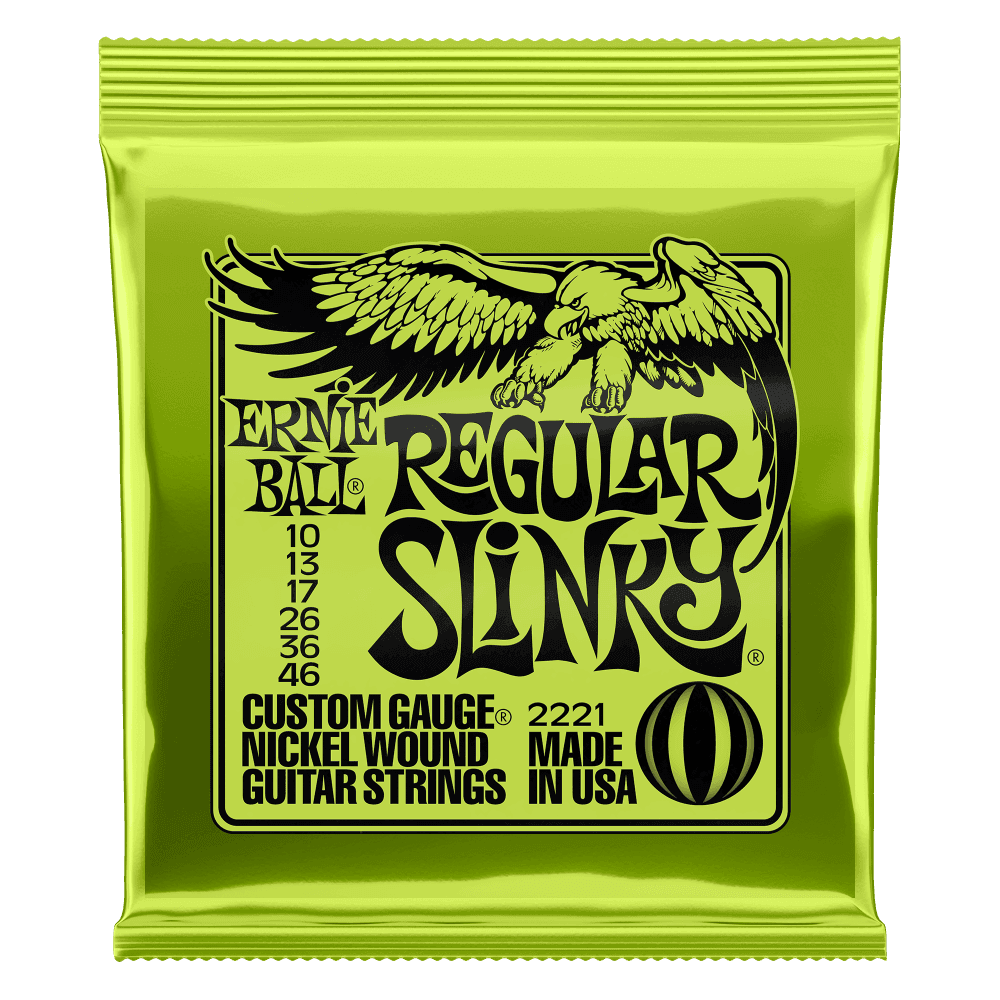
Regular Slinky (.010–.046)
Why this one: Armstrong's documented standard set across Blue, Floyd, and the signature Les Paul Junior. The canonical pop-punk-into-arena-rock rhythm gauge.
Further reading and listening
Go deeper on Billie Joe Armstrong. Books and Audible audiobooks on Amazon, so you can read or listen.

Please Kill Me: The Uncensored Oral History of Punk
by Legs McNeil and Gillian McCain
The oral history of the punk scene Green Day grew out of, told by the people who lived it.