Ernie Ball Primo Slinky (.0095–.044): the original half-gauge Slinky
Written with AI help · Updated
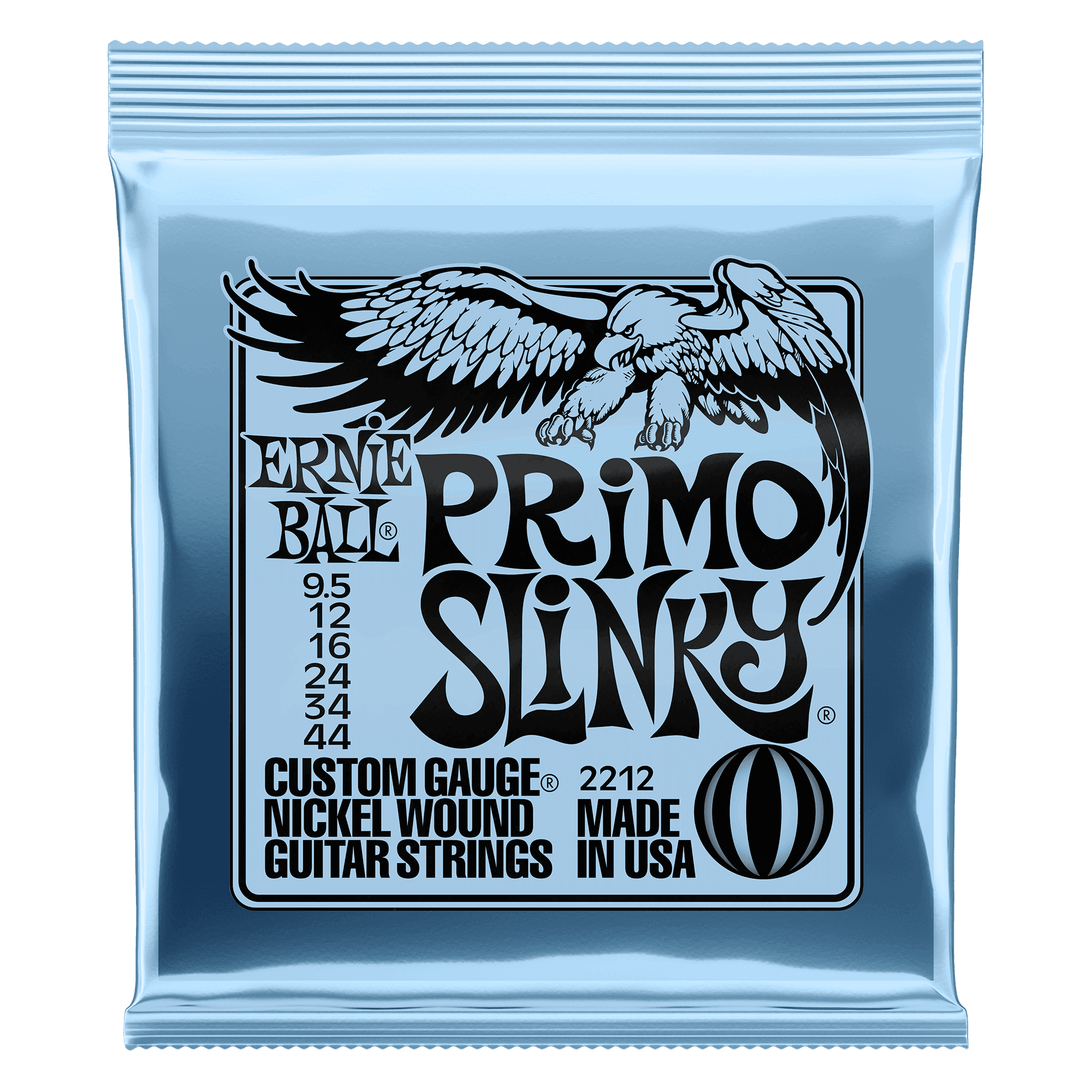
Ernie Ball Primo Slinky Nickel Wound (2212/P02212) runs .0095 to .044, the original half-gauge Slinky Ernie Ball launched in 2019, before extending the same gauge into Cobalt and Paradigm construction. Nickel-plated steel over a tin-plated hex core gives the classic bright, balanced Slinky voice at the lowest price of the three .0095-.044 options. No documented pro anchors this exact gauge. Pick it if you've tried .009 and .010 and landed in between, on a budget.

What this set is
Ernie Ball Primo Slinky Nickel Wound runs .0095 to .044, a half-gauge step that sits exactly between Super Slinky (.009 to .042) and Regular Slinky (.010 to .046). It's built the same way as every other gauge in Ernie Ball's standard Slinky Nickel Wound line: nickel-plated steel wire wrapped around a tin-plated hex steel core, with plain strings of specially tempered tin-plated high-carbon steel.
What makes this particular version notable is that it's the original. Ernie Ball introduced the half-gauge concept, Primo and its heavier sibling Mega Slinky, in the standard nickel line first. Primo Slinky Cobalt and Paradigm Primo Slinky both came later, taking this same .0095–.044 spec and rebuilding it in a different wrap alloy or construction. This is the plain, cheapest version of the idea, not a stripped-down variant of the other two.
Anatomy
- SKU
- Ernie Ball 2212
- MPN
- P02212
- Gauge
- .0095 – .044 (Primo Slinky)
- Gauge set
- .0095, .012, .016, .024, .034, .044
- Core wire
- Tin-plated hex steel
- Wrap wire
- Nickel-plated steel
- Plain strings
- Tin-plated hex-core steel (.0095, .012, .016 plain)
- Coating
- None, uncoated
- Winding
- Standard roundwound
- Intended scale
- 25.5" (Fender-scale) primary; 24.75" Gibson-scale playable, slightly looser top
- Intended tunings
- E standard primary; Eb standard workable
- Total tension
- Not published by Ernie Ball as a blanket chart; the company provides unit weights on individual request instead (see FAQ)
- Package
- Single pack (P02212), 3-pack (P03212)
Why the half-gauge exists
Ernie Ball's own explanation, from an October 2019 blog post, frames the half-gauge idea as a fit problem: "Playing guitar strings that aren't the right fit for your playing style is like wearing the wrong size shoe, it's just not comfortable. If you find yourself bouncing between gauges and neither feels just right, then half-gauge guitar strings may be the solution." The company describes the 9.5 gauge specifically as carrying "the flexibility of a 9, while offering the fuller, fatter tone of 10s."
The same post makes a second, less obvious case for half-gauges: compensating for scale length. Ernie Ball's example compares a Gibson (24.75" scale) with an Ernie Ball Music Man Cutlass (25.5" scale): stringing both with an identical gauge leaves the longer-scale guitar under noticeably more tension. A half-gauge-lighter set on the longer-scale instrument closes that gap, so two guitars of different scale lengths can feel closer to matched under your hands. Ernie Ball is explicit that this isn't a mandate to standardize every guitar in a rig to the same tension, just an option for players who want to.
Ernie Ball announced Primo, Mega, and Mammoth Slinky together in June 2019, per Guitar World's contemporary coverage, a follow-up to that March's Ultra and Burly Slinky launch.
The three Primo Slinky constructions, compared
Ernie Ball now sells this exact .0095–.044 gauge in three different builds. Side by side, for the first time on CYS:
| Primo Slinky (this set) | Primo Slinky Cobalt | Paradigm Primo Slinky | |
|---|---|---|---|
| Gauge | .0095–.044 | .0095–.044 | .0095–.044 |
| SKU / MPN | 2212 / P02212 | 2712 / P02712 | P02018 |
| Core wire | Tin-plated hex steel | Tin-plated hex steel | Ultra-high-strength hex steel |
| Wrap wire | Nickel-plated steel | Cobalt-iron alloy | Plasma-enhanced nickel-plated steel |
| Treatment | None | None (alloy swap only) | Everlast nano-treatment + RPS ball-end |
| Guarantee | None | None | 90-day breakage/rust replacement |
| Price tier | $ | $$ | $$ |
| Best known for | Lowest price, the original build | Louder output, brighter upper mids | Fewer breaks, longer bright window |
If you already know you want the .0095–.044 gauge and don't need more output or more durability, this is the cheapest way to get it. Step up to Primo Slinky Cobalt for more output and upper-mid push, or to Paradigm Primo Slinky for a breakage guarantee and a longer bright window. For a coated alternative near this gauge from another brand, see D'Addario NYXL0942 (.009–.042, not an exact gauge match, but the closest NYXL neighbor).
Where this sits in the nickel Slinky ladder
Ernie Ball's Slinky Nickel Wound family runs twenty 6-string gauges. Primo Slinky's immediate neighbors, all confirmed on Ernie Ball's own catalog page:
- Lighter: Super Slinky (.009–.042, SKU P02223).
- This set: Primo Slinky (.0095–.044, SKU P02212).
- Same top three, heavier bottom: Turbo Slinky (.0095–.046, SKU P02224) pairs Primo's exact top three strings (.0095, .012, .016) with Regular Slinky's bottom three.
- A different kind of in-between: Hybrid Slinky (.009–.046, SKU P02222) splices Super Slinky's top with Regular Slinky's bottom instead of stepping every string up uniformly.
- Heavier: Regular Slinky (.010–.046, SKU P02221), the line's default gauge.
Primo Slinky's low string (.044) is the exact arithmetic midpoint between Super Slinky's .042 and Regular Slinky's .046, and its top string (.0095) is the exact midpoint between .009 and .010. The whole set scales proportionally rather than mixing two other sets together, which is the distinction from Hybrid and Turbo Slinky above.
Best for
- Players who've actually tried both .009 and .010 sets and landed in the gap between them, rather than guessing.
- Budget-conscious players who still want the .0095–.044 gauge. This is the cheapest of the three Ernie Ball versions of this spec.
- E standard or Eb standard on a 25.5-inch scale electric. The gauge sits within Ernie Ball's Fender-scale-oriented Slinky family.
- Multi-guitar players compensating for scale length. Per Ernie Ball's own half-gauge logic, stepping a half-gauge lighter on a longer-scale guitar can bring its feel closer to a shorter-scale instrument strung with a full gauge.
Worst for
- Drop D and below. The .044 low string is lighter than Regular Slinky's already-light .046; step up to Power Slinky or Skinny Top Heavy Bottom instead.
- Players who already know they prefer straight .009 or .010. A half-gauge step is a marginal difference, not worth chasing without a specific complaint about the neighboring gauges.
- Anyone chasing longer string life or a breakage guarantee. This construction has no coating and no reinforcement. The identical .0095–.044 gauge exists in Paradigm Primo Slinky construction with a 90-day breakage-and-rust guarantee, a better fit for that priority.
- Anyone chasing a specific documented pro's exact rig. No sourced player anchors this gauge in any of its three constructions.
Who plays this set
We don't have a primary-source citation for a documented guitarist on this exact .0095–.044 plain-nickel gauge. The same sourcing gap shows up on both Primo Slinky Cobalt and Paradigm Primo Slinky, so it isn't specific to this construction, it's specific to the gauge.
For a documented roster in the wider nickel Slinky family this set belongs to, Regular Slinky's page lists Eric Clapton and Billie Joe Armstrong, and Super Slinky's page lists Angus Young, all confirmed through Ernie Ball's own current artist materials. None of them is documented on this specific half-gauge, so treat those as neighbors, not citations for this product.
Install and break-in
Coming from Regular Slinky's .010–.046, expect a modest tension drop across the set, similar in scale to the drop Primo Slinky Cobalt's page estimates at this identical gauge (roughly a few pounds total), not enough to demand major truss rod work, but worth a quarter-turn relief check and a fresh intonation pass. Coming from Super Slinky's .009–.042, expect the opposite: a small tension increase that can pull the neck very slightly forward. Ernie Ball doesn't publish an exact figure for either direction (see the tension FAQ above), so treat any pound number, including this one, as an estimate.
Break-in runs the usual 20 to 30 minutes of playing before the bright initial top end settles into its played-in voice. Stretch each string first: press behind the 12th fret, pull up about an inch, three to four times per string, retune, repeat.
Verdict
Primo Slinky exists for one specific reader: someone who has actually tried both .009 and .010 nickel sets and landed in the gap between them. If you haven't made that comparison yet, start with Regular Slinky, the line's default, and only reach for Primo if .010 feels a shade stiff or .009 feels a shade thin.
It's also the answer if you want that exact .0095–.044 gauge without paying for Cobalt's output bump or Paradigm's breakage guarantee. Both exist at the identical gauge if you decide you want what they add.
Related
Related