Ernie Ball Beefy Slinky Bass (.065–.130): built for BEAD, not standard tuning
Written with AI help · Updated
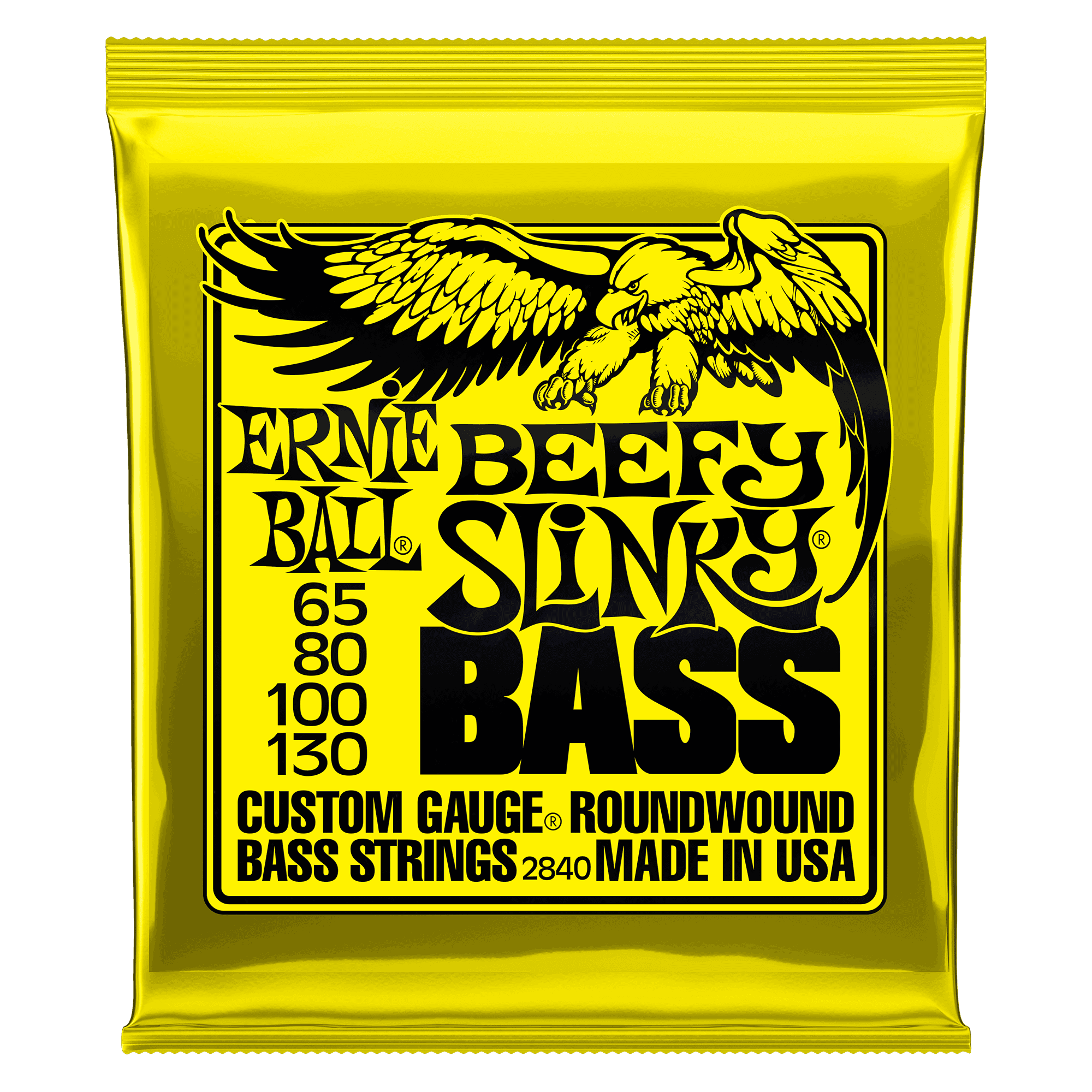
Ernie Ball Beefy Slinky Bass is the heaviest gauge in the nickel Slinky bass line at .065, .080, .100, .130, built for BEAD and other low tunings, not standard E-A-D-G. Ernie Ball's own product page never says so; only Fret Nation's listing names it, and a TalkBass thread confirms it through years of real player reports. Uncoated, hex-steel core, SKU P02840.

What this set is
Ernie Ball's Beefy Slinky Bass is the heaviest of seven gauges in the company's 4-string nickel Slinky bass family: .065, .080, .100, .130, wound with nickel-plated steel over a hex steel core. Ernie Ball's own product page gives it the same one-line description it gives every gauge in the line, a bright, balanced tone from strings "manufactured with the finest and freshest raw materials in the beautiful Coachella Valley of Southern California." Source: Ernie Ball's own Beefy Slinky Bass product page.
What that description leaves out matters more than what it says. Every lighter gauge in the nickel Slinky bass line works fine at standard E-A-D-G tuning. Beefy Slinky doesn't, and you won't find that stated on Ernie Ball's own site, on the packaging, or on most retailers' listings checked. A 2021 TalkBass thread and one retailer's own product name are the clearest places that spell it out plainly: this gauge is built for BEAD and similarly low tunings, not standard.
Anatomy
- Model
- Ernie Ball P02840 Beefy Slinky Bass
- MPN
- P02840
- Gauge
- .065 – .130 (heaviest nickel Slinky bass gauge)
- Gauge set
- .065, .080, .100, .130
- String count
- 4 strings
- Core wire
- Hex steel
- Wrap wire
- Nickel-plated steel
- Coating
- None, uncoated
- Winding
- Standard roundwound
- String length
- 37.25" winding, long scale
- Intended tunings
- BEAD and other low tunings, not standard E-A-D-G
- Package
- Single pack
Built for BEAD, a tuning Ernie Ball never mentions
Ernie Ball's own product page for Beefy Slinky Bass lists gauges and construction and nothing else. No recommended tuning, no mention of BEAD, nothing distinguishing it from any lighter gauge in the line beyond the numbers themselves. That's a real gap for a set this specialized.
A TalkBass thread that started the week a new owner unboxed a gifted set makes the gap obvious. The original poster asked plainly: "I was just gifted a set of Ernie Ball Beefy Slinky Bass strings. This is 4 string set that goes from 65 to 130, which I have never seen before. I'm assuming this is for those folks who leave their bass in a dropped tuning at all times." Source: TalkBass.com, "Beefy Slinky Bass 65,80,100,130," January 2021.
Experienced posters answered fast and consistently. "That particular set is designed for the BEAD tuning (= bottom four of 5-string), and as such, not recommended for standard tuning," one replied, followed by a blunter warning from another a few posts later: "DO NOT tune these to standard tuning. They are for drop tuninings." The original poster's own follow-up captures exactly why this matters: "I figured that was the case, but find it odd that there is absolutely no information about that anywhere on the packaging, the Ernie Ball site, or the sites of any of the vendors who sell them."
One retailer breaks that pattern. Fret Nation's own product listing names the set outright in its title: "BEAD Beefy Slinky 2840." Confirmed live on Fret Nation's own product page, which also lists a 37.25-inch winding length for the long-scale set. It's the only outlet, out of Ernie Ball's own site plus half a dozen retailers checked, that spells the intended tuning out in plain text.
A detailed 2021 reply lays out the practical range better than any packaging does. One TalkBass member explained the set is built for B standard tuning (B-E-A-D), the same low-string arrangement some players choose specifically so they don't need a 5-string bass. That poster also described running the bottom four strings of a similar set up to D standard, but only on a short-scale bass, "about two frets shorter than a full scale bass," calling the result "stiff, but nowhere near difficult" and sounding "monstrous." Their recommended ceiling on a full-scale, long-neck bass was C standard (C-F-Bb-Eb) at most, not standard tuning, and not D standard unless the bass is short scale.
Where this sits in Ernie Ball's nickel Slinky bass family
Ernie Ball ships seven gauges under its nickel Slinky 4-string bass line, all confirmed on Ernie Ball's own catalog page:
- Extra Slinky: .040, .060, .070, .095 (P02835). Full review.
- Hyper Slinky: .040, .060, .080, .100 (P02841). Full review.
- Super Slinky: .045, .065, .080, .100 (P02834). Full review.
- Hybrid Slinky: .045, .065, .085, .105 (P02833). Full review.
- Regular Slinky: .050, .070, .085, .105 (P02832), Ernie Ball's standard-tuning default. Full review.
- Power Slinky: .055, .075, .090, .110 (P02831). Full review.
- Beefy Slinky: .065, .080, .100, .130 (P02840), this set, the heaviest.
| Power Slinky (.055–.110) | Beefy Slinky (this set) | |
|---|---|---|
| Gauge set | .055, .075, .090, .110 | .065, .080, .100, .130 |
| Low string | .110 | .130 |
| Intended tuning | Standard, Eb standard | BEAD and other low tunings |
| Best for | Hard pick attack, standard/Eb | Low-tuned 4-string, maximum grip |
Tension: what the numbers say, and why we can't fully confirm them
Ernie Ball has never published tension figures for any gauge in its nickel Slinky bass line, Beefy Slinky included. A detailed TalkBass reply from 2021 supplies the closest sourced reference available: a member looked up D'Addario's own tension chart for the identical .065-.080-.100-.130 numeric gauge and reported roughly 164.3 lbs of total tension at BEAD tuning, climbing to about 232.3 lbs at D-G-C-F, a jump of about 41% (68 lbs) for one and a half tuning steps up.
Treat that specific figure as a forum member's own citation, not a number CYS independently reproduced. The static D'Addario tension-chart PDF the thread links to no longer resolves the same way: fetching it live in 2026 redirects to D'Addario's newer interactive String Tension Pro calculator instead of a fixed table, a dead end other TalkBass threads have separately complained about. The 164 to 232 lbs range is the best sourced estimate on record, offered with that caveat attached rather than as a confirmed current number.
Multiple posters agree on the underlying physics even without exact figures. One member's explanation of why standard tuning is a bad idea holds regardless of the precise number: "it's the treble strings that may (and, in the .065 case, is very, very likely to) break well before reaching the intended pitch," naming .055 and .075 as the practical ceiling for G and D gauges on a long-scale bass, both lighter than this set's .065 and .080.
What real players report
Real-world use backs up the low-tuning-only guidance. One TalkBass member described tuning a .130 low string as high as C or C#, but only "for a particularly demanding metal band situation where I needed the quickness of very high tension strings," not as everyday standard-tuning use. That's a working musician using this exact heavy gauge for a specific, unusual tuning need, not a general recommendation to push it that high.
More than a year after the original thread, a different player asked specifically about Drop C (C-G-C-F) tuning on this exact gauge set. The reply pointed to the Stringjoy Tension Calculator as a more current, easier-to-use alternative to D'Addario's now-hard-to-navigate chart, useful confirmation that players are still actively researching this exact question well after the thread started.
No electric guitar naming collision
Two of Beefy Slinky's own siblings, Power Slinky and Hyper Slinky, share their exact names with unrelated 6-string electric guitar sets, a mix-up worth double-checking before you buy either of those. Beefy Slinky doesn't have that problem. Checked against Ernie Ball's full current electric guitar Slinky lineup (Nickel Wound, Paradigm, Cobalt, Classic, and Cobalt Flatwound), none of them uses the "Beefy" name. If you're buying this set, at least the name itself won't send you to the wrong product.
Best for
- Down-tuned 4-string bassists who want BEAD (or a similarly low tuning) without adding a 5th string to the instrument.
- Metal and hard rock players who need one seriously heavy low string, the use case every sourced report on this set actually describes.
- Players who already know their target tuning going in. This isn't a general "heavier gauge for standard tuning" upgrade like Power Slinky, it's a specialist set.
Worst for
- Standard E-A-D-G tuning. Multiple experienced TalkBass posters warn against it outright, with real risk of snapping the thin .065 G and .080 D strings before they reach pitch.
- Players who want a published tension spec to build a setup around. Ernie Ball has never published one, and the commonly-cited third-party chart is no longer easy to access directly.
- Buying by gauge number alone without a target tuning already picked. Decide on BEAD, B standard, or another confirmed low tuning first. This isn't the set to buy "just in case."
Install and setup notes
Jumping straight to Beefy Slinky from a standard-tuning set is a bigger setup change than a normal gauge step. Expect to adjust the truss rod for the added string mass (typically tightening in small increments as you bring the set up to your target low tuning), recheck nut slot width on the .130 low string so it seats without binding, and reset intonation at the 12th fret on every string once you're at pitch. Because this set is built for a lower tuning than E-A-D-G, don't judge nut and saddle clearance against a standard-tuning setup, do the whole setup at the tuning you actually intend to play.
Standard nickel roundwound break-in applies otherwise: bring the set to pitch, stretch each string gently a few times, retune, and repeat two or three times before trusting it on stage or in a session.
Verdict
Beefy Slinky Bass earns its place as Ernie Ball's specialist gauge, not its heaviest all-purpose option. Every sourced report agrees on the same point Ernie Ball's own product page never states: this is a BEAD-and-lower set, not a heavier standard-tuning string. Buy it knowing your target tuning first, and the .065-.130 gauge does exactly what players describe, a monstrous low end with real grip, without the floppiness a standard gauge set would have at that same low pitch.
The honest caveats carry real weight here. There's no published tension chart from Ernie Ball, the closest sourced third-party numbers come with an access caveat of their own, and tuning this set to standard risks snapping the top strings before they reach pitch. If you want a heavier gauge that still works at standard or Eb-standard tuning, Power Slinky is the better-suited set, not this one.
Related
Related