Ernie Ball Hybrid Slinky Bass (.045–.105): Justin Chancellor's Tool gauge
Written with AI help · Updated
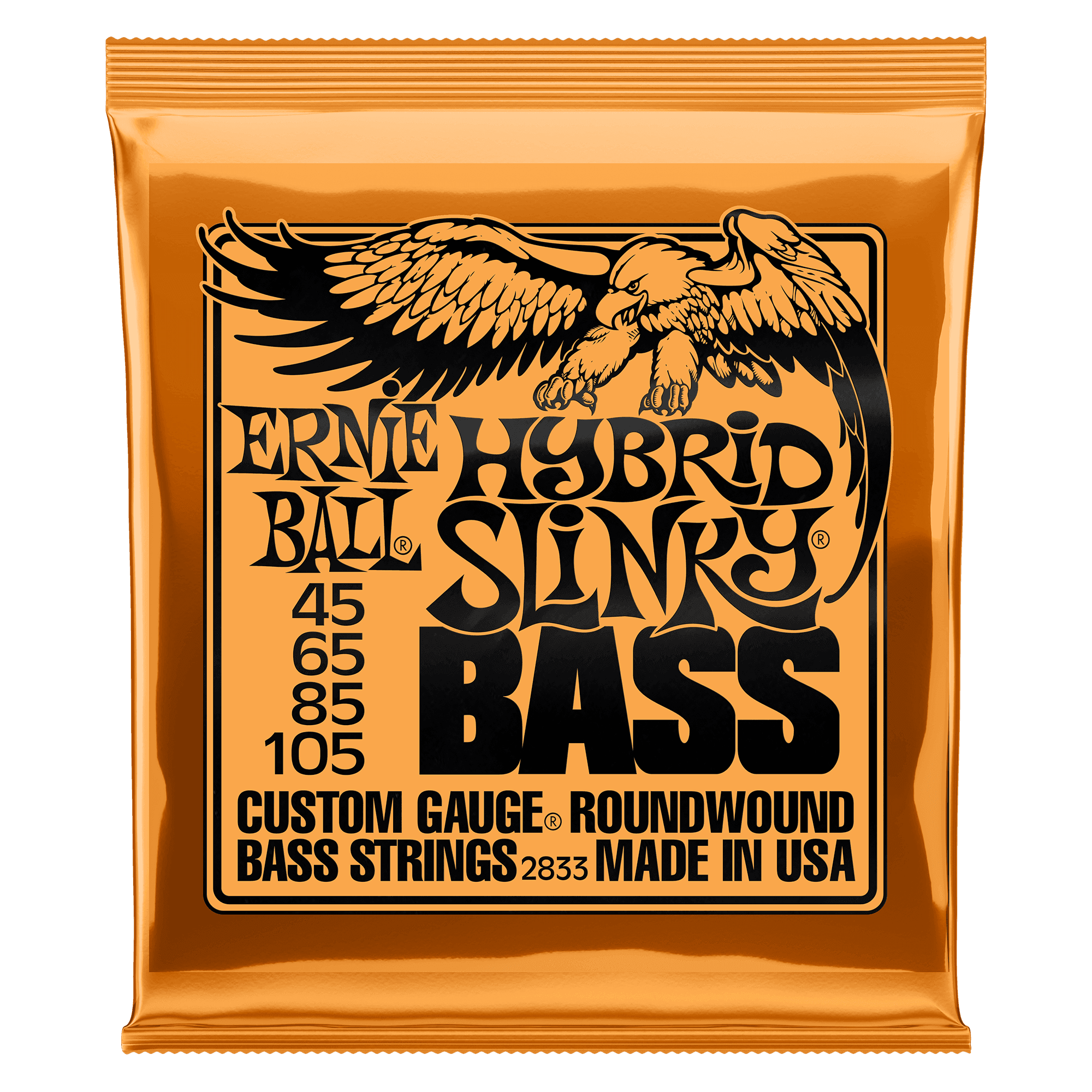
Ernie Ball P02833 Hybrid Slinky Nickel Wound Bass strings run .045, .065, .085, .105, a light-top, standard-low 4-string gauge on a nickel-plated steel wrap over a hex steel core. Tool bassist Justin Chancellor customizes this exact base set, swapping in a heavier .110 or .135 low string depending on the song's drop tuning, per Premier Guitar's 2024 Rig Rundown. A bright, balanced, all-purpose gauge for standard-tuned rock and prog bass.

What this set is
Ernie Ball's Hybrid Slinky Bass is the lighter-top gauge in the company's 4-string nickel Slinky bass family: .045, .065, .085, .105, wound on a hex steel core, built for standard long-scale bass. Ernie Ball's own product page describes the whole nickel bass line in one line: strings "made from nickel plated steel wrapped around a hex shaped steel core wire," producing "a bright, balanced tone."
It's also a real touring gauge, not just a catalog filler. Tool bassist Justin Chancellor builds his custom live set on this exact base, per Premier Guitar's 2024 Rig Rundown: the stock .045-.065-.085 top three strings, then a swap on the low string depending on the song's tuning.
Hybrid Slinky sits just below Regular Slinky, Ernie Ball's own standard-tuning default, in the company's broader nickel 4-string bass family: Extra Slinky (.040–.095), Hyper Slinky (.040–.100), Super Slinky (.045–.100), Hybrid Slinky (.045–.105), Regular Slinky (.050–.105), Power Slinky (.055–.110), and Beefy Slinky (.065–.130). It pairs Super Slinky's lighter .045 and .065 top strings with Regular Slinky's heavier .085 and .105 bottom strings, a genuine hybrid of its two neighboring gauges, which is where the name comes from.
Anatomy
- Model
- Ernie Ball 2833 Hybrid Slinky Bass
- MPN
- P02833
- Gauge
- .045 – .105 (Hybrid Slinky)
- Gauge set
- .045, .065, .085, .105
- String count
- 4 strings
- Core wire
- Hex steel
- Wrap wire
- Nickel-plated steel
- Coating
- None, uncoated
- Winding
- Standard roundwound
- Intended scale
- Long scale, Ernie Ball's standard 4-string bass length
- Intended tunings
- E standard primary; handles Eb standard and Drop D
- Package
- Single pack
Where this sits in Ernie Ball's nickel Slinky bass family
Ernie Ball ships seven gauges under its nickel Slinky 4-string bass line, all confirmed on Ernie Ball's own catalog page:
- Extra Slinky: .040–.095 (P02835), the lightest.
- Hyper Slinky: .040–.100 (P02841).
- Super Slinky: .045–.100 (P02834).
- Hybrid Slinky: .045–.105 (P02833), this set.
- Regular Slinky: .050–.105 (P02832), Ernie Ball's standard-tuning default.
- Power Slinky: .055–.110 (P02831).
- Beefy Slinky: .065–.130 (P02840), the heaviest.
Hybrid Slinky pairs Super Slinky's easier top strings with Regular Slinky's heavier bottom strings, so it suits a player who wants an easier top end without giving up low-end authority. A player used to Regular Slinky Bass and looking for less tension under the fretting hand is the clearest fit.
Who plays it: Justin Chancellor's Tool rig
Justin Chancellor has been Tool's bassist since 1995, and Premier Guitar's Chris Kies covered his live rig in detail for a February 2024 Rig Rundown, walking through the setup with Chancellor and his bass tech Pete Lewis. On strings, the article is specific: Chancellor's basses take a custom set of Ernie Ball Hybrid Slinky Bass strings at the standard .045, .065, .085 top three gauges, but because Tool tunes down to drop-D for most songs, he swaps in a .110 low string from the Power Slinky pack. The article adds: "And when they go to drop-C for their oldest material, he'll put on a .135 string."
That's a documented, tuning-driven customization built on top of this exact set: the stock Hybrid Slinky Bass top three strings, then a heavier low string sourced from Ernie Ball's own Power Slinky Bass pack depending on what the song calls for. Tool's catalog runs primarily in drop-D and lower, which is why the stock .105 low E rarely makes his board as-is.
Worth flagging honestly: Ernie Ball's own marketing has not been perfectly consistent over the years. A 2017 blog post tied to Chancellor's String Theory episode names him as a Slinky Cobalt Bass player and links out to the Cobalt product. Premier Guitar's 2024 Rig Rundown is the more recent, more specific, on-site account, with tech-verified gauge swaps named string by string, so that's the claim this page follows. If his gear changed between 2017 and 2024, or if the older post was simply promotional copy that didn't reflect his actual board, either is plausible; CYS can't resolve which without a more definitive source, so the honest answer is: nickel Hybrid Slinky Bass is what the best-documented, most recent source shows.
Nickel vs Cobalt
Ernie Ball sells the identical .045-.065-.085-.105 spread in two wrap-wire alloys. This nickel version is the brighter, more classic of the two tones. The Hybrid Slinky Cobalt Bass swaps in a cobalt alloy wrap that Ernie Ball markets for more output and a tighter low end through a passive pickup. Neither changes the gauge or tension, only the wrap-wire material and the resulting voicing. For the fully measured breakdown (output, brightness, longevity, bend feel), see Cobalt vs nickel Slinky: the voicing difference, measured, built on Ernie Ball's guitar Cobalt line; the alloy story carries over to bass, though CYS hasn't independently measured bass-specific numbers.
Best for
- Players who want an easier top string than Regular Slinky Bass. The .045 G string is 10 percent thinner than Regular's .050, a real difference for fast fingerstyle runs and light-touch tapping, without losing low-end authority on the .105 E.
- Drop-tuned rock and prog bass. Justin Chancellor's documented approach, this exact top-three gauge plus a heavier low string pulled from Power Slinky, is a practical template for anyone tuning down without wanting a whole heavier set.
- Players who want the classic nickel tone over Cobalt's output bump. Same gauge, a brighter and more familiar voicing, and a real touring-documented pedigree via Chancellor's rig.
Worst for
- Players chasing maximum string life. This is an uncoated roundwound set with the standard wear curve; Ernie Ball's coated bass options live in separate product lines.
- Heavy drop-tuned bass played stock. The stock .105 low string is a standard-tuning gauge. Chancellor himself doesn't play it stock in drop-D, he swaps in a heavier low string. A 5-string set, or a heavier 4-string like Power Slinky or Beefy Slinky, handles low tunings with more authority out of the pack.
- Players who specifically want Cobalt's output bump. If magnetic output and a tighter low end matter more than price, the Cobalt version in this same gauge is the better fit.
Install and break-in
Because the A and E strings match Regular Slinky Bass exactly (.085 and .105), a bass already set up for that gauge needs only a light nut-slot check on the G and D strings when switching to this .045 top. Break-in runs about the same as any fresh nickel roundwound, 15 to 20 minutes of playing before the top end settles. Stretch each string, pull up gently a few times, retune, and repeat before a gig or session. If you're following Chancellor's approach and swapping in a heavier low string from a Power Slinky or Beefy Slinky pack, double-check your nut slot and bridge saddle can accept the thicker gauge before you're on a stage with it.
Verdict
Hybrid Slinky Bass is Ernie Ball's answer for a bassist who wants an easier top string than the Regular Slinky default without giving up low-end weight. It's a real, currently-sold catalog gauge, not filler, and it's the documented base that Tool's Justin Chancellor customizes for his band's drop-tuned catalog.
If you play mostly standard tuning and want the classic nickel Slinky bass tone, this is a straightforward choice. If you're chasing more output and a tighter low end at the same gauge, the Cobalt version delivers that voicing shift at the identical spread. If you tune down further than drop-D as your default, look at Power Slinky or a 5-string set before you land here.
Related
Related