Ernie Ball Power Slinky Bass (.055–.110): the Heavy gauge before Beefy Slinky
Written with AI help · Updated
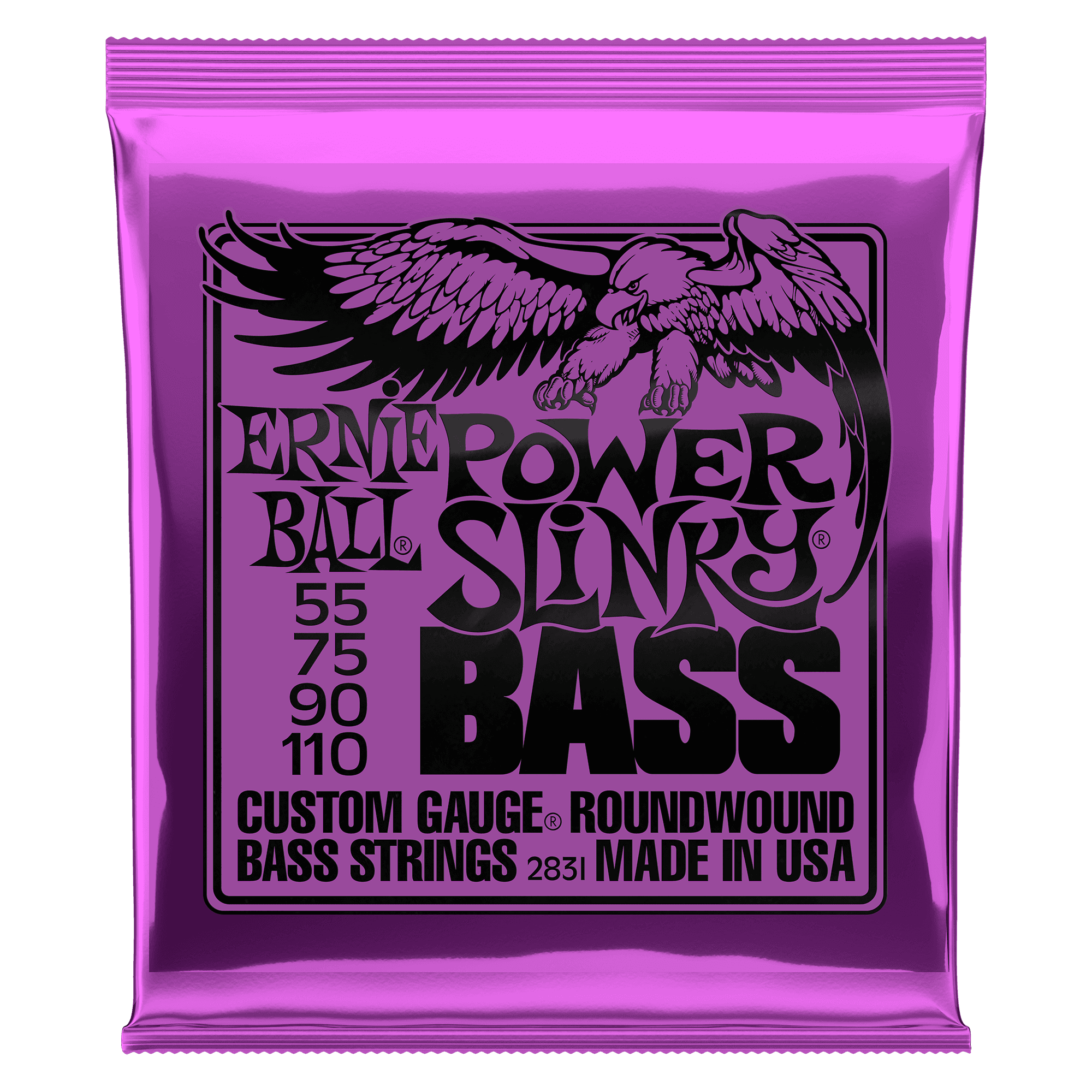
Ernie Ball Power Slinky Bass is a nickel-plated-steel roundwound 4-string set gauged .055, .075, .090, .110, the Heavy tier in Ernie Ball's seven-gauge nickel Slinky bass family, one step below Beefy Slinky. Ernie Ball doesn't publish tension specs, but D'Addario's own identical .055-.110 gauge totals roughly 201 to 217 lbs depending on alloy. Uncoated, hex-steel core, SKU P02831, built for players who dig in hard in standard tuning.
What this set is
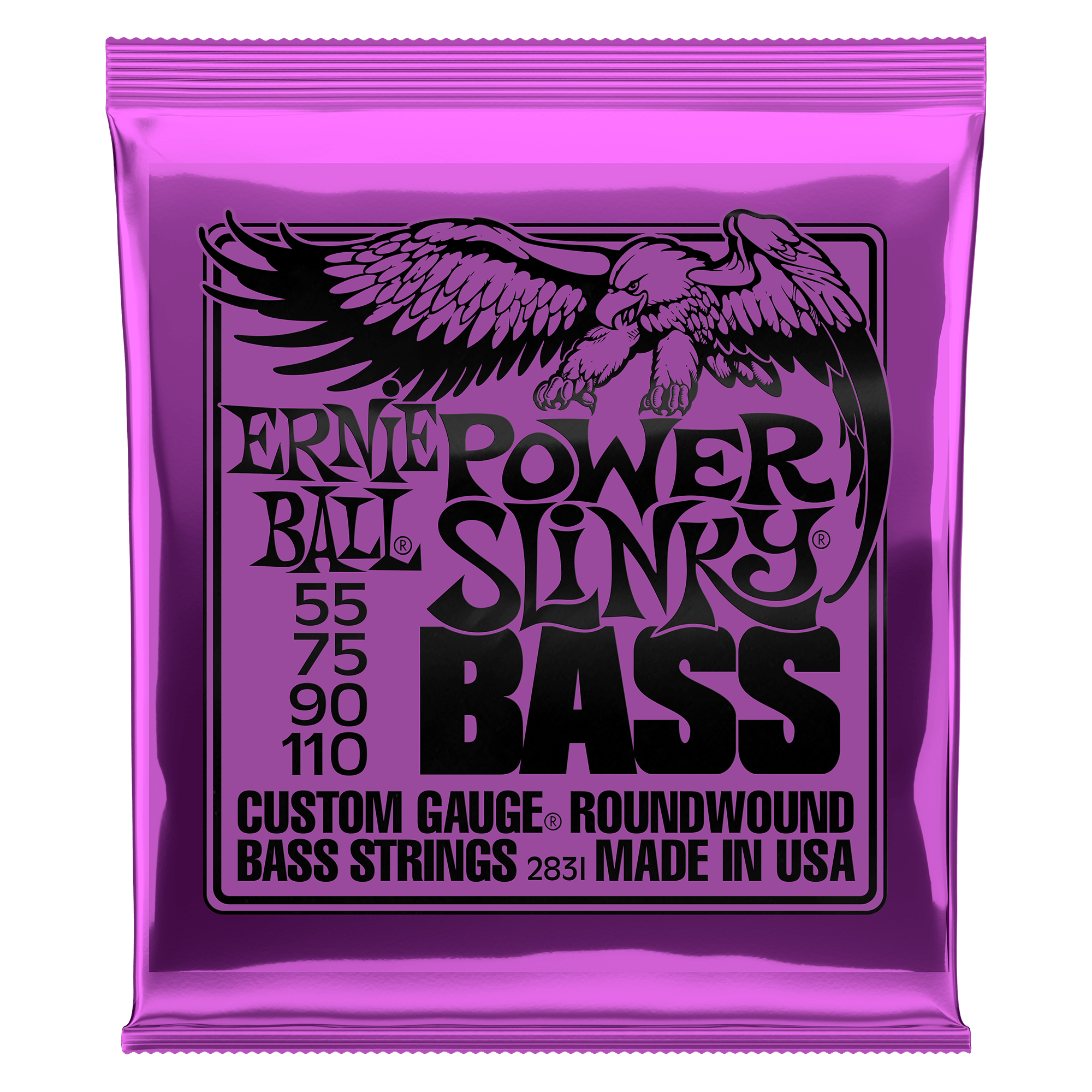
Ernie Ball's Power Slinky Bass is the sixth of seven gauges in the company's 4-string nickel Slinky bass family: .055, .075, .090, .110, wound with nickel-plated steel over a hex steel core. Ernie Ball's own product page uses the same one-line description it gives every gauge in the line, "a bright, balanced tone" from strings "manufactured with the finest and freshest raw materials in the beautiful Coachella Valley of Southern California." Source: Ernie Ball's own Power Slinky Bass product page.
Retailers and players sort it the same way. Long & McQuade lists it plainly as "Bass Power Slinky," and a 2021 TalkBass thread breaks down the whole nickel Slinky bass line by feel: Extra Slinky is Extra Light, Super Slinky is Light, Hybrid Slinky is Light Top and Medium Bottom, Regular Slinky is Medium, and Power Slinky is Heavy. One step past this set is Beefy Slinky, the heaviest gauge Ernie Ball makes for 4-string nickel Slinky bass.
That positioning matters more than a marketing label. Power Slinky is the set players reach for when Regular Slinky's .050-.105 starts to feel thin under a hard pick attack, but a full jump to Beefy Slinky's .065-.130 is more than they need.
Anatomy
- Model
- Ernie Ball P02831 Power Slinky Bass
- MPN
- P02831
- Gauge
- .055 – .110 (Heavy)
- Gauge set
- .055, .075, .090, .110
- String count
- 4 strings
- Core wire
- Hex steel
- Wrap wire
- Nickel-plated steel
- Coating
- None, uncoated
- Winding
- Standard roundwound
- Intended scale
- Long scale, Ernie Ball's standard 4-string bass length
- Intended tunings
- E standard, Eb standard
- Package
- Single pack
Not the same string as electric guitar's Power Slinky
One naming collision worth flagging before you buy: Ernie Ball's electric guitar line also ships a "Power Slinky," a completely different 6-string set gauged .011-.048 (SKU P02220). Ernie Ball extends the same name across several electric guitar variants too, Power Slinky Cobalt, Paradigm Power Slinky, and Power Slinky RPS all share the "Power Slinky" name while being 6-string electric guitar sets, not bass strings.
Power Slinky Bass shares nothing with any of them but a family name. If you're shopping by search or by memory rather than by package photo, double-check the listing says "Bass" before you add it to your cart. A guitar player's Power Slinky strung on a bass, or vice versa, isn't just the wrong gauge, it's the wrong instrument's strings entirely.
Where this sits in Ernie Ball's nickel Slinky bass family
Ernie Ball ships seven gauges under its nickel Slinky 4-string bass line, all confirmed on Ernie Ball's own catalog page:
- Extra Slinky: .040, .060, .070, .095 (P02835). Full review.
- Hyper Slinky: .040, .060, .080, .100 (P02841). Full review.
- Super Slinky: .045, .065, .080, .100 (P02834). Full review.
- Hybrid Slinky: .045, .065, .085, .105 (P02833). Full review.
- Regular Slinky: .050, .070, .085, .105 (P02832), Ernie Ball's standard-tuning default. Full review.
- Power Slinky: .055, .075, .090, .110 (P02831), this set.
- Beefy Slinky: .065, .080, .100, .130 (P02840), the heaviest. Full review.
| Regular Slinky (.050–.105) | Power Slinky (this set) | Beefy Slinky (.065–.130) | |
|---|---|---|---|
| Gauge set | .050, .070, .085, .105 | .055, .075, .090, .110 | .065, .080, .100, .130 |
| Low string | .105 | .110 | .130 |
| Feel | Working-pro default | Heavier, more resistance | Heaviest Ernie Ball makes |
| Best for | All-purpose standard-tuned rock | Hard pick attack, standard/Eb | Lower tunings, maximum grip |
Tension: what the identical .055–.110 gauge measures elsewhere
Ernie Ball's product page lists gauges and construction for Power Slinky Bass, but no tension figures, and none of the other six gauges in the nickel Slinky bass line get a published tension chart either. That's worth knowing before you assume a spec Ernie Ball hasn't actually published.
D'Addario has, for the identical numeric gauge. Their nickel-wound EXL230 (.055, .075, .090, .110, the same four numbers) publishes a full tension chart at E standard, long scale: the .055 G reads 61.8 lbs, the .075 D reads 63.1 lbs, the .090 A reads 51.0 lbs, and the .110 E reads 41.4 lbs, about 217 lbs total. Source: D'Addario's own EXL230 product page.
D'Addario's stainless-wound EPS230, the exact same .055-.110 numeric gauge in their ProSteels line, publishes a lower total: .055 G at 57.6 lbs, .075 D at 58.4 lbs, .090 A at 47.2 lbs, .110 E at 38.2 lbs, about 201 lbs total. Source: D'Addario EPS230, CYS's own reviewed tension breakdown.
Both charts share a genuinely counterintuitive pattern: the .075 D string, not the thicker .090 A or .110 E, carries the highest tension in the set. A heavy-gauge bass set doesn't mean uniformly higher tension string to string, it means a thicker low end while the geometry of pitch and gauge still governs each string individually.
Treat these two numbers, 201 to 217 lbs, as the best available reference for what a .055-.110 bass gauge measures, not as Ernie Ball's own promise. Wrap alloy and manufacturing tolerances mean Power Slinky's actual tension could sit anywhere in or near that range, but Ernie Ball has never published a number to confirm it exactly.
What real players report
Power Slinky Bass has a real track record on TalkBass going back years, with reports that line up on the important points. A player who put a set on a Thunderbird, trying Ernie Ball for the first time, reported the tension "really positive, actually not as firm as I'd expected and easy on the fingers," adding that "the additional bit of tension seems to have given the lower register notes a touch more clarity." Source: TalkBass.com, "Ernie Ball Power Slinky?", August 2021.
A 2023 reply on the same thread tried Power Slinky specifically for a drop-tuned bass and found it "still too floppy for that purpose," but loved the set in regular tuning: "for 'heavy' gauge strings they are very flexible and smooth to the touch," comparing the .110 low string favorably to a .105 flatwound set they'd used before, and calling the low price "a pleasant surprise" next to premium alternatives.
Longer-term use tells a more mixed story. One player who ran Power Slinky for years described it as well-suited to a heavier-handed playing style, but switched to lighter D'Addario EXL170s at 62 after deciding to ease up on both technique and gauge. Another described the .055 G string's extra tension as a real adjustment, "gonna need more pinky strength," while praising the added authority it gave fingerstyle playing.
Best for
- Players stepping up from Regular Slinky who want more resistance and low-end grip without jumping all the way to Beefy Slinky.
- Hard pick attack in standard or Eb-standard tuning, where the multiple TalkBass reports agree the extra tension adds clarity to the low register.
- Fingerstyle players who want a stiffer, more defined feel under the hand, matching the "positive tension" and added authority players describe.
Worst for
- Genuine drop tunings. The one direct real-world drop-tuning report on record found Power Slinky "still too floppy" for that purpose. Step to Beefy Slinky (.065-.130) instead if you need a low tuning to hold its grip.
- Fast fingerstyle and light-touch players. Regular Slinky (.050-.105) or lighter feels quicker and looser under a fast hand.
- Long-term comfort as hands change. One long-time user's own account describes switching away from Power Slinky to a lighter gauge after years of play, for hand comfort as much as tone.
- Players who want a published tension spec to plan a setup around. Ernie Ball has never published one for this line. D'Addario's identical-gauge lines are the closest sourced reference, not a substitute for Ernie Ball's own number.
Verdict
Power Slinky Bass earns its place as the deliberate middle ground: heavier and more resistant than Ernie Ball's Regular Slinky default, without the full commitment of Beefy Slinky's .065-.130. Real player reports back that positioning up consistently, more low-end authority and clarity, tension that reads as "positive" rather than stiff, at the cost of more work from your fretting and picking hand, especially on the .055 G string.
The honest caveats are worth repeating. Ernie Ball has never published a tension chart for this set, so the closest sourced numbers, D'Addario's own 201 to 217 lbs for the identical gauge, are a reference point, not a guarantee. And the one detailed real-world drop-tuning report available says Power Slinky doesn't hold up the way a dedicated drop-tuning gauge would. If that's your use case, Beefy Slinky is the better-sourced next step.
Related
Related