Ernie Ball Super Slinky Bass (.045–.100): Mark Hoppus's Blink-182 gauge
Written with AI help · Updated
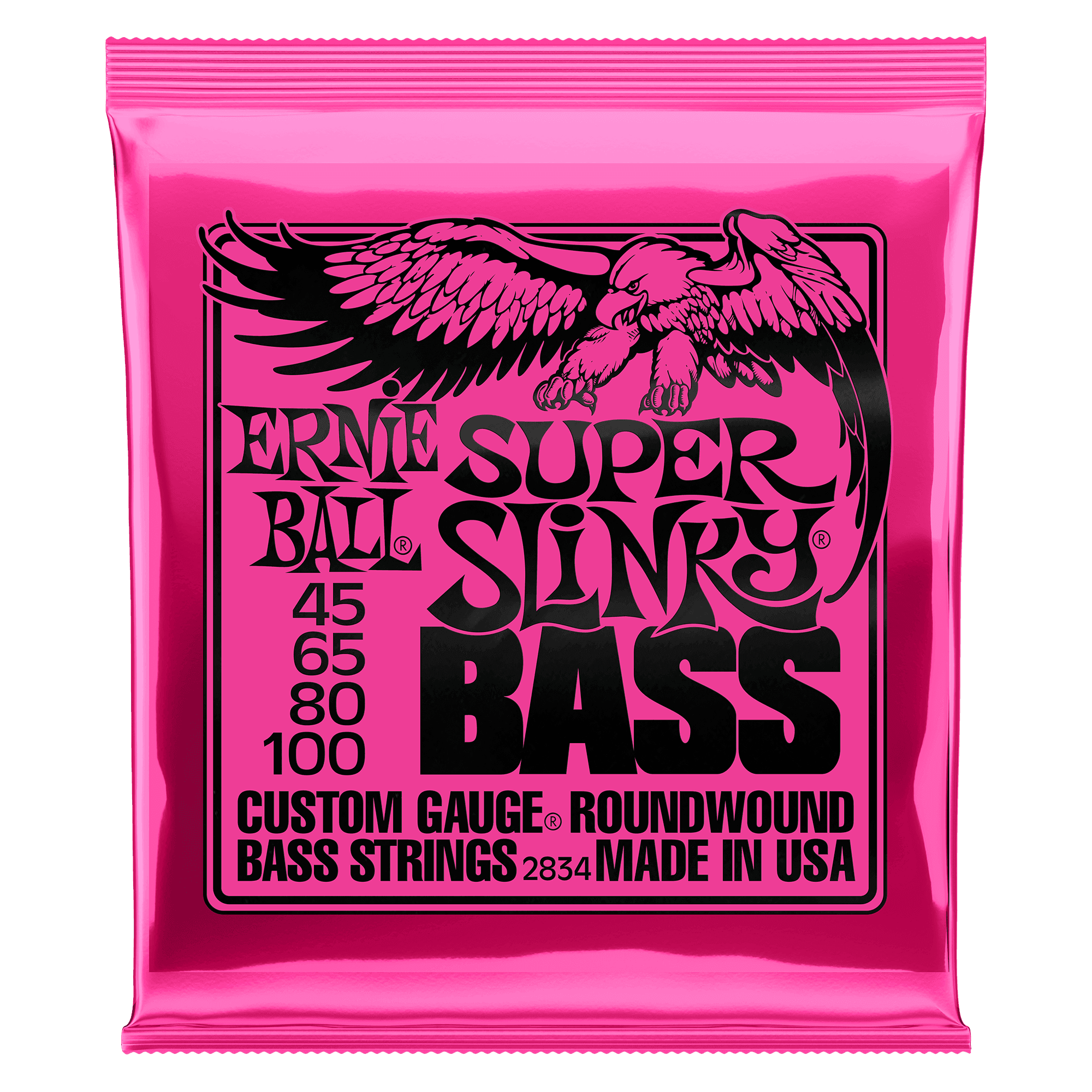
Ernie Ball P02834 Super Slinky Nickel Wound Bass strings run .045, .065, .080, .100, a light-gauge roundwound sitting just above Hyper Slinky and Extra Slinky in Ernie Ball's 7-gauge nickel Slinky bass family. Blink-182 bassist Mark Hoppus runs this exact set on his signature Fender Jaguar basses, confirmed by Premier Guitar's January 2026 Rig Rundown and Wikipedia's sourced profile. A bright, fast-feeling gauge built for pick-driven punk and pop-punk bass.

What this set is
Ernie Ball's Super Slinky Bass is the third-lightest of seven gauges in the company's 4-string nickel Slinky bass family, running .045, .065, .080, .100, wound on a hex steel core, built for standard long-scale bass. Ernie Ball's own product page describes the whole nickel bass line in one line: strings "made from nickel plated steel wrapped around a hex shaped steel core wire," producing "a bright, balanced tone." Source: Ernie Ball's own Super Slinky Bass product page.
It's also a real touring gauge. Blink-182 bassist Mark Hoppus runs this exact set, per Premier Guitar's January 2026 Rig Rundown, which lists "Ernie Ball 2834 Super Slinky Strings" directly in his gear rundown. Wikipedia's sourced profile backs this up independently: "Hoppus has been a longtime user of Ernie Ball strings and his instruments are strung with Super Slinky Bass strings (.45-.100)."
Super Slinky sits below the midpoint of Ernie Ball's broader nickel 4-string bass family (light to heavy): Extra Slinky (.040–.095), Hyper Slinky (.040–.100), Super Slinky (.045–.100), Hybrid Slinky (.045–.105), Regular Slinky (.050–.105), Power Slinky (.055–.110), and Beefy Slinky (.065–.130), confirmed on Ernie Ball's own catalog page. It shares its top two strings exactly with Hybrid Slinky, then steps down to a lighter A and E, a genuinely light-feeling set without dropping into the thinnest end of Ernie Ball's range.
Anatomy
- Model
- Ernie Ball 2834 Super Slinky Bass
- MPN
- P02834
- Gauge
- .045 – .100 (Super Slinky)
- Gauge set
- .045, .065, .080, .100
- String count
- 4 strings
- Core wire
- Hex steel
- Wrap wire
- Nickel-plated steel
- Coating
- None, uncoated
- Winding
- Standard roundwound
- Intended scale
- Long scale, Ernie Ball's standard 4-string bass length
- Intended tunings
- E standard
- Package
- Single pack
Where this sits in Ernie Ball's nickel Slinky bass family
Ernie Ball ships seven gauges under its nickel Slinky 4-string bass line, all confirmed on Ernie Ball's own catalog page:
- Extra Slinky: .040–.095 (P02835), the lightest. Full review.
- Hyper Slinky: .040–.100 (P02841). Full review.
- Super Slinky: .045–.100 (P02834), this set.
- Hybrid Slinky: .045–.105 (P02833).
- Regular Slinky: .050–.105 (P02832), Ernie Ball's standard-tuning default.
- Power Slinky: .055–.110 (P02831).
- Beefy Slinky: .065–.130 (P02840), the heaviest.
Super Slinky and Hybrid Slinky Bass share an identical .045 G and .065 D string, so the two only diverge on the A and E: .080 and .100 here, versus .085 and .105 on Hybrid. A player who finds Regular Slinky Bass too heavy across the board, but doesn't want to go as light as Extra or Hyper Slinky, lands on Super Slinky.
Who plays it: Mark Hoppus's Blink-182 rig
Mark Hoppus co-founded Blink-182 in San Diego in 1992 and is the only member to appear on every album, playing bass and sharing lead vocals since day one, per Wikipedia's sourced profile. Premier Guitar's Chris Kies covered his live rig for a January 2026 Rig Rundown, filmed backstage at the Orion Amphitheater in Huntsville, Alabama during the band's Missionary Impossible Tour, working with Hoppus's bass tech Brian Diaz. The gear list attached to that piece names "Ernie Ball 2834 Super Slinky Strings" directly.
Wikipedia's profile corroborates the brand and gauge from a separate angle: "Hoppus has been a longtime user of Ernie Ball strings and his instruments are strung with Super Slinky Bass strings (.45-.100)." Two independent sources landing on the identical SKU is about as solid as string-gauge sourcing gets.
The bass doing the work is Hoppus's signature Fender Jaguar, nicknamed "Stoned Fruit" after a paintjob by Ohio artist Burrito Breath that Fender turned into a Limited Edition production model in 2024. It carries his now-signature "reversed P" pickup configuration: a Seymour Duncan Quarter Pound (SPB-3) split-coil P-bass pickup mounted backwards, a setup Hoppus has used since 2006 and carried over when he switched from Fender Jazz-style basses to Jaguar basses in 2015. Light Super Slinky strings under a hot, reversed pickup and a pick attack are a big part of why Blink-182's bass tone cuts as bright and percussive as it does.
For the rest of his rig, guitars, amps, and the full gear breakdown, see his full CYS bassist profile.
Best for
- Pick-driven punk and pop-punk bass. Mark Hoppus's documented gauge, and a light-enough top end to keep up with a fast pick attack.
- Players who want a genuinely light 4-string set without going all the way to Extra or Hyper Slinky. The .045 top string is easy under the fretting hand; the .100 low E still holds up in standard tuning.
- Players who want the classic bright nickel tone over a coated or Cobalt alternative.
Worst for
- Drop tunings played stock. A .100 low E is a standard-tuning gauge. Drop it down a whole step or more and it goes slack fast; look at Regular Slinky, Power Slinky, or a 5-string set instead.
- Players chasing maximum string life. This is an uncoated roundwound set with the standard wear curve.
- Players who want more low-end mass and output. Hybrid Slinky, Regular Slinky, and the heavier sets in the same nickel family add string mass without changing the brand or winding style.
Install and break-in
Standard nickel roundwound install: stretch each string after tuning to pitch, pull up gently a few times along its length, retune, and repeat two or three times before trusting it on stage or in a session. Expect 15 to 20 minutes of playing before the top end settles into its final voice. Because the gauge is on the lighter side, double-check your nut slots aren't cut for a heavier set (Regular Slinky Bass or up) before installing; a too-wide slot lets a light string rattle or sit off-center.
Verdict
Super Slinky Bass is Ernie Ball's light-but-not-lightest 4-string gauge, the documented set behind Blink-182 bassist Mark Hoppus's pick-driven, treble-forward pop-punk tone. If you play mostly standard tuning, want a fast, easy top end, and like your bass bright rather than scooped, this is a straightforward pick.
If you're tuning down, look further down Ernie Ball's nickel Slinky family before landing here; the stock .100 low E isn't built for it. And if you're chasing more output than a nickel wrap gives you, Ernie Ball's separate Cobalt bass line is worth a look before you buy, though CYS hasn't independently verified Cobalt's bass-specific specs against this exact gauge.