Ernie Ball Baritone Slinky (.013–.072): the only baritone set in the Slinky lineup
Written with AI help · Updated
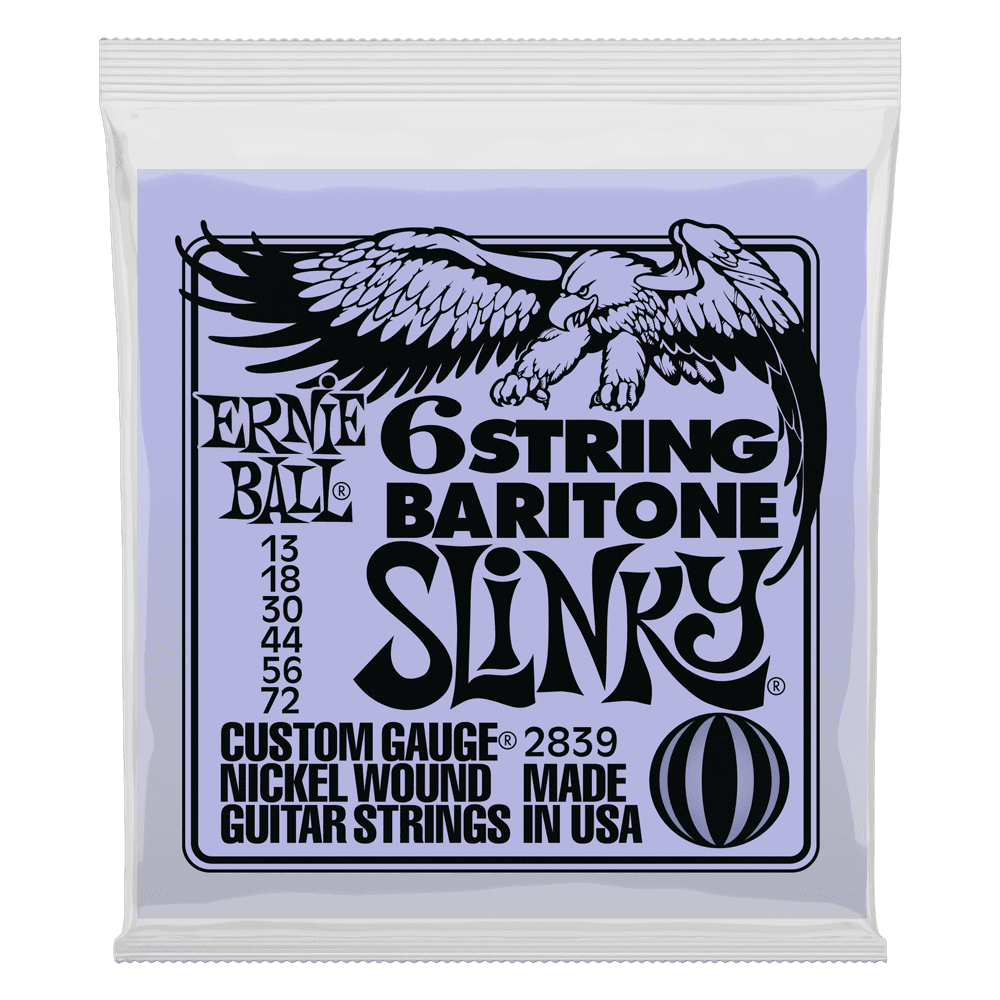
Ernie Ball's Baritone Slinky (SKU 2839, .013 to .072) is the only baritone-specific set in Ernie Ball's Slinky Nickel Wound lineup: nickel-wound, small guitar-style ball ends, built for A-to-A or B-to-B tuning. Despite Ernie Ball's own copy mislabeling it a bass string, it's sized for baritone guitars, not basses. No artist endorsement is confirmed on this exact set, but it's the straightforward off-the-shelf choice for a 27 to 30 inch baritone in either tuning.

What this set is
Ernie Ball's Baritone Slinky is the company's plain, nickel-wound answer to "what strings go on a baritone guitar." SKU 2839, MPN P02839: .013, .018, .030, .044, .056, .072, confirmed on Ernie Ball's own product page. Small guitar-style ball ends, built for A-to-A or B-to-B tuning on the same set. It's the one baritone-specific SKU in Ernie Ball's Slinky Nickel Wound electric guitar lineup, the tab it ships under is shared with exactly one other product, a genuine 6-string bass set at a much heavier gauge.
This is the reference set CYS already points to across its own baritone gauge guide and baritone strings primer, both of which cite this exact ASIN. This page exists so those citations have a real review to land on instead of just a bare inline product card.
Anatomy
- Model
- Ernie Ball Baritone Slinky, Nickel Wound
- SKU / MPN
- 2839 / P02839
- Gauge
- .013 – .072 (Baritone Slinky)
- Gauge set
- .013, .018, .030, .044, .056, .072
- String count
- 6 strings
- Plain strings
- .013, .018, specially tempered tin-plated high carbon steel
- Wound strings
- .030, .044, .056, .072, nickel-plated steel wrap over a hex-shaped steel core
- Coating
- None, uncoated
- String length
- .013 to .044 run 48 inches; .056 and .072 run 39.5 inches, with the .072 tapering at 37 inches
- Ball ends
- Small, guitar-style (the sibling bass set on the same product tab uses small ball ends too)
- Intended tuning
- A-to-A or B-to-B, per Ernie Ball's own product description
- Intended scale
- 27 to 30 inch baritone (typical retail range; Ernie Ball doesn't publish a scale spec on this SKU)
- Reverse headstocks
- Ernie Ball flags possible fit issues on its own product page
- Catalog placement
- Strings > Electric Guitar Strings > Slinky Nickel Wound > Baritone & Bass
- Package
- Single pack (ASIN B0019FX5F2)
Not a bass string set, despite Ernie Ball's own copy
This page exists partly to clear up a real, verifiable point of confusion: Ernie Ball's own body copy for this exact SKU describes it as "Baritone Electric Bass Strings," even though the product's own title is "Slinky Nickel Wound Electric Baritone Guitar Strings" and its own spec line says the ball ends are sized "like guitar strings, not large ball ends used on traditional electric bass strings."
Read past the copy-paste inconsistency and the facts are clear. This is a 6-string set, .013 to .072, filed under Ernie Ball's Electric Guitar Strings breadcrumb (Strings, Electric Guitar Strings, Slinky Nickel Wound, Baritone & Bass). It shares that "Baritone & Bass" tab with exactly one other product: a genuine 6-string bass set, a 29 5/8 inch scale product at much heavier .020 to .090 gauges, which (per Ernie Ball's own copy for that product too) also uses small, guitar-style ball ends rather than large bass-style ones, so ball-end size alone won't tell the two apart. The gauge will: .013 to .072 is guitar-weight, .020 to .090 is bass-weight. If you're shopping by gauge number, don't mix them up; a baritone guitar and a 6-string bass are different instruments tuned an octave apart, and stringing either with the other's set won't intonate correctly even on a setup where the hardware happens to fit.
Built for A standard and B standard, on one set
Most 6-string baritones run one of two tunings: B standard (B-E-A-D-F#-B), a fourth below standard tuning, or A standard (A-D-G-C-E-A), a fifth below. Ernie Ball builds the Baritone Slinky for both at once, its own product description calls it "optimal for A-A or B-B tuning combinations," rather than splitting the job across two gauges the way some competitors do. That makes it a reasonable first purchase if you haven't settled on a tuning yet.
For the tension and gauge math across 27, 28.625, and 30 inch baritone necks in all three common baritone tunings, see CYS's own baritone gauge guide by scale length and tuning. Compared to D'Addario's baritone sets, the other major off-the-shelf option, Ernie Ball's single .013 to .072 gauge runs heavier than D'Addario's lighter baritone set and covers more tuning ground on one SKU; D'Addario answers the same question with two separate gauges instead of one. Full details in CYS's baritone strings primer.
Who actually plays it
Not documented, and this page won't guess one in. A web search turns up gear-aggregator sites naming Tom DeLonge on this set for a baritone Starcaster, but Ernie Ball's own String Theory feature on DeLonge, its dedicated artist-interview series, lists his actual strings as Custom Gauge Nickel Wound .052 singles and Paradigm Skinny Top Heavy Bottom for guitar, plus Earthwood Phosphor Bronze Medium Light for acoustic. No baritone set anywhere in Ernie Ball's own copy about him. When a manufacturer's own primary source contradicts a secondary aggregator, CYS follows the primary source.
That doesn't mean nobody plays it, baritone guitars show up across shoegaze, post-hardcore, and drop-tuned metal, and Stephen Carpenter of Deftones has played a 27-inch baritone-scale 8-string as his primary guitar since 2010. His instrument runs a different string count and a different Ernie Ball set entirely, so it's context rather than a citation for this specific product. Until a primary source names an artist on this exact SKU, treat the Baritone Slinky as Ernie Ball's uncomplicated default rather than a documented signature spec.
Best for
- Switching between B standard and A standard on the same baritone. The one Ernie Ball gauge built for both tunings.
- A first baritone purchase. One SKU to buy instead of choosing between two competing gauges up front.
- Metal, hard rock, and djent-adjacent drop tuning on a real 27 to 30 inch baritone neck, where the longer scale keeps a heavy low string articulate instead of floppy.
Worst for
- Reverse headstocks. Ernie Ball's own product page flags possible fit issues; check your guitar before ordering.
- A standard 25.5 inch guitar tuned down. At that shorter scale, a .072 low string sits at noticeably lower tension than the baritone length it's built around, and standard hardware typically isn't sized for the gauge either. Use Not Even Slinky Cobalt (.012–.056) instead.
- Players set on a brighter alloy. This SKU is nickel-wound only. If you want to check whether Ernie Ball's Cobalt or Paradigm lines carry a baritone gauge, look at those product lines directly; this review covers the Slinky Nickel Wound baritone set specifically.
Install notes specific to baritone gauge
A .072 low string is a significant step up from a standard set's .046, close to territory some 8-string guitars use for their low string. Before installing:
Setup checklist for baritone-gauge strings
- Nut slots
- Factory nut slots cut for a lighter set often need widening for a .072 low string. If it rides high in the slot, file to fit rather than force it.
- Bridge and saddles
- Confirm your bridge's saddle slots and intonation range can accommodate a .072 wound string; some standard-guitar bridges weren't designed for baritone gauge.
- Truss rod
- Heavier gauge means more neck tension. Adjust in small increments and let the neck settle for a day before fine-tuning relief.
- Break-in
- Stretch each string by hand after installing, press behind the 12th fret and pull up about an inch, several times per string, then retune. Repeat until pitch holds. Budget more break-in time than a standard set; heavier wound strings take longer to settle.
The full walk-through applies from CYS's own heavy-gauge electric string install guide; for the nut-slot procedure specifically, see precision nut filing for heavy-gauge strings.
Verdict
The Baritone Slinky is Ernie Ball's plain answer to "what do I string a baritone with." No signature story, no alloy story, just a nickel-wound .013 to .072 set built to cover both common baritone tunings on one SKU. It's also the one Ernie Ball product where the manufacturer's own website can't decide if it's a guitar string or a bass string, so double-check the gauge and ball-end size before you buy if that confusion trips you up.
If you already know you want a brighter alloy or a signature spec, look elsewhere; this is the uncomplicated default, not a documented artist's exact rig. If you just bought a 27 to 30 inch baritone and want the off-the-shelf set most players start with, this is it.
Related